

Hiring a web developer is more than matching keywords on a CV. It's about uncovering problem-solving skills, deep conceptual knowledge, and practical experience. For CTOs, non-technical founders, and recruiters, asking the right questions is the key to differentiating a good developer from a great one. A well-structured interview process reveals not just what a candidate […]

Hiring a web developer is more than matching keywords on a CV. It's about uncovering problem-solving skills, deep conceptual knowledge, and practical experience. For CTOs, non-technical founders, and recruiters, asking the right questions is the key to differentiating a good developer from a great one. A well-structured interview process reveals not just what a candidate knows, but how they think, collaborate, and tackle real-world challenges. This is crucial for building a high-performing engineering team capable of delivering on your business goals.
This curated list of top-tier interview questions for a web developer is designed to reveal a candidate's true capabilities across frontend, backend, and full-stack domains. We move beyond generic puzzles to focus on concepts that directly impact application quality, such as performance optimization, state management, and API design. This approach helps you assess practical skills rather than just theoretical knowledge.
Inside, you'll find a comprehensive bank of questions covering everything from JavaScript fundamentals like var, let, and const to advanced topics like the Virtual DOM and RESTful API architecture. To help in the crucial task of identifying top web talent, consider these additional insights on Top 9 Interview Questions for Developers.
Our goal is to provide a practical toolkit for your hiring process. We'll break down each question, explain what a strong answer looks like, provide a scoring rubric, and offer live-coding prompts. This guide will help you efficiently assess candidates from junior to senior levels, ensuring you identify engineers who can build robust, scalable, and high-performance applications. Let's begin.
This is a cornerstone among interview questions for a web developer, as it quickly reveals a candidate's understanding of fundamental JavaScript concepts like scope, hoisting, and immutability. It's a simple question on the surface but offers deep insight into whether a developer is proficient with modern ES6+ standards or still relies on outdated practices. A strong answer demonstrates precision and practical knowledge.
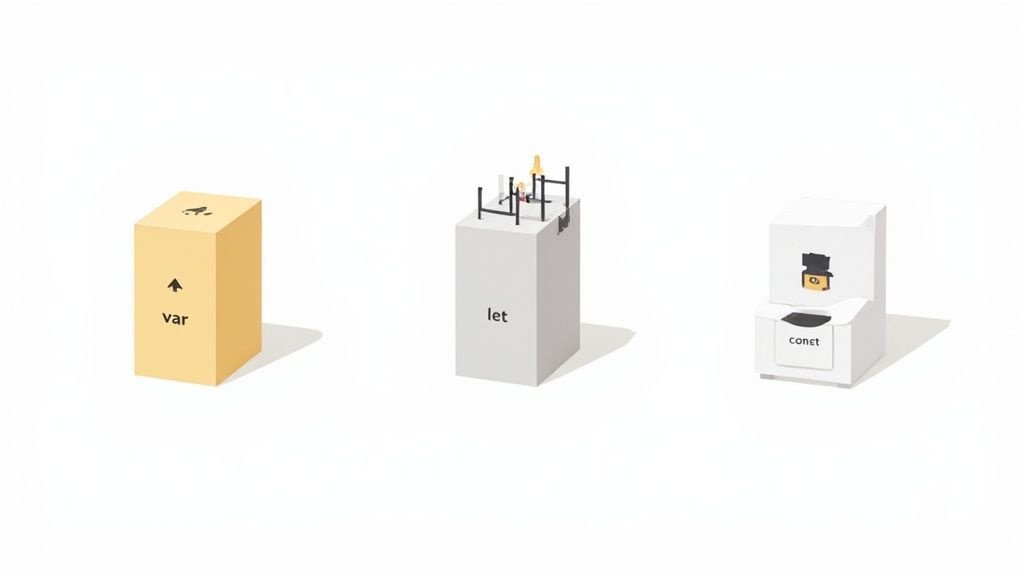
A solid answer should clearly differentiate the three keywords based on their scope, hoisting behavior, and re-assignability.
var: Function-scoped (or global-scoped if declared outside a function). It is hoisted to the top of its scope and initialized with undefined, which can lead to unexpected behavior.let: Block-scoped (limited to the {} curly braces it's defined in). It is hoisted but not initialized, creating a "temporal dead zone" (TDZ) where it cannot be accessed before declaration. It can be reassigned.const: Block-scoped, just like let. It also has a TDZ. The key difference is that it cannot be reassigned once a value is assigned.Key Insight: A top-tier candidate will voluntarily mention the "temporal dead zone" when discussing
letandconst. They will also clarify thatconstdoes not make objects or arrays immutable; it only prevents re-assigning the variable to a new object or array. The properties or elements within can still be modified.
To further assess their understanding, ask how they decide which to use. A good developer generally follows a simple rule: default to const, use let only when you know a variable needs to be reassigned (like in a loop counter), and avoid var in modern codebases to prevent scope-related bugs. This knowledge is equally crucial when working with typed supersets of JavaScript; you can see more advanced questions in this guide to interview questions on TypeScript.
This question probes a developer's understanding of user experience, modern web standards, and the business impact of a fast website. It moves beyond just writing functional code to assess if a candidate can build applications that are efficient, scalable, and user-friendly. A strong answer indicates a holistic view of web development, touching on everything from frontend assets to network delivery.

A comprehensive answer should cover multiple layers of the performance stack, not just one or two techniques. Look for a structured response that organizes optimizations into categories.
async or defer attributes for scripts to avoid render-blocking.Key Insight: A top-tier candidate will connect these technical strategies to business-critical metrics like Google's Core Web Vitals (LCP, FID, CLS). They will also mention specific tools they use for auditing and monitoring, such as Lighthouse, WebPageTest, or Sentry, demonstrating a data-driven approach to optimization.
Dig deeper by asking for a real-world example of a performance bottleneck they identified and solved. Ask them to explain the trade-offs of a particular strategy, such as the complexity introduced by code splitting versus its loading time benefits. A great developer will discuss performance not as a one-time task but as a continuous process of monitoring and improvement. This mindset is vital when considering the broad spectrum of challenges covered in other interview questions for a web developer.
This question is a staple in interviews for frontend and full-stack positions, especially those involving React. It separates candidates who only know the syntax from those who understand the core performance optimizations that make React so powerful. A candidate's answer reveals their grasp of rendering performance, state management, and the internal mechanics of modern JavaScript frameworks.
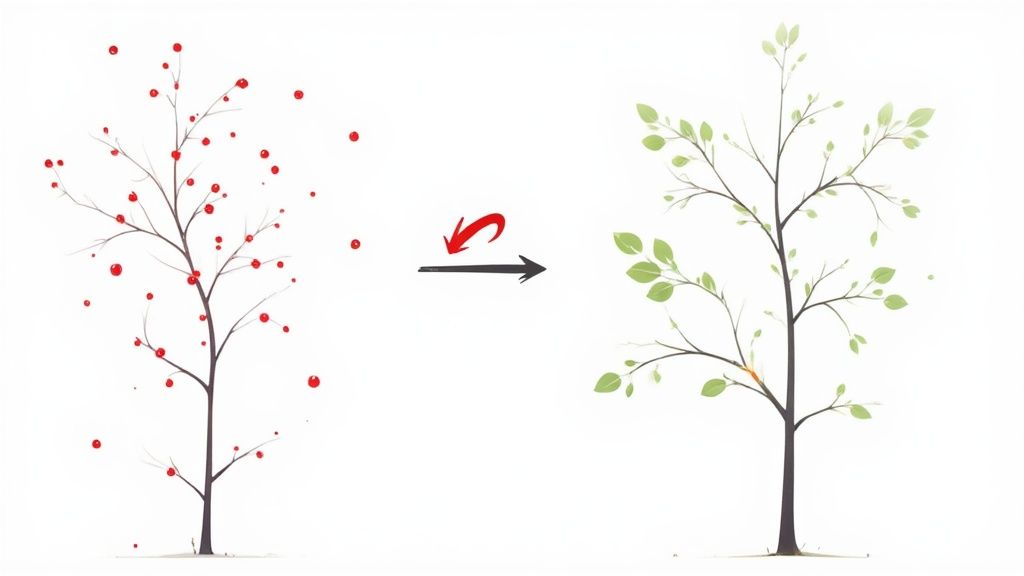
A strong candidate will explain that the Virtual DOM (VDOM) is an in-memory representation, or a "copy," of the real browser DOM. They should articulate why direct DOM manipulation is computationally expensive and slow. The key is to listen for an explanation of React's process:
Key Insight: A top-tier candidate will go beyond the basic definition. They will mention the "diffing algorithm" and its efficiency, the importance of the
keyprop for optimizing list rendering, and perhaps even touch on the newer React Fiber architecture, which allows for more advanced features like concurrent rendering and error boundaries.
To dig deeper, ask how this concept improves performance compared to vanilla JavaScript DOM updates or older libraries like jQuery. An excellent response will highlight that while individual DOM manipulations in vanilla JS can be fast, React’s declarative approach and batched updates prevent developers from making inefficient, piecemeal changes that thrash the DOM. In modern web development, this is a critical concept, and you can find out more by exploring our detailed guide on how to hire dedicated ReactJS developers. This ensures you're assessing a candidate's practical, performance-oriented mindset.
Asynchronous operations are at the heart of modern web applications, making this one of the most revealing interview questions for a web developer. It tests a candidate's ability to handle non-blocking operations like API calls or file reads, which is crucial for building responsive user interfaces. A candidate's answer reveals their grasp of JavaScript's event loop, callback patterns, and the evolution toward more readable, maintainable asynchronous code.
A comprehensive answer should start by explaining what problem Promises solve: the "callback hell" pyramid of doom. They should then describe Promises as objects representing the eventual completion or failure of an asynchronous operation.
.then() is used for success and .catch() for failure. Chaining promises to handle sequential async tasks is a key concept to mention.async/await: They should describe this as syntactic sugar built on top of Promises, allowing asynchronous code to be written in a more synchronous, linear fashion. An async function always returns a promise. The await keyword pauses the function execution until the promise settles.try...catch blocks are used for error handling with async/await, which is often cleaner than chaining .catch() methods.Key Insight: A top-tier candidate will go beyond the basics. They will discuss Promise combinators like
Promise.all()(for running multiple promises in parallel) andPromise.race()(for getting the result of the first promise to settle). They might also explain how errors propagate through promise chains andasync/awaitfunctions, demonstrating a deeper, practical understanding.
To dig deeper, ask for a practical scenario, such as fetching data from two different API endpoints and then combining the results. A good developer will confidently choose Promise.all() for this task and wrap it in a try...catch block within an async function. Ask them about the difference in error handling between a .catch() block and a try...catch. This line of questioning effectively assesses their ability to write robust, error-free asynchronous code, a vital skill for any web developer.
This is a classic among interview questions for a web developer, acting as a powerful litmus test for a candidate's grasp of core JavaScript mechanics. The concept of closures touches on lexical scoping, function execution context, and memory management. A candidate's ability to explain it clearly indicates a deep, rather than superficial, understanding of how JavaScript works under the hood.
A strong answer will define a closure as a function that "remembers" the environment in which it was created. This means it has access to its own scope, the outer function's scope, and the global scope.
Key Insight: A top-tier candidate will go beyond a simple definition. They will explain why closures are useful, emphasizing their role in creating private state and encapsulating data. They might also touch upon potential memory implications, such as creating memory leaks if closures hold onto large, unnecessary objects.
To probe their practical knowledge, ask for a code example of a closure that solves a specific problem, like creating a private counter. For instance, a function that returns another function, where the inner function increments a variable defined in the outer function's scope. This demonstrates their ability to not just define the concept but to implement it effectively. A great developer can articulate how modern frameworks and libraries implicitly rely on closures for features like React's useState hook.
This question probes a developer's architectural thinking and their ability to design scalable, maintainable frontend systems. It moves beyond individual components to assess their grasp of application-wide data flow, a critical skill for mid-level and senior roles. A candidate’s answer reveals their experience with common frontend challenges like prop drilling and maintaining a single source of truth.
A strong candidate will not just name a library like Redux but will discuss the patterns and trade-offs involved in state management. They should be able to articulate why a particular solution is chosen over others based on the application's complexity, team size, and performance requirements.
Key Insight: A top-tier candidate will frame their answer around a "problem-first" approach. They'll start by explaining the problem (e.g., "prop drilling becomes unmanageable") and then introduce a solution (e.g., "the Context API for localized state or Redux for global state"). This demonstrates a deeper, more practical understanding than simply listing library names.
To dig deeper, ask about a time they faced a difficult state management challenge. How did they debug it? What performance optimizations have they implemented, such as using selectors to prevent unnecessary re-renders? A great developer will likely discuss tools like Redux DevTools and their role in debugging complex state interactions. Their ability to discuss the pros and cons of different libraries (e.g., Redux's boilerplate vs. Zustand's simplicity) is a clear indicator of senior-level expertise. This is one of the more telling interview questions for a web developer, as it separates those who just use tools from those who understand architecture.
This two-part question is a staple in frontend web developer interviews because it tests foundational and modern CSS layout knowledge simultaneously. The first part, on the CSS Box Model, assesses a candidate's grasp of how elements are rendered and occupy space. The second part, comparing Flexbox and Grid, reveals their ability to choose the right tool for creating complex, responsive user interfaces. A strong answer shows both theoretical understanding and practical application.
A comprehensive answer will first break down the CSS Box Model and then articulate the distinct use cases for Flexbox and Grid.
box-sizing property, highlighting the difference between content-box (the default) and border-box (which is more intuitive for sizing).Key Insight: An expert candidate will emphasize that Flexbox and Grid are not mutually exclusive; they are often used together. For instance, a page layout might be built with Grid, while the components within that grid (like a card's header or footer) use Flexbox for internal alignment. They will also confidently explain why
box-sizing: border-box;is a best practice for predictable element sizing.
To dig deeper, ask for a specific scenario: "How would you build a responsive card component with a header, body, and footer that always sticks to the bottom?" A good candidate will likely suggest using Flexbox with flex-direction: column and margin-top: auto on the footer to push it down. Ask them to verbally walk through the CSS properties they would use. This approach effectively tests their problem-solving skills and practical knowledge, which are critical for any web developer role.
This question is a fundamental backend and full-stack interview question for a web developer. It moves beyond isolated code and assesses a candidate's ability to think architecturally about how services communicate. A strong answer indicates an understanding of web standards, scalability, and creating intuitive, maintainable systems. It reveals if a developer can design APIs that are logical, predictable, and easy for other developers to consume.
A comprehensive answer should define REST (Representational State Transfer) as an architectural style, not a rigid protocol. The candidate must articulate its core principles, including client-server architecture, statelessness, and the use of standard HTTP methods.
POST (Create), GET (Read), PUT/PATCH (Update), and DELETE (Delete)./users instead of /getUsers). They should demonstrate an understanding of how to represent specific resources (e.g., /users/123) and collections.200 OK, 201 Created, 400 Bad Request, 404 Not Found).Key Insight: An exceptional candidate will voluntarily differentiate between
PUT(replaces an entire resource) andPATCH(applies a partial update). They will also bring up practical considerations like API versioning (e.g.,/api/v1/users) and the use of query parameters for filtering, sorting, and pagination (e.g.,/users?status=active&sort=name).
To dig deeper, ask how they would handle related resources or more complex scenarios. For instance, "How would you design an endpoint to retrieve all the blog posts for a specific user?" A good answer would be GET /users/:userId/posts. Probing about idempotency (whether an operation can be applied multiple times without changing the result beyond the initial application) is a great way to test advanced knowledge. A solid developer will understand that GET, PUT, and DELETE should be idempotent, while POST is not.
This question moves beyond writing code to ensuring its quality and reliability. It's a critical topic in any modern development workflow, and a candidate's answer reveals their commitment to building robust, maintainable applications. This is one of the more telling interview questions for a web developer because it gauges their understanding of the software development lifecycle and their ability to think about long-term code health.
A strong candidate will articulate a clear strategy, usually referencing the "Testing Pyramid." They should be able to explain the purpose, scope, and value of each primary testing type.
Key Insight: An excellent response will not just define the types but discuss the trade-offs. The candidate should emphasize writing many fast unit tests, some integration tests, and very few comprehensive E2E tests. They might also bring up Test-Driven Development (TDD) as a methodology for writing clean, testable code from the start.
Dig deeper by asking about their practical experience. Ask them to describe a difficult bug that a specific type of test helped them catch. You can also inquire about their views on code coverage metrics: do they aim for 100%, and why or why not? A mature developer will explain that a high percentage is a good goal but that it doesn't guarantee quality; the focus should be on testing critical paths and complex logic. This commitment to quality is a hallmark of strong software engineering best practices, which you can explore further in our guide on how to improve your engineering practices.
This question is a staple in interview questions for a web developer because it evaluates a candidate's grasp of the DOM event model, which is crucial for building interactive and performant web applications. A candidate’s answer reveals their understanding of event flow, DOM traversal, and performance optimization techniques. A strong response goes beyond definitions to cover practical application and benefits.
A comprehensive answer should define both concepts and explain how they relate to one another. The candidate should demonstrate a clear mental model of how events propagate through the DOM.
document object.event.target property to determine which child element actually triggered the event and then executes the appropriate code.Key Insight: An expert candidate will proactively explain the entire event flow: the capturing phase (from the window down to the target element) followed by the bubbling phase (from the target back up to the window). They should also clearly distinguish between
event.target(the element that originated the event) andevent.currentTarget(the element the listener is attached to), which is the core mechanism that makes delegation possible.
To probe deeper, ask for a practical scenario where event delegation is superior. A classic example is a dynamic list where items are added and removed. Attaching listeners to a static parent container avoids the need to add and remove listeners for each new list item, improving performance and simplifying code. Also, ask about methods like event.stopPropagation() to halt the bubbling phase and event.preventDefault() to stop the browser's default action for an event. A candidate who can articulate the when and why for using these methods demonstrates a mature understanding of event management.
| Topic | Implementation complexity | Resource requirements | Expected outcomes | Ideal use cases | Key advantages |
|---|---|---|---|---|---|
| Explain the Difference Between var, let, and const in JavaScript | Low — basic language concepts | Low — no tooling required | Clear assessment of scope, hoisting, and reassignment knowledge | Junior to mid-level JS interviews, fundamentals checks | Quickly reveals core JS understanding and best-practice awareness |
| How Do You Optimize Website Performance and Loading Times? | High — wide range of techniques and trade-offs | Medium–High — build tools, CDNs, monitoring, infra | Improved load times, better Core Web Vitals, higher UX/SEO | High-traffic sites, e-commerce, SPA performance work | Direct business impact: faster UX, better retention and SEO |
| What is the Virtual DOM and How Does React Use It? | Medium — conceptual plus React specifics | Medium — profiling tools and React knowledge | Demonstrates understanding of rendering, diffing, reconciliation | React-focused roles and performance tuning | Reveals framework architecture knowledge and optimization ability |
| Explain Async/Await and Promises, Including Error Handling | Medium — async patterns and error propagation | Low — knowledge and simple tooling for demos | Ability to write non-blocking code with robust error handling | API integrations, I/O-heavy frontend/backend work | Improves readability and control of asynchronous flows |
| What Are Closures and How Would You Use Them in Your Code? | Medium — conceptual with practical examples | Low — no extra tooling | Shows mastery of lexical scope, encapsulation, and function factories | Functional programming, module patterns, callbacks | Enables data privacy, currying, and reusable abstractions |
| How Do You Handle State Management in Large Applications? | High — architectural decisions and trade-offs | High — libraries, tooling, devtools, potential server setup | Scalable, maintainable data flow and predictable updates | Large SPAs, enterprise apps, complex client state | Improves scalability, debuggability, and team consistency |
| Describe the CSS Box Model and How You Would Use Flexbox vs Grid | Low–Medium — fundamentals plus layout choices | Low — browser devtools and examples | Correct, responsive layouts and predictable sizing | UI/UX layout tasks, responsive components and pages | Clear rules for layout; choose one-dimensional (Flex) vs two-dimensional (Grid) |
| What Are RESTful APIs and How Would You Design Endpoints? | Medium — design principles and HTTP semantics | Low–Medium — API tools, docs, versioning strategies | Well-structured, consistent, and maintainable APIs | Full-stack projects, public APIs, microservices | Standardized interfaces, clearer client-server contracts |
| How Would You Approach Testing Your Code (Unit, Integration, E2E)? | Medium–High — multiple test levels and strategies | Medium–High — frameworks, CI, test infrastructure | Higher code quality, fewer regressions, measurable coverage | Production systems, critical features, teams practicing TDD | Increases reliability, speeds debugging, documents behavior |
| Explain Event Delegation and Event Bubbling in JavaScript | Medium — requires DOM event model understanding | Low — no special tooling | Efficient event handling and better performance on dynamic DOMs | Dynamic lists, heavy DOM manipulation, legacy code | Reduces listeners, improves performance and memory usage |
The journey from a job description to a high-performing team member is paved with insightful questions and a structured evaluation process. This comprehensive guide of interview questions for web developers was designed to move your hiring process beyond simple syntax checks and into the realm of true problem-solving assessment. By leveraging these targeted questions, you can effectively distinguish between candidates who can merely recall definitions and those who can architect, debug, and build robust, scalable solutions.
We've explored everything from the fundamental nuances of JavaScript's var, let, and const to the architectural complexities of state management and RESTful API design. The goal is not to find a candidate who answers every single question perfectly, but to identify developers who demonstrate a deep, practical understanding of core web development principles. It's about recognizing the thought process behind their answers on website performance optimization or their strategies for comprehensive code testing.
Simply having a list of questions is only half the battle. The real value emerges from how you structure the interview and interpret the responses. Here are the key takeaways to transform your technical interviews into a powerful vetting tool:
Prioritize Problem-Solving Over Recitation: Focus less on "what is X?" and more on "how would you use X to solve Y?" For instance, instead of just defining the CSS Box Model, ask a candidate to build a complex layout with it. This reveals practical application skills, not just memorized theory.
Contextualize for Your Stack: Adapt these questions to fit your company's specific technology stack and challenges. If your application heavily relies on real-time data, dig deeper into WebSockets or server-sent events. If it’s a data-intensive platform, focus more on database optimization and backend architecture.
Evaluate Communication and Collaboration: The best developers are also great communicators. Pay close attention to how they articulate their thought process during a live-coding challenge. Do they ask clarifying questions? Can they explain complex topics in simple terms? This is a strong indicator of how they will perform in a team environment.
To truly gauge a candidate's depth of knowledge and problem-solving skills, it can be invaluable to understand their perspective on how to answer difficult interview questions. Observing how a candidate approaches a tough, unexpected prompt can reveal more about their resilience and critical thinking than a dozen standard questions.
Mastering the art of the technical interview provides a significant competitive advantage. It allows you to build stronger, more efficient engineering teams, reduce turnover, and accelerate your product roadmap. A well-vetted hire contributes to a healthier codebase, mentors junior developers, and drives innovation from within.
Ultimately, these interview questions for web developers are tools. They are designed to help you uncover the technical acumen, architectural mindset, and collaborative spirit that define a top-tier engineer. By implementing a thoughtful, structured, and challenging interview process, you are not just filling a role; you are making a strategic investment in your company's future. You are building the team that will turn your vision into a reality, one line of clean, efficient code at a time. The right questions lead to the right people, and the right people build incredible products.
The demand for skilled IT professionals, from AI/ML engineers to cybersecurity experts, has never been higher. Yet, the cost of a bad hire can exceed 30% of their first-year salary, not to mention the project delays and team disruption. This makes your choice of recruitment partner a critical strategic decision. A generic approach won't work; […]

In modern software development, speed and quality are non-negotiable. Continuous Integration (CI) is the bedrock practice that enables elite teams to deliver reliable software faster by automating the integration of code changes from multiple developers. Adopting robust best practices for continuous integration transforms development from a series of error-prone manual steps into a streamlined, automated, […]

It’s easy to get tangled up when comparing Agile, Kanban, and Scrum. People often treat them like three competing options, but the relationship is much simpler. Think of it this way: Agile is a philosophy—a set of guiding principles—while Scrum and Kanban are the frameworks you use to put that philosophy into practice. The core […]


