

Nearshore outsourcing is a smart way to hire talent from nearby countries. It’s the perfect middle ground between hiring expensive local teams and managing the headaches of working with people on the other side of the world. Think of it as tapping into a world-class talent pool that’s practically in your backyard. Understanding Nearshore Outsourcing […]

Nearshore outsourcing is a smart way to hire talent from nearby countries. It’s the perfect middle ground between hiring expensive local teams and managing the headaches of working with people on the other side of the world. Think of it as tapping into a world-class talent pool that’s practically in your backyard.
Let's say your company needs to build a new software feature, but your in-house team is swamped. You basically have three choices: hire someone locally (onshore), find a team halfway across the globe (offshore), or work with experts in a neighboring country (nearshore).
Nearshore outsourcing is all about that third option. It means partnering with professionals in countries that are geographically close, often sharing similar time zones and cultural norms.
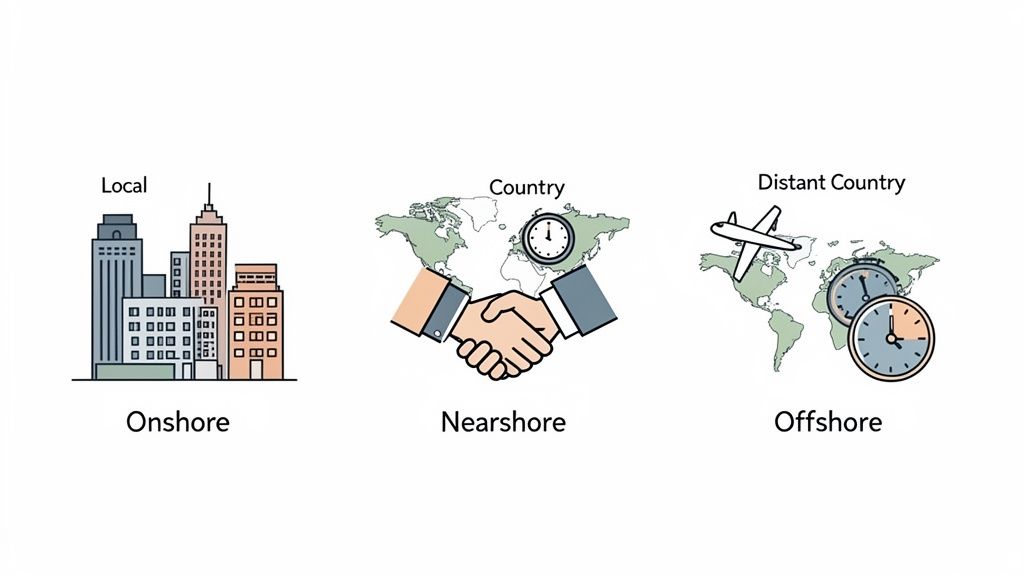
This model has become incredibly popular because it sidesteps the biggest problems with the other two. Onshore is great for alignment, but it comes with the highest price tag. Offshore offers big savings, but you often run into trouble with massive time zone differences and cultural misunderstandings.
Nearshore outsourcing strikes a strategic balance. It delivers meaningful cost savings without sacrificing the real-time collaboration that is essential for agile development and innovation. It's less about cutting costs and more about gaining a competitive advantage.
To really get a feel for what is nearshore outsourcing, it helps to compare it directly with the other models. Each one comes with its own unique blend of pros and cons related to cost, communication, and teamwork. This isn't just a simple hiring choice; it's a strategic move that affects your project timelines, team chemistry, and ultimately, your bottom line.
Of course, none of this would be as seamless without tools like video conferencing, which have completely changed the globalization of business and made these flexible work models possible.
The market numbers tell the story. The global nearshore business process outsourcing market brought in a massive USD 57.3 billion and is expected to rocket to USD 93.5 billion by 2030. This isn't just a trend; it's a major shift toward smarter, more collaborative outsourcing.
To give you a clearer picture, here’s a quick breakdown of how these three models compare.
This table gives you a high-level snapshot of the core differences between the three main outsourcing strategies.
| Factor | Onshore | Nearshore | Offshore |
|---|---|---|---|
| Location | Within your own country | In a neighboring country | In a distant country |
| Time Zone | Same time zone | Similar or same (0-3 hour difference) | Significant difference (8-12+ hour difference) |
| Cost Savings | Minimal or none | Moderate to significant | Highest potential savings |
| Collaboration | Seamless, real-time | High, easy real-time communication | Challenging, often asynchronous |
| Cultural Affinity | High | High, shared cultural context | Low, potential for significant differences |
| Travel | Easy and inexpensive | Relatively easy and affordable | Costly and time-consuming |
As you can see, nearshoring hits a sweet spot, offering a practical mix of cost efficiency and collaborative ease that's hard to beat.
Okay, let's move past the textbook definitions. The real reason businesses are turning to nearshore outsourcing is for the tangible, day-to-day advantages it brings to the table. This isn't just about hiring people in a different country; it’s a strategic play that can fundamentally change how your business operates for the better.
When you get it right, a nearshore partnership can turn common operational headaches into genuine opportunities for growth. It’s about building a better, more efficient way to get work done.
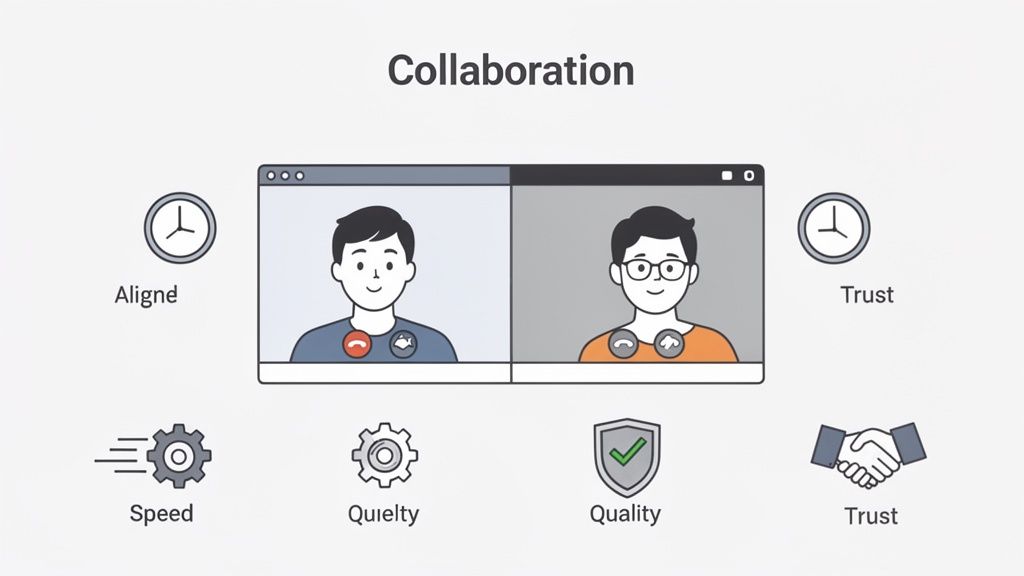
From overlapping work hours to having a shared cultural shorthand, each piece of the puzzle contributes to a more productive and cohesive team. Let's dig into what those real-world benefits look like.
One of the biggest game-changers with nearshore is time zone alignment. This is where it immediately outshines offshore models. Instead of dealing with a frustrating 12-hour time difference, you’re typically looking at a gap of zero to three hours. It sounds small, but the impact is massive.
Think about it. Your team hits a critical bug just before a major release. With an offshore team, you might log the issue and wait until tomorrow morning for a response, losing an entire day. A nearshore partner, on the other hand, is right there with you. You can jump on a quick video call and solve the problem in real-time.
This proximity makes collaboration feel effortless. Daily stand-ups, sprint planning, and spontaneous problem-solving sessions happen during everyone's regular workday. No more 10 PM conference calls or communication bottlenecks. For anyone running an Agile team, where quick feedback loops are everything, this synchronization is pure gold.
Beyond just being in the same time zone, cultural and linguistic similarities are the secret sauce to making a remote team truly click. When your partners share similar business etiquette and communication styles, you sidestep a ton of potential friction and misunderstanding.
It’s the little things that make a big difference—knowing how to interpret a direct comment, sharing a similar sense of humor, or understanding how feedback is best delivered. This shared context helps your in-house and nearshore teams build genuine trust and rapport almost instantly. You end up with one cohesive unit, not a disjointed "us vs. them" situation.
This alignment directly translates to better outcomes:
A nearshore partnership feels less like outsourcing and more like expanding your office to a nearby location. The shared context helps create an environment where everyone feels like a true part of the team.
Let’s be honest: hiring top tech talent locally is tough and incredibly expensive. Nearshore outsourcing blows the doors open to thriving tech hubs in places like Latin America and Eastern Europe. You get access to highly skilled, experienced professionals without having to fight a bidding war in your own backyard.
These regions have been pouring resources into tech education, and it shows. They are producing world-class engineers and developers. Countries like Brazil, Mexico, and Colombia are now recognized hotspots for software engineering and innovation.
This isn't a secret anymore. The nearshore software development market is on fire, with over 80% of U.S. tech companies now looking to Latin America for talent. They're finding that an average of 35% cost savings doesn't mean compromising on quality. In fact, they're accessing high-caliber engineers who are accelerating project timelines. You can dive deeper into these nearshore software development statistics to see the full picture.
By tapping into these talent pools, your company can:
When you put all these pieces together, you get a powerful competitive edge. You're getting the real-time teamwork of an in-house team, the cost benefits of outsourcing, and access to a global talent market—all in one smart, strategic package.
While the benefits of nearshore outsourcing are compelling, a truly successful partnership means going in with your eyes open. Like any smart business move, it has potential risks. The trick is to be proactive and turn those potential issues into a checklist you can manage before they become real problems.
By thinking ahead about the common challenges, you can build a strong, transparent, and secure relationship from day one. This isn't about just hoping for the best; it's about actively setting your project up for a win.
One of the first questions that comes up when working with any outside team is about protecting your intellectual property (IP). Your code, your unique processes, and your business ideas are the lifeblood of your company—they have to be protected. Luckily, this is a well-known challenge with clear, proven solutions.
A solid legal framework is your first and best line of defense. Don't gloss over this part.
Taking these steps creates a legal shield around your innovations, removing any gray areas about who owns what.
In today's world of constant cyber threats, data security isn't optional. When you bring on a nearshore partner, you're essentially extending your company's security perimeter. You need to vet their security practices just as carefully as you would for an internal team.
A partner's commitment to security is a direct reflection of their professionalism and reliability. Don't just take their word for it—ask to see proof that they comply with recognized international standards. This homework is crucial for protecting your data and keeping your customers' trust.
Look for certifications and compliance with regulations that matter to your industry and where your customers are.
Choosing partners who are already certified and compliant drastically cuts down your risk. For a closer look at what separates a good partner from a great one, check out our guide on IT outsourcing development best practices.
Even with closely aligned time zones and cultural similarities, communication can still fall apart if you don't have clear ground rules. Misunderstandings lead to delays, wasted effort, and frustration, which can completely undo the benefits of going nearshore in the first place.
The key is to set up a clear communication plan right from the start.
By actively managing these risks from the get-go, you build a solid foundation of trust and security that lets your nearshore partnership really shine.
Alright, you’ve seen the benefits, and now you’re ready for the exciting part: actually building your nearshore team. This is where the rubber meets the road. Hiring a nearshore developer isn’t just about ticking boxes on a resume; it's about finding a genuine partner who gets your vision, clicks with your team, and understands your workflow.
With a smart, structured approach, what seems like a huge undertaking becomes a clear path to finding the right talent. Let's walk through how to do it right.
Before you even think about looking for candidates, you need to know exactly what you're building and who you need to build it. A vague job description is a recipe for disaster—it attracts everyone and no one at the same time. A sharp, detailed one, on the other hand, acts like a beacon for the exact expert you’re looking for.
This isn't just busywork; it's the foundation of your entire hiring process. Get this right, and you'll avoid costly headaches down the line.
With your requirements in hand, it's time to find your people. You can go one of two ways: sift through freelance marketplaces on your own or partner with a specialized nearshore platform. Each has its pros and cons.
Going it alone gives you total control, but it also means you're responsible for every single step, from sourcing to vetting. Platforms like HireDevelopers.com, however, do the heavy lifting for you. They can give you a pre-vetted shortlist of top-tier talent in as little as 24 hours, letting you focus on finding the right fit instead of digging through hundreds of profiles.
When you're evaluating a platform or a potential partner, here's what to look for:
Interviewing a nearshore candidate is about more than just a technical grilling. You're looking for a new team member, not just a pair of hands. That means cultural fit, communication style, and problem-solving skills are just as critical as their coding ability.
A great remote interview feels less like an interrogation and more like a collaborative brainstorming session. This reveals how a candidate thinks on their feet and communicates their ideas—two skills that are absolutely essential for a successful remote partnership.
A three-stage process usually works best:
If you want to dig deeper into running great remote interviews, check out our full guide on https://hiredevelopers.com/how-to-hire-remote-developers/.
Let’s be honest: navigating international labor laws, contracts, and payments can be a massive headache. This is one of the biggest hurdles for companies going nearshore, and it’s where having an experienced partner really pays off. As you figure out your team structure, it's crucial to understand the best way to pay international contractors to keep everything compliant and running smoothly.
A proactive strategy that covers your bases from the get-go is the only way to operate.
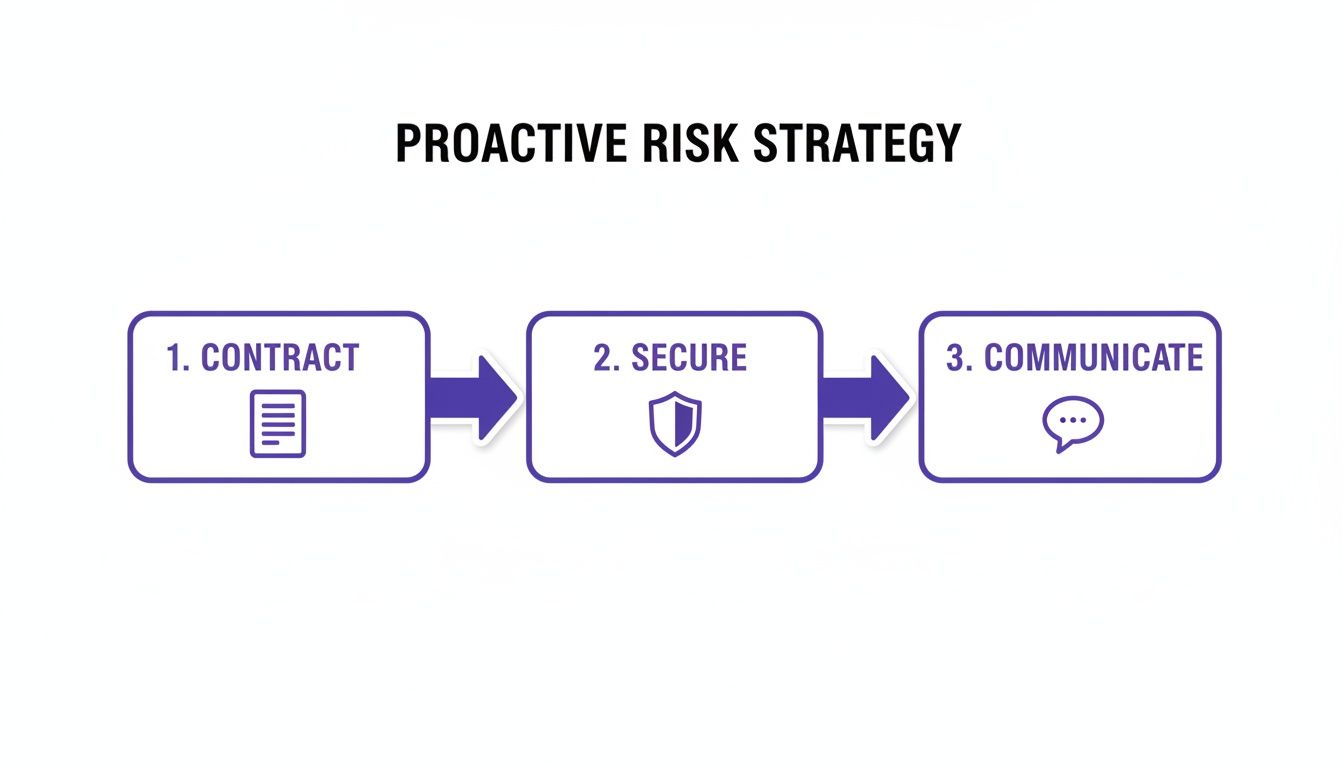
Following a simple flow like this—locking down contracts, ensuring security, and maintaining clear communication—is your best defense against common outsourcing risks.
The move toward nearshore talent is only getting stronger. A recent study found that a massive 52% of companies are planning to increase their nearshore spending. U.S. tech firms are leading the way, with over 80% actively recruiting developers in Latin America. Platforms like HireDevelopers.com are built for this reality, giving companies access to the top 1% of vetted developers, onboarded in a week, with all the compliance handled for you.
The theory behind nearshore outsourcing is solid, but what does it actually look like when the rubber meets the road? The real proof is in the results. It's one thing to talk about benefits like cost savings and time zone alignment, but it's another to see how companies use this model to tackle real, high-stakes business problems.
These stories show how a smart nearshore partnership can turn ambitious goals into tangible outcomes. Each one follows a similar arc: a company hits a wall, finds a clever solution with nearshore talent, and achieves something remarkable that pushes their business forward.
The Problem: A founder had a fantastic idea for a new SaaS platform but zero in-house tech skills to bring it to life. Hiring a senior developer locally was just too expensive, and they couldn't afford to wait months trying to find a technical co-founder. The clock was ticking—they needed a minimum viable product (MVP) fast to get investors on board.
The Solution: Instead of getting stuck, the founder hired a single, top-tier full-stack developer from Latin America through a nearshore partner. Because they worked in the same time zone, they could hop on calls and collaborate every single day. This wasn't just about hiring a coder; the developer became a true technical partner, offering ideas and turning the founder's vision into clean, functional code.
The Result: In just three months, the MVP was built and launched—a timeline that was 40% faster than the founder's most optimistic projection. The project also came in well under budget, freeing up cash for their first marketing push. With a live product to show off, the founder successfully closed a $1.5 million seed round, officially turning their idea into a funded company.
This wasn't about finding temporary help. The CTO needed a fully integrated squad that could jump into complex projects from day one—a true extension of their team, not some distant, hands-off vendor.
The Solution: The CTO worked with a nearshore partner to build a dedicated team of four engineers: two backend, one frontend, and a QA specialist. This "squad-as-a-service" approach let them handpick developers who were a perfect fit for their existing tech stack. Since the nearshore team worked on a similar schedule, they plugged right into the company's daily stand-ups, sprint planning, and other Agile routines.
The Result: The company hit every single one of its quarterly product deadlines that year. The integration was so seamless that the in-house engineers quickly saw the nearshore developers as part of their own team. This move boosted their development velocity by over 30% without the headaches and overhead of traditional hiring.
The Problem: A digital agency's workload was a constant rollercoaster. One month, they'd be desperate for a React Native developer for a new mobile app. The next, they'd need a DevOps guru for a tricky cloud migration. Keeping a huge bench of full-time specialists on payroll just wasn't practical.
The Solution: The agency shifted to a flexible nearshore staffing model. They began using a nearshore talent platform as their on-demand pool of experts. Whenever a new project landed, they could quickly bring on a pre-vetted specialist for the exact time needed, whether it was a three-month contract or a nine-month engagement.
The Result: This flexible model completely changed the agency's game. They could confidently pitch for a much wider variety of projects, knowing they had the talent to back it up. Clients were thrilled because projects were delivered on time by true experts, leading to a 25% jump in client retention.
Knowing what nearshore outsourcing is and how it works is one thing. Actually picking the right partner to bring that strategy to life? That’s where success or failure is decided.
Think of your nearshore partner less like a vendor and more like an extension of your own team. The right one will magnify every single benefit we’ve discussed, from lower costs to smoother collaboration. The wrong one, well, they just create headaches.
The goal is to find a partner that removes friction, not one that adds it. You need a platform that’s built from the ground up for speed, quality, and adaptability.
We built HireDevelopers.com to be the simplest, most effective way to hire top-tier nearshore talent. We didn't just want to create another job board; we wanted to engineer a better hiring experience. We do that by focusing on three things that truly matter.
We firmly believe your energy should be spent building great products, not wrestling with the complexities of global hiring. That's why we handle all the administrative heavy lifting—like international payroll, benefits, and compliance—at no extra cost to you.
This model is designed to work for you, no matter what stage your business is in. Startups can build their MVP fast and without breaking the bank. Growing companies can add the engineering muscle they need to hit ambitious targets. Even large enterprises can tap into specialized talent pools without the usual HR and legal overhead.
For a deeper look at what makes a great partner, check out our guide on the best nearshore software development companies.
Ready to see just how easy building a world-class nearshore team can be? Let’s talk. We can find you the exact talent you need to move your projects forward with confidence.
As we wrap things up, let's tackle a few of the most common questions that pop up when businesses start seriously looking into nearshore outsourcing. Getting these points clarified can make all the difference.
Nearshore outsourcing really hits the sweet spot between cost and quality. Compared to hiring locally in the U.S., you can easily see savings in the 30-50% range.
Now, you might see slightly lower hourly rates from offshore teams in places like Asia. But that's not the whole story. With nearshore, you avoid the hidden costs—like project rework from miscommunication, expensive travel, and delays caused by massive time zone gaps—that can quickly eat into those initial savings.
This is a big one, and rightly so. Protecting your intellectual property is non-negotiable. The best way to do it is with a solid, multi-layered legal strategy:
For companies in the United States, Latin America is the undisputed leader. Countries like Brazil, Mexico, Colombia, and Argentina have become tech powerhouses, churning out a huge number of skilled software engineers who are fluent in English and work on the same clock as you.
For businesses in Western Europe, the popular nearshore hubs are often in Eastern Europe—think Poland, Romania, and Ukraine.
The real secret is to look for a country with a strong tech education system, a good cultural fit, and a stable business climate. That’s how you find a reliable talent pipeline you can depend on for years to come.
This is where it gets exciting. Traditional hiring can drag on for months. With a dedicated platform like HireDevelopers.com, the whole process gets put on the fast track.
You can get a handpicked list of pre-vetted, top-tier developers in as little as 24 hours. From there, you can have your new team member fully onboarded and coding alongside your team in about a week. It’s a complete game-changer.
So, you’ve found the perfect software developer. She’s a genius. The only catch? She’s in Germany, and your company is in the US. This is exactly the kind of global hiring puzzle that an Employer of Record (EOR) is designed to solve. An EOR service acts as your in-country HR and legal partner, making it […]

When you hear "offshore software development," you might immediately think of hiring a team in a faraway country to handle your coding. And you're not wrong, but that's just the surface. A better way to think about it is assembling a global 'dream team' for your project—sourcing the absolute best talent for the job, no […]

Hiring an engineer is about more than matching keywords on a résumé to a job description. The real challenge is identifying an individual who not only possesses technical skill but can also solve ambiguous problems, design robust systems, and communicate effectively within a team. How do you uncover that genuine capability in a brief interview? […]


