

When you hear "part-time developer," what comes to mind? It’s more than just someone working fewer hours. Think of them as a highly skilled specialist you bring in for a specific, high-stakes mission. Typically, they work anywhere from 10 to 25 hours per week, but their real value isn't measured in hours—it's measured in impact. […]

When you hear "part-time developer," what comes to mind? It’s more than just someone working fewer hours. Think of them as a highly skilled specialist you bring in for a specific, high-stakes mission.
Typically, they work anywhere from 10 to 25 hours per week, but their real value isn't measured in hours—it's measured in impact. This model gives companies access to specialized technical talent without the overhead and long-term commitment of a full-time hire.
Imagine you're building a custom race car. You've got a great team working on the chassis, engine, and aerodynamics. But now you've reached the transmission—a critical component that requires a world-class specialist. You don't need them for the entire build, just for their unique, high-impact expertise. That's a part-time developer.
This isn’t about cutting costs or filling small gaps. It's a strategic move to inject senior-level talent exactly where you need it most. These developers are force multipliers, bringing deep experience to solve thorny problems that could otherwise bring your project to a grinding halt.
Unlike a generalist juggling day-to-day tasks, a part-time developer is usually a master of a specific domain. They’re brought in for a well-defined, outcome-focused mission.
Here are a few common scenarios where they shine:
The core value of a part time developer is surgical precision. They deliver high-impact results on focused tasks, allowing businesses to access top-tier skills on a flexible, as-needed basis.
It's easy to see this role as just temporary help, but that misses the bigger picture. Hiring part-time experts is a modern, agile way to build resilient development teams.
This approach lets you scale your technical capabilities up or down based on project demands, market shifts, or even funding cycles. That kind of flexibility ensures you always have the right person for the job without being locked into a rigid team structure.
Ultimately, a part-time developer gives you a strategic edge. It lets you build better products faster and more efficiently. Whether you're thinking about this model for your company or looking for opportunities yourself, you can learn more about part time software developer jobs and see how they fit into today's workforce.
Deciding to bring on a part-time developer isn't just a cost-saving measure; it's a strategic move. Knowing the right moment to pull the trigger can be the difference between a nice-to-have and a game-changing play for your business. It's about getting specialized expertise applied with surgical precision, exactly when and where you need it most.
Think of it less as a compromise and more as a tactical advantage. For many companies, the flexibility and focused skills of a part-time pro offer a much smarter path forward than rushing into a full-time commitment. Let's dig into a few real-world situations where this approach really pays off.
Picture a startup with a killer idea but a shoestring budget. The founders need to build a Minimum Viable Product (MVP) to show investors and early users they're onto something. They don't need a whole engineering department, but they absolutely need a sharp Python expert for 15 hours a week to build their core algorithm.
For them, a part-time developer is the perfect fit. Here's why:
This smart move helps the startup prove its concept and lock down that next round of funding. From there, they can scale the team thoughtfully. That initial part-time hire becomes the technical foundation they needed to grow.
Now, let's look at a big, established company. They have a full-time team humming along, maintaining their main products. But over in the corner, there's a critical legacy system—written in a language almost no one on the team knows—that needs to be moved to a modern cloud setup. It’s a messy, one-off project expected to take six months.
Hiring a full-timer for this would be a huge waste. Once the migration is done, what happens to that specialist?
A part-time developer or contractor delivers the precise, temporary expertise needed to get the job done. This lets the company tackle a critical project without derailing the core team or adding a permanent headcount.
This model also de-risks the entire project. You're bringing in someone who has seen and solved this exact problem before. They can lead the charge, train a few internal folks on the new system, and then smoothly transition out once the mission is complete.
Digital agencies live and die by project flow. One month, they're juggling three big projects that all need React Native developers. The next, a new client needs a complex e-commerce site built by a Shopify expert. Keeping a massive bench of full-time specialists for every possible need is a recipe for going broke.
This is where a trusted network of part-time developers becomes an agency's secret weapon.
By embracing this flexible model, agencies stay nimble and highly competitive. They can deliver top-notch work for their clients without the financial weight of a rigid staffing structure. In each of these stories, the part-time developer isn't just a band-aid—they're the key that unlocks efficiency, growth, and innovation.
Bringing on a part-time developer isn't just a line item on your budget; it's a strategic move that can seriously impact your project's momentum, cost, and ability to adapt. In a world where top-tier, specialized skills are both rare and expensive, this model gives you a way to bring in exactly the expertise you need, right when you need it, without the long-term overhead of a full-time hire.
But let's be realistic—this kind of flexibility comes with its own set of challenges. The trick is to understand both sides of the coin. If you anticipate the potential snags ahead of time, you can build systems that turn those hurdles into manageable tasks, making sure you get every ounce of value from your part-time talent.
One of the biggest wins of hiring a part-time developer is immediate access to a global talent pool. Suddenly, you're not limited to who's available in your city. You can find the perfect expert for the job, whether that's a specialist in a niche AI framework or someone who knows their way around a tricky legacy system migration.
The financial logic is hard to ignore, too. You’re not just saving on salary; you’re cutting out a whole slew of other expenses like benefits, payroll taxes, office space, and equipment. It’s not small change, either. A close look at the numbers shows that these overhead costs can easily add 25-40% on top of a full-time employee's base salary. With a part-time pro, your budget goes directly into the work itself.
And then there's the agility. This model lets you scale your team up or down based on what the project demands. Need to hit a feature deadline faster? Bring in an expert for a few months. As the project winds down, you can scale back without going through a complicated and often painful offboarding process.
For all its benefits, bringing a part-time developer into the fold requires a thoughtful game plan. The usual worries pop up around communication, making them feel like part of the team, and keeping everyone aligned on the project goals. These aren’t deal-breakers, but they are things you need to manage from day one.
The secret to making part-time talent work isn't luck—it's process. Solid communication channels, crystal-clear documentation, and a transparent culture can solve almost any challenge that comes with a flexible team.
Take time zones, for instance. They can feel like a major headache, but with the right setup, they can actually be a superpower. A developer on the other side of the world can be fixing bugs or running tests while your local team is asleep, meaning they come in to a cleaner codebase. This just means shifting your mindset from real-time meetings to asynchronous communication, where detailed project tickets and thorough documentation do the heavy lifting.
To get a clearer picture, it helps to see a direct comparison.
This table breaks down the key differences to help you decide which model aligns best with your business goals, project scope, and long-term strategy.
| Factor | Full-Time Developer | Part-Time Developer |
|---|---|---|
| Cost & Budget | Higher fixed cost: salary, benefits, taxes, overhead. | Lower variable cost: pay only for hours worked, no benefits. |
| Commitment | Long-term employment contract, deeper integration. | Short-term or project-based, focused on specific tasks. |
| Talent Access | Limited to local talent pool or those willing to relocate. | Access to a global talent pool with specialized, niche skills. |
| Flexibility | Less flexible; scaling up or down is slow and costly. | Highly flexible; easily scale team size based on project needs. |
| Management | More direct oversight, deeper cultural integration. | Requires strong asynchronous communication and clear goals. |
| Onboarding | Comprehensive process, often takes weeks to full productivity. | Needs a streamlined process for quick, impactful starts. |
Ultimately, the choice isn't about which is "better" but which is better for you right now. Your decision will depend entirely on your specific needs.
You don't need to reinvent the wheel to support a part-time developer. A few key practices can make all the difference, helping them plug into your team and start contributing effectively from the get-go.
This flexible approach is becoming more of a necessity than a choice. Projections show the developer shortage in 2026 will be 40% more severe than in 2025, thanks to things like the boom in AI and a wave of retiring senior engineers. Companies that wait to hire until early 2026 could be looking at 42% higher salaries and losing a whole quarter of productivity. Having the ability to tap into part-time talent is quickly becoming a serious competitive edge. You can find more insights on developer hiring trends to help you plan ahead.
Platforms like HireDevelopers.com are built to take these risks off your plate. We provide a community of pre-vetted professionals who are already pros at working remotely and delivering high-impact results. We help you find talent that's ready to plug into your structured workflows, so you can build your team smartly and securely.
Hiring a top-tier part-time developer isn’t about getting lucky; it's about having a solid, repeatable process. Let's move past the generic advice and build a real-world playbook that attracts senior talent, not just a mountain of résumés. A smart, disciplined approach is what separates a great hire from a costly mistake.
The journey from "we need help" to welcoming a new developer to the team has a few key stages. Each step builds on the last, helping you tap into global talent, get more from your budget, and make your team far more agile.
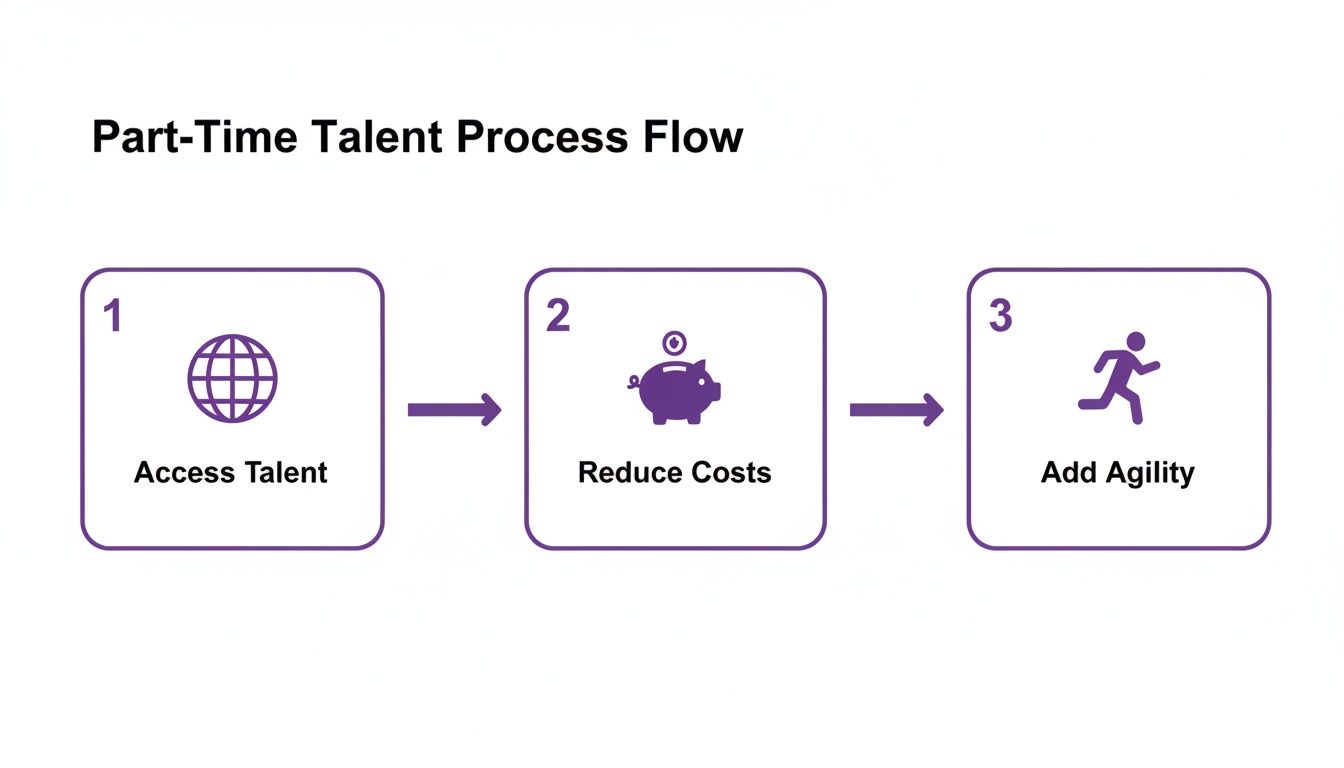
This workflow shows how hiring a part-time developer isn't just a stop-gap. It’s a strategic move to access a wider talent pool, control costs, and scale your team’s firepower exactly when you need it.
Before you even think about writing a job description, you need to define the mission with absolute clarity. Here's a secret: great developers are drawn to compelling problems, not a laundry list of tech skills.
Start by asking yourself these critical questions:
Your answers become the core of your project brief. A strong brief is your magnet for attracting the right kind of part-time developer—the one who wants to make a real impact.
With your mission brief in hand, it's time to decide where to hunt for talent. Your options boil down to two main paths, each with its own pros and cons.
1. Open Freelance Marketplaces
These platforms are huge and offer access to a massive number of candidates. The catch? You're on your own. The vetting responsibility is 100% on you, and that can eat up a ton of time and resources.
2. Curated Talent Networks
Networks like HireDevelopers.com do the heavy lifting for you. They pre-screen candidates for both technical and soft skills, so you only see a small, highly qualified shortlist. This approach radically shortens your hiring timeline and lowers the risk of a bad hire.
For most businesses—especially those without a dedicated recruiting army—a curated network is simply the most efficient and reliable way to land high-quality part-time talent.
The heart of any successful hire is a vetting process that tests for real-world skills, not just textbook knowledge. It's time to ditch the generic coding puzzles and focus on what actually matters for your project.
A solid process has three key parts:
This multi-stage approach gives you a complete picture of the candidate, making sure they have both the technical chops and the soft skills to be a great addition to your team.
Getting this right is more important than ever. The global software development market is projected to hit $823.92 billion by 2026, with a worldwide talent pool of 28.7 million developers. Yet, the U.S. Bureau of Labor Statistics expects developer jobs to grow 17% by 2033, creating intense competition. This is precisely why flexible, strategic staffing is becoming so critical.
To dig deeper into your own process, check out our guide on how to find and hire the best developers for more advanced strategies.
Getting a talented part-time developer on board is a great start, but it's only half the job. Real success comes from how well you bring them into the fold. The right onboarding and management can make the difference between a high-impact team player and a source of constant friction. Those first few weeks are absolutely crucial—they set the stage for everything that follows.
Think of it like setting up a pilot in a new cockpit. On day one, they need all the tools, documents, and communication lines to navigate your projects. Without that, even the most brilliant developer will struggle to get their bearings, which just leads to delays and headaches for everyone.

Get this right, and they'll start adding value almost immediately, proving you made a smart strategic move.
The bedrock of any good part-time arrangement is crystal-clear expectations. When you're juggling different schedules and time zones, ambiguity is your worst enemy. Before a single line of code gets written, your new developer needs to know exactly what success looks like.
This isn't just about technical tasks; it's about the bigger picture.
A smooth integration is non-negotiable. You can learn how to effectively onboard remote employees to get them up to speed and contributing in no time.
Consistent, predictable communication is the lifeblood of any remote team, and it's even more important for a part-timer. They miss out on all the informal office chatter that keeps full-time folks in the loop, so you have to be deliberate about how information flows.
Establish a regular cadence for check-ins that works with their schedule but keeps them connected. A daily asynchronous update in a dedicated Slack channel can be far more effective than forcing them into a stand-up meeting that doesn't fit their hours. This gives them a low-friction way to share progress and flag blockers.
A common mistake is to treat part-time developers like they're on the sidelines. To get the most out of them, they need full visibility into the project and a real voice in key discussions, no matter how many hours they work.
This means you have to get serious about documentation. All major decisions, technical debates, and project updates should live in a central, accessible place, like your project management tool or an internal wiki. This becomes the single source of truth that empowers your developer to work with confidence.
If you want a part-time developer to do their best work, they have to feel like they're truly part of the team—not just a hired gun. Building an inclusive culture is a management responsibility, and it pays off massively in motivation, engagement, and keeping great people around.
Make an effort to pull them into virtual team activities and social channels. When you're celebrating wins, make sure their contributions get the same shout-outs as everyone else's. That sense of belonging is a powerful motivator.
Even better, give them ownership over a specific feature or component. Granting them that autonomy builds trust and shows you value their expertise. When you empower them like this, you'll often see higher-quality work and more creative solutions. For more on scaling your team the right way, check out these https://hiredevelopers.com/staff-augmentation-best-practices/ that help you build a cohesive, high-performing team.
When you treat your part-time developer like a strategic partner, you unlock their true potential and make a real impact on your projects.
This is where all the theory and strategy we’ve talked about gets a whole lot simpler. The very real challenges—defining the role, finding top-tier talent, and managing remote developers—are exactly what HireDevelopers.com was built to handle. We take the messy, time-consuming process of finding a skilled part-time developer and turn it into a clear, direct path to getting your project done.
Forget spending weeks scrolling through thousands of unvetted profiles on noisy freelance sites. Our entire approach is about quality, not quantity. We connect you with the top 1% of pre-screened, global software engineers who are hand-picked to match not just your tech stack, but your company’s unique way of working.
Our process is built for speed, but never at the expense of quality. It’s entirely possible to go from our first conversation to having a new developer pushing code to your repository in about a week. That’s a world away from traditional hiring cycles that can drag on for months.
Here’s how we make that happen:
HireDevelopers removes the guesswork and risk from hiring. We handle the screening, contracts, payroll, and compliance, freeing you up to do what you do best: build incredible products with elite talent.
Think of it as your direct line to a top-tier part-time developer. Instead of rolling the dice on the open market, you get a dedicated partner committed to finding the perfect fit for your team. Our goal is to make hiring exceptional talent less of a chore and more of a genuine strategic advantage for your business.
Thinking about bringing on a part-time developer? It’s a smart move, but it naturally comes with a few questions. You’re probably wondering about the cost, how to protect your code, and whether they can really make a difference on your most important projects.
Let’s get those questions answered so you can feel confident about your next steps.
This is usually the first thing people ask, and for good reason. The honest answer is: it depends. The hourly rate for a part-time developer isn't one-size-fits-all and hinges on a few things:
Knowing these factors will help you set a realistic budget that matches the skills you actually need.
This one is a deal-breaker, and it’s simpler than you might think. How do you make sure the amazing work they do for you… actually belongs to you? It all comes down to the contract.
Your developer agreement needs a crystal-clear clause stating that every line of code, every design, and every bit of work they create for you is 100% owned by your company.
This isn't some tricky legal maneuver; it's standard operating procedure. Any professional developer or reputable hiring platform will expect this. Just make sure you never, ever start a project without a signed agreement that nails down your IP ownership.
Absolutely, and this is a myth worth busting. Some people think part-timers are just for fixing minor bugs or handling tasks on the back burner. The reality couldn't be more different.
We see companies bring in part-time experts to lead and build core, mission-critical features all the time. Think about it: a seasoned pro working a focused 20 hours per week can often deliver more value on a complex problem than a junior full-timer still finding their footing. The trick is to give them clear goals, real ownership, and the right environment to do their best work.
Finding the right Drupal developer can make or break your project. It's that simple. We're not just talking about a content management system here; Drupal is the backbone for some of the most complex, enterprise-level digital experiences out there. For that reason, hiring a true specialist isn't just a good idea—it's essential for building a […]

Hiring an engineering manager is one of the most critical decisions for a growing tech company. A great manager not only accelerates delivery but also builds a resilient, innovative, and motivated team. A poor hire, on the other hand, can introduce process bottlenecks, erode culture, and lead to high turnover among your best engineers. So, […]

In modern software development, technical skill is just the starting point. The real challenge for engineering managers and CTOs is identifying developers who can collaborate, problem-solve under pressure, and drive projects to completion in a distributed team environment. A well-structured interview process that prioritizes behavioral interview questions for software developer candidates uncovers these crucial traits, […]


