

Hiring an engineering manager is one of the most critical decisions for a growing tech company. A great manager not only accelerates delivery but also builds a resilient, innovative, and motivated team. A poor hire, on the other hand, can introduce process bottlenecks, erode culture, and lead to high turnover among your best engineers. So, […]

Hiring an engineering manager is one of the most critical decisions for a growing tech company. A great manager not only accelerates delivery but also builds a resilient, innovative, and motivated team. A poor hire, on the other hand, can introduce process bottlenecks, erode culture, and lead to high turnover among your best engineers.
So, how do you distinguish a truly exceptional leader from a candidate who just interviews well? It comes down to asking the right interview questions for an engineering manager—ones that probe beyond surface-level experience and reveal their true approach to leadership, technical strategy, and team building. Moving past simple yes/no queries is essential. For interviewers aiming to uncover genuine insights, leveraging a strategic guide to 150+ open-ended questions examples can transform your hiring process by helping you formulate questions that reveal a candidate's core competencies.
This curated list provides a comprehensive set of interview questions designed to assess the nuanced skills needed to lead high-performing teams, especially in a distributed or remote context. We'll break down why each question matters, what to look for in a strong answer, potential red flags to watch for, and how to adapt them to find the perfect fit for your organization's specific needs. Whether you're a startup CTO scaling your first team or an enterprise leader optimizing a global engineering function, these questions will help you hire a leader who can navigate complex technical challenges and foster a world-class engineering culture.
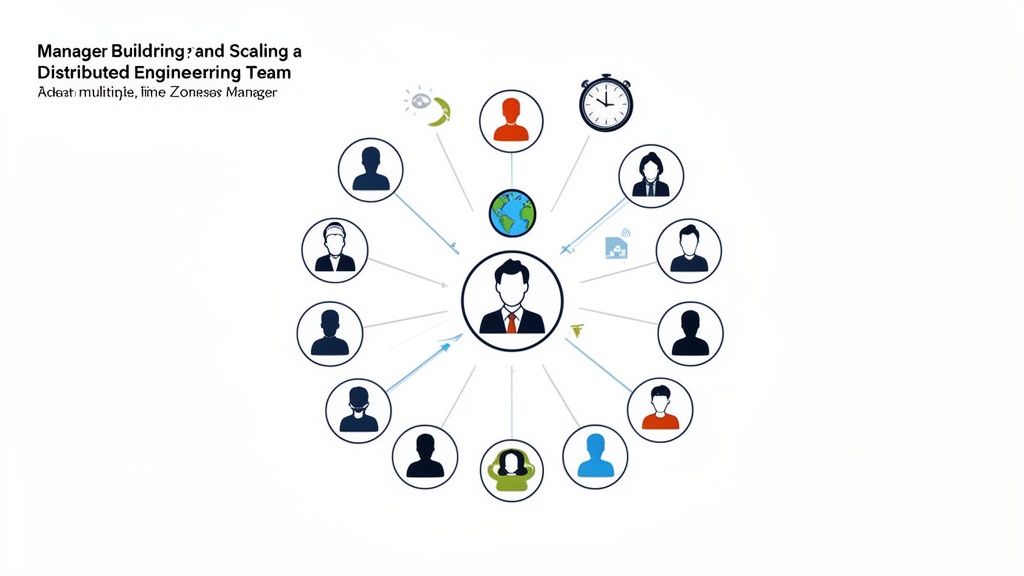
This foundational question is often one of the first interview questions for an engineering manager, designed to assess their direct experience in growing and leading teams. It moves beyond theoretical knowledge to gauge their practical ability to handle the complexities of team expansion, from initial hiring to long-term retention and performance management. The candidate's answer reveals their approach to organizational structure, process implementation, and cultural preservation during periods of high growth.
For companies scaling with distributed or nearshore talent, this question is especially critical. An effective manager must demonstrate an understanding of the unique challenges involved, such as navigating multiple time zones, fostering communication across continents, and integrating remote developers into a cohesive team culture.
A strong response will be structured and data-driven, providing specific examples of team growth. Look for candidates who can articulate the "before and after" picture of a team they scaled.
This line of questioning helps you dig deeper into a candidate's hands-on experience, distinguishing those who have merely overseen growth from those who have actively and strategically managed it.
This question probes one of the core tensions in the engineering manager role: the shift from being a hands-on individual contributor to a people and process leader. It reveals a candidate's philosophy on technical leadership, how they maintain credibility with their team, and their ability to make informed technical decisions without micromanaging. Their answer shows whether they can effectively delegate while still guiding the team's technical direction.
For companies hiring specialized or diverse engineering talent, this is a vital interview question for an engineering manager. A manager must be able to evaluate and guide engineers across varied tech stacks, from backend to AI/ML, even if they aren't an expert in every domain. An effective leader knows how to stay technically relevant enough to support their team, unblock them, and contribute to high-level architectural discussions.

A strong answer demonstrates self-awareness and a clear strategy for staying technically grounded without becoming a bottleneck. Look for candidates who have a defined system for this balance, rather than just good intentions.
These follow-up questions help you understand how a candidate applies their philosophy in practice, distinguishing between those who can talk about technical leadership and those who can effectively execute it.
This question probes a candidate's core management philosophy and their ability to foster individual growth. It assesses their approach to communication, mentorship, and performance management at a micro-level. The quality of a manager's one-on-ones and feedback mechanisms directly correlates with employee engagement, retention, and overall team health.
For companies managing distributed engineers, this practice is non-negotiable. Regular, structured one-on-ones are the primary channel for building rapport, identifying blockers, and ensuring remote team members feel connected and supported. An effective manager must demonstrate a deliberate and consistent approach to these crucial interactions, making them a cornerstone of their management practice.
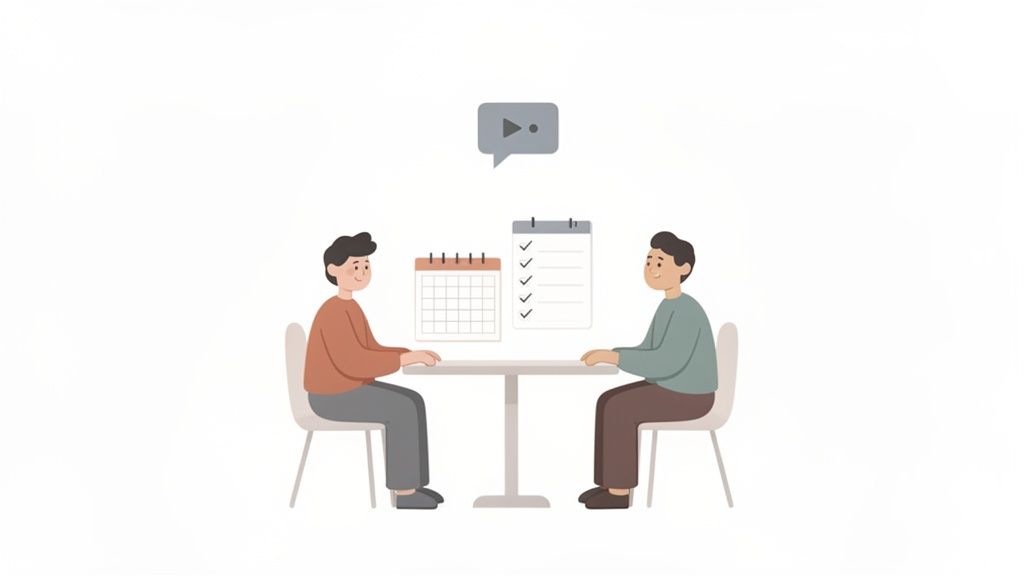
A strong answer will describe a structured, repeatable process that is engineer-centric. Look for candidates who view one-on-ones as the engineer's meeting, not just a status update for the manager. They should also be able to articulate a specific framework for delivering feedback.
These follow-up questions for an engineering manager help distinguish candidates who simply go through the motions from those who use these interactions to strategically develop and retain their talent.
This question tests a candidate's practical knowledge of modern development frameworks and, more importantly, their flexibility. It moves beyond textbook definitions of agile or scrum to see if they can tailor processes to fit a team's specific context, a critical skill when managing distributed teams. A manager who is dogmatic about process can hinder productivity, while one who is pragmatic can unlock a team's full potential.
For companies working with distributed developers, this adaptability is non-negotiable. Standard ceremonies like daily standups or sprint planning often don't work across multiple time zones. An effective manager must demonstrate experience in modifying these rituals to maintain alignment and momentum without forcing engineers into inconvenient schedules. Their answer reveals whether they see process as a rigid rulebook or a flexible toolkit.
A strong answer will showcase a deep understanding of agile principles rather than just a specific framework. The candidate should provide clear examples of how they've modified processes to solve real-world problems, especially those related to remote or distributed work.
These questions probe a candidate's ability to diagnose process issues and implement practical, context-aware solutions, a key differentiator in a modern engineering leader.
This crucial behavioral question assesses a candidate's emotional intelligence, problem-solving skills, and ability to foster a psychologically safe yet accountable environment. It reveals whether they approach sensitive issues with a structured, fair process or reactively. For companies managing distributed teams, conflict can arise from miscommunication across time zones, cultural nuances, or perceived performance disparities, making a manager's resolution skills paramount.
An engineering manager’s ability to handle these situations directly and empathetically is a strong indicator of their leadership maturity. Their response demonstrates how they balance the needs of the individual with the goals of the team and the company, a core competency for any leader. This is one of the most telling interview questions for an engineering manager because it uncovers their true management philosophy.
A strong answer will be grounded in specific, real-world examples that showcase a clear, repeatable process. Avoid candidates who speak only in hypotheticals; look for those who can describe the situation, their actions, and the outcome.
These follow-ups help you evaluate whether the candidate is a proactive problem-solver who builds healthier, more resilient teams, or one who avoids difficult conversations.
This question probes a candidate's ability to manage with objectivity and data. It’s a critical interview question for an engineering manager because it reveals whether they rely on vanity metrics (like lines of code) or focus on meaningful indicators that reflect team health, productivity, and business impact. For companies managing distributed teams, having a clear, data-driven framework is essential for maintaining alignment, tracking progress, and ensuring accountability without resorting to micromanagement.
An engineering manager’s choice of metrics demonstrates their understanding of the software development lifecycle and what truly drives value. Their answer shows how they balance the competing pressures of speed, quality, and team morale, using data not as a tool for punishment but as a compass for continuous improvement.
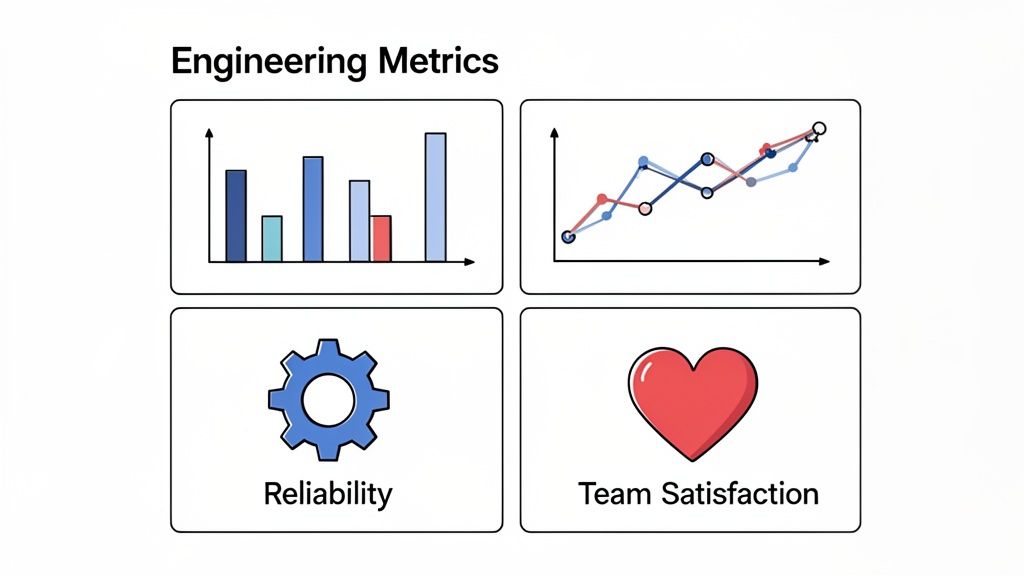
A strong candidate will present a balanced scorecard of metrics, explaining the "why" behind each one and how they are used collectively to paint a complete picture of team performance. They should emphasize outcomes over pure output.
These follow-ups help assess the candidate's strategic thinking. When discussing metrics, it's also valuable to understand how candidates approach setting and tracking goals, perhaps using practical Objectives and Key Results examples. This reveals if they can translate high-level business objectives into measurable engineering outcomes.
This question is fundamental to understanding a manager’s ability to build a high-performing team. A great engineering manager is also an excellent recruiter who can identify, attract, and assess top talent. Their answer reveals the maturity of their hiring process, their ability to reduce bias, and their strategy for evaluating candidates across different engineering disciplines and seniority levels.
For companies that need to scale efficiently, a manager's approach to technical evaluation is a direct indicator of future team quality. An effective manager must have a clear, structured process that balances technical rigor with a positive candidate experience, ensuring they can accurately identify the right skills for roles ranging from Frontend and DevOps to AI/ML and Data Engineering.
A strong response will detail a structured and consistent hiring process, emphasizing fairness and relevance to the actual job. Look for candidates who move beyond simplistic "whiteboard algorithm" tests and focus on assessing real-world problem-solving skills.
These questions probe deeper into the candidate's practical experience and strategic thinking, helping you understand how they hire software engineers who will truly elevate your team.
This behavioral question is designed to evaluate a candidate's resourcefulness, prioritization skills, and grace under pressure. It moves beyond hypothetical scenarios to reveal how a manager actually navigates the real-world constraints of scope, budget, and time. Their answer demonstrates their ability to make tough trade-offs, motivate a team during a high-stress period, and deliver value when resources are scarce.
For companies working with lean teams or looking to maximize the output of a distributed engineering team, this question is paramount. An effective manager must prove they can strategically allocate limited resources, whether that's a small internal team or a fixed budget for nearshore developers, to achieve critical business goals without causing burnout.
A strong answer will follow a clear narrative, like the STAR (Situation, Task, Action, Result) method, and will focus on strategic decision-making rather than just hard work. Look for candidates who can clearly explain their logic and quantify the outcome.
This line of questioning helps distinguish managers who can strategically navigate constraints from those who simply push their teams to work longer hours. It uncovers their true leadership style when the pressure is on.
This question assesses a candidate’s ability to build a forward-thinking and engaged team culture, which is far more challenging without the organic interactions of an office. It tests their proactive strategies for creating an environment where engineers feel empowered to experiment, learn, and contribute beyond their immediate tasks. The answer reveals their leadership philosophy on psychological safety, continuous improvement, and intrinsic motivation.
For companies managing global teams, this is a non-negotiable skill. A manager must prove they can deliberately cultivate connection and creativity across different cultures, communication styles, and time zones. This question helps distinguish a manager who simply assigns tasks from a leader who builds a resilient, innovative, and high-retention remote engineering organization.
A strong answer will move beyond generic statements like "I encourage new ideas" and provide specific, structured programs they have implemented. Look for concrete examples of systems and rituals designed to spark innovation and maintain morale remotely.
These follow-ups help verify that the candidate's approach is intentional and effective, rather than a collection of unmeasured, ad-hoc initiatives. They reveal a manager's true commitment to building a thriving distributed team.
This multi-faceted question probes a candidate's ability to balance short-term delivery pressure with long-term engineering sustainability. It reveals their maturity in understanding that consistent output is impossible without high code quality, a strategic approach to technical debt, and a healthy, engaged team. An effective manager knows these three elements are interconnected; poor code quality creates technical debt, which in turn leads to frustrating work and eventual burnout.
For companies looking to scale efficiently, a manager who neglects these areas will create a fragile system that grinds to a halt under pressure. Their answer demonstrates whether they build resilient, high-performing teams for the long haul or optimize for immediate feature delivery at a high future cost.
A strong response will connect these three concepts and provide a framework for managing them holistically. Look for candidates who speak about systems and processes, not just one-off fixes.
This line of questioning helps assess whether a candidate is merely paying lip service to these concepts or has developed a practical, sustainable system for managing them. It's a crucial part of the interview questions for an engineering manager who will be responsible for a team's long-term health and productivity.
| Question | Implementation complexity | Resource requirements | Expected outcomes | Ideal use cases | Key advantages |
|---|---|---|---|---|---|
| Tell me about your experience managing and scaling engineering teams | Medium–High — requires concrete examples and metrics | Moderate — time for probing, references, onboarding data | Clarity on scaling approach, remote onboarding, retention strategies | Hiring CTOs/engineering managers for distributed or rapidly growing teams | Validates ability to grow and manage vetted remote engineers |
| How do you balance technical expertise with management responsibilities? | Low–Medium — behavioral plus technical examples | Low — recent hands-on examples and decision points | Understanding of hands-on level, credibility with engineers | Startups and teams where managers must be technical leaders | Reveals mentorship ability and technical credibility |
| How do you conduct one-on-ones and provide feedback to your engineers? | Low — focused behavioral and process questions | Low–Moderate — request agendas, frameworks, examples | Insight into development, feedback quality, retention focus | Distributed teams needing consistent coaching and integration | Predicts strong individual development and communication practices |
| Describe your experience with agile/scrum methodologies and how you adapt them | Medium — needs process details and adaptations for async work | Moderate — artifacts, cadence examples, metrics (velocity, cycle time) | Assessment of process pragmatism and coordination for distributed teams | Teams using agile across multiple time zones/geographies | Reveals ability to customize ceremonies and support async collaboration |
| How do you handle underperformance or conflict within your team? | Medium — behavioral with documentation and outcomes | Low–Moderate — examples, PIPs, referenceable outcomes | Evidence of conflict resolution, fairness, accountability | Diverse, remote teams prone to miscommunication or cultural friction | Shows emotional intelligence and consistent performance management |
| What metrics or KPIs do you use to measure engineering team performance? | Medium — requires metric selection and interpretation | Moderate — dashboards, historical metrics, examples of action taken | Demonstrates data-driven management and ROI visibility | Scaling teams and clients justifying offshore/nearshore investment | Identifies meaningful indicators and prevents vanity metrics |
| How do you approach technical hiring and evaluating engineering candidates? | Medium–High — needs process, rubrics, bias mitigation examples | Moderate — interview rubrics, take-homes, paired interviews | Predicts hiring quality and fit across tech stacks | Managers evaluating pre-vetted candidates or building new teams | Shows structured, role-specific assessment and reduced bias |
| Tell me about a time you had to deliver a project with tight deadlines and limited resources | Low — STAR-style behavioral question | Low — one or two concrete examples with metrics | Insight into prioritization, trade-offs, and resourcefulness | Startups, MVP builds, or crisis-driven deliveries | Reveals pragmatic decision-making and ability to meet deadlines |
| How do you foster innovation and keep your team motivated, especially in a distributed environment? | Medium — requires programs and cultural examples | Moderate — mentorship, learning budget, async rituals | Evidence of engagement, learning culture, and innovation channels | Distributed, multicultural teams needing long-term retention | Encourages experimentation, inclusion, and continuous learning |
| What's your experience with code quality, technical debt management, and preventing burnout? | Medium–High — needs policies, metrics, and trade-off examples | Moderate — tooling, refactor cycles, capacity allocation | Balances velocity with sustainability; reduces burnout and debt | Mature products or teams scaling long-term with technical constraints | Promotes sustainable engineering practices and team well‑being |
Navigating the landscape of hiring an engineering manager is a high-stakes endeavor. The right leader doesn't just manage projects; they cultivate talent, shape technical strategy, and build the very engine that propels your company's innovation forward. The comprehensive list of interview questions for an engineering manager provided throughout this guide is your blueprint for moving beyond surface-level conversations and truly understanding a candidate's potential impact.
The goal is not to conduct a simple Q&A session. It is to orchestrate a deep, diagnostic conversation. You've seen how to probe into a candidate's philosophy on everything from one-on-ones and performance metrics to handling technical debt and fostering team culture. This multidimensional approach is critical because an engineering manager's role is inherently multifaceted. They are simultaneously a strategist, a mentor, a project manager, and a technical advisor.
To transform this knowledge into a successful hire, focus on these actionable next steps. It's time to refine your process from a checklist into a strategic evaluation framework.
1. Create Your Role-Specific "Question Menu":
Before your next interview, review the categories in this article (Leadership, Technical Strategy, Hiring, Execution, etc.). Select the top two or three questions from each category that are most critical for the specific team this manager will lead. For a team struggling with deadlines, focus on execution questions. For a team needing a morale boost, prioritize culture and communication. This creates a tailored, relevant interview experience.
2. Define Your "Green Flags" and "Red Flags":
For each question you select, document what a great answer looks like for your company. Don't just copy the examples; adapt them to your culture. A "green flag" might be a candidate who proactively discusses managing burnout, while a "red flag" could be someone who can't articulate how they measure team success beyond just shipping features. This scoring rubric removes ambiguity and reduces hiring bias.
3. Implement a Multi-Stage, Multi-Stakeholder Process:
A great engineering manager must connect with people across the organization. Your interview loop should reflect this reality.
Mastering the art of asking insightful interview questions for an engineering manager is more than just a hiring tactic; it's a foundational business strategy. A skilled manager acts as a force multiplier. They retain top talent, improve code quality, increase delivery velocity, and ensure the engineering department is a strategic partner to the business, not just a cost center. They build resilient, high-performing teams that can navigate tight deadlines and complex technical challenges, especially in a distributed or remote environment.
Finding this person is the first critical step. The second is empowering them with the resources to succeed. In today's global talent market, building elite remote teams is a key competitive advantage. A platform that handles the complexities of sourcing, vetting, compliance, and payroll for international talent allows your new manager to skip the administrative hurdles and focus immediately on what they were hired to do: build and lead.
Ultimately, the interview process is your first and best opportunity to find a leader whose philosophy on people, process, and product aligns with your vision. By investing the time to ask the right questions, you are not just filling a role; you are laying the cornerstone for your company's future technical success.
Finding the right Drupal developer can make or break your project. It's that simple. We're not just talking about a content management system here; Drupal is the backbone for some of the most complex, enterprise-level digital experiences out there. For that reason, hiring a true specialist isn't just a good idea—it's essential for building a […]

When you hear "part-time developer," what comes to mind? It’s more than just someone working fewer hours. Think of them as a highly skilled specialist you bring in for a specific, high-stakes mission. Typically, they work anywhere from 10 to 25 hours per week, but their real value isn't measured in hours—it's measured in impact. […]

In modern software development, technical skill is just the starting point. The real challenge for engineering managers and CTOs is identifying developers who can collaborate, problem-solve under pressure, and drive projects to completion in a distributed team environment. A well-structured interview process that prioritizes behavioral interview questions for software developer candidates uncovers these crucial traits, […]


