

Hiring software engineers today isn't about just posting a job and hoping for the best. That old "post and pray" method is broken. To actually succeed, you need a proactive, deliberate playbook—one that defines the role with razor-sharp precision, sources candidates from the right places, and runs an assessment process that actually predicts on-the-job success. […]

Hiring software engineers today isn't about just posting a job and hoping for the best. That old "post and pray" method is broken. To actually succeed, you need a proactive, deliberate playbook—one that defines the role with razor-sharp precision, sources candidates from the right places, and runs an assessment process that actually predicts on-the-job success.
It’s the only way to win in a market this competitive.

If you feel like you're fighting an uphill battle, you’re not imagining things. The market has completely changed. With the explosion of remote work, you're no longer just competing with a few local companies. You're now in a global talent war, and the best engineers have an entire world of options.
The old methods just don't work anymore. Fierce competition is pushing salaries to eye-watering levels, and slow, bureaucratic hiring processes mean you’re losing great people to nimbler companies before you even get to a final offer.
This is all made worse by a simple numbers game. The global developer population is expected to grow from 26.9 million in 2023 to 28.7 million by 2025, but demand is still rocketing past supply.
So, what's the real problem? There's a massive disconnect between how most companies hire and what top engineers actually want. Too many hiring processes are stuck in the past, asking irrelevant brain teasers and failing to sell the candidate on the opportunity.
Engineers aren’t just looking for a good salary anymore. They want to work on interesting problems, see the impact of their work, and be part of a team that pushes them to grow.
"The best engineers today don’t just write good code—they think like product owners, use AI tools effectively, and move fast with clarity and autonomy. But most interviews haven’t caught up."
This guide is built to bridge that gap. We're not talking about finding just any engineer. We’re talking about creating a system that attracts and lands the right one for your team.
Here's a quick look at the fundamental challenges hiring managers face and the modern solutions that actually move the needle.
The old playbook relied on a captive, local talent pool. Today’s reality requires a completely different approach.
| Traditional Hiring Challenge | Modern Strategic Solution |
|---|---|
| Limited Local Talent Pool: Fishing in the same small pond as your local competitors. | Global Sourcing: Actively recruiting from nearshore/offshore talent hubs to find top-tier skills at a sustainable cost. |
| Slow, Multi-Stage Interviews: Losing candidates to faster-moving companies due to a long, drawn-out process. | Efficient, Focused Assessments: Combining a take-home project with a single, intensive technical interview to assess real-world skills quickly. |
| Generic Job Descriptions: Using boring, templated JDs that attract a high volume of unqualified applicants. | Impact-Oriented Role Definitions: Crafting compelling descriptions that focus on the problems the engineer will solve and the impact they'll have. |
| Passive "Inbound-Only" Approach: Waiting for applications to trickle in from job boards. | Proactive Outreach: Engaging talent directly on platforms like GitHub, niche communities, and through targeted recruiter outreach. |
This isn't just about tweaking your current process; it's about a fundamental shift in mindset.
To get there, you need to focus on a few key areas:
By adopting this strategic approach, you can turn a frustrating, endless search into a powerful competitive advantage—and finally build the world-class engineering team you need.
Jumping straight into writing a job description is a classic mistake. It's like trying to build a house without a blueprint. A great hire starts long before you post an ad; it begins with getting brutally honest internally about what your team actually needs. Skipping this step is the fastest way to waste weeks interviewing the wrong people.
Forget skills for a minute. Start with the problem. Ask yourself: What specific pain point will this engineer solve? Are you trying to ship an MVP faster? Is a legacy system on fire and needs stabilizing? Or are you finally getting to experiment with that new AI feature you’ve been talking about? The answer to that question defines the entire role.
Think about it. A seed-stage startup building its first product needs a jack-of-all-trades full-stack developer who thrives in chaos and can push code without much hand-holding. On the other hand, a big bank might need a hyper-specialized cybersecurity expert who lives and breathes compliance and threat modeling for a single platform. The titles might look similar, but the jobs couldn't be more different.
One of the biggest traps I see hiring managers fall into is creating a massive "laundry list" of technologies. This wish list doesn't just scare away great candidates who might have 8 out of your 10 requirements; it makes finding a "perfect" match practically impossible.
You have to be ruthless. Split your needs into two buckets:
This simple exercise forces you to get clear on what truly matters. It also dramatically widens your talent pool to include sharp engineers who have the core skills to crush the job, even if they haven't used your exact stack before.
Deciding on seniority isn't just about experience; it's a strategic move. The 2025 software engineer job market has a serious seniority problem—over 50% of open roles are now for senior-level talent. This is largely driven by Big Tech snapping up experienced engineers after the layoffs, creating a hyper-competitive environment. You can get a deeper look at the software engineer job market trends on Underdog.io.
If you’re a non-technical founder or a team rushing to an MVP, the instinct is to hire the most senior person you can find. But you need to match seniority to your real-world needs and budget.
A senior engineer can give you architectural vision and mentor the team, but a strong mid-level developer might be the perfect sweet spot for speed and cost if you already have a technical lead.
Be realistic about how much autonomy the role requires. If you need someone to build a technical roadmap from a blank slate, you absolutely need a senior or staff-level engineer. If the roadmap is already in place and you need someone to own features and execute, a solid mid-level hire could be your best bet.
Finally, where will this person be? Sticking to your local talent pool can be a huge, self-imposed limitation. Opening your search to nearshore or offshore talent can be a game-changer, giving you access to a massive pool of skilled engineers you'd otherwise miss.
It's a balance of trade-offs, of course:
By nailing down these fundamentals—the core problem, the real skill priorities, the right seniority, and a location strategy— you're not just preparing to write a job description. You’re creating the north star for your entire hiring process, from how you source to the final offer you make.
Let’s be honest: your job description is your first sales pitch. In a market where great engineers get hit up with new opportunities daily, that generic, corporate-speak job post is a guaranteed way to get ignored. It’s the difference between drowning in a sea of irrelevant applications and attracting a handful of people who are genuinely perfect for the role.
Think of it this way: you’re not just listing a bunch of requirements. You're extending an invitation to solve a meaningful problem with you. The real goal is to craft a message that speaks to a builder's mindset, sparks their curiosity, and convinces them this isn't just another cog-in-the-wheel job.
Most job descriptions are just plain boring. They kick off with a canned paragraph about the company, throw in a laundry list of a dozen technologies, and wrap up with some boilerplate HR text. Engineers have seen this script a thousand times, and they've gotten very good at tuning it out.
If you want to stand out, you have to flip that script. Start with the impact.
Your job description isn’t a filter; it’s a magnet. It should attract people who are genuinely excited by your specific challenges and repel those who are just looking for any backend role that happens to use Python.
This shift in focus—from a simple list of duties to an opportunity for tangible impact—is what will make your role catch the eye of the best engineers out there.
Let's break down what turns a dull post into one that actually gets a response. The key is to keep it clear, concise, and human.
1. A Magnetic Title
Vague titles like "Software Engineer" are a waste of a first impression. Get specific. Something like "Senior Backend Engineer (Python & AWS)" or "Founding Frontend Engineer (React & AI Products)" immediately tells a candidate if they should keep reading.
2. The Core Pitch
You have one paragraph to hook them. Make it count. Instead of the tired "We are a fast-growing SaaS company," try this: "We're building a platform to help non-profits manage their donor data, and we need a backend engineer to help us scale our core APIs to handle 10x our current traffic." See the difference?
3. What You'll Actually Do
Use bullet points here, but focus on outcomes, not just vague responsibilities. Verbs are your friend.
4. The Tech Stack (Be Honest)
List the primary technologies this person will work with every day. And please, be honest about it. If there's some legacy code they'll have to wrangle, just say so. A little transparency up front builds a lot of trust.
5. Compensation and Benefits
This is no longer optional. A 2024 study showed that a whopping 73% of tech professionals are more likely to apply for a job that includes a salary range. Be upfront about salary, equity, and key perks like your remote work policy or healthcare.
Finally, while you're crafting the perfect pitch, you also have to stay on the right side of the law. Beyond just attracting talent, it’s crucial to understand the legal ins and outs of how to write a compliant job description. This ensures your language is inclusive and you’re not accidentally stepping into any legal gray areas. Your post has to be both compelling and fair.
Let's be honest: waiting for the perfect software engineer to stumble upon your job post is a losing game. The best people are almost always passive candidates—they’re not actively looking, but they’re open to a compelling opportunity. If you want to hire top-tier engineers, you need a proactive, multi-channel strategy that goes way beyond just posting on LinkedIn.
This means flipping your mindset from reactive to active. Stop just filtering inbound applications and start building a strong, consistent pipeline by meeting engineers where they already are. It's about genuine engagement, not just recruitment.
Relying on a single channel is like fishing in a small, overfished pond. To find the kind of talent your competitors are missing, you have to diversify your sourcing strategy. This means looking beyond the usual job boards and tapping into the vibrant ecosystems where developers live and breathe code.
Here are a few high-impact channels to get you started:
The most effective sourcing isn't about blasting a generic message to hundreds of people. It’s about making a genuine, one-to-one connection that shows you value a candidate’s specific skills and experience.
This active approach means you're not just waiting for the market to bring people to you; you're going out and finding the best fit. For a deeper dive into this, check out these talent acquisition best practices.
This visual breaks down what makes a job description actually work—moving from a compelling title to showcasing the role's impact and the tech involved.
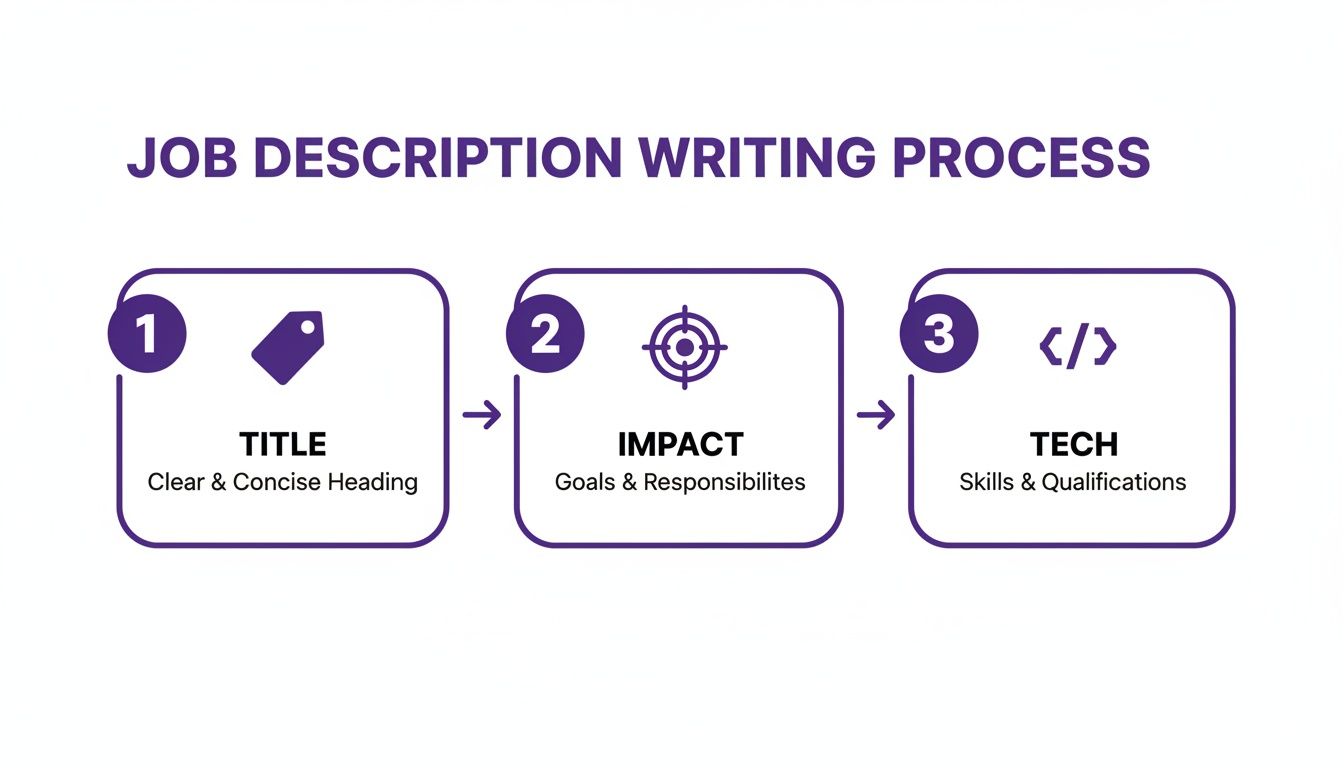
Think of a well-structured job description as the first critical filter in your entire process. Get it right, and you'll attract the right people from the very start.
Choosing the right channels can make or break your hiring timeline. Some offer speed, others offer quality, and the best strategy often involves a mix. This table breaks down what you can expect from each.
| Sourcing Channel | Average Time-to-Hire | Candidate Quality | Best For |
|---|---|---|---|
| LinkedIn/Job Boards | 30-60 days | Varies (High volume) | General roles, active candidates |
| Referrals | 15-30 days | High | Building a cohesive team, finding culture fits |
| Niche Communities | 45-75 days | High (Specialized) | Hard-to-fill roles, finding passionate experts |
| Global Talent Platforms | 7-21 days | Vetted (Often High) | Scaling quickly, finding nearshore/offshore talent |
| Direct Outreach | 30-90 days | Very High | Senior or highly specialized roles, passive candidates |
As you can see, there's no single "best" channel. A balanced approach that combines the speed of global platforms with the quality of referrals and direct outreach will give you a robust and resilient talent pipeline.
Once your sourcing engine is humming, the next challenge is screening candidates efficiently without wasting anyone's time—especially your own. A multi-stage vetting process helps you quickly identify the most promising people while giving everyone a positive experience.
Your goal here is to filter fast, not to find perfection. You need a lightweight process that gives you strong signals early on.
Forget finding a perfect match on paper. Instead, you're looking for the core competencies and signs of a "builder" mindset.
Before you even think about a technical assessment, a quick 15-30 minute call can save you hours down the line. This is a vibe check, not a technical grilling.
You're really just trying to assess two things: communication skills and genuine interest. Can they clearly explain what they've worked on? Do they sound genuinely curious about your company's challenges? This first conversation is often the best signal you'll get for a potential culture fit. This is especially critical when you're learning how to find developers from different backgrounds and regions.
By putting this two-part initial screen in place, you ensure that you only invest your team's valuable technical interview time with candidates who are a genuinely strong potential match. It respects everyone’s time and dramatically speeds up your hiring timeline.
The technical interview is the heart of the hiring process, but it’s also where things most often go wrong. We've all been there—staring at a whiteboard, trying to recall some obscure algorithm we haven't touched since college.
That old-school approach is fundamentally broken.
As a manager, you don't really care if someone can invert a binary tree on the spot. You care if they can build, ship, and solve the real problems your team faces every day. The goal isn't to test trivia; it's to design an experience that gives you a clear signal on how they'll perform on the job.
A great technical interview should feel less like an interrogation and more like a collaborative jam session. It's a chance to see how a candidate thinks, communicates, and handles the inevitable ambiguities that come with building software.
Today’s best engineers use AI-powered tools to write boilerplate and look up syntax. Rote memorization is less important than ever. What really matters are the deeper skills: problem decomposition, architectural thinking, and simply knowing the right questions to ask.
Your interview process needs to reflect this new reality.
It’s time to ditch the abstract puzzles and build your assessments around scenarios that mirror the actual work.
A successful technical interview should leave the candidate feeling energized and excited about the problems your team is solving, even if they don't get an offer. Remember, they're interviewing you just as much as you're interviewing them.
A well-structured interview loop gathers all the signals you need without completely burning out your candidate (or your team). Every stage should have a clear purpose. It's not just about raw coding ability; how a candidate approaches teamwork and problem-solving is just as critical. For a deeper dive, our guide on behavioral interview questions for software developers is a fantastic resource.
Here’s a sample loop I’ve seen work wonders:
To fight bias and keep your feedback consistent, you need a rubric. Don't just give a "pass" or "fail." Scoring candidates on specific dimensions makes your team's debrief sessions way more productive.
Here's a simple table to get you started:
| Evaluation Area | What to Look For |
|---|---|
| Problem Solving | Do they break the problem down into smaller, manageable chunks? Do they ask smart questions or just make assumptions? |
| Code Quality | Is the code clean, readable, and well-organized? Do they write tests? Does it look maintainable? |
| Technical Communication | Can they clearly explain their thought process? Do they articulate the trade-offs they’re making? |
| Collaboration | How do they take feedback? Are they open to different ideas or do they get defensive? |
When you focus on these practical, observable behaviors, your technical interviews transform. They become a far more accurate predictor of who will thrive on your team. You'll end up hiring builders, not just puzzle-solvers.
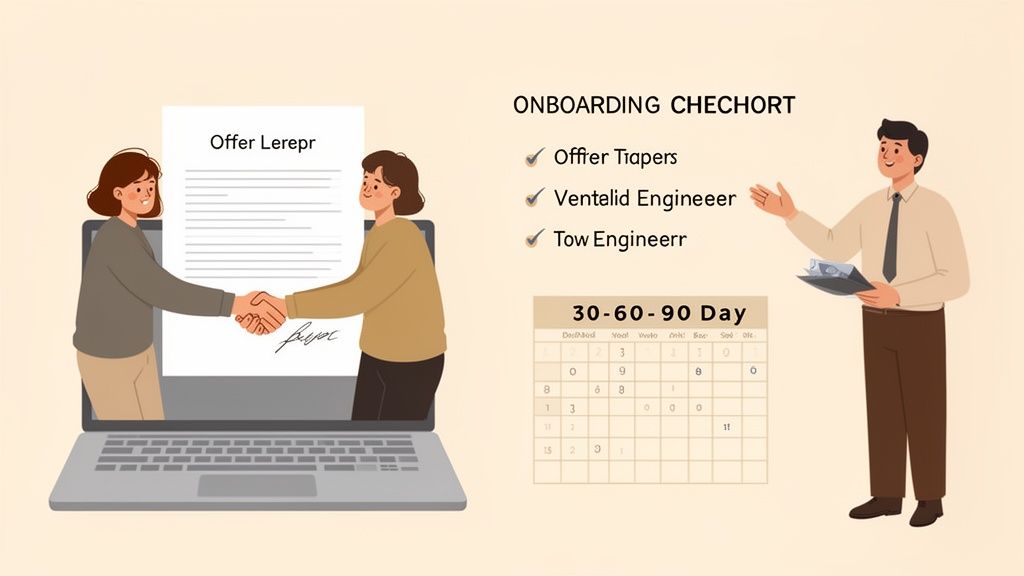
You’ve navigated the technical gauntlet and found someone who feels like a perfect fit. Getting here is a huge relief, but don’t pop the champagne just yet. The next two steps—the offer and the onboarding—are where you either seal the deal or watch all that hard work go to waste.
Let’s be honest: in this market, speed is your biggest advantage. Great engineers almost always have multiple offers on the table. If you drag your feet, you’ve already lost. Once you’ve made your decision, you have to move fast and with conviction.
A compelling offer isn't just about the salary number; it's the whole story you tell. It’s a package that screams, "We see your value, and we want you to be a part of this." Generic, lowball offers are a great way to insult a candidate you just spent weeks trying to woo.
A winning offer is really built on a few key pillars:
When it's time to extend the offer, pick up the phone. A call is far more personal and allows you to share your genuine excitement and answer questions on the spot. Immediately follow up with a crystal-clear offer letter that breaks down every single component.
Your best offers are strong and respectful from the start. The goal is to make the candidate feel valued, not to start a drawn-out negotiation. Give them time to think, but show them you're confident this is the best place for them to be.
The real work begins after they sign. I’ve seen it happen too many times: a company lands an amazing engineer, only to lose them within six months because the onboarding was a complete disaster. A chaotic first few weeks can trigger instant buyer's remorse.
A great onboarding experience, on the other hand, makes a new developer feel welcomed, empowered, and ready to contribute. This is your chance to turn that new hire into a highly engaged, long-term cornerstone of your team.
Your plan should be all about providing clarity and building connections. Here’s a checklist I’ve used to build successful onboarding programs:
This kind of structured approach transforms onboarding from a boring administrative task into a powerful strategic advantage. You’re not just hiring someone; you're integrating a key player into your team from the moment they say "yes."
When you're in the trenches trying to hire great engineers, the same questions tend to pop up again and again. Let's tackle some of the most common ones I hear from hiring managers, so you can move forward with more confidence.
Look, in a perfect world, you’d have an offer out within three to four weeks from your first conversation with a candidate. If you let the process drag on, you're practically inviting your top choice to accept another offer. I’ve seen it happen countless times.
The key is momentum. Keep your interview stages tight and your communication crystal clear. A quick, decisive process doesn't just help you win candidates; it sends a powerful message about your company's culture.
A slow hiring process is a signal to top engineers that your company might also be slow to build, innovate, and make decisions. Speed reflects your company's culture.
Technical incompetence is easy to spot. What's trickier are the behavioral red flags that hint at bigger problems down the road.
Be on high alert for these:
These aren't just personality quirks; they're often early indicators of someone who will struggle with collaboration and accountability.
Take-home assignments can be a fantastic tool, but you have to use them thoughtfully. If you're going to ask for someone's time, respect it.
A good rule of thumb is to keep the challenge short, focused, and directly relevant to the job. It should take no more than two to four hours of real work. Sending a candidate a massive, unpaid project is one of the fastest ways to alienate great people who already have jobs and busy lives.
Cloud computing stopped being a hosting decision a while ago. It's now a board-level question about speed, margin, resilience, and whether your team can ship AI-enabled products without turning infrastructure into a bottleneck. The striking part is the scale. Global public cloud spending is projected to exceed $830 billion in 2026, with the overall market […]

A hiring manager has 30 minutes, a resume full of Spring buzzwords, and one job opening that cannot afford a weak hire. A candidate has the same 30 minutes to prove they understand more than annotations and starter-project patterns. This context defines Spring MVC interviews. Strong interviews usually turn on practical judgment. Can the candidate […]

Payroll usually breaks before founders admit it has broken. At first, the system looks manageable. One spreadsheet tracks hours. Another tracks bonuses. Someone exports a bank file, someone else checks tax dates, and payroll goes out. Then headcount creeps up, one hire moves to another state, a contractor becomes an employee, and the process stops […]


