

Finding the right Drupal developer can make or break your project. It's that simple. We're not just talking about a content management system here; Drupal is the backbone for some of the most complex, enterprise-level digital experiences out there. For that reason, hiring a true specialist isn't just a good idea—it's essential for building a […]

Finding the right Drupal developer can make or break your project. It's that simple. We're not just talking about a content management system here; Drupal is the backbone for some of the most complex, enterprise-level digital experiences out there. For that reason, hiring a true specialist isn't just a good idea—it's essential for building a secure, scalable, and high-performance platform that actually delivers.
Hiring a generalist web developer for a Drupal project is a classic mistake. It's a bit like asking your family doctor to perform open-heart surgery. They might understand the basic principles of anatomy, but they lack the deep, nuanced expertise needed for a successful outcome. A genuine Drupal expert brings a specific skill set that helps you sidestep common pitfalls like sluggish performance, gaping security holes, and scalability nightmares that can tank a project long after it goes live.
The decision to hire a Drupal developer is more than just a line item in your IT budget; it’s a strategic business decision. The right person doesn't just write code. They architect solutions that align with your long-term business goals, making sure your digital platform can evolve as your company grows.
The market data backs this up. The global Drupal Development Service market was recently valued at around USD 1.2 billion and is on track to more than double to USD 2.5 billion by 2033. That growth, humming along at a compound annual rate of 8.9%, shows just how much businesses are relying on Drupal for mission-critical projects. You can dig into the full report for a deeper dive into these market trends.
This spike in demand means one thing: the competition for top-tier Drupal talent is fierce. The companies that win are the ones who can tell the difference between a developer who knows Drupal and one who lives and breathes it. That's exactly what this guide will help you do.
I've seen this happen countless times: a company inherits a Drupal site built by a non-specialist. The code is a mess, core modules are hacked apart, and simple content updates become week-long ordeals. The cost to clean up that technical debt almost always dwarfs the original development budget.
This isn't just another generic hiring checklist. We're going to give you a clear, actionable roadmap for finding and hiring the exact talent your project needs.
Here’s what you'll learn:
By the time you're done reading, you’ll be ready to hire a Drupal developer who isn't just a coder, but a genuine partner in your digital success.
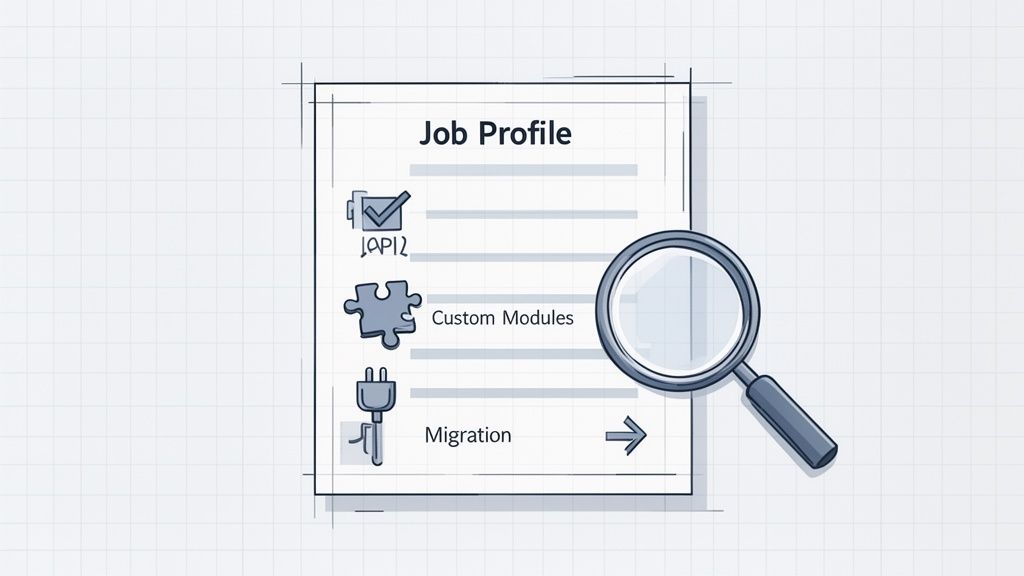
Before you even think about writing a job post, you need a crystal-clear picture of who you're looking for. Jumping the gun here is like trying to build a house without a blueprint. You’ll end up with something, but it almost certainly won’t be what you actually need.
This first step is all about translating your business goals into a specific, actionable developer profile. It’s the difference between saying, “we need a better website,” and saying, “we need a headless Drupal backend to serve content to our mobile app and React marketing site.” That second statement immediately tells you that API integration skill is non-negotiable.
The kind of Drupal developer you need is a direct reflection of your project. A small business that just needs a standard brochure site has wildly different needs than an enterprise migrating a decade of content from Drupal 7 to Drupal 10.
Let's walk through a few common scenarios to see how the project itself dictates the skills you should prioritize.
Scenario 1: The Startup MVP
A startup needs to launch a Minimum Viable Product (MVP), and they need it fast. The game is all about speed, core functionality, and being able to pivot on a dime. You’re probably looking for a full-stack generalist who can handle backend module configuration and basic frontend theming to get a working product live.
Scenario 2: The Enterprise Migration
A large organization is finally getting off its ancient Drupal 7 platform. This project is all about mitigating risk, ensuring data integrity, and navigating complex architecture. Here, you need a senior developer with proven, hands-on experience in large-scale migrations and custom module rewrites.
Scenario 3: Ongoing Support and Maintenance
Your Drupal site is live and performing well, but it requires regular security patches, small feature additions, and performance monitoring. In this case, you're searching for a reliable mid-level developer with strong debugging skills and a solid command of maintenance tools like Composer and Drush.
Don't over-hire. It’s so tempting to create a "unicorn" job description with every skill imaginable. This usually just scares off great candidates and inflates your costs. Be brutally honest about what's essential for success right now.
Once your project scenario is clear, it's time to separate the absolute essentials from the desirable extras. This simple exercise keeps you from passing on a fantastic candidate who’s missing a minor skill while ensuring your core requirements are met.
Think of it like building a skills pyramid. The base is non-negotiable, and everything else builds on top of that.
These are the absolute, unshakeable requirements.
This layer is completely dependent on your project's goals.
These are valuable skills but aren't deal-breakers.
By creating this tiered list, you build a much more realistic and effective hiring profile. It sharpens your focus, helps you write better interview questions, and makes it easier to find a developer who can solve your actual problems.
Alright, you’ve mapped out who you need. Now comes the real challenge: finding and confirming they’re the right person for the job.
Sourcing good Drupal talent has gotten tricky. The talent pool isn't what it used to be. With Drupal's market share now at just 0.7% for websites and 1.8% for CMSs, the community has gotten smaller and, frankly, a bit older. Developer optimism has even dipped from 80% to 64%. This scarcity means the hunt for skilled, modern Drupal experts is more competitive than ever. You can dig into more data on the Drupal talent landscape and its alternatives if you're curious.
To navigate this landscape, you have to know where to look and, more importantly, how to rigorously check out the candidates you find.
Where you search for a developer directly shapes how fast you hire, how much you spend, and the quality you get. Each channel comes with its own set of pros and cons, suiting different project needs and budgets.
Finding the right sourcing channel is a classic trade-off between speed, cost, and the quality of talent. To help you decide, here’s a quick comparison of the most common options.
| Sourcing Channel | Speed to Hire | Average Cost | Talent Quality & Vetting | Best For |
|---|---|---|---|---|
| Freelance Platforms | Fast (1-2 weeks) | $ (Low) | Low to Medium (Self-vetted) | Small, well-defined tasks and short-term gigs. |
| Specialized Drupal Agencies | Moderate (2-4 weeks) | $$$$ (High) | High (Agency-vetted) | Large, complex enterprise projects needing a full team. |
| Traditional Job Boards | Slow (4-8+ weeks) | $$ (Moderate) | Variable (You do all the vetting) | Casting a wide net when you have time and resources to screen. |
| Global Talent Platforms | Very Fast (1-3 days) | $$$ (Med-High) | High (Pre-vetted) | Projects needing top-tier talent quickly without agency overhead. |
As you can see, there's no single "best" place. Freelance sites are great for quick, small jobs, but you're rolling the dice on quality. Agencies offer top-tier, reliable teams but come with a serious price tag. For many, a global talent platform hits that sweet spot, delivering vetted experts quickly without the sticker shock of a full agency.
My two cents: Don't put all your eggs in one basket. A multi-channel approach can work well. But if you're short on time and need quality you can trust, starting with a vetted talent network like HireDevelopers.com can save you weeks of headaches.
For a deeper dive into sourcing strategies, check out our guide on how to find developers for your project.
Getting a name is easy. The hard part is making sure they can actually do the work. The vetting process is where you separate the real experts from those who just look good on paper. You absolutely need a multi-stage approach that checks both their technical chops and their soft skills.
A resume can say anything. You need to see a developer's skills in action. A hands-on technical assessment isn't just a nice-to-have; it's essential when you hire a Drupal developer.
A question I love to ask is: "You've noticed a page is loading slowly. Walk me through your process for diagnosing and fixing the performance bottleneck. What tools are in your toolbox?"
Their answer will quickly reveal their depth of knowledge on caching layers like Varnish or Memcached, database query optimization, and their comfort with debugging tools like Xdebug or Devel.
Brilliant code is useless if the developer can't communicate or work with a team, especially in a remote world. Your interview questions have to be designed to pull these traits out.
By combining a deep dive into their technical work with smart questions about how they operate, you get a full picture of the candidate. This kind of thorough vetting ensures you don't just hire a coder—you hire a problem-solver who will be a genuine asset to your team.
Alright, let's talk numbers. Figuring out your budget is easily one of the most important—and often daunting—steps when you decide to hire a Drupal developer. The cost isn't a single, flat figure. It's a range that gets pushed and pulled by experience level, where the developer is located, and the type of working arrangement you choose.
Getting a handle on these variables from the start is the key to avoiding sticker shock down the road. It means you can make smart, strategic decisions instead of just reacting to invoices.
This decision tree is a great visual for thinking through one of the first big questions: should you hire a freelancer or go with an agency?
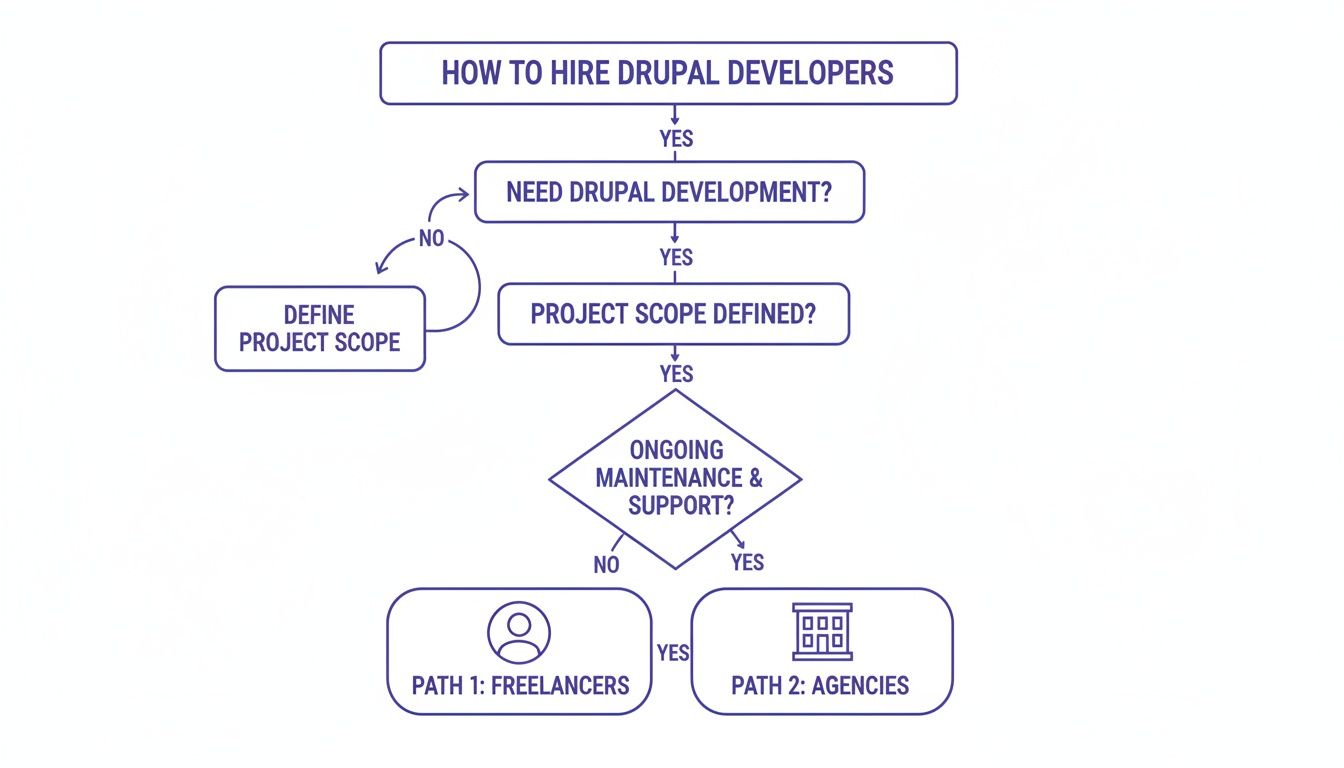
As you can see, the "right" path really depends on your project’s scope, how fast you need it done, and whether you’ll need support long after launch.
Where a developer lives plays a massive role in what they charge. A senior developer based in North America will have a much higher rate than someone with the exact same skills in Latin America or Eastern Europe, mostly because of the difference in living costs.
Here’s a rough sketch of what you can expect to see for hourly rates:
These are good ballpark figures, but keep in mind that within each region, the developer's specific experience—junior, mid-level, or senior—will shift the numbers.
Budgeting for a Drupal developer isn't just about chasing the lowest hourly rate. It's about finding the best value. I've seen experienced developers solve a complex problem in a couple of hours that would take a junior developer days to untangle, saving a lot of money in the long run.
Beyond location, how you structure the working relationship will have a big say in your total cost and flexibility. Each model has its pros and cons, and the best one for you really depends on your project and team.
Hiring a freelancer is your most agile option. You're paying for a specific block of hours or a fixed scope, which is perfect for short-term tasks, building out a single feature, or bringing in a specialist to fix one tricky problem. You get maximum flexibility, but the trade-off is often less long-term commitment and the administrative headache of managing contracts and payments yourself.
I love this model because it’s basically a "try before you buy" scenario. You bring a developer on for a fixed term, usually 3-6 months, with the option to offer them a full-time position at the end. It’s a fantastic way to make sure their technical skills are as good as advertised and, just as importantly, that they’re a good fit for your team culture. It seriously lowers the risk of making a bad hire.
If you have a long-term project that needs someone deeply embedded in your team, a full-time hire is the way to go. It’s a bigger financial commitment, no doubt, but it builds loyalty and gives the developer the time to truly understand your business inside and out. Using a global talent platform can take the sting out of this by handling things like international payroll and compliance, making it surprisingly simple to build a dedicated remote team. For a deeper dive, check out our complete guide to developer salary trends.
Drupal's power is most obvious in high-stakes enterprise projects. Even with all the market changes, it still powers 3.1% of the top one million websites and a whopping 7.5% of the top 1,000 highest-traffic sites. While you can find developers for $20-$60/hour, pushing total project costs anywhere from $5,000 to over $100,000, the right hiring partner can make that investment much more efficient. There are ways to find significant cost savings on Drupal development services for your next build.
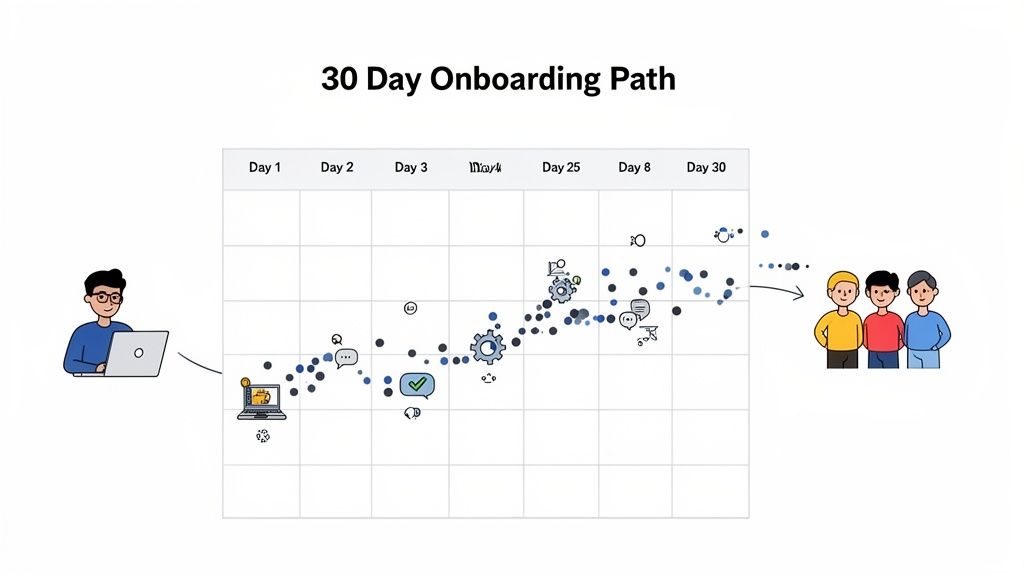
You’ve navigated the interviews and made your hire—congratulations. But the real work is just beginning. The first 30 days are absolutely critical. They set the tone for the entire working relationship and have a massive impact on long-term retention and how quickly your new developer starts contributing.
A haphazard start guarantees confusion and a slow ramp-up. A structured process, on the other hand, empowers them to make a real impact from day one. This isn't just about handing over a laptop; it's about methodically integrating them into your team’s environment, workflows, and culture.
The first few days should be laser-focused on one thing: eliminating technical roadblocks. There's nothing more frustrating for a new developer than being ready to work but blocked by access issues or a broken local environment. Your job is to get them set up to code as smoothly as possible.
Before they even start, have an onboarding checklist ready.
The smoother the technical onboarding, the faster your new developer can start delivering value. A developer who spends their first three days fighting with a local setup is a developer who feels disempowered and frustrated. Make it seamless.
A well-maintained internal wiki or guide is a lifesaver here. If you don't have one, it's a great time to build a knowledge base your team will actually use.
Once the technical foundation is solid, the focus shifts to integrating them into the team's rhythm. This is where they learn not just what to do, but how your team gets it done. They need to understand the unwritten rules, communication styles, and collaborative habits.
A great way to start is by assigning a small, low-risk bug fix or a tiny feature enhancement. This gives them a safe, hands-on way to navigate your entire workflow—from grabbing a ticket to creating a pull request and participating in their first code review. The task itself isn't the point; learning the process is.
To really help them feel like part of the crew, try these steps:
This phase is all about building connections and turning a new hire into a true team member. If your team is remote, this becomes even more important. We have a whole guide on how to onboard remote employees that you might find helpful.
Hiring a Drupal developer from another country introduces a layer of logistics that can feel daunting. Navigating international contracts, tax compliance, and payroll is a specialized field that can quickly become an administrative nightmare if you try to manage it all yourself.
This is where a global talent platform really proves its worth. By acting as the Employer of Record (EOR), they handle all the legal and financial complexities for you. They ensure your international hires are paid on time, in their local currency, and in full compliance with local labor laws. This completely removes the burden from your team, letting you focus on what really matters: integrating your new developer and building great software.
Even with a great plan, a few questions always seem to pop up when you're ready to hire a Drupal developer. These are the nitty-gritty details that can trip you up. Let’s get them sorted out right now so you can move forward with confidence.
Think of this as the final gut-check before you make that critical decision.
This is a big one, and getting it wrong can be costly. The distinction is pretty simple when you break it down.
A Drupal Developer builds the engine. They're the ones in the backend, writing PHP for custom modules, architecting the database, and handling tricky API integrations. Their world is all about functionality, security, and making sure the site runs like a well-oiled machine.
A Drupal Themer, on the other hand, builds the car's body and interior. They are frontend specialists who live in Twig, CSS (like Sass or Less), and JavaScript. They take the designer's vision and turn it into a beautiful, responsive user experience that people can actually interact with.
Sure, some pros are "full-stack" and can do both, but most people specialize. You have to know what your biggest pain point is right now. Is it a need for complex business logic (developer) or a clunky, outdated user interface (themer)? That answer tells you who to hire first.
Your project's most urgent need dictates the hire. If the site's foundation is shaky or you need new features, get a developer. If the core is solid but the user experience is a disaster, you need a themer.
The million-dollar question. Honestly, it all comes down to where you're looking.
If you go the traditional route with job boards, you should plan for four to eight weeks from start to finish. And that’s if you get lucky. Top-tier Drupal talent is a scarce resource, so that timeline can easily stretch out. You'll burn weeks just writing the job description, filtering out unqualified applicants, and sitting through multiple interview rounds before you even get to an offer.
This is where specialized talent platforms completely change the game. They've already done the heavy lifting of vetting candidates. Because of this, it's not uncommon to get a shortlist of qualified, available developers in a day or two and have someone ready to start in under a week. The time difference is staggering.
For a new project? Yes, absolutely. It's not even a question.
Modern Drupal (think Drupal 10 and beyond) is a different universe from the older versions. It's built on the Symfony framework, uses Composer to manage all its moving parts, and is designed to be "API-first." You need someone who speaks this language fluently.
Hiring a developer who is up-to-date ensures your site is secure, supported, and won't be a technical mess in a year. It's about starting off on the right foot.
The only time this isn't true is if you're trying to maintain or migrate an old site. If you're stuck on Drupal 7, for example, you specifically need a developer with proven migration experience. That’s a unique skill set, and you need that expertise to move your site without losing data or causing a major business disruption.
The risk isn't about geography; it's about your vetting process.
Hiring a random freelancer from an open marketplace without any real screening is a gamble, no matter where they live. You're crossing your fingers and hoping their skills, communication, and reliability are what they claim to be.
That risk basically vanishes when you work with a reputable global talent platform like HireDevelopers.com. Their entire business model depends on providing high-quality, reliable talent, so they handle all the vetting for you.
A good platform’s screening process usually looks something like this:
By the time a candidate lands in your inbox, they’re from the top percentile of applicants. When you factor in that these platforms often handle payroll and compliance, the whole process becomes far safer and simpler than hiring directly. The access to a global talent pool and significant cost savings make it a clear win when you have the right partner.
When you hear "part-time developer," what comes to mind? It’s more than just someone working fewer hours. Think of them as a highly skilled specialist you bring in for a specific, high-stakes mission. Typically, they work anywhere from 10 to 25 hours per week, but their real value isn't measured in hours—it's measured in impact. […]

Hiring an engineering manager is one of the most critical decisions for a growing tech company. A great manager not only accelerates delivery but also builds a resilient, innovative, and motivated team. A poor hire, on the other hand, can introduce process bottlenecks, erode culture, and lead to high turnover among your best engineers. So, […]

In modern software development, technical skill is just the starting point. The real challenge for engineering managers and CTOs is identifying developers who can collaborate, problem-solve under pressure, and drive projects to completion in a distributed team environment. A well-structured interview process that prioritizes behavioral interview questions for software developer candidates uncovers these crucial traits, […]


