

Before you can write a great front end web developer job description, you need to really get what the role is all about. I like to think of them as the digital world's architects and interior designers rolled into one. While the back end team is busy laying the foundation and running the plumbing, the […]

Before you can write a great front end web developer job description, you need to really get what the role is all about. I like to think of them as the digital world's architects and interior designers rolled into one. While the back end team is busy laying the foundation and running the plumbing, the front end developer is the one who makes the space livable—designing the layout, picking the colors, and making sure every switch and faucet is exactly where you'd expect it to be.
They’re focused entirely on the user's experience.

Simply put, a front end developer is the person who brings a design to life. They’re the crucial link between a static design mockup and a living, breathing website that people can actually use. Everything you see and interact with on a website—the buttons you click, the forms you fill out, the way a page resizes on your phone—that’s the handiwork of a front end developer.
Their world is what we call the "client-side." This just means they write the code that runs in your browser, using the core languages of the web: HTML, CSS, and JavaScript. This code tells the browser how to structure a page, how to style it, and what should happen when a user interacts with it.
At the end of the day, a front end developer’s job is to build a great user experience. It's not just about making things work; it's about making them work beautifully. They obsess over performance, accessibility, and ensuring a site is intuitive on every single device, from a tiny phone to a giant desktop monitor. Their work is often the first impression a customer has of your brand.
A slow, confusing interface can send a potential customer running in seconds. On the flip side, a seamless and enjoyable experience can build instant trust and credibility. That's why this role is so critical to business success.
The demand for talented front end developers is a direct reflection of this. The U.S. Bureau of Labor Statistics projects that jobs for "web developers and digital designers" will grow by 7 percent from 2024 to 2034. That translates to about 14,500 new openings every year, a trend driven by the simple fact that every business needs a compelling online presence to compete.
Getting this context right is the first step. It's how you'll write a front end web developer job description that attracts the kind of person who can truly elevate your user experience and deliver real value.

When you're writing a front end web developer job description, you need to get specific. Forget the vague high-level ideas—what will this person actually be doing every day? At their core, a front end developer is the person who turns a static design into a living, breathing website or application that people can interact with.
They are the digital craftspeople, taking the beautiful mockups from a UI/UX designer and building them out, pixel by pixel, with code. This isn't just about making things look pretty; it's about building an experience. They use HTML to create the structure, CSS for the styling, and JavaScript to make it all interactive.
The heart of the job is turning design blueprints into functional code. A front end developer spends most of their time building the intuitive, responsive layouts that users see and touch. This is a huge responsibility because a clunky or broken experience on a smartphone means you've lost a customer.
Some of their most common tasks include:
To give you a clearer picture, here’s a quick breakdown of how these responsibilities cluster together.
| Responsibility Area | Example Tasks |
|---|---|
| UI Development & Implementation | Writing HTML, CSS, and JavaScript; translating wireframes into code; building reusable code libraries. |
| Performance Optimization | Minifying CSS/JS; optimizing images; ensuring fast load times; improving Core Web Vitals. |
| Cross-Browser Compatibility | Testing on Chrome, Firefox, Safari, etc.; debugging browser-specific issues; ensuring a consistent experience. |
| Collaboration & Workflow | Working with UI/UX designers on feasibility; integrating back end APIs; participating in code reviews. |
| Testing & Debugging | Identifying and fixing UI bugs; writing unit or integration tests; ensuring overall application quality. |
This table helps illustrate that the role is about more than just coding; it's about building a robust and high-quality product.
Beyond the initial build, a front end developer's work is never truly done. A beautiful site that takes forever to load is a useless site. That's why a huge part of their job is constantly optimizing the application for speed and performance. They’ll do things like shrink file sizes, streamline code, and use smart loading techniques to make everything feel snappy.
And here’s the thing: no developer is an island. They are a critical part of a larger team, often working in an agile environment.
The best front end developers are connectors. They act as the bridge between the creative vision of UI/UX designers and the functional logic built by back end developers. They have to speak both languages fluently.
This knack for collaboration is what keeps a project moving smoothly. If you want to understand how these team dynamics play out, it's worth reading up on the different roles in agile software development. They also spend a good chunk of their time testing and debugging to squash any UI bugs before a user ever sees them.
By laying out these responsibilities clearly in your front end web developer job description, you show candidates you truly get what they do. It signals that you’re looking for a skilled professional, not just a "coder," to join your team.
If you want to write a job description that actually attracts the right front end developers, you have to speak their language. That means getting specific about the technical skills and the tools they'll be using every day. Think of this part of the job description as the blueprint for your ideal candidate—it clearly separates the absolute must-haves from the nice-to-haves.
At the heart of every single website or web application are three core technologies. These aren't just skills; they're the fundamental building blocks of the web. Without them, nothing else works.
You don't just have to take my word for it. Market data consistently shows that employers are looking for these three skills above all else. A quick look at job postings reveals that HTML, CSS, and JavaScript pop up in over 70–80% of all front end roles, making them the universal language of the job.
While that core trio is non-negotiable, modern front end development runs on JavaScript frameworks and libraries. These are essentially toolkits of pre-written code that help developers build complex applications much faster. Your job description needs to be crystal clear about which framework your team uses.
The big three you'll see everywhere are:
You have to pick one and state it clearly. A seasoned React developer could take months to get up to speed in an Angular environment. Don't be vague here.
A job description that just asks for "framework experience" is a red flag—it signals a lack of technical direction. Naming your stack, like "Proficiency in React and the Next.js framework is required," shows you know what you're doing and attracts people with the exact skills you need.
For a deeper dive into the language that powers all these tools, check out our guide on essential JavaScript knowledge for developers.
Great developers rely on more than just languages and frameworks. They have a whole suite of tools for building, managing, and optimizing their code. Listing these in your job description shows candidates you have a professional, modern development workflow.
Git is the absolute industry standard for tracking code changes. Every developer needs to know it. Proficiency with platforms like GitHub, GitLab, or Bitbucket isn't just a plus—it's essential for any collaborative team.
Modern web apps are complicated. Developers use build tools to automate repetitive tasks and bundle all their code files for a production-ready website. Mentioning tools like Webpack, Vite, or Parcel tells candidates you're following best practices.
Nobody writes plain CSS by hand anymore, at least not on large projects. Developers use tools to write CSS that's more efficient and easier to maintain.
By detailing these skills and tools, your job description acts as a powerful filter. It ensures that the people who apply are the ones who can actually hit the ground running and fit right into your tech stack.
Writing a job description isn't just about listing a bunch of tasks. It’s your first pitch to a potential new team member, and a generic front end web developer job description will only attract generic candidates. To get the attention of someone truly great, you need to speak their language and tailor the description to the exact experience level you’re hiring for.
Think about it: the journey of a developer is a story of growth. What you expect from a junior developer is worlds away from what a senior architect brings to the table. A junior role is all about nurturing potential and building on core skills. A mid-level role is about shipping features and working independently. A senior role? That's about big-picture strategy, mentoring others, and owning outcomes.
Each level demands a completely different approach to grab the right person's attention. Understanding this progression is key.
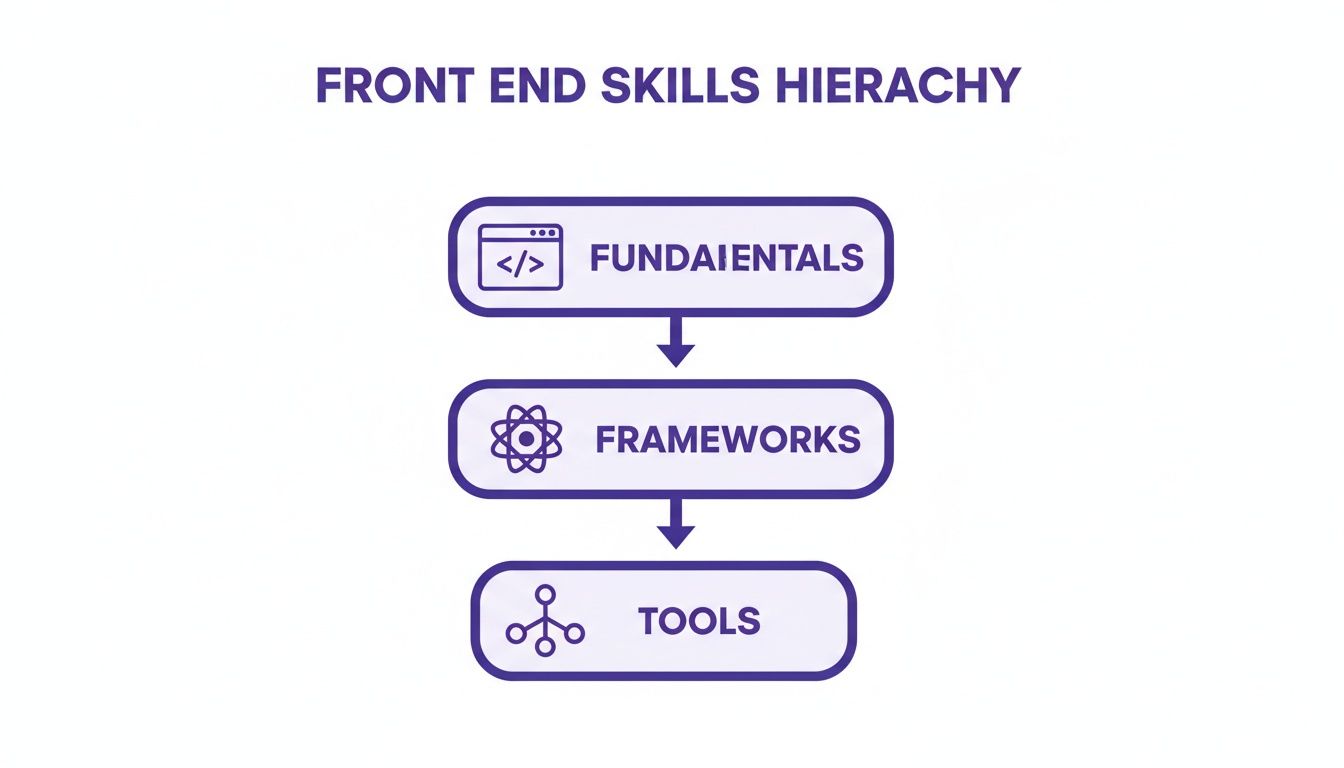
As you can see, a developer’s career is built layer by layer—from the absolute fundamentals to mastering complex frameworks and tools. Your job descriptions should reflect where a candidate is on that journey.
This template is built for folks with 0-2 years of experience. The goal here is to highlight growth and mentorship. You're looking for someone with a solid grasp of the basics, a ton of curiosity, and the drive to learn from your team. Keep the language encouraging and focused on opportunity.
Job Title: Junior Front End Developer
Location: [City, State or Remote]
Job Summary:
We’re looking for a motivated and passionate Junior Front End Developer to join our growing team. You'll work side-by-side with our senior developers and designers to bring beautiful, responsive, and user-friendly web applications to life. This is a fantastic opportunity to sharpen your skills in a collaborative environment while contributing to exciting projects.
Key Responsibilities:
Required Skills and Qualifications:
This template is for developers with 2-5 years under their belt. The conversation shifts from "what can you learn?" to "what can you do?" Candidates at this level should be comfortable with your tech stack and able to own features from concept to deployment with minimal hand-holding.
Job Title: Front End Developer
Location: [City, State or Remote]
Job Summary:
We're looking for a skilled Front End Developer to play a key role in building our user-facing applications. You’ll be responsible for developing and implementing UI components using modern JavaScript frameworks. The perfect person for this role is a self-starter who can take ownership of their work, write clean, efficient code, and collaborate effectively to deliver incredible products.
Key Responsibilities:
Required Skills and Qualifications:
Tip for Customization: Be specific! Instead of a generic line like "Develop new features," try something like, "Develop new features for our customer-facing analytics dashboard." This gives candidates a real sense of the work.
This template is for the seasoned pros with 5+ years of experience. Here, the focus is on architectural vision, mentorship, and strategic impact. A senior developer doesn’t just write excellent code; they shape technical decisions, elevate the skills of their teammates, and ensure the codebase is healthy for the long run.
Job Title: Senior Front End Developer
Location: [City, State or Remote]
Job Summary:
We’re hiring a Senior Front End Developer to lead the technical direction and implementation of our UI architecture. In this role, you’ll make high-level architectural decisions, mentor other developers, and champion front end best practices across the entire engineering team. You will be a key player in shaping our product’s future, ensuring our applications are scalable, performant, and maintainable.
Key Responsibilities:
Required Skills and Qualifications:
A great front end web developer job description gets candidates in the door, but a competitive salary is what gets them to sign on the dotted line. To land the right person, you have to understand what the market is paying. Front end developer salaries aren't a one-size-fits-all number; they're a mix of experience, location, and specific technical skills.
Think of compensation as a clear signal of how much you value the role. For a developer, that number reflects their expertise and the impact you expect them to have. When your offer aligns with industry standards, it shows you've done your research and are serious about bringing top talent on board.
As a developer gains skills and takes on more responsibility, their salary expectations naturally grow with them. A junior developer is still building their foundation, a mid-level developer is a dependable workhorse, and a senior developer is a strategic leader. Your pay scale needs to mirror that journey.
Junior Developers (0-2 years): These are your up-and-comers, focused on learning the ropes and applying their new skills. Their pay reflects their entry-level status, but it needs to be attractive enough to snag promising talent eager to grow with your company.
Mid-Level Developers (2-5 years): By this point, developers have proven they can work independently and get features out the door. Their salary should acknowledge their ability to make solid contributions to projects without needing constant hand-holding.
Senior Developers (5+ years): Seniors are force multipliers. They do more than just write code; they design systems, mentor other engineers, and help set the technical direction for the team. Their compensation needs to be significantly higher to match their deep expertise and leadership.
Where a developer lives and the specific tech they’ve mastered have a huge impact on their salary. A developer based in a tech hub like San Francisco or New York will command a much higher salary than someone in a lower-cost area, simply due to market demand and the cost of living.
Likewise, deep knowledge of a popular framework like React or specialized skills in performance optimization or web accessibility can seriously boost a developer's market value. These aren't just buzzwords; they're skills that directly lead to a better product and healthier profits.
Real-world pay can swing wildly, but front end development is consistently a well-paid career. The U.S. BLS reports a median annual wage for web developers around $95,380, but that's just an average. Junior developers often start in the $60,000–$75,000 range, mid-level developers typically land between $85,000 and $110,000, and senior engineers in expensive tech hubs can easily clear $150,000+ in total compensation. You can get a clearer picture of current trends by reviewing recent industry analysis.
A truly compelling offer is more than just a number. The best developers look at the whole picture. To compete for top talent, especially at the senior level, you need to build a holistic package.
Consider including elements like:

So, you've crafted a stellar front end web developer job description. That's half the battle. Now, it's time to build a hiring process that can actually spot top-tier talent. A great description gets people in the door, but a thoughtful interview process is what separates a good hire from a great one.
The real goal here is to move beyond the resume and get a feel for a candidate's practical skills and how they tackle problems. Can they actually build something that works? And can they explain why they built it that way? A solid process will give you those answers.
A multi-stage interview process is the way to go. It lets you evaluate different skills at each step without overwhelming the candidate or your team. Think of it as a funnel, where only the strongest potential fits move on to the next round.
A typical hiring journey might look something like this:
This progressive approach gives you a complete picture of the candidate, helping you make a much more confident decision.
The best interviews feel less like an interrogation and more like a collaborative brainstorming session. The questions you ask should be designed to uncover how a candidate thinks. If you need some inspiration, checking out a list of common web developer interview questions is a great starting point.
Try to stick with open-ended questions that can't be answered with a simple "yes" or "no."
Your interview process should be a filter for problem-solvers, not just order-takers. The best front end developers are true partners in building an amazing product. They ask smart questions, push back when needed, and often suggest a better way to get things done.
Ultimately, your hiring process says a lot about your company culture. A process that's respectful, organized, and genuinely challenging will attract high-caliber people who value that same level of professionalism. For some more modern ideas, you might find this guide to recruiting software developers helpful. By refining your approach, you’ll be in a great position to hire a developer who can truly elevate your team and your product.
Hiring for a technical role always kicks up a few questions. We've gathered some of the most common ones that pop up when you're putting together a front end web developer job description or sizing up candidates. Getting these basics straight from the start will make your whole hiring process run a lot smoother.
Think about it like building a house. The UI/UX designer is your architect. They draft the blueprints, figure out the best room layout so you don't have to walk through a bedroom to get to the kitchen (that's the UX part), and pick out the paint colors and light fixtures (the UI part). They’re all about the vision and the feel of the experience.
Then, the front end developer is the master builder who shows up with the tools. They take those exact blueprints and bring them to life, framing the walls, installing the windows, and wiring the electricity. They use code like HTML, CSS, and JavaScript to construct the tangible, interactive home that people actually live in. One designs the dream, the other builds the reality.
Honestly, while a formal computer science degree lays a great theoretical groundwork, it’s not the dealbreaker it once was for front end roles. This field moves so fast that what a developer can do often speaks louder than where they studied.
Today, hiring managers are much more interested in a strong portfolio packed with real-world projects. Demonstrable skill with modern frameworks like React or Vue and a knack for creative problem-solving will almost always win out over a purely academic background. If a candidate can show you they’ve built impressive things, that’s your proof right there.
Coding chops are just one piece of the puzzle. A truly great front end developer is also a fantastic team player, because their work sits right at the crossroads of design, engineering, and product.
Here are the soft skills that really matter:
The demand for skilled IT professionals, from AI/ML engineers to cybersecurity experts, has never been higher. Yet, the cost of a bad hire can exceed 30% of their first-year salary, not to mention the project delays and team disruption. This makes your choice of recruitment partner a critical strategic decision. A generic approach won't work; […]

In modern software development, speed and quality are non-negotiable. Continuous Integration (CI) is the bedrock practice that enables elite teams to deliver reliable software faster by automating the integration of code changes from multiple developers. Adopting robust best practices for continuous integration transforms development from a series of error-prone manual steps into a streamlined, automated, […]

It’s easy to get tangled up when comparing Agile, Kanban, and Scrum. People often treat them like three competing options, but the relationship is much simpler. Think of it this way: Agile is a philosophy—a set of guiding principles—while Scrum and Kanban are the frameworks you use to put that philosophy into practice. The core […]


