

In modern software development, technical prowess is just the entry ticket. The real differentiator between a good developer and a great one lies in their ability to collaborate, solve problems under pressure, and navigate complex team dynamics. While coding challenges test what a candidate can do, behavioural questions reveal how they do it—predicting their on-the-job […]

In modern software development, technical prowess is just the entry ticket. The real differentiator between a good developer and a great one lies in their ability to collaborate, solve problems under pressure, and navigate complex team dynamics. While coding challenges test what a candidate can do, behavioural questions reveal how they do it—predicting their on-the-job performance with far greater accuracy. A developer who can communicate effectively, handle conflict constructively, and learn from failure is an invaluable asset to any team.
This guide moves beyond generic advice to provide a comprehensive framework for the most impactful behavioural interview questions software developer candidates encounter. We dissect the top 10 questions that reveal critical soft skills, from handling production fires to mentoring junior colleagues.
For each question, you will find:
Whether you are a hiring manager aiming to build an elite engineering team or a developer preparing to land a top-tier role, this playbook will equip you to master the behavioural interview and identify true long-term value.
This classic behavioural interview question for a software developer is designed to test more than just technical skill; it evaluates a candidate's problem-solving methodology, composure under pressure, and communication abilities during a crisis. It’s a powerful tool to understand how an engineer moves from identifying a symptom to implementing a robust solution.
This question reveals how candidates diagnose complex issues, interact with stakeholders during high-stakes incidents, and deploy fixes under tight deadlines. For companies hiring remote engineers, this is crucial for identifying individuals who can operate autonomously and resolve critical problems effectively, often across different time zones.
A strong answer moves beyond simply fixing the bug. Look for a structured narrative that includes diagnosis, collaboration, resolution, and prevention.
Red Flag: A candidate who blames others, cannot articulate the root cause, or describes a purely reactive, chaotic process may struggle in a high-stakes environment. Conversely, a green flag is an engineer who takes ownership and focuses on systemic improvements.
This behavioural interview question assesses a software developer's collaboration, communication skills, and technical humility. It reveals their ability to navigate healthy debate, respect differing viewpoints, and work towards a consensus, which is vital for productive and innovative teams. It’s a key indicator of how a candidate contributes to a positive engineering culture rather than a divisive one.
This question is particularly important when hiring for integrated or distributed teams, as it uncovers a developer's capacity to articulate complex technical arguments constructively. For companies building global teams, it helps identify engineers who can bridge potential cultural and communication gaps to achieve the best technical outcome for the project.
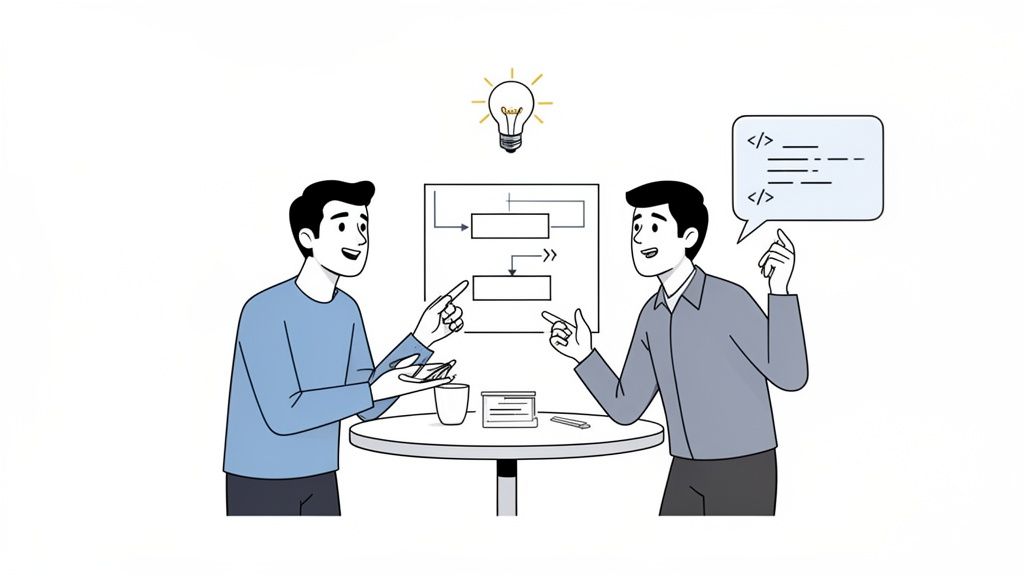
A strong answer focuses on a data-driven, respectful process, not on "winning" the argument. Look for candidates who prioritize the project's success over their personal preferences. To effectively navigate team disagreements and foster collaborative problem-solving, it's essential to master skills in improving workplace communication.
Red Flag: A candidate who dismisses their colleague's idea, uses dismissive language ("their idea was obviously wrong"), or focuses on being right is a significant concern. A green flag is an engineer who can clearly articulate both sides of the technical debate and explains the resolution process collaboratively.
This behavioural interview question assesses a software developer's learning agility, self-directed growth, and adaptability. These traits are critical in a rapidly evolving tech landscape. It reveals how candidates approach upskilling and whether they can become productive when faced with an unfamiliar technology stack, a common scenario in consulting or fast-paced product teams.
This question is essential for identifying developers who can quickly adapt to client-specific environments or contribute to projects requiring rapid prototyping. For example, a backend developer who learned Go in two weeks to build a new microservice demonstrates immense value. The same is true for a frontend engineer who self-taught React by building personal projects and pair-programming with a senior teammate before leading a feature build.
A strong answer showcases a structured, multi-stage learning process that goes beyond passive consumption of content. Look for candidates who actively apply new knowledge.
Red Flag: A candidate who says, "I watched a tutorial and now I'm an expert" lacks the depth and humility required for professional development. A green flag is an engineer who can articulate their learning journey, including challenges faced and how they overcame them.
This behavioural interview question for a software developer probes a candidate's ability to balance speed, quality, and scope under pressure. It's a pragmatic test of their project management skills, communication, and understanding of business value. The goal is to see how an engineer makes intelligent compromises to deliver a functional product without accumulating unmanageable technical debt.
This question reveals how a developer thinks about Minimum Viable Product (MVP) principles and their ability to negotiate scope with stakeholders. For startups and product teams needing to ship features quickly, it identifies engineers who are pragmatic and business-aware, capable of making smart decisions to meet aggressive timelines.
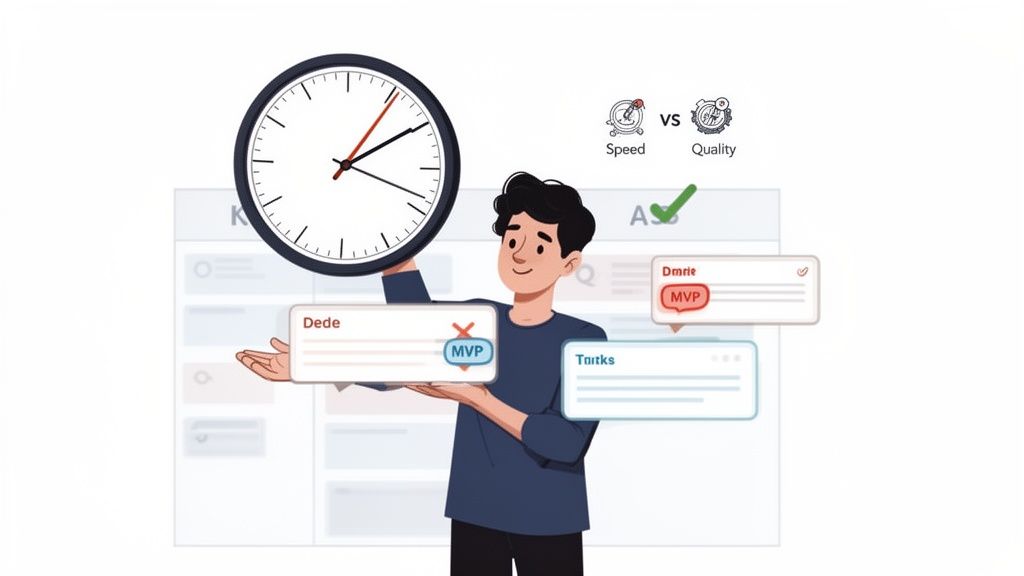
A strong answer will articulate a clear, logical process for descaling a feature while preserving its core value. Look for a narrative that demonstrates strategic thinking, not just corner-cutting.
Red Flag: A candidate who says "I just skipped testing to meet the deadline" shows a disregard for quality and stability. A green flag is an engineer who says, "I automated tests for the critical path and scheduled a follow-up task to improve UI polish and refactor the temporary solution."
This behavioural interview question for a software developer probes a candidate's ego, humility, and capacity for growth. The goal is to determine if they view critical feedback as a personal attack or a collaborative opportunity for improvement. It’s a direct window into their professionalism and teamwork capabilities.
For remote teams, where asynchronous code reviews are a primary form of collaboration, this question is especially vital. It helps identify engineers who can receive and process written feedback constructively without the benefit of in-person nuance, ensuring a positive and productive development cycle.
A strong answer demonstrates a growth mindset and a process for handling criticism, not just defensiveness. Look for a story that highlights reflection, action, and a commitment to quality.
Red Flag: A candidate who blames the reviewer, dismisses the feedback as a matter of opinion, or becomes defensive is a significant concern. Conversely, a green flag is a developer who frames the experience as a valuable learning opportunity and can articulate what they changed as a result.
This behavioural interview question for a software developer probes a candidate's communication, initiative, and ability to translate vague business needs into concrete technical specifications. It highlights whether an engineer passively waits for direction or proactively seeks clarity to prevent wasted effort and rework. This is a critical skill, especially in fast-paced or startup environments where requirements are often fluid.
The question reveals how a developer handles ambiguity and engages with non-technical stakeholders. For companies building products, it’s vital to hire engineers who can bridge the gap between a high-level vision and the detailed steps required for implementation, ensuring the final product aligns with business goals.
A strong answer demonstrates a proactive, structured approach to requirement clarification. The candidate should describe a process of inquiry, documentation, and validation, not just a single conversation.
Red Flag: An answer like, "I just started coding based on what I thought they meant," is a major warning. It indicates a reactive developer who is likely to build the wrong thing. A green flag is a candidate who takes ownership of the clarification process to ensure alignment before writing a single line of code.
This behavioural interview question for a software developer is designed to assess humility, self-awareness, and the ability to learn from past errors. It moves beyond technical success stories to explore how a candidate handles missteps. It’s a powerful way to gauge an engineer's maturity and their process for personal and professional growth.
This question reveals whether an engineer can reflect critically on their own work, take responsibility for suboptimal outcomes, and adapt their approach for the future. For companies seeking experienced developers, it helps identify individuals who have evolved through real-world experience and won't repeat costly mistakes.
A strong answer goes beyond simply admitting a mistake; it demonstrates a deep understanding of the consequences and outlines a clear learning process. Look for a specific, non-trivial technical choice with a measurable negative impact.
Red Flag: A candidate who claims to have no regrets, blames external factors ("the requirements changed"), or offers a trivial example is avoiding the question. A green flag is an engineer who can say, “I should have gathered more data before deciding,” and explains how they do that now.
This behavioural interview question assesses leadership potential, empathy, and a candidate's commitment to team growth. It shifts the focus from individual contribution to force multiplication, revealing if a developer can elevate the skills of those around them. For companies building sustainable, long-term engineering cultures, this is key to identifying future tech leads and senior mentors.
The question uncovers a candidate's teaching style, patience, and ability to tailor communication. It’s particularly insightful for remote or distributed teams, where effective asynchronous mentorship is critical for onboarding and developing junior talent successfully.
A strong answer demonstrates a deliberate, empathetic approach rather than just giving away the solution. Look for a narrative that shows the candidate invested time in understanding the junior developer’s needs and guided them toward independent problem-solving.
Red Flag: A candidate who says "I just told them the answer" or expresses frustration at the junior's pace shows a lack of mentorship aptitude. Conversely, a green flag is a candidate who explains how they helped the junior "learn how to learn" and find solutions on their own.
This behavioural interview question for a software developer probes for resilience, accountability, and the ability to learn from failure. It’s a powerful indicator of a candidate's maturity and their approach to setbacks, moving beyond technical execution to reveal their professional character. It shows how they process disappointment and whether they extract valuable lessons to carry forward.
This question is especially important for startups and fast-paced environments where pivots and project cancellations are common. It helps identify engineers who can navigate uncertainty and adapt without losing momentum or morale. It's a direct window into their sense of ownership and capacity for constructive self-reflection.
A strong answer demonstrates ownership and a focus on learning, not blame. Look for a candidate who can candidly discuss what went wrong, their specific role in it, and how the experience influenced their future work.
Red Flag: A candidate who blames others, dismisses the project's failure as "political," or cannot identify any personal takeaways may lack the maturity and accountability needed. A green flag is an engineer who openly discusses their own missteps and frames the failure as a valuable learning experience.
This behavioural interview question for a software developer evaluates professional standards, attention to detail, and commitment to craftsmanship. It reveals how candidates think about quality beyond just "making it work," showing whether it's a deliberate practice or an afterthought. This is vital for building maintainable, production-ready code.
The question uncovers a developer's philosophy on building robust software and their practical application of testing principles. For companies needing long-term system stability, it identifies engineers who integrate quality into every stage of the development lifecycle, not just at the end.
A strong answer showcases a pragmatic and balanced approach to quality, discussing different testing layers and strategic trade-offs.
Red Flag: Vague answers like "I write code and then test it" or "I rely on the QA team to find bugs" suggest a lack of ownership. Conversely, a green flag is a candidate who describes how they automated fragile tests or improved the team's overall testing culture.
| Question | Implementation complexity | Resource requirements | Expected outcomes | Ideal use cases | Key advantages |
|---|---|---|---|---|---|
| Tell me about a time you had to debug a critical production issue. What was your approach? | Medium — requires deep technical probing and follow-ups | Senior technical interviewer, 30–45 min, access to metrics/examples | Demonstrates troubleshooting, incident response, ownership | SRE, backend, on-call roles, remote support | Reveals real-world problem solving and communication under pressure |
| Describe a situation where you disagreed with a team member's technical approach. How did you handle it? | Low–Medium — behavior-focused with scenario exploration | Behavioral-aware interviewer, 20–30 min | Shows conflict resolution, persuasion, cultural adaptability | Cross-functional teams, distributed teams, collaborative environments | Predicts teamwork, EQ, and ability to reach consensus |
| Tell me about a project where you had to learn a new technology or framework quickly. How did you approach it? | Low — straightforward behavioral question with examples | Interviewer able to assess learning methods, 20–30 min | Reveals learning agility, time-to-productivity, resourcefulness | Startups, multi-stack roles, emerging tech projects | Indicates adaptability and ability to onboard fast |
| Describe a time when you had to deliver a feature with tight deadline constraints. How did you prioritize and what tradeoffs did you make? | Medium — needs probing on tradeoffs and metrics | Technical interviewer, 30–40 min, may request concrete outcomes | Shows prioritization, pragmatic tradeoffs, stakeholder management | MVP development, agencies, sprint-driven teams | Demonstrates business awareness and ability to ship under pressure |
| Tell me about a time you received critical feedback or code review comments. How did you respond? | Low — behavioral, focused on reaction and follow-up | Behavioral or tech interviewer familiar with code review culture | Assesses humility, coachability, collaboration in reviews | Remote teams, code-review-driven organizations | Predicts team fit and continuous improvement mindset |
| Describe a situation where you had to work with unclear or ambiguous requirements. How did you clarify them? | Medium — probes communication and documentation practices | Interviewer skilled in product/requirements evaluation, 20–30 min | Reveals proactive clarification, stakeholder management, spec writing | Non-technical founders, product teams, startups | Reduces rework and improves alignment with stakeholders |
| Tell me about a technical decision you made that you later regretted. What did you learn? | Medium — requires honest reflection and technical context | Experienced interviewer to evaluate tradeoffs and learning | Shows self-awareness, learning from mistakes, improved judgment | Senior, architecture, mentorship and advisory roles | Indicates maturity and ability to avoid repeat mistakes |
| Describe a time you mentored or helped a junior developer succeed. What was your approach? | Low–Medium — behavior plus outcome-focused | Interviewer assessing leadership, 20–30 min, examples of impact | Demonstrates coaching style, teaching effectiveness, team uplift | Tech lead roles, teams scaling hiring, org development | Identifies multiplier effects and leadership readiness |
| Tell me about a project that failed or was cancelled. What was your role and what did you learn? | Medium–High — sensitive; needs careful probing for ownership | Skilled behavioral interviewer, 30–45 min, seeks concrete lessons | Reveals resilience, accountability, ability to extract lessons | Startups, high-uncertainty environments, rapid iteration teams | Shows ability to learn from failure and adapt processes |
| Describe your approach to code quality and testing. Give me a specific example of how you ensured quality on a recent project. | Medium–High — may require technical validation and artifacts | Technical interviewer, 30–60 min, may review code/tests and CI | Assesses testing discipline, maintainability, CI/CD practices | Enterprise, regulated systems, long-lived products | Predicts production stability, reduced technical debt and better maintainability |
Moving beyond the traditional technical quiz is no longer an option; it's a strategic imperative. The detailed exploration of these behavioural interview questions for software developer roles demonstrates a crucial shift in hiring philosophy. It's about moving from "Can you code?" to "How do you think, collaborate, and grow as an engineer?" By meticulously dissecting past behaviour, you gain a far more reliable predictor of future performance than any abstract puzzle or algorithmic challenge can provide.
The true power of this approach lies in its ability to uncover the underlying traits that define an exceptional developer. You’re not just assessing their ability to solve a bug; you’re evaluating their resilience under pressure, their systematic problem-solving process, and their accountability. You’re not just asking about a disagreement; you’re probing for their capacity for constructive conflict, their humility, and their commitment to team success over individual ego. These are the qualities that transform a group of coders into a cohesive, high-performing engineering team.
To truly embed these insights into your hiring process, consider these immediate, actionable steps:
Mastering the art of the behavioural interview is an investment that pays dividends in team stability, innovation, and long-term success. It allows you to build a team that is not only technically proficient but also resilient, collaborative, and adaptable to the inevitable challenges of software development. By focusing on how a candidate achieves results, you build a foundation for a culture of excellence and continuous improvement.
For organizations looking to accelerate this crucial process, you don't have to build this capability from scratch. HireDevelopers.com provides direct access to the top 1% of globally-vetted software developers who have already been rigorously assessed for these critical soft skills alongside their technical expertise. Our multi-stage vetting includes live soft-skills evaluations, ensuring every developer you meet can communicate, problem-solve, and contribute effectively from day one. Book a consultation to receive a curated shortlist of qualified candidates in just 24 hours and build the engineering team your vision deserves.
Cloud computing stopped being a hosting decision a while ago. It's now a board-level question about speed, margin, resilience, and whether your team can ship AI-enabled products without turning infrastructure into a bottleneck. The striking part is the scale. Global public cloud spending is projected to exceed $830 billion in 2026, with the overall market […]

A hiring manager has 30 minutes, a resume full of Spring buzzwords, and one job opening that cannot afford a weak hire. A candidate has the same 30 minutes to prove they understand more than annotations and starter-project patterns. This context defines Spring MVC interviews. Strong interviews usually turn on practical judgment. Can the candidate […]

Payroll usually breaks before founders admit it has broken. At first, the system looks manageable. One spreadsheet tracks hours. Another tracks bonuses. Someone exports a bank file, someone else checks tax dates, and payroll goes out. Then headcount creeps up, one hire moves to another state, a contractor becomes an employee, and the process stops […]


