

In modern software development, technical skill is just the starting point. The real challenge for engineering managers and CTOs is identifying developers who can collaborate, problem-solve under pressure, and drive projects to completion in a distributed team environment. A well-structured interview process that prioritizes behavioral interview questions for software developer candidates uncovers these crucial traits, […]

In modern software development, technical skill is just the starting point. The real challenge for engineering managers and CTOs is identifying developers who can collaborate, problem-solve under pressure, and drive projects to completion in a distributed team environment. A well-structured interview process that prioritizes behavioral interview questions for software developer candidates uncovers these crucial traits, moving beyond what's on a résumé to reveal how a candidate actually performs.
Technical assessments can verify a candidate’s ability to write clean code, but they can't predict how that person will handle a production outage, navigate a technical disagreement with a colleague, or adapt when project requirements suddenly shift. These are the moments that define a project's success and a team's health. By asking targeted, experience-based questions, you gain insight into a candidate's communication style, ownership mentality, and resilience-attributes that are notoriously difficult to teach but are essential for high-performing teams.
This guide provides a curated collection of the most impactful behavioral questions designed specifically for software development roles, from junior to senior levels. For each question, we provide a detailed breakdown including:
Use this framework to distinguish between a good coder and a great teammate, ensuring your next hire is a true asset. For a deeper dive into crafting effective interview strategies, explore this practical guide on Software Engineer Interview Questions. Let's dive into the questions that will help you build a world-class engineering team.
This question is a cornerstone of behavioral interview questions for software developers because it moves beyond theoretical knowledge. It directly assesses a candidate's real-world problem-solving skills under pressure, a critical competency for any high-performing engineering team.
The goal is to understand a candidate's debugging methodology, their ability to remain calm and systematic during a crisis, and how they communicate with stakeholders when the stakes are high.
A strong answer reveals more than just technical ability. It demonstrates a structured approach to troubleshooting, strong ownership, and effective collaboration.
Encourage candidates to frame their answers using the STAR method (Situation, Task, Action, Result). This provides a clear, structured narrative that is easy to follow and evaluate.
Situation: "Our e-commerce platform's checkout service was experiencing a 50% failure rate during a flash sale."
Task: "I was the on-call engineer tasked with identifying the root cause and restoring service immediately to minimize revenue loss."
Action: "I first checked our monitoring dashboards, which showed a spike in database latency. I then analyzed the query logs and found a specific query that was timing out. To mitigate the immediate impact, we rolled back a recent change that introduced that query. Afterward, I collaborated with a senior engineer to optimize the query and add better indexing."
Result: "The rollback immediately restored checkout functionality, reducing the failure rate to less than 1%. The subsequent optimization prevented the issue from recurring, and we implemented new alerts for query performance."
This example clearly demonstrates a methodical approach, immediate mitigation, and long-term prevention, which are all hallmarks of a strong senior developer.
This is a key behavioral interview question for software developers because it probes a candidate's conflict resolution skills, communication style, and technical advocacy. It reveals their ability to navigate professional disagreements constructively, a vital skill for collaborative and innovative environments.
The interviewer's goal is to see if the candidate prioritizes the project's success over their own ego. It assesses their emotional intelligence and whether they can support a decision they initially opposed, which is critical for team cohesion.
A strong answer demonstrates maturity, respect for others' opinions, and a data-driven approach to persuasion. It's less about being "right" and more about how the candidate contributes to finding the best collective solution.
Encourage candidates to use the STAR method to structure their response. This framework helps them provide a complete and compelling story that is easy for interviewers to evaluate.
Situation: "My team lead proposed using a new, less-established JavaScript framework for a critical client-facing project, citing its modern features. I was concerned about its small community support and potential long-term maintenance risks."
Task: "My task was to voice my concerns constructively and persuade the team to consider a more stable, well-supported alternative like React or Vue, without undermining my lead's authority."
Action: "I prepared a brief document comparing the proposed framework with React. It included data on community size, available libraries, long-term support roadmaps, and hiring pool availability. During our next planning meeting, I presented my findings, focusing on project risk rather than personal preference."
Result: "After reviewing the data, the team, including my lead, agreed that the risks of the new framework were too high for this specific project. We decided to use React, and my lead thanked me for the thorough research. The project was delivered on time with a stable and maintainable codebase."
This example showcases a mature, data-driven approach to resolving a technical disagreement, which is a hallmark of a collaborative and effective software developer.
This question evaluates adaptability, self-directed learning, and resourcefulness. These are critical traits for software developers in the fast-moving tech industry. It reveals whether a candidate can thrive in dynamic environments where requirements change and new tools emerge frequently.
The goal is to understand a candidate's learning process. You want to see if they can move from theoretical knowledge to practical application efficiently and independently, a key skill for any developer joining a new project or team.
A strong answer demonstrates a structured and proactive approach to acquiring new skills, not just passively consuming information. It shows they are resourceful and focused on delivering value.
Encourage candidates to frame their answers using the STAR method (Situation, Task, Action, Result). This format helps them articulate their experience clearly and allows you to evaluate their learning aptitude effectively.
Situation: "My team was tasked with building a new microservice, and leadership decided we should use Go for its performance benefits, even though none of us had prior production experience with it."
Task: "I needed to become proficient enough in Go within two weeks to build the initial API endpoints and set up the project structure for the rest of the team."
Action: "I started with the official 'A Tour of Go' to understand the syntax and core concepts. Then, I built a small, personal CRUD API project over a weekend to apply what I learned. For the actual task, I focused on learning just the necessary libraries for web servers and database connections, and I leaned on a senior engineer from another team for a code review of my initial structure."
Result: "I successfully delivered the foundational API service on time. My proof-of-concept and structured approach helped onboard the rest of my team more quickly, and the service has since become a core part of our infrastructure."
This example showcases a balanced approach of foundational learning, hands-on practice, and strategic collaboration, making it a powerful answer to this behavioral interview question for software developers.
This is a key behavioral interview question for software developers because it probes their ability to navigate ambiguity. In fast-paced environments like startups or MVP development, requirements are often fluid or ill-defined. This question reveals if a candidate is proactive, resourceful, and capable of driving projects forward without perfect information.
For non-technical founders or product managers, a developer who excels at clarifying ambiguity is invaluable. They reduce wasted cycles, prevent costly rework, and ensure the final product aligns with the business vision, even when that vision is not perfectly articulated.

A strong answer demonstrates a proactive, rather than passive, approach to ambiguity. It shows a commitment to building the right thing, not just building the thing right now.
Encourage candidates to use the STAR method to structure their response. This helps them provide a concrete, compelling story that highlights their skills in handling unclear project briefs.
Situation: "A product manager asked me to build a new 'user export' feature, but the requirements were just a one-line ticket: 'Allow admins to download a list of their users'."
Task: "My task was to deliver this feature, but first, I needed to define what it actually meant. The scope was completely open-ended."
Action: "I created a short document outlining key questions: What file format (CSV, JSON)? What data fields should be included? Should this be an asynchronous process for large datasets? I scheduled a 30-minute meeting with the PM and a lead engineer to walk through my questions. Based on that conversation, I built a simple MVP that only exported user emails as a CSV."
Result: "This approach allowed us to ship a functional feature in two days. The PM was thrilled because it met the immediate need, and my documented questions became the backlog for future enhancements. We avoided over-engineering a complex solution based on guesswork."
This example showcases a developer who takes ownership, manages ambiguity through structured communication, and focuses on delivering business value efficiently.
This behavioral interview question for software developers probes a candidate's technical judgment, pragmatism, and approach to risk. It’s crucial because nearly every developer will encounter and need to improve existing code. How they navigate this challenge separates good engineers from great ones.
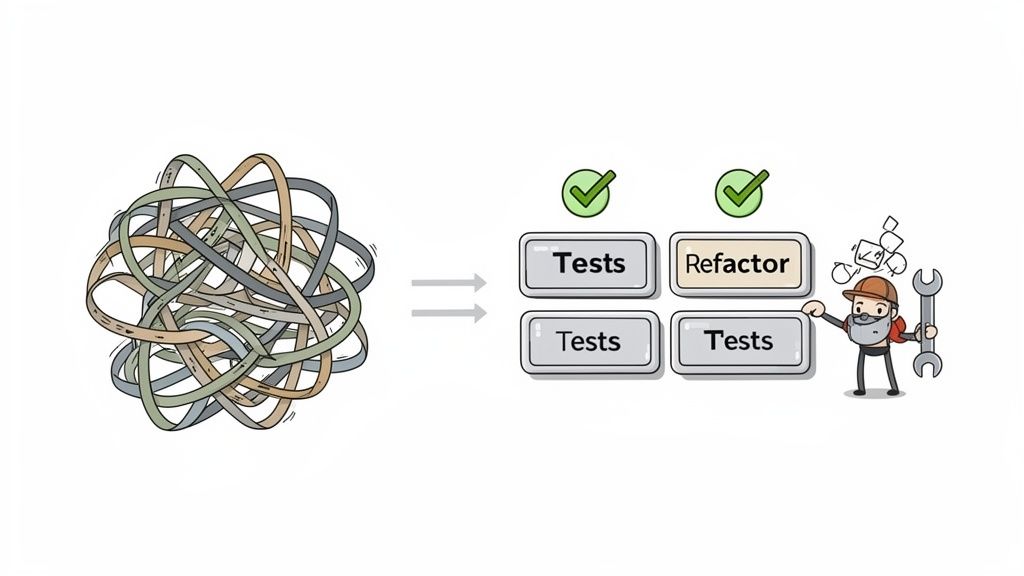
The goal is to see if a candidate can balance technical excellence with business needs. It reveals their strategy for managing technical debt, their ability to make incremental, safe improvements, and their communication skills in advocating for necessary changes. Understanding what technical debt is and how to manage it is a key competency.
A strong answer goes beyond just rewriting code. It demonstrates a strategic, measured approach that considers the broader impact on the system and the business.
Encourage candidates to use the STAR method to provide a clear, structured narrative that highlights their strategic thinking and technical execution.
Situation: "A critical microservice responsible for user authentication was written in a deprecated framework, had no test coverage, and was becoming difficult and risky to update."
Task: "My task was to modernize this service by migrating it to a current framework and establishing a test suite, without causing any downtime for users."
Action: "First, I wrote a comprehensive suite of integration tests against the existing service to create a safety net. Then, I incrementally replaced modules, using feature flags to route a small percentage of internal traffic to the new code paths. I monitored logs and performance metrics closely with each step."
Result: "After two months of incremental work, we fully migrated the service with zero production incidents. The new service had 90% test coverage, deployment times were cut in half, and the number of post-deployment bugs dropped by 75% over the next quarter."
This example showcases a safe, incremental strategy, a focus on testing, and a clear connection between the technical work and positive business outcomes.
This is one of the most insightful behavioral interview questions for software developers because failure is an inevitable part of engineering. The question isn't about the failure itself; it's a test of resilience, accountability, and the candidate's ability to learn and adapt.
An engineer who can't handle setbacks gracefully can become a bottleneck, whereas one who embraces failure as a learning opportunity contributes to a culture of continuous improvement and psychological safety. This is especially crucial for distributed teams where transparent communication about what went wrong is vital.
A strong answer demonstrates maturity, ownership, and a growth mindset. It's less about the technical mistake and more about the recovery and learning process.
Encourage candidates to use the STAR method to structure their story about a time they encountered a significant setback.
Situation: "I was tasked with implementing a new caching layer to improve API response times for our main dashboard. My initial solution used an in-memory cache on each application server."
Task: "The goal was to reduce database load and cut p95 latency by 50%. However, after deploying to a staging environment, we noticed inconsistencies in the data displayed to users."
Action: "I realized my approach didn't account for data synchronization across servers. When a write occurred on one server, the caches on other servers became stale. I immediately communicated the issue to my team lead, explained my flawed assumption, and proposed a new solution using a centralized Redis cache. I then wrote the new implementation, including robust integration tests for cache invalidation."
Result: "The revised solution not only achieved the original latency goals but also ensured data consistency. As a result of this failure, I documented a new best-practice guide for caching strategies in our team's playbook to help others avoid the same pitfall."
This example showcases humility, clear communication, and a proactive approach to turning a personal failure into a team-wide improvement.
This question is a crucial behavioral interview question for software developer roles because it probes a candidate's pragmatism and business acumen. It separates engineers who can only see technical perfection from those who understand that software development serves business objectives.
The goal is to assess a candidate's ability to make intelligent trade-offs, communicate the implications of those decisions, and prioritize shipping a product that delivers value, even if it's not technically flawless.
A strong answer demonstrates maturity and an understanding that engineering is a means to an end. It shows the candidate can align their technical decisions with strategic business needs, a vital skill in fast-paced environments.
Encourage candidates to frame their answers using the STAR method (Situation, Task, Action, Result). This provides a clear, structured narrative that is easy to follow and evaluate.
Situation: "We were building a new analytics dashboard for a key enterprise client, and the hard deadline was just two weeks away, mandated by their annual conference."
Task: "My task was to implement the data visualization component. The ideal solution involved a complex, custom-built library for maximum performance, but that would have taken at least a month."
Action: "I proposed using a well-documented, third-party charting library as a temporary solution. I communicated to my product manager that this would get us to the deadline but might have minor performance issues with very large datasets. I documented the chosen library and created a follow-up ticket to build our custom solution in the next quarter."
Result: "We successfully launched the dashboard in time for the client's conference, which was a major win for the business. The performance was adequate for the initial launch, and we later paid down the technical debt by replacing the library as planned, with no disruption to the client."
This example showcases a pragmatic compromise, clear communication of trade-offs, and a responsible plan for future improvement, which are all signs of a senior-level, business-minded developer.
This question probes beyond individual technical skill, assessing a candidate's potential for leadership, empathy, and their ability to elevate the entire team. It’s a key behavioral interview question for a software developer because it reveals whether they are a "knowledge multiplier" or a "knowledge silo."
The goal is to understand how a candidate fosters growth in others, their communication style when explaining complex topics, and their commitment to building a collaborative and supportive engineering culture.
A strong answer highlights patience, a structured teaching method, and genuine investment in a teammate's success. It shows the candidate can adapt their communication style and effectively build others' confidence.
Encourage candidates to use the STAR method to frame their response, providing a clear narrative of their mentorship experience. This helps evaluate their approach and impact.
Situation: "A new junior developer on our team was struggling with our code review process. Their pull requests were often large, lacked context, and they were having trouble understanding feedback."
Task: "My team lead asked me to mentor them to improve their code review etiquette and help them integrate more smoothly with the team's workflow."
Action: "I scheduled a few pair programming sessions. First, we reviewed one of my recent PRs together so I could explain my thought process. Then, we worked on one of their tasks, focusing on creating small, atomic commits. I introduced them to a PR template to provide better context and taught them how to proactively ask for specific feedback."
Result: "Within a few weeks, their pull requests became much clearer and easier to review. They started receiving more constructive feedback, and their confidence grew significantly. This not only improved their own productivity but also reduced the review cycle time for the entire team."
This example showcases a proactive, structured, and empathetic approach to mentorship, demonstrating qualities essential for senior roles and healthy team dynamics.
This behavioral interview question for software developers probes emotional intelligence, humility, and a growth mindset. Technical skills are vital, but a developer's ability to receive and act on criticism is what enables personal and team growth. It reveals if a candidate is defensive or a genuine learner.
The goal is to assess how a candidate processes constructive criticism. A developer who can separate the feedback from their ego is more likely to improve, collaborate effectively, and contribute to a healthy engineering culture.
A strong answer demonstrates maturity and a proactive approach to self-improvement. It shows that the candidate views feedback not as a personal attack but as a valuable tool for growth.
Encourage candidates to use the STAR method to structure their response. This framework helps them provide a clear, compelling narrative that highlights their professional maturity.
Situation: "In a previous role, I submitted a large pull request for a new feature. A senior engineer left a series of very direct comments, pointing out that my approach was inefficient and not scalable."
Task: "My task was to process this critical feedback without getting defensive and to implement the necessary changes to meet the team's quality standards."
Action: "I first took a moment to read through all the comments carefully. I then scheduled a brief call with the senior engineer to ensure I fully understood their concerns. Based on their guidance, I refactored my solution, breaking it down into smaller, more performant functions and improving the database query."
Result: "The revised pull request was approved with positive comments. This experience fundamentally changed how I approach complex features, and I now actively seek early feedback from senior developers. The relationship with that engineer became one of mentorship."
This example showcases a candidate who is resilient, proactive, and truly committed to learning, which are key indicators of a successful long-term team member.
This is a crucial behavioral interview question for a software developer because it directly measures their commitment to quality and their understanding of the software development lifecycle. It separates candidates who see testing as a checkbox from those who view it as an integral part of building robust, reliable software.
The goal is to evaluate a candidate's technical rigor, their proactive mindset in preventing bugs, and their ability to articulate the value of a strong testing culture. A developer with a disciplined testing approach is a long-term asset who reduces maintenance costs and protects user trust.
A compelling answer demonstrates a nuanced understanding of different testing strategies and connects them to real-world business impact. It shows a developer who thinks about quality from the start, not as an afterthought.
Encourage candidates to use the STAR method to structure their answer. This helps them tell a coherent story that highlights their skills and the tangible outcomes of their work.
Situation: "We were developing a new multi-threaded data processing service that consumed messages from a queue and updated user records in a database."
Task: "My responsibility was to ensure the service was free of race conditions and could handle concurrent updates correctly without causing data corruption, a major business risk."
Action: "Beyond standard unit tests for the business logic, I wrote a specific set of integration tests that simulated high-concurrency scenarios. I used a testing library to spin up multiple threads that would attempt to update the same user record simultaneously. The initial test runs immediately failed, revealing a critical race condition where one update would overwrite another."
Result: "By catching this in the integration testing phase, we were able to implement a pessimistic locking strategy before the code ever reached production. This prevented what would have been silent, hard-to-debug data corruption for our users. We also added this scenario to our CI pipeline to prevent future regressions."
This response shows a deep understanding of a complex technical problem and demonstrates the high value of a thoughtful testing strategy. For more insights on this topic, explore this guide on quality assurance in software development.
| Question | Implementation complexity | Resource requirements | Expected outcomes | Ideal use cases | Key advantages |
|---|---|---|---|---|---|
| Tell me about a time you had to debug a critical production issue. What was your approach? | High — complex technical scenario, often multi-component | Moderate — time for probing, may need log/technical validation | Reveals troubleshooting depth, incident handling, calm under pressure | On-call roles, backend services, high-availability systems | Predicts real-world performance; shows ownership and prevention mindset |
| Describe a situation where you disagreed with a team member or manager about a technical decision. How did you handle it? | Low–Moderate — behavioral with trade-off discussion | Low — conversational, follow-up questions sufficient | Assesses EQ, persuasion, documentation and compromise ability | Collaborative teams, engineering leads, distributed teams | Indicates conflict resolution, ability to influence without authority |
| Tell me about a project where you had to learn a new technology quickly. How did you approach the learning curve? | Low — focused on learning process and examples | Low — ask for resources, timelines, outcomes | Measures adaptability, self-directed learning speed, resourcefulness | Fast-moving startups, multi-stack projects, roles requiring ramp-up | Predicts rapid onboarding and flexibility across tech stacks |
| Describe a time when you had to work with unclear or incomplete requirements. How did you handle it? | Low–Moderate — evaluates clarification and documentation habits | Low — needs examples of questions/artifacts produced | Shows proactivity, assumption management, stakeholder communication | MVPs, non-technical founders, early-stage product work | Reduces rework and scope creep; improves delivery predictability |
| Tell me about a time you had to refactor or improve legacy code. What was your strategy? | Moderate–High — technical judgment and incremental planning | Moderate — may require metrics, code examples, test strategy | Assesses risk management, testing-first approach, prioritization | Teams inheriting codebases, long-lived products, maintenance projects | Demonstrates safe incremental improvements and maintainability gains |
| Describe a situation where your initial solution didn't work. How did you handle failure? | Low–Moderate — behavioral + root-cause analysis | Low — probe for ownership and corrective actions | Reveals accountability, resilience, learning from mistakes | Any role where reliability and iteration matter | Predicts professionalism, humility, and continuous improvement |
| Tell me about a time you had to balance technical excellence with business/time constraints. How did you decide? | Moderate — requires articulation of trade-offs and follow-up plan | Low–Moderate — ask for documented trade-offs and debt repayment plan | Measures pragmatism, business awareness, prioritization skills | Startups, MVPs, tight deadlines, client-driven timelines | Aligns engineering choices with business goals; speeds time-to-market |
| Describe a time you had to mentor or help a junior developer. What was your approach? | Low — behavioral with examples of teaching methods | Low — probe for measurable mentee outcomes | Assesses teaching ability, patience, delegation, coaching style | Senior hires, rapid scaling teams, knowledge-transfer needs | Multiplies team capability, reduces onboarding time, improves retention |
| Tell me about a time you received critical feedback about your work. How did you respond? | Low — focuses on emotional maturity and follow-up actions | Low — conversational; ask for concrete changes made | Reveals coachability, humility, specific improvement steps | Any collaborative or remote team with asynchronous reviews | Predicts growth potential and smoother team interactions |
| Describe your approach to testing. Tell me about a time when testing caught a critical issue. | Moderate — technical depth across test types required | Moderate — may need examples, tools, and test artifacts | Shows testing rigor, edge-case thinking, and risk mitigation | Mission-critical systems, payments, compliance-heavy projects | Directly correlates with reliability, fewer production incidents, and lower support costs |
Mastering the art of the behavioral interview is a transformative step in building a world-class engineering team. The list of behavioral interview questions for software developer candidates provided in this guide moves beyond rote technical quizzes, allowing you to uncover the essential soft skills that define an exceptional engineer: resilience, collaboration, ownership, and a growth mindset. By integrating these targeted questions into your process, you shift the focus from what a candidate knows to how they think and how they behave under pressure. This insight is the difference between hiring a good coder and hiring a future technical leader.
The true value of this approach emerges when you consistently apply it. You begin to see patterns in how top performers describe their problem-solving processes, handle interpersonal conflict, and take ownership of their mistakes. This creates a powerful, data-driven feedback loop that refines your hiring rubric over time, making your team more effective and predictable in identifying A-plus talent.
Having a great set of questions is the first critical step, but a successful hiring strategy requires a robust and efficient pipeline. The most insightful interview process in the world is ineffective if you don't have a steady stream of high-quality candidates to evaluate. This is where many organizations, from startups to enterprises, face their biggest bottleneck. Traditional sourcing is often slow, costly, and yields a high volume of mismatched applicants.
To truly streamline your hiring process and ensure you're not missing out on top talent, it's crucial to understand the entire recruitment pipeline, including how candidates are initially screened. For more insights into common pitfalls, explore topics like why resumes often fail ATS, which can inadvertently filter out qualified individuals before they ever reach an interview.
Asking the right behavioral questions is only half the battle. The other half is sourcing enough high-quality candidates to make the process worthwhile. Traditional hiring funnels are slow, expensive, and often yield inconsistent results. That's why leading companies are turning to pre-vetted talent platforms like HireDevelopers.com. We handle the rigorous multi-stage vetting, from AI résumé screening to deep technical and soft-skill assessments, so you only interview the top 1% of global software engineers.
Here’s how this approach revolutionizes your hiring:
By combining a sophisticated behavioral interview framework with a pre-vetted talent pipeline, you don't just fill roles faster; you build a more cohesive, resilient, and innovative engineering organization. You reduce your time-to-hire from months to days, giving you a critical competitive advantage in the race for top technical talent. The ultimate goal isn't just to hire a developer; it's to build the team that will build the future of your company.
Finding the right app developer isn't just about posting a job ad and hoping for the best. It requires a clear, repeatable framework. This process starts by defining your project scope, then choosing an engagement model that fits your needs—like freelance or full-time—before sourcing and rigorously vetting your candidates. Following a structured approach like this […]

So, you need a web developer, and you need one yesterday. The traditional hiring route feels like a non-starter—it’s slow, expensive, and often a drain on resources you don't have. There’s a much better way. By tapping into the global freelance market, you can find specialized talent almost immediately, letting you build products faster and […]

For a startup, outsourcing software development isn’t just a nice-to-have; it’s a competitive edge. It’s how you, as a founder, can build a world-class product with top-tier talent, even when you're just starting out. This isn't about cutting corners on cost. It's a strategic move to build faster, smarter, and compete with the big players […]


