

Hiring software developers is so much more than just posting a job and crossing your fingers. If you want to build a truly exceptional team, you need a smart, strategic approach. This means getting crystal clear on the business impact of the role, casting a wide net across global talent channels, and, most importantly, creating […]

Hiring software developers is so much more than just posting a job and crossing your fingers. If you want to build a truly exceptional team, you need a smart, strategic approach. This means getting crystal clear on the business impact of the role, casting a wide net across global talent channels, and, most importantly, creating a respectful vetting process that actually evaluates real-world skills.

Let's be honest—finding and landing great software developers is incredibly tough right now. The old playbook of posting a job description and waiting for applications to roll in simply doesn't work anymore. Why? Because the best engineers are almost always passive candidates; they’re already employed, valued, and not actively looking for a new gig.
Sticking to outdated methods leads to frustratingly long hiring cycles, ballooning recruitment costs, and, worst of all, missed opportunities as your most important projects get delayed.
The heart of the issue is a massive global talent shortage. Demand for skilled engineers has completely outpaced supply. Evans Data Corporation counted 26.9 million developers worldwide in 2023, a number projected to hit 28.7 million by 2024. But even with that growth, demand is accelerating even faster. The US Bureau of Labor Statistics, for instance, projects a staggering 24% growth in developer jobs over the next decade. For a deeper dive, you can find more insights about the global developer population here.
The traditional hiring funnel is fundamentally broken for tech roles. It was built for an era when employers held all the power. Today, the tables have turned. Elite developers are in the driver's seat, and they have zero patience for slow, bureaucratic, or impersonal hiring processes.
Here’s exactly where the old model falls apart:
To put these challenges into perspective, let's compare the old way of doing things with a more modern, global approach.
| Hiring Challenge | Traditional Approach | Global Platform Solution (e.g., HireDevelopers.com) |
|---|---|---|
| Limited Local Talent | Posting on local job boards, hoping for the best. | Access to a pre-vetted global network of top-tier developers. |
| Long Hiring Cycles | A multi-month process involving recruiters, multiple interviews, and slow feedback loops. | Rapid matching with qualified candidates, often within days. |
| High Recruitment Costs | Hefty agency fees (15-25% of salary) and significant internal time spent sourcing and screening. | A more cost-effective model, often subscription or flat-fee based, with vetting already handled. |
| Skill Verification | Relying on resumes and standard interview questions, which are poor predictors of on-the-job performance. | Rigorous, multi-stage vetting, including technical assessments and live coding challenges. |
| Candidate Experience | Often slow, impersonal, and frustrating for the candidate. | A smooth, professional, and transparent process that respects the candidate's time. |
The contrast is pretty stark. Platforms designed for a global, remote-first world aren't just a minor improvement; they're a complete overhaul of how to build a high-performing team.
The most significant shift is realizing that you are not just buying a skill; you are investing in a problem-solver. The best hiring processes are designed to identify and attract individuals who are motivated by your company's unique challenges, not just a list of technical requirements.
This isn’t just an introduction; it’s a playbook designed to give you a serious competitive edge. By embracing a global talent pool and working with modern hiring platforms, you can build a world-class team faster and more effectively than your competitors who are stuck in the past.

Before you even think about writing a job description, you need a clear blueprint of who you're actually looking for. A vague wish list like "we need a Python developer" is a one-way ticket to a long, frustrating search that likely ends with a bad hire. The real first step is to stop thinking about a list of skills and start defining the business problems this person is coming on board to solve.
I like to think of it as creating a detailed “developer persona.” This goes way beyond just technical skills. It's about truly understanding how this individual will contribute to your team, your product, and your company's culture. Getting this foundation right is what separates a good hire from a great one.
The gap between a successful hire and a costly mistake is almost always in the details. You have to translate a fuzzy business need into a concrete role with specific responsibilities. This means taking a hard look at your current challenges and where you're headed.
Let’s look at two very different scenarios:
Scenario A: The High-Traffic SaaS Platform
Your company's SaaS product is growing fast, but downtime is becoming a real headache. You don't just need "a DevOps engineer." You need an engineer who can build a scalable, resilient infrastructure on AWS, automate deployment pipelines with Terraform, and cut latency by 15% in their first quarter. See the difference?
Scenario B: The New Mobile App
You’re about to launch a new consumer app and need a killer user experience to make a splash. You don't just need a "front-end developer." You need someone who lives and breathes React Native, can work hand-in-glove with UX designers to implement pixel-perfect interfaces, and has deep experience with state management libraries like Redux to create a buttery-smooth user flow.
When you frame the role around tangible outcomes, you instantly start attracting people who are genuinely excited by those specific challenges.
Once you know the why, you can start listing the what. I find it helpful to break down the required competencies into a few clear categories. This not only clarifies the role for you but also gives you a solid framework for your interview process down the road.
Technical Expertise (Hard Skills)
This is where you need to be precise. Instead of saying they "know JavaScript," specify the exact frameworks, libraries, and tools that are critical for the job.
Collaborative Abilities (Soft Skills)
Technical skills might get a developer through the door, but it’s the soft skills that determine their long-term success and impact.
Here’s something I’ve learned over the years: you are hiring a whole person, not just a walking tech stack. A candidate with 80% of the technical skills but 100% of the right collaborative spirit is almost always a better long-term bet than the reverse.
The final piece of your blueprint is defining what success actually looks like, right from the start. This makes the role real for candidates and sets clear expectations from day one. A simple 30-60-90 day plan is a fantastic tool for this.
First 30 Days: The focus should be on getting up to speed. Success could be as simple as getting their dev environment set up, pushing their first small code commit, and having a solid grasp of the core architecture.
First 60 Days: Time to start contributing. A great goal is for them to take full ownership of a small-to-medium-sized feature ticket, from initial development all the way through to deployment.
First 90 Days: This is where you want to see autonomy and impact. By now, they should be a fully integrated team member, contributing independently and actively participating in planning meetings and code reviews.
Putting in this strategic groundwork transforms your hiring from a reactive chore into a proactive plan for building a truly exceptional engineering team.
Once you've nailed down the blueprint for your ideal developer, the real hunt begins. Let's be honest: the best software engineers aren't just scrolling through job boards. They're already heads-down, solving complex problems in their current roles. To get their attention, you have to go where they are and show them an opportunity that’s too compelling to ignore.
This means you need a proactive, multi-channel sourcing strategy. Just posting on a single job site is like fishing in a small pond—you might get a bite, but you're missing out on a vast ocean of global talent.
Job boards can sometimes work, but they often bury your hiring team in a mountain of applications from underqualified candidates. It’s a lot of noise. The most effective strategies mix active, targeted outreach with tapping into curated networks where top-tier talent actually spends their time.
Here’s where to focus your energy for the best results:
The current market really drives this point home. The software engineering field is bouncing back strong, with over half of all open roles now targeting senior-level engineers. With a projected 17% growth from 2023-2033, which translates to nearly 327,900 new jobs, the competition is only getting fiercer. You can dive deeper into the competitive software engineer job market on Underdog.io.
To help you decide where to invest your time and budget, let's break down the pros and cons of the main sourcing channels.
Choosing the right channel depends on your urgency, budget, and how critical quality is for the role. No single channel is perfect for every situation.
| Sourcing Channel | Typical Speed | Average Cost | Candidate Quality | Best For |
|---|---|---|---|---|
| Traditional Job Boards | Slow | Low | Low to Mixed | High-volume roles where you can filter heavily. |
| Niche Communities | Moderate | Low | High | Finding specialists with proven, public work. |
| Direct Outreach | Moderate | Mid (Time) | Very High | Targeting specific, high-impact individuals. |
| Curated Platforms | Fast | Mid to High | High (Vetted) | Urgent hires needing verified skills quickly. |
| Referrals | Fast | Low (Bonus) | Very High | Building a strong, cohesive team culture. |
As you can see, curated platforms and direct outreach often provide the highest quality candidates, though they come at a higher investment of either time or money. Traditional job boards are faster to set up but can quickly become a time sink during the screening phase.
Even when you're actively sourcing, you still need a compelling job description. Think of it as your "landing page" for the role. It’s time to ditch the boring, corporate template. Your job post is a marketing document meant to sell the opportunity, not just list a bunch of requirements.
To make it truly effective, frame it around the "what" and the "why":
By combining a smart, multi-channel sourcing plan with thoughtful, personalized outreach, you fundamentally change the hiring game. You stop waiting for talent to come to you and start actively engaging the world-class developers who can truly move your business forward. And if you're looking for even more channels, check out our guide on the best engineering job boards to find top talent.
Let's be blunt: a clunky, outdated interview process is the fastest way to lose the best engineers. Top talent is interviewing you just as much as you're interviewing them. If your process is full of pointless brain teasers or whiteboard hazing, you're sending a clear signal that you don't value their time or real-world skills.
To bring on developers who can actually move the needle, you need a modern, efficient, and deeply respectful vetting system. Forget the adversarial approach. The goal is to create an experience that feels more like a collaborative problem-solving session. This gives you a much better read on a candidate's true abilities and, just as importantly, makes your company a place they want to work.
The old way of doing things—like asking someone to invert a binary tree on a whiteboard under pressure—is a terrible predictor of on-the-job performance. It tests for rote memorization and how well someone handles anxiety, not the kind of thoughtful, collaborative problem-solving that defines great engineering.
A modern process swaps these theatrics for practical assessments that actually mirror the work they’d be doing. We’ve found a multi-stage approach works best, as it allows you to gather different signals at each step without wasting anyone’s time.
This flowchart shows the common paths for finding talent, moving from broad communities to highly focused platforms where vetting becomes much more efficient.
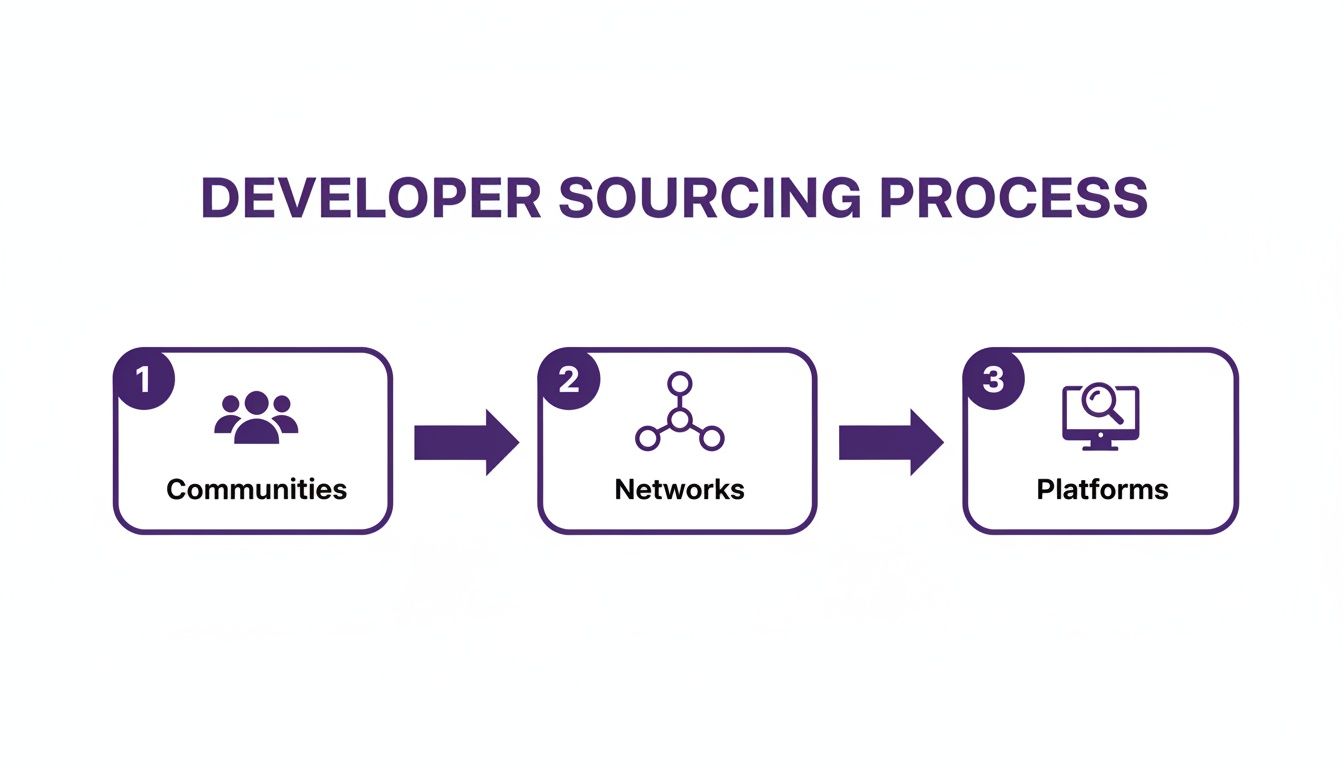
As you move from left to right, the signal-to-noise ratio gets much, much better.
That very first conversation should feel less like an interrogation and more like a real discussion. This is your chance to sell the vision and the role, while also getting a feel for what drives the candidate. It’s a quick, high-level filter to ensure there’s a fundamental match before anyone invests more time.
A great initial screen feels like an interesting conversation, not a checklist. Instead of asking them to recite their resume, try something like, "Tell me about a technical project you're particularly proud of and why." The answer reveals far more about their passion and problem-solving DNA.
This is also the perfect time to be transparent about your entire process. Let them know the timeline and what to expect at each stage. Top candidates always appreciate clarity and professionalism.
Take-home assignments can be incredibly revealing, but only if they're designed with respect for the candidate's time. A bad test feels like asking for free work, and senior-level folks will walk away.
Here are my hard-and-fast rules for a great take-home:
You're not just looking for working code. You're evaluating code structure, clarity, and whether they bothered to write any tests.
For mid-to-senior level roles, the system design interview is where the magic happens. This is what separates the good from the great. But again, this is not a pop quiz.
Frame it as a collaborative brainstorming session. Present a high-level business problem, like, "Let's sketch out how we might build a URL shortening service like Bitly." Then, and this is the important part, you work with them to explore the solution.
Your job as the interviewer is to be a partner. Poke and prod with questions:
Their ability to articulate trade-offs, ask smart clarifying questions, and adapt their design is the real signal you’re looking for. It reveals their architectural thinking and collaborative skills in a way a whiteboard puzzle never could.
Ultimately, it all boils down to one thing: empathy. When you optimize for a positive candidate experience and focus on practical skills, you don’t just make better hires—you build an employer brand that the very best engineers actually want to be a part of.
You’ve found them. After all the searching, screening, and interviewing, you've identified the perfect developer for your team. This is a huge win, but don't celebrate just yet. The final step—crafting and extending the offer—is where many companies falter.
A weak offer can undo weeks of hard work, especially when top engineers are often juggling multiple opportunities. The goal here isn't just to present a number; it's to extend an invitation. Your offer should feel like the beginning of a partnership, not just a transaction.
Of course, compensation is a massive piece of the puzzle. But the best developers I've worked with are rarely motivated by money alone. They’re looking for a holistic package that signals a real investment in their growth, well-being, and future. A truly compelling offer is a well-rounded one.
Think beyond the base salary and consider what else you can bring to the table:
A great offer tells a story. It should paint a picture of the candidate's future with your company—what they'll build, how they'll grow, and the impact they'll make.
Opening your search to global talent is a game-changer. Suddenly, you have access to an incredible pool of candidates. But it also opens a can of worms when it comes to legal, financial, and administrative compliance.
Hiring someone in Berlin is completely different from hiring someone in Buenos Aires. Each country has its own set of rules, and getting it wrong can be costly. The administrative overhead can be a nightmare.
You’re suddenly juggling things like:
This is exactly why so many companies lean on a global talent partner. Instead of trying to become an overnight expert in international labor law, you can offload the administrative burden. A platform like HireDevelopers.com takes care of the compliant contracts, global payroll, and benefits administration for you.
This de-risks the entire process, letting you focus on what actually matters: building great products with great people. For a deeper dive, check out our guide on how to hire remote developers. By turning compliance from a major roadblock into a streamlined part of your process, you can build a world-class team, no matter where they live.
The work doesn’t stop once the offer letter is signed. In fact, that’s when the really important part begins. A developer's first few weeks are a make-or-break period that sets the stage for their entire time with your company. Retention isn't something you think about when an engineer is already looking for the door; it starts on day one.
A great start is about more than just getting the HR paperwork sorted. It means having their entire development environment, all necessary access credentials, and software licenses ready to go before they even log in. Trust me, nothing drains a new hire's excitement faster than spending their first week stuck in access-request limbo, unable to do anything meaningful.
To really get your new engineer integrated, you need a clear 30-day plan. This isn't about micromanagement; it's a roadmap that helps them score some early wins, which is absolutely critical for building their confidence and making them feel like part of the team. The whole point is to get them from learning the ropes to actively contributing without a lot of friction.
Here’s a simple structure that works well:
For a deeper dive, check out our guide on how to properly onboard remote employees for a complete checklist.
Retention is a direct outcome of a positive employee experience. This means having clear paths for career growth, providing regular and genuinely constructive feedback, and fostering a culture where engineers feel safe enough to experiment, ask questions, and even fail.
Beyond just getting someone in the door, successfully integrating talent into the fabric of your team is what really matters. You can explore more strategies for building high-performing engineering teams that are built to last. When you build that foundation of trust and purpose, great developers don't just stay—they grow with you.
Hiring developers, especially for the first time, brings up a ton of questions. Let's tackle some of the most common hurdles that founders and hiring managers run into.
If you're going the traditional route, be prepared to wait. The entire cycle—from writing the job description to sourcing, interviewing, and waiting out a notice period—often takes anywhere from 4 to 12 weeks. That’s a long time, and frankly, you risk losing the best people to companies that move faster.
But there’s a shortcut. Using a platform with pre-vetted developers completely changes the game. It’s not uncommon to get a shortlist of qualified people within a day and potentially make a hire in less than a week.
Technical skill is one thing, but some of the biggest red flags have nothing to do with code. Poor communication is a deal-breaker. Can they actually walk you through how they solve a problem, or do they just give you the answer? Another one is a pattern of blaming others for past project failures.
Watch out for a lack of curiosity. The best engineers are naturally inquisitive. They should be asking you smart questions about the product, the users, and the technical roadblocks you're facing. If they aren't, they might not be engaged enough to truly solve your problems.
This really boils down to what you need to accomplish right now versus your long-term vision.
You can’t win a salary war against Big Tech, so don’t even try. Instead, sell them on what you do have. Focus on the outsized impact they can make.
Emphasize the ownership they'll have over the product and highlight your company culture—especially if it’s more flexible and less bureaucratic. Meaningful equity and the chance to tackle genuinely interesting problems without red tape are incredibly attractive to the kind of engineers you want on your team.
You're probably in one of two situations right now. You need to hire a Scrum Master fast because delivery feels messy, or you've already interviewed a few and every candidate sounds polished, certified, and strangely interchangeable. They know the terms. They can define artifacts and ceremonies. But you still can't tell who can steady a […]

Most advice on API vs REST API starts with definitions and stops there. That's too shallow for a real project. The decision affects delivery speed, integration risk, documentation load, support burden, and even who you need to hire to keep the system stable after launch. The common mistake is treating “API” and “REST API” like […]

You're probably in one of two situations right now. You need to hire a Java developer because a core system is growing faster than your team can support, or you inherited a Java codebase and need someone who can stop the bleeding without making the architecture worse. Both situations punish vague hiring. A generic “Java […]


