

Ever feel like your development team is moving slower and slower, even as you add more people? You might be dealing with technical debt. At its core, technical debt is the future cost you'll pay for choosing an easy, quick solution today instead of a better, more thoughtful one that would have taken longer. It's […]

Ever feel like your development team is moving slower and slower, even as you add more people? You might be dealing with technical debt.
At its core, technical debt is the future cost you'll pay for choosing an easy, quick solution today instead of a better, more thoughtful one that would have taken longer. It's the classic trade-off between speed and quality. When you cut corners to ship software faster, you're essentially taking out a loan against your codebase. That loan has to be repaid, often with interest.
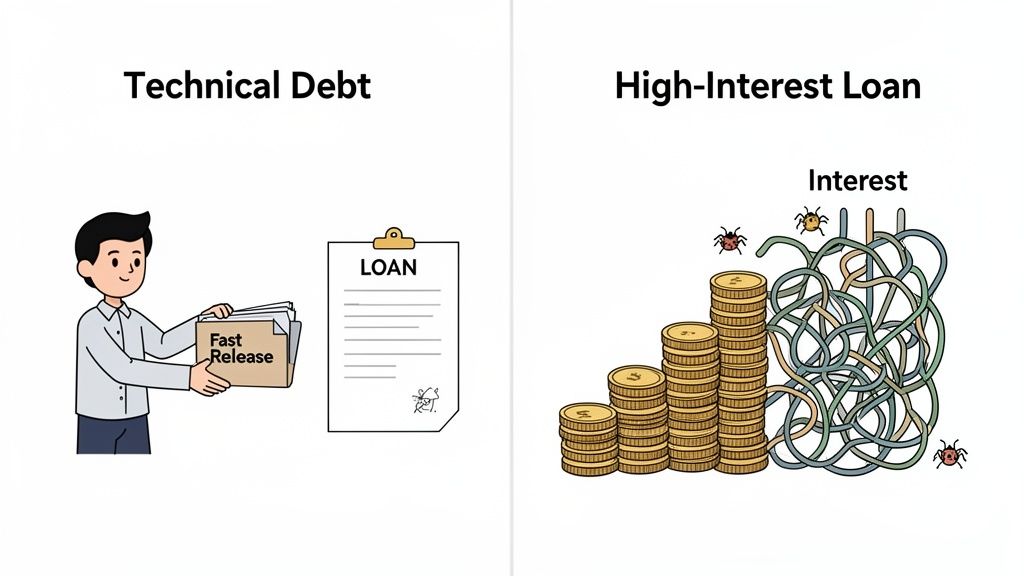
The term "technical debt" was coined by developer Ward Cunningham to help explain the long-term consequences of messy code to people who weren't programmers. The financial debt metaphor is perfect because it's something everyone gets.
Let's say you're rushing to launch a new feature to get ahead of a competitor. Your team lays out two options:
You go with the fast path. And it works! You beat the competition and capture the market. But you've just taken out your first "loan," and the interest payments are about to start.
To make this comparison even clearer, let's break down how financial debt concepts map directly to the world of software development.
| Financial Debt Concept | Technical Debt Equivalent | Real-World Example |
|---|---|---|
| Principal | The initial shortcut or suboptimal solution. | Hardcoding a value instead of building a proper settings page. |
| Interest | The extra effort required to work around the initial shortcut. | Developers manually changing the hardcoded value every time it needs updating. |
| High-Interest Loan | A deliberate, known shortcut taken to meet a deadline. | Shipping an MVP with minimal testing to validate a business idea quickly. |
| Defaulting on a Loan | The codebase becomes so complex and bug-ridden that adding new features is nearly impossible. | A complete system rewrite is needed because the old one is unmaintainable. |
| Refinancing | Refactoring a specific part of the code to improve its design and reduce future interest. | Replacing a slow, inefficient algorithm with a more optimized one. |
This table shows that the "cost" of technical debt isn't just a theoretical idea; it has real, measurable consequences on your team's productivity and your product's stability.
This interest doesn't show up on a balance sheet. Instead, it creeps into your daily operations, slowly draining resources and killing agility.
Technical debt is like an unmanaged credit card. The initial purchase provides immediate gratification, but the accumulating interest eventually makes every future purchase more expensive and difficult.
Here’s how that "interest" typically shows up:
This is a familiar story for many startups. When you need to learn how to build an MVP, taking on some strategic debt is often a necessary evil to test your assumptions quickly. The trick is to manage it before those interest payments bring everything to a grinding halt.
Just like in finance, not all debt is bad. A mortgage helps you buy a house, and a business loan can fuel critical growth. In the same way, taking on technical debt on purpose can be a smart strategic move. Accepting a bit of mess to launch an MVP and get real user feedback is often the right call.
The real trouble begins when debt is accumulated accidentally or, worse, ignored completely. For a deeper dive into the specifics, this guide on understanding technical debt and its solutions offers some great insights.
In the end, the goal isn't to have zero debt. It's to be a smart borrower—making deliberate choices and having a solid plan to pay it down before it takes over.
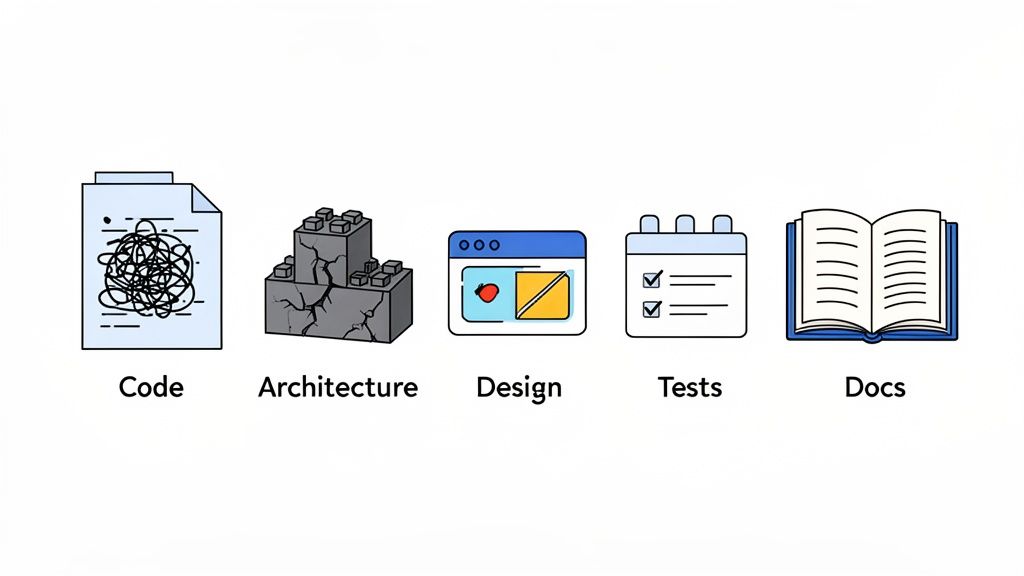
Saying your project has "technical debt" is a bit like telling a doctor you feel "unwell"—it’s a useful start, but it doesn't get to the root of the problem. To actually manage and pay it down, you have to diagnose the specific types of debt you’re dealing with.
Each one has its own unique "interest rate" and requires a different repayment plan. Getting specific transforms that vague feeling of "bad code" into an actionable list of issues. It’s the difference between guessing what’s wrong and knowing exactly where to start fixing things.
This is what most people think of first. Often called "code rot" or "cruft," this is the debt living right inside your codebase. It’s the messy, complex, or hard-to-understand code that developers often write under pressure to hit a deadline.
Code debt usually shows up in a few familiar ways:
The fix for code debt is usually refactoring, which means restructuring the code without changing what it does on the outside. It’s like finally organizing a messy workshop—suddenly, you can find your tools and get back to working efficiently.
If code debt is a messy room, architectural debt is a crack in the building’s foundation. This debt comes from poor high-level design choices that affect the entire system, and it’s often the most expensive and painful to fix.
A flawed architecture doesn't just slow down one feature; it creates a bottleneck for the entire product's evolution. Scaling becomes a nightmare, and every new addition feels like a monumental effort.
A classic example is a startup that builds its MVP as a monolith—a single, tightly-coupled application. That’s great for a fast launch, but it can quickly become a huge liability. As the company grows, they can’t scale individual services, and a small bug in one area can bring the whole application down.
This type of debt is felt directly by your customers. It builds up when the user interface (UI) or user experience (UX) is inconsistent, confusing, or just plain outdated. This usually happens when new features are bolted onto a product without a cohesive design strategy.
You can spot design debt by looking for:
Paying down design debt means running usability tests, building a unified design system, and redesigning confusing workflows to give your customers a much smoother experience.
These two are the silent killers. They represent the "unseen" work that’s almost always the first to get skipped when a project is behind schedule.
The scale of these issues across the industry is staggering. A landmark 2025 analysis by CAST, which looked at over 10 billion lines of code, found that organizations worldwide have racked up 61 billion workdays of technical debt. To put that in perspective, clearing this massive backlog would require the entire global software developer workforce to work for nine years straight. You can read the full research on global technical debt to truly grasp the scope of the challenge.
Let's be clear: technical debt isn't just some abstract problem for your engineering team. It's a silent tax on your entire business. While developers are the first to feel the pain of a clunky codebase, the consequences ripple outward, hitting your bottom line, tanking team morale, and crippling your ability to compete.
Think of it like interest on a loan. Ignoring it doesn't make it go away; it just creates a drag that slows everything down. That quick fix you pushed through six months ago to hit a deadline? It's the reason every new feature now takes twice as long to build. This isn't a one-time hit. It's a compounding penalty that makes your whole operation less agile and more expensive to run.
The most immediate and damaging business impact of technical debt is how it grinds your development velocity to a halt. As debt piles up, your team's productivity plummets. They end up spending more and more of their time just trying to understand tangled code, patching surprise bugs, and building workarounds instead of creating new value for your customers.
This slowdown is a direct attack on innovation. Your product roadmap gets longer, and your ability to pivot or respond to a competitor’s new feature gets weaker. Before you know it, simple feature requests that should take a few days are taking weeks—not because your team has lost its edge, but because they’re constantly wrestling with the very system they’re trying to improve.
Technical debt is a real and substantial drain on your budget, often gobbling up a huge chunk of your IT spending right under your nose. The costs show up in a few key ways:
This isn't just pocket change. Studies have shown that technical debt can eat up to 40% of a company's total IT budget. Worse, research from McKinsey found that 10-20% of the money set aside for new products is often diverted to resolving old issues. This means every new feature you build is secretly costing you far more than you planned. You can discover more insights about IT budget impacts to get the full financial picture.
Beyond the balance sheet, unmanaged technical debt takes a heavy toll on your most valuable asset: your people. Good engineers want to build great products and solve interesting challenges. Forcing them to constantly battle a broken, frustrating system is a surefire way to cause burnout and high turnover.
High technical debt is a leading cause of low developer morale. When engineers feel they can't do their best work, they lose their sense of ownership and pride, leading to disengagement and, eventually, attrition.
When a talented developer walks out the door, you don’t just lose their skills. You also get hit with the massive costs of recruiting, hiring, and onboarding a replacement. A clean, well-maintained codebase is a cornerstone of a healthy engineering culture—the kind that attracts and keeps top talent. Managing debt isn't just a technical chore; it's a critical investment in your team's long-term health and stability.
You can't fix what you can't see. Technical debt often feels like a vague, invisible force grinding your team to a halt, but making it tangible is the first step toward getting it under control.
By turning abstract worries into concrete metrics, you can stop guessing and start making smart, data-driven decisions about where to invest your team's valuable time. It’s about building a business case for code quality.
One of the most effective metrics for getting buy-in is the Technical Debt Ratio (TDR). This simple calculation gives you a clear percentage that anyone in the business, from the CFO to a project manager, can immediately understand.
It compares the cost to fix your debt against the cost to build the code in the first place.
The formula is pretty straightforward:
TDR = (Remediation Cost / Development Cost) x 100
A healthy, manageable ratio is generally considered to be under 5%. Once you start creeping above that, the "interest payments" on your debt really begin to slow down new feature development.
This isn't just a theoretical number; it has a direct, and often shocking, impact on productivity. Data from Stripe and CodeScene found that developers can lose up to 42% of their workweek just wrestling with bad code and technical debt. Think about that—it's a massive drain on your most expensive resources.
But the flip side is that getting a handle on your debt can boost feature velocity by as much as 25%. It's like getting a quarter of your development team for free.
Beyond the TDR, several other metrics can act as an early warning system, helping you spot accumulating debt before it spirals out of control. These are often easier to track on an ongoing basis and can be monitored with various software development tools.
A few key indicators to watch include:
Keeping a close eye on these software development KPIs is critical for proactive management. They give you the hard data you need to pinpoint problem areas and justify cleanup efforts.
Okay, so you’ve made your debt visible. Now what? The next question is what to fix first, because you can't tackle everything at once. And frankly, not all debt is created equal.
The key is to prioritize based on business value, not just what bothers the engineers most. A simple but incredibly effective way to do this is with a 2×2 prioritization matrix.
This framework helps you categorize debt based on two critical factors: Business Impact and Remediation Effort. Before you start plotting items on a matrix, this quick decision tree can help you decide if something even qualifies as technical debt in the first place.
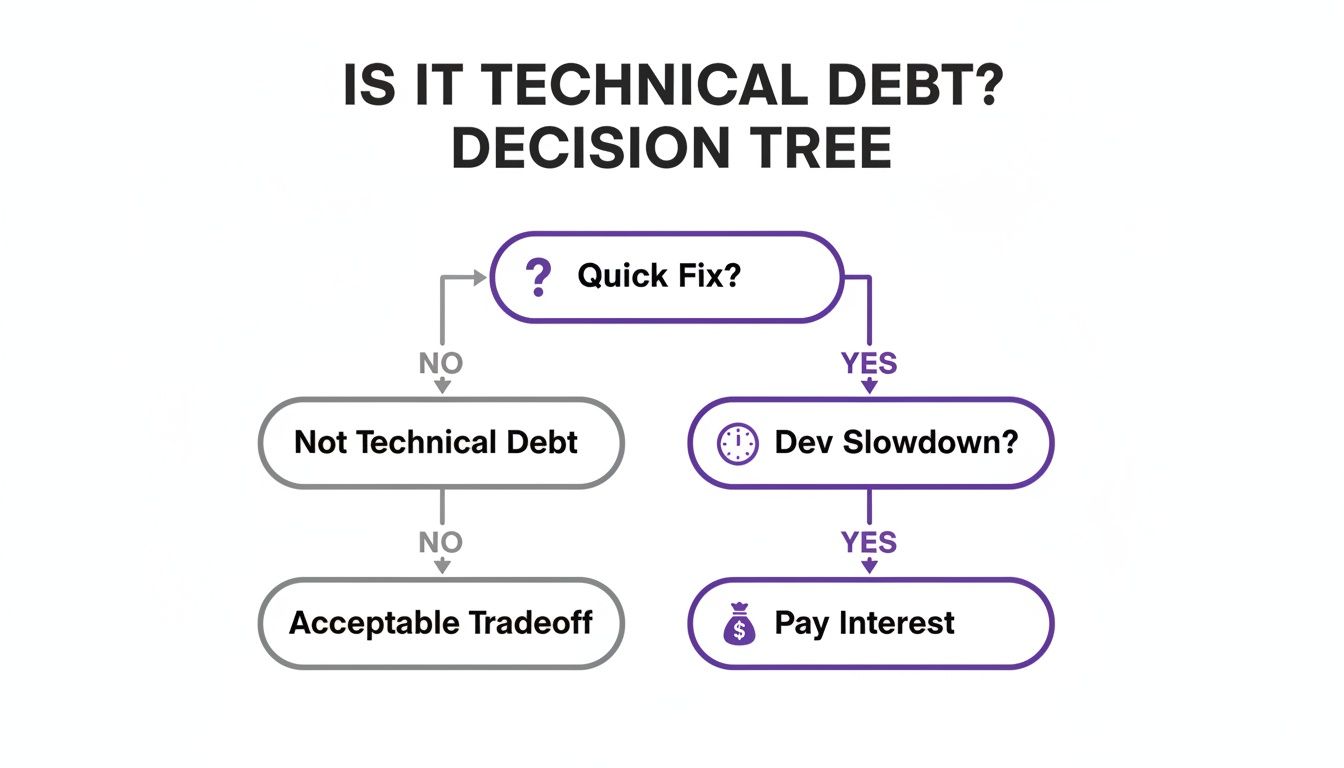
As the flowchart shows, not every shortcut creates debt. The real problems are the quick fixes that introduce long-term slowdowns. Those are the debts that require repayment.
This matrix provides a clear framework for deciding which technical debt items to address first. By categorizing tasks based on their impact on the business and the effort required to fix them, you can move from a chaotic backlog to a strategic action plan.
| Priority Quadrant | Business Impact | Remediation Effort | Action to Take |
|---|---|---|---|
| Quick Wins | High | Low | Fix these immediately. They offer the best return on investment and build momentum. |
| Major Projects | High | High | Plan these strategically. Break them down into smaller, manageable tasks. |
| Fill-In Tasks | Low | Low | Address these when you have downtime. They're good for "cleanup" sprints. |
| Revisit Later | Low | High | Acknowledge but defer. Only tackle if the business impact increases significantly. |
By plotting your known technical debt items into these quadrants, you create a clear roadmap. Start with the "Quick Wins" to score some easy victories and demonstrate value. This approach transforms an overwhelming backlog into a manageable, strategic initiative.
For a deeper dive, there are many proven strategies to identify, prioritize, and fix technical debt that can help you refine this process even further.
Alright, so you’ve identified your technical debt. That’s the easy part. The real work is figuring out how to manage it without bringing all new development to a screeching halt. The good news? You don't have to tackle it all at once.
The most effective approach is a two-pronged attack: proactively preventing new debt while strategically paying down what you already owe. Think of it like managing a real-world loan. You can’t just keep making minimum payments while opening new credit cards. You need a plan to pay down the principal and change the spending habits that got you into trouble.
Remediating technical debt needs a real plan, not just a vague directive to "clean up the code." The trick is to weave these efforts into your team's everyday rhythm, making debt reduction a consistent habit rather than a dreaded, massive project that never gets prioritized.
Here are a few proven ways to do just that:
Adopt the Boy Scout Rule: This is a classic for a reason. Coined by Robert C. Martin, the principle is simple: "Always leave the code cleaner than you found it." When a developer is in the code to fix a bug or add a feature, they should spend a few extra minutes tidying up the immediate area—maybe clarifying a variable name, untangling a confusing function, or adding a helpful comment. These tiny, incremental improvements really add up over time.
Dedicate Sprint Capacity: Make debt repayment a non-negotiable part of your workflow. Formally allocate a slice of every sprint—say, 15-20% of your team's capacity—to refactoring and other cleanup tasks. This stops debt from being endlessly kicked down the road and gives developers the permission they need to address known issues before they snowball.
Schedule Focused Refactoring Sprints: Sometimes, you’re dealing with a bigger, more tangled mess that can't be fixed with small tweaks. For deep architectural debt, dedicating an entire sprint just to remediation can be a game-changer. It gives the team the deep-focus time they need to solve systemic problems without the constant distraction of new feature requests.
While paying down existing debt feels good, preventing it from piling up in the first place is the ultimate long-term win. This is less about any single tool or tactic and more about fostering a culture where quality is everyone's job, right from the start.
It's about building a system of checks and balances that catches potential shortcuts and lazy decisions before they ever get merged into your main codebase. A strong prevention-focused culture leads to smoother, more predictable development cycles and a far more stable product.
Technical debt is often a symptom of process and cultural issues. Fixing the code is only half the solution; you also have to fix the system that produced the messy code.
Here are the cornerstones of a solid prevention strategy:
Establish Clear Coding Standards: Don't leave code style to chance. Create and enforce a clear style guide that covers everything from naming conventions to module structure. When everyone follows the same playbook, the code becomes instantly easier for anyone on the team to read, understand, and safely modify.
Automate Code Quality Checks: Put your tools to work. Use static analysis tools and linters to automatically scan code for common mistakes, overly complex logic, and style violations. When you integrate these checks directly into your CI/CD pipeline, developers get instant feedback, often catching issues before a human reviewer even sees the code.
Foster Robust Peer Reviews: A healthy code review process is your single best defense against new debt. It’s more than just a bug hunt; it's a critical opportunity for mentorship, knowledge sharing, and collective ownership of the codebase. For a deeper dive, check out these code review best practices to see what separates a great review from a rubber-stamp approval.
Prioritize Testing and Documentation: Stop treating tests and docs as "nice-to-haves." Build time for writing solid automated tests and clear documentation directly into every project estimate and timeline. When these are considered core parts of the definition of "done," you starve testing and documentation debt of the oxygen they need to grow.
At the end of the day, technical debt is a people problem, not just a code problem. You can have all the best strategies, tools, and processes in the world, but they mean nothing without the right engineers driving them. The single most powerful defense against technical debt is a team that simply refuses to create it in the first place.
This shifts hiring from a simple task—filling a seat—to a core strategic weapon for building a healthy, sustainable product. When you build a team that instinctively understands the long-term price of cutting corners, you're not just managing debt; you're preventing it.
The dream, of course, is to stop technical debt before it even starts. This all begins with hiring developers who have more than just raw technical skill; they need a disciplined, craftsman-like mindset. For them, writing clean code, comprehensive tests, and clear documentation isn't an afterthought—it's just how they work.
But let's be realistic: finding engineers with that perfect blend of skill and discipline is incredibly difficult. Traditional hiring processes are long, expensive, and often miss the very qualities that separate a good developer from a great one. That’s why so many companies now lean on talent platforms that do the heavy lifting of vetting engineers for you.
Investing in top-tier, pre-vetted talent is a direct investment in your product's future. It's a proactive measure that pays dividends by reducing the "interest payments" on technical debt for years to come.
When you hire from a pool of developers who have already been rigorously tested, you’re getting more than just someone who can code. You’re bringing on a professional who has a proven commitment to best practices, which saves you a fortune in cleanup costs down the road.
So, what if you're already drowning in technical debt? Often, your in-house team is so buried in building the next feature that they can't possibly tackle a massive refactoring project. This is the perfect scenario for bringing in specialized contractors. They can surgically remove debt without the long-term cost of a full-time hire.
A flexible staffing model gives you some serious advantages:
Platforms like HireDevelopers.com are built for this exact purpose. They give you access to the top 1% of global engineers who have already been vetted for both their technical skills and their professionalism. This allows you to either build a team that prevents debt from the start or bring in the precise expertise you need to finally conquer it.
We’ve walked through the what, why, and how of technical debt. But let's be honest, that's where the real questions start to pop up. Here are some of the most common ones I hear from teams who are finally getting serious about tackling it.
Absolutely not. Think of it like a business loan. Sometimes, taking on debt is a sharp, strategic decision that helps you seize an opportunity.
Pushing out a Minimum Viable Product (MVP) to test the waters before a competitor does? That's a classic example. You might cut a few corners to be first, and that’s okay, as long as it's a conscious choice. The trick is to have a clear plan to go back and clean things up once you've validated your idea.
The real danger lies in reckless debt—the kind that creeps in from sloppy work or a lack of awareness. Strategic debt is a tool; reckless debt is a landmine.
You have to speak their language. Stop talking about "messy code" and start talking about business impact. Your manager cares about metrics, so connect the dots for them.
Frame the conversation around the bottom line. Explain how paying down this debt will directly speed up feature development, slash the time and money spent fixing bugs, and drastically reduce the risk of a catastrophic system outage.
Show them the data. Point to the rising number of bugs, the hours your team is wasting on rework instead of innovation, or how slow development is delaying your next big release. Make it impossible for them to ignore the business case.
You don't have to go on a treasure hunt to find technical debt. There are plenty of great tools that can automate the search for you by scanning your codebase.
Static analysis tools are the perfect place to start. They act like a quality inspector for your code, sniffing out issues like unnecessary complexity, duplicated logic, and violations of your team's coding standards.
Tools like SonarQube or CodeClimate are popular for a reason. They give you a quantifiable look at the health of your code and help you track whether your cleanup efforts are actually working over time.
It definitely can, and it's often a smart move. Bringing in outside help can be a powerful way to get a handle on a thorny debt problem without derailing your internal team from their work on new features.
You can hire a specialized agency or vetted contractors to parachute in for a targeted refactoring project. They bring fresh eyes and deep expertise, knock out the problem, and let your team keep its momentum. The key is to partner with talent who can quickly get up to speed on your system and deliver the clean, high-quality code you need.
When you hear "offshore software development," you might immediately think of hiring a team in a faraway country to handle your coding. And you're not wrong, but that's just the surface. A better way to think about it is assembling a global 'dream team' for your project—sourcing the absolute best talent for the job, no […]

Hiring an engineer is about more than matching keywords on a résumé to a job description. The real challenge is identifying an individual who not only possesses technical skill but can also solve ambiguous problems, design robust systems, and communicate effectively within a team. How do you uncover that genuine capability in a brief interview? […]

Software engineering project management is all about steering a software project from a great idea to a finished product. It’s the practical art of guiding developers, defining features, and wrangling technology to get things done on time and on budget. The Art of Building Digital Products Think of a software project manager like a film […]


