

Staff augmentation is a smart way to bring outside talent into your company to fill a specific role or skill gap, but without the long-term strings attached to a full-time hire. Think of it like calling in a specialist consultant for a single, critical part of a project. You get precisely the expertise you need, […]

Staff augmentation is a smart way to bring outside talent into your company to fill a specific role or skill gap, but without the long-term strings attached to a full-time hire. Think of it like calling in a specialist consultant for a single, critical part of a project. You get precisely the expertise you need, for exactly as long as you need it, and you stay in the driver's seat the entire time. It's a go-to strategy for businesses that need to scale up their skills quickly and keep costs in check.
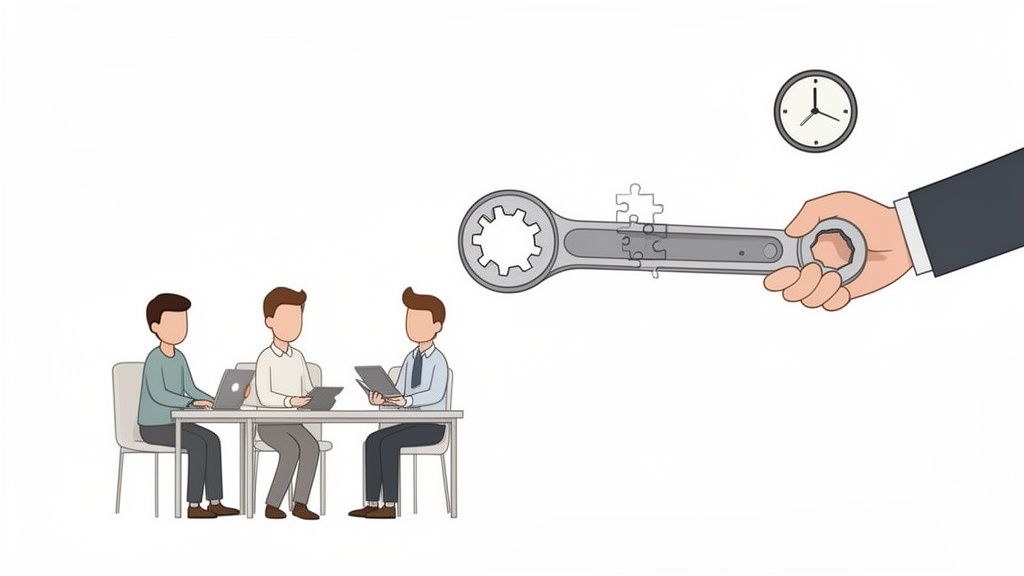
In a nutshell, staff augmentation means you’re adding qualified professionals from an outside agency to your in-house team. While these folks are officially on the agency's payroll, they work under your direct management, becoming a seamless part of your daily operations, your projects, and your company culture.
This isn’t your typical hiring process, nor is it about outsourcing an entire project. Instead of spending months sifting through résumés or handing over control to a third party, you get to pick from a pool of pre-vetted experts who report directly to you. It's the perfect blend: you get the control you'd have with an employee and the flexibility of a contractor.
So, why do companies even go this route? Most turn to staff augmentation to solve immediate problems. Maybe a key developer just went on parental leave, you need someone with niche cybersecurity skills for a new product feature, or you simply need more hands on deck to hit a critical deadline.
But it’s more than just a quick fix; it's a strategic move that helps companies grow. The numbers back this up. The global IT staff augmentation market was already valued at USD 299.3 billion in 2023 and is expected to skyrocket to USD 857.2 billion by 2031. This massive growth shows just how vital this model has become for businesses that need to stay agile. You can dive into the full analysis of the IT staff augmentation service market on Verified Market Research.
Staff augmentation provides direct control over expert talent without the long-term overhead. You manage the person and the work, while the provider handles payroll, benefits, and administrative tasks. This clear division of responsibility is what makes the model so powerful.
To make it even clearer, let's break down the key characteristics of the staff augmentation model in a simple table.
| Aspect | Description |
|---|---|
| Control | You maintain full day-to-day management and direct the professional's tasks. |
| Integration | The augmented staff member works alongside your existing team, as a part of it. |
| Purpose | Primarily used to fill a specific, often temporary, skill gap. |
| Employment | The professional is legally employed by the augmentation agency, not your company. |
| Duration | Contracts are flexible, designed for short-term to medium-term engagements. |
| Speed | Hiring is much faster than traditional recruitment because the talent is pre-vetted. |
This table shows how staff augmentation is specifically designed for flexibility and control, setting it apart from other hiring models.
To really get what staff augmentation is all about, let's look at what makes it unique. This model is defined by a few core principles that distinguish it from other ways of bringing on help.
Thinking of staff augmentation as just filling an empty chair is missing the bigger picture. It's not a temporary band-aid; it's a strategic move that can fundamentally change how your company operates for the better. When you bring in external experts, you're not just plugging a gap—you're building a more agile, cost-efficient, and powerhouse organization capable of hitting goals that used to feel out of reach.
The real magic lies in how it tackles the biggest headaches of traditional hiring: speed, cost, flexibility, and finding those unicorn skill sets. Each one of these benefits is a direct answer to a common business bottleneck.
Let's be honest, the traditional hiring process is a marathon. You post a job, sift through mountains of resumes, schedule endless interviews, and then comes the offer negotiation. Before you know it, two or three months have flown by. In that time, a competitor could have already launched the very thing you were hiring for.
Staff augmentation completely flips that script. A good partner has a roster of pre-vetted, top-tier talent ready to go. This means you can have a highly skilled developer integrated into your team in under a week. That kind of speed is a massive advantage when you're up against a tight deadline or need to jump on a market opportunity now.
When you hire a full-time employee, the salary is just the tip of the iceberg. You’re also on the hook for recruitment agency fees, payroll taxes, health insurance, retirement plans, and all the overhead that comes with an in-office employee. These hidden costs can easily add 25-40% on top of their base salary.
With staff augmentation, all of that baggage disappears. Your partner handles the HR, payroll, and benefits. You simply pay a straightforward, predictable rate for the exact expertise you need, for as long as you need it. It’s the most direct way to get A-level talent without the long-term financial weight.
Business priorities shift—it’s a fact of life. You might need to ramp up your development team to push for a major product launch, then scale back down once things are running smoothly. Traditional employment locks you in, making it painful and expensive to adapt.
This is where staff augmentation truly proves its worth. It gives you the operational elasticity to resize your team on demand.
This level of control lets you align your resources perfectly with your immediate goals, ensuring you’re never overstaffed or under-resourced.
Some skills are just plain hard to find. Think specialized AI engineers, blockchain architects, or cybersecurity experts with niche experience. Trying to find—and afford—that person in your local market can feel like searching for a needle in a haystack, especially if you're not in a major tech hub.
Staff augmentation blows the doors wide open, giving you access to a global pool of specialists. You can bring in a world-class expert for a specific six-month project without committing to a permanent hire or investing in years of internal training. It’s like having an elite special-ops team on call, ready to help you tackle your most complex and innovative projects.
Knowing what staff augmentation is is only half the battle. The real trick is knowing when to use it instead of other popular ways to bring in talent. It's easy to get lost in a sea of buzzwords like outsourcing and managed services, which people often use interchangeably. But in reality, each of these models gives you a completely different level of control, responsibility, and team integration.
Let's break it down with an analogy. Think of staff augmentation as bringing in a specialist contractor to work on your home renovation. They join your crew, you tell them exactly what to do, and they work alongside you. Outsourcing is like hiring a company to build a prefabricated extension; you give them the plans, and they deliver the finished room. Managed services is like paying for a home maintenance subscription; they just make sure your plumbing and electrical systems are always running perfectly, no questions asked.
The absolute defining feature of staff augmentation is direct managerial control. You’re not just paying for a finished product; you're paying for a professional's time and skills. They effectively become a temporary member of your team, reporting directly to you or your managers.
This model is a perfect fit when your internal leadership is solid, but you have a specific skill gap that needs filling without the long-term overhead of a full-time hire.
For a more granular look, check out our detailed comparison of staff augmentation vs managed services.
With outsourcing, the focus shifts from individual talent to the entire project. When you outsource, you hand over a whole chunk of work—or an entire project—to a third-party vendor. That vendor is then responsible for managing their own people, processes, and deadlines to hit the agreed-upon goal.
This is the way to go when you want to offload a non-essential function or a massive project, preferring a hands-off approach where your main concern is the final result.
Managed services takes this a step further, focusing on long-term outcomes rather than one-off projects. A managed service provider (MSP) assumes full responsibility for a specific business function, like your IT helpdesk or cybersecurity. They operate under a strict Service Level Agreement (SLA) that guarantees a certain level of performance.
This is your best bet when you need an entire business function handled by experts, freeing up your internal team completely.
To make sense of these choices, it helps to understand the landscape. The global tech talent shortage has pushed over 65% of companies to adopt these kinds of blended workforce strategies. And with 28% of the global workforce now remote, mixing in-house staff with augmented experts is becoming the new standard for getting things done faster.
This decision tree gives you a simple visual guide for figuring out which path to take when you need to grow your team and bring in new skills.
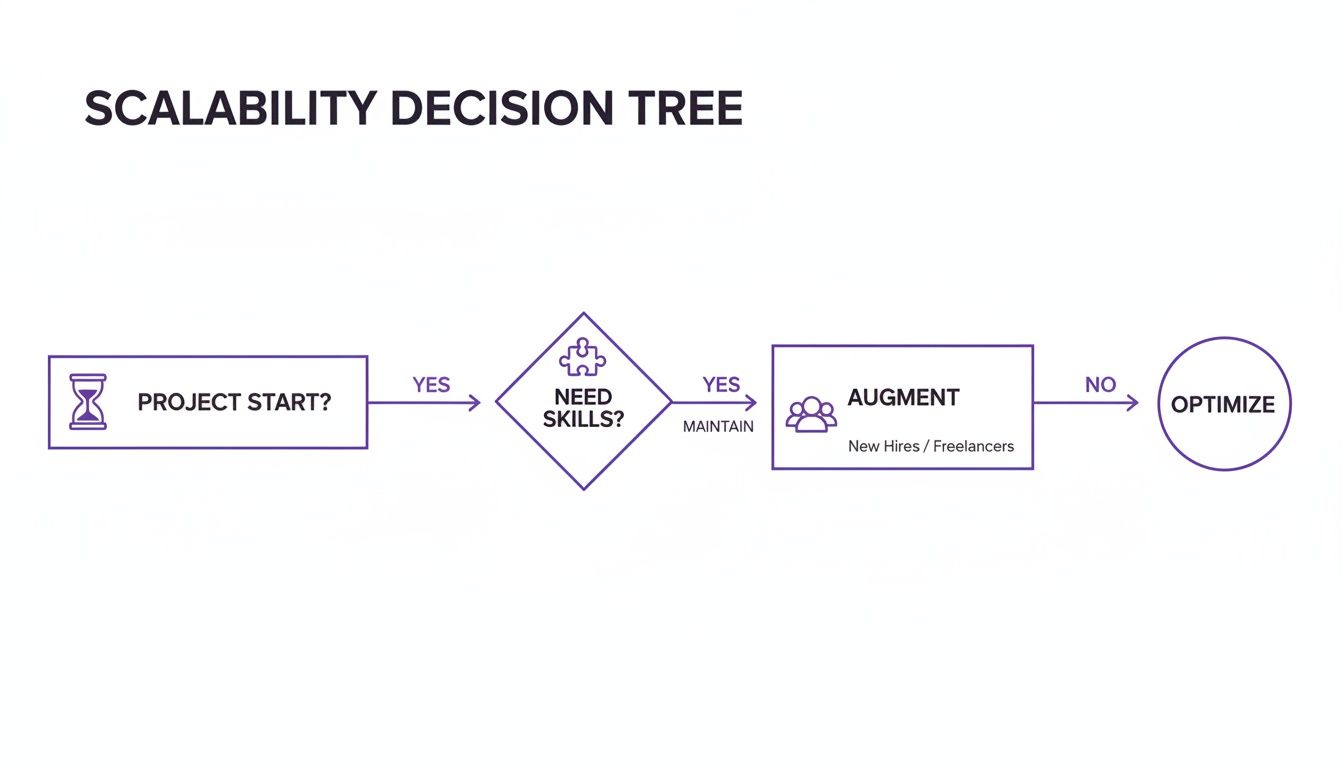
As the flowchart shows, the critical question is about control. If you need to add specific skills to your current team and want to keep directing the day-to-day work, staff augmentation is almost always the right answer.
Let's put these three models side-by-side to make the differences crystal clear. Each has its place, and the best choice depends entirely on your project's needs, your management style, and your long-term goals.
| Criteria | Staff Augmentation | Outsourcing | Managed Services |
|---|---|---|---|
| Control | High (Client manages resources directly) | Low (Vendor manages the entire project) | Low (Provider manages the entire function) |
| Responsibility | Shared (Client and vendor are both responsible) | Vendor (Vendor is responsible for deliverables) | Provider (Provider is responsible for outcomes) |
| Integration | High (Resources integrate with the in-house team) | Low (Vendor team works separately) | Very Low (Provider operates independently) |
| Best For | Filling skill gaps, short-term projects | Non-core functions, large-scale projects | Ongoing operational needs, predictable functions |
| Cost Structure | Time & Materials (Pay for hours worked) | Fixed Price or Time & Materials | Subscription-based (Fixed monthly fee) |
| Scalability | High (Easy to scale up or down quickly) | Moderate (Requires new contract negotiations) | Moderate (Based on SLA tiers) |
By carefully weighing these factors, you can confidently choose the talent model that will get you where you need to go without any costly detours. It’s all about matching the solution to the specific problem you're trying to solve.
Staff augmentation isn't a rigid, one-size-fits-all approach. It’s more like a flexible toolkit with different models you can adapt to your specific project needs, timeline, and budget. Picking the right one is half the battle.
The models really boil down to two key factors: the skills you're looking for and the location of the talent.
Think about it like hiring a contractor for a home renovation. Sometimes you just need a single plumber to fix a leak (an individual specialist). Other times, you need a coordinated crew with an electrician, a painter, and a carpenter to remodel a whole kitchen (an integrated team). This choice fundamentally changes how you'll manage the work and communicate day-to-day.
The first thing to figure out is the scope of the expertise you need. Are you just plugging a small hole in your team's capabilities, or are you trying to build out an entire new function from scratch?
Deciding on this first sets the stage for how many new people you'll be integrating into your existing workflow.
Next up is deciding where your new team members will physically (or virtually) be. Each location model presents a different mix of cost, collaboration, and convenience. As you explore these options, it's also worth understanding the newer trends like the augmented recruiter hybrid model, which blends technology with human expertise for talent acquisition.
Choosing a location model is a strategic trade-off. You might prioritize real-time, high-touch collaboration with a nearshore team, or you might want to maximize your budget with an offshore partner. There's no single "best" choice—only what's best for your specific situation.
Let's look at the main options on the table:
Choosing who to partner with for staff augmentation is one of the most important calls you'll make. Get it right, and the firm acts like a natural extension of your own team, bringing in top-notch talent that just clicks. Get it wrong, and you're looking at frustrating delays, shoddy communication, and money down the drain.
This isn't a decision you can make by just comparing price tags. A truly great partner doesn't just have a list of names; they've invested time and energy into building a talent pool. They have a serious, multi-step vetting process that goes way beyond a resume, testing for real technical skill, communication ability, and overall professionalism. That’s how you get someone who can contribute from day one, not just someone who looks good on paper. When looking for a partner, it helps to understand the various solutions for staffing agencies to get a feel for their capabilities.
You have to cut through the marketing fluff. The best way to do that is by asking sharp, direct questions that get to the heart of what a provider actually delivers. Think of it like a checklist to keep your evaluations consistent and to spot the firm that truly aligns with what you need.
Here’s what you should be digging into:
The world of staff augmentation is changing fast, and it’s being pulled along by some major shifts in technology. It’s pretty telling that a massive 62% of demand is now coming from companies adopting cloud and AI. Digital transformation projects are right behind, driving another 48%. And of course, remote work is now a fundamental piece of the puzzle, supporting 56% of workforce needs around the world. These numbers make it crystal clear: you need a partner who gets these trends.
A key question to ask any potential partner is: "How do you validate technical expertise beyond a resume?" Their answer will reveal the depth of their vetting process and their commitment to quality over quantity.
At the end of the day, picking a partner is all about reducing your risk while getting the most value possible. If you’re building software, you also need to understand how this model stacks up against other options. For some extra context on that, you can outsource custom software development and see how the approaches differ.

Finding and hiring a great developer is only half the battle. The real work begins when you start folding that new person into your existing team. Without a solid plan, even the most brilliant engineer will feel like an outsider, leading to frustration, delays, and a whole lot of wasted potential.
The trick is to treat your augmented staff exactly like you would any permanent employee. This isn't just about being welcoming; it's about giving them the tools, context, and support they need to hit the ground running and make a real difference. A thoughtful integration plan isn't optional—it's what separates a successful project from a stalled one.
A well-structured onboarding process is the single best thing you can do to get a new team member up to speed quickly. Don't make them hunt for information or guess how things are done.
Your onboarding should cover a few critical bases right away:
Putting in this effort upfront pays off massively. New hires feel empowered and can start contributing valuable work much, much faster.
When your new team member is remote, you have to be deliberate about communication. Ambiguity is the enemy of productivity, so setting up clear channels and routines is absolutely essential to keeping everyone on the same page.
The core principle is simple: over-communicating is always better than under-communicating. A strong communication framework prevents misunderstandings and makes your augmented staff feel like part of the team, not just hired help.
Establish a rhythm of regular check-ins, like daily stand-ups and weekly syncs, to talk about progress and clear any roadblocks. Encourage discussions in public channels so everyone has visibility, no matter where they are. For a deeper dive, our guide to staff augmentation best practices lays out a complete roadmap.
By making integration a priority, you turn a temporary hire into a true project asset.
Even with a clear understanding of staff augmentation, some practical questions always come up. Let's tackle some of the most common ones I hear from clients.
It’s actually simpler than you might think. Staff augmentation pricing usually comes down to a straightforward monthly or hourly rate for each person you bring on board.
Think of this rate as all-inclusive. It covers the developer's salary and benefits, plus the vendor’s fee for finding and managing that talent. You’re not on the hook for things like payroll taxes, insurance, or providing a laptop. This transparency makes budgeting a whole lot easier and helps you sidestep the hidden costs that always pop up with direct hires.
Getting this right is crucial, and it all starts with a solid onboarding plan. The moment they start, make sure your new team member has access to everything they need—your project management tools, code repositories, and communication channels like Slack.
Set up some casual intro meetings with the rest of the team to get the conversations started. The most important thing is to treat them just like any other employee. Loop them into daily stand-ups, sprint planning, and even virtual coffee breaks. When you make them feel like a genuine part of the team, they'll be ready to contribute their best work from day one.
A seamless integration is about more than just tools and access. It’s about creating a welcoming environment where the augmented professional feels like a true part of the team, empowered to contribute their best work.
This happens, and any good staff augmentation partner has a plan for it. Most reputable firms will offer a risk-free trial period or a replacement guarantee. If you find that a developer isn't quite hitting the mark, whether in technical skill or team chemistry, the process is simple.
You just need to give your vendor clear, honest feedback. From there, they’ll handle the rest, quickly finding a better-suited replacement from their pool of vetted talent. This ensures your project stays on track with minimal disruption.
A lot of founders reach the same point at the same time. Revenue is starting to move. Customers want reliability. Engineers need direction. The product has outgrown ad hoc decisions, but the business still isn't ready for a permanent executive seat. That gap creates expensive mistakes. The team ships features without a clear architecture plan. […]

Cloud computing stopped being a hosting decision a while ago. It's now a board-level question about speed, margin, resilience, and whether your team can ship AI-enabled products without turning infrastructure into a bottleneck. The striking part is the scale. Global public cloud spending is projected to exceed $830 billion in 2026, with the overall market […]

A hiring manager has 30 minutes, a resume full of Spring buzzwords, and one job opening that cannot afford a weak hire. A candidate has the same 30 minutes to prove they understand more than annotations and starter-project patterns. This context defines Spring MVC interviews. Strong interviews usually turn on practical judgment. Can the candidate […]


