

A solid web development contract isn't just a legal hoop to jump through—it's the blueprint for a successful project. Think of it as the tool that gets you and your developer on the same page from day one, clearly defining the scope, deliverables, payment terms, and who owns what. It’s your best defense against the […]

A solid web development contract isn't just a legal hoop to jump through—it's the blueprint for a successful project. Think of it as the tool that gets you and your developer on the same page from day one, clearly defining the scope, deliverables, payment terms, and who owns what. It’s your best defense against the costly misunderstandings that can sink a project.
Don't see the contract as a hurdle; see it as the foundation you're building your project on. Without one, you’re essentially operating on guesswork and hoping for the best. Verbal agreements and vague emails are notorious for causing chaos—scope creep, blown deadlines, and messy intellectual property (IP) fights are almost guaranteed.
In today's market, you can't afford that kind of ambiguity. Demand for skilled web developers is intense, with the field expected to grow by a staggering 13% by 2032. With so much competition, clarity isn’t just nice to have; it’s essential. You can get a better sense of this by looking into the growing demand for web professionals.
Picture this: a startup hires a developer to build their main product. The agreement? A quick email that just says "build a functional e-commerce platform." Halfway through, the founder asks for a customer loyalty program, figuring it's part of a "functional" platform. The developer, rightly, sees this as a huge new feature that wasn't in the original plan.
Suddenly, everything grinds to a halt. They spend weeks arguing over extra costs and new timelines, and the startup nearly misses its launch date. This entire nightmare could have been avoided with a detailed Scope of Work (SOW) that spelled out exactly what was included—and what wasn't—from the very beginning.
A great contract does one thing exceptionally well: it turns assumptions into documented agreements. It forces everyone to have the tough, important conversations before a single line of code is written.
Ultimately, a well-crafted contract is a multi-purpose tool that does more than just cover you legally.
It serves as:
When you start treating your web development contract as a strategic asset, you move from a reactive, compliance-focused mindset to one of proactive project management. It's the most powerful tool you have to avoid the common traps that derail so many projects.
Picking the right structure for your web development contract is a bit like choosing the right tool for a job. You wouldn't use a hammer to drive a screw, and you shouldn't force a one-size-fits-all agreement onto every project. The model you select will have a direct ripple effect on your budget, your ability to adapt, and how you manage the entire process.
Your project's unique DNA—whether it's a small, tightly-defined website or a sprawling, complex application that will evolve over time—is the ultimate guide. Let's walk through the three most common models I've seen in the wild: Fixed-Price, Time and Materials (T&M), and Retainer agreements. Each has its own set of strengths and weaknesses.
To make this choice easier, I've put together a quick comparison table that breaks down the essentials of each model.
This side-by-side breakdown of Fixed-Price, Time & Materials, and Retainer contracts should help you pick the right fit for your specific needs.
| Contract Type | Best For | Pros | Cons | Real-World Use Case |
|---|---|---|---|---|
| Fixed-Price | Small, well-defined projects with a crystal-clear scope and minimal expected changes. | Budget predictability; you know the total cost upfront. | Inflexible; changes often require a new contract or costly change orders. | Building a simple, five-page informational website for a local business. |
| Time & Materials (T&M) | Complex, long-term, or Agile projects where requirements are expected to evolve. | High flexibility; allows for pivots and iterative development based on feedback. | Budget can be unpredictable; requires close monitoring to control costs. | Developing a new SaaS application where features will be added based on user testing. |
| Retainer | Businesses needing ongoing, long-term support for an existing application. | Guaranteed access to a developer for maintenance, updates, and support. | Can be inefficient if the allocated hours aren't consistently used. | An e-commerce site paying a monthly fee for bug fixes and security updates. |
Hopefully, that gives you a clearer picture. Now let's dive a little deeper into the nuance of each one.
A Fixed-Price contract is as straightforward as it gets: you agree on a single, set price for a very specific, clearly defined scope of work. This is the perfect model when you know exactly what you need, down to the last detail, and you don't expect any surprises.
Think of it as the go-to for small-scale projects, MVPs (Minimum Viable Products), or any task where you can create an exhaustive, unambiguous feature list from day one. The biggest win here is total budget predictability, which makes financial planning a breeze.
The catch? It's rigid. If you suddenly get a brilliant idea for a new feature or need to change direction, you can't just do it. You'll have to draft a formal change order or even a whole new contract, which almost always introduces delays and extra costs.
On the complete opposite end of the spectrum, you have the Time and Materials (T&M) contract. Here, you pay for the actual time developers put in, plus the cost of any third-party tools or software they need. It’s built for flexibility, making it a fantastic choice for complex or long-term projects where the requirements are bound to change.
T&M is the lifeblood of agile development. It gives you the freedom to build, test, learn, and pivot as you get feedback from real users. You’re not locked into a rigid plan, which allows you to create the best possible product. The trade-off, of course, is that you sacrifice a predictable budget.
A T&M model thrives on trust and transparent communication. It's less about a rigid set of deliverables and more about a collaborative partnership focused on achieving a shared goal.
This is the preferred approach in the booming web development outsourcing market. The global market, which was valued at USD 1.6 billion in 2022, is on track to hit USD 3.0 billion by 2032, largely because mid-size companies are looking for exactly this kind of flexible, high-value partnership.
A vague contract, regardless of the model, is a recipe for disaster. It can quickly lead to scope creep and ugly disputes over who owns the intellectual property.
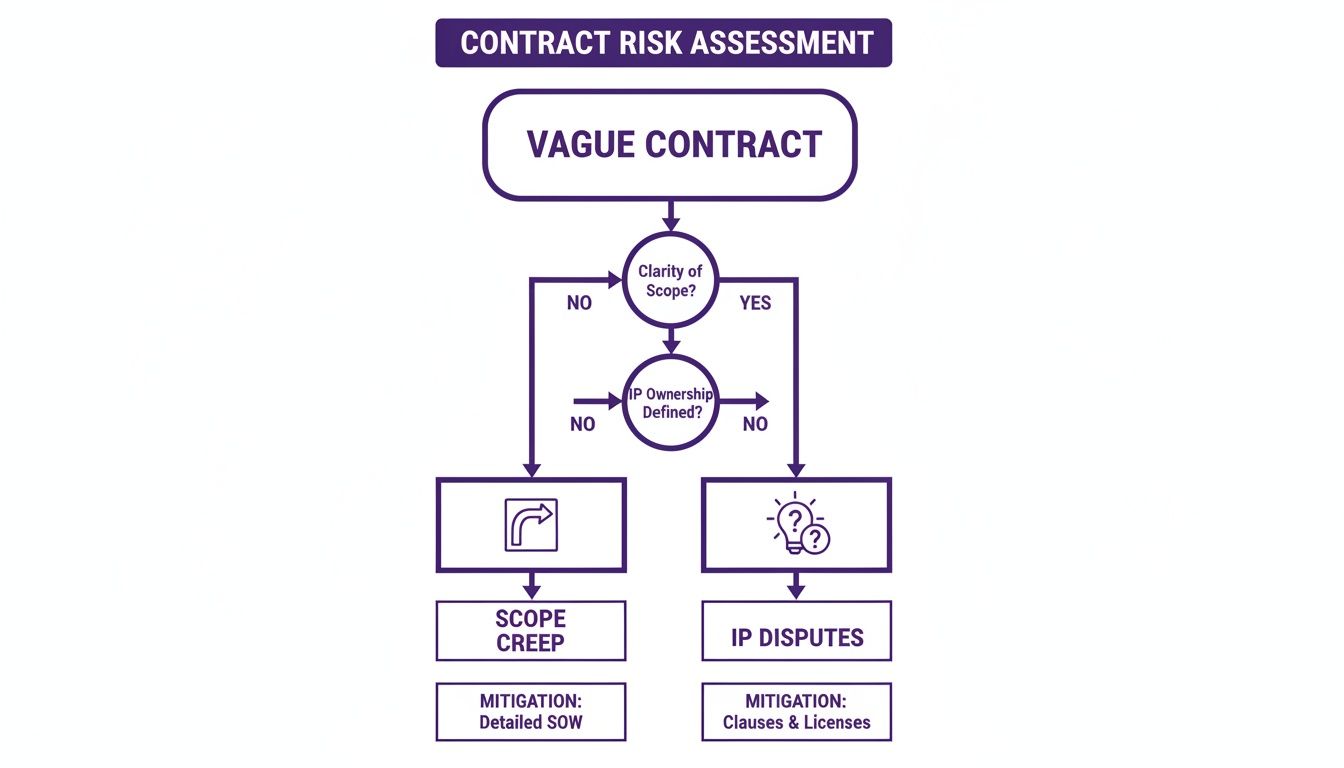
This flowchart really drives home the point: ambiguity is the root cause of the most expensive problems. That's why picking a contract model that naturally encourages clarity is so important.
Finally, we have the Retainer agreement. This is where you pay a developer or agency a fixed monthly fee to secure their availability for a set number of hours or for ongoing work. This isn't really about a single, discrete project; it's about fostering a long-term partnership.
This model is a lifesaver for businesses that need continuous maintenance, support, and feature updates for an existing application. For example, an e-commerce store on a retainer has peace of mind knowing a developer is always on call for critical bug fixes, security patches, and performance tweaks. When you're weighing your options, understanding local service agreement models can offer additional perspectives on structuring long-term partnerships.
Ultimately, the choice often boils down to your operational style. It helps to understand the core differences between various engagement strategies, like staff augmentation vs managed services. A retainer is essentially a form of managed service, guaranteeing that expert help is always just a call or email away.
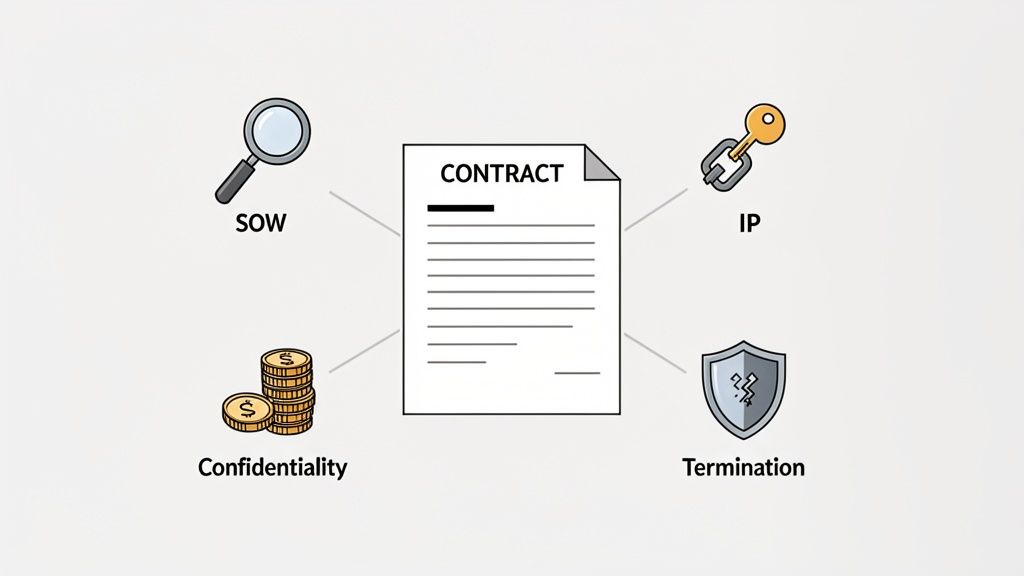
Now we’re getting to the good stuff—the specific clauses that make or break your contract. A great agreement isn't just one long legal document; it's a collection of individual parts, each with a critical job to do. Getting these components right is what separates a truly protective contract from one that’s just a piece of paper.
Let's walk through the non-negotiable clauses you absolutely must have in any web development contract. Think of these less as legal formalities and more as the ground rules for a successful project.
If you only get one thing right, make it the Scope of Work (SOW). I've seen it time and time again: 90% of project disputes start right here. A vague SOW is practically an invitation for scope creep, where small, innocent-sounding requests slowly derail your timeline and blow up your budget.
Your SOW needs to be painfully specific. "Build a user profile page" is a terrible start. You need to break down every single detail.
A rock-solid SOW leaves no room for assumptions. Someone with zero context should be able to read it and know exactly what’s being built.
This one is a deal-breaker. This clause decides who owns the final product once the invoices are paid. Without it, you could pay a fortune for a custom app only to discover the developer legally owns the code and can sell it to your direct competitor. It happens.
The industry standard, and what you should always push for, is a "work for hire" clause. This language makes it crystal clear that upon final payment, every bit of the code, design, and other deliverables—the "work product"—belongs to you.
The rule is simple: if you paid for it, you should own it. Your contract must make this legally airtight.
Watch out for developers who want to retain rights to "pre-existing" or "background" code. While it can be a legitimate request, make sure it’s narrowly defined so you know exactly which parts of your application you don’t own. For anything built specifically for your project, full ownership is non-negotiable.
Nothing sours a relationship faster than confusion over money. This clause needs to detail not just the total cost, but exactly how and when payments will be made.
Your payment terms should cover:
This protects everyone. You know you're only paying for work you can see, and the developer has a predictable cash flow.
To give you a quick reference, here’s a checklist of the essential clauses you should look for in any web development contract.
| Clause | What It Does | Key Question to Answer |
|---|---|---|
| Scope of Work (SOW) | Defines the exact project deliverables, features, and technology stack. | What exactly is being built and what is being excluded? |
| Intellectual Property | Determines who owns the final code, designs, and other assets. | Does all IP transfer to me upon final payment? |
| Payment & Milestones | Outlines the total cost, payment schedule, and invoicing process. | How much, when, and how will payments be made? |
| Confidentiality (NDA) | Protects your sensitive business information and trade secrets. | Is the developer legally bound to keep my information private? |
| Termination | Defines the conditions under which the contract can be ended. | What is our clean exit strategy if things go wrong? |
| Warranties & Support | Guarantees the work will be bug-free for a set period post-launch. | Who is responsible for fixing bugs after the project is live? |
Having these six clauses clearly defined will save you from the vast majority of potential conflicts and misunderstandings down the road.
You're going to be sharing sensitive information—business plans, customer data, maybe even a secret algorithm. A Confidentiality or Non-Disclosure Agreement (NDA) clause legally binds the developer to keep their mouth shut.
Make sure this clause "survives" the end of the contract, typically for 2-5 years. This ensures your competitive edge stays protected long after the project is done. The developer’s obligation is simple: they can't use or share your confidential information for any reason other than doing their job.
This is especially crucial for larger companies, which are projected to make up 62.40% of the web development services market by 2025—a massive $50.3 billion slice of an $80.6 billion pie. These big projects often involve incredibly sensitive data, and you can dig deeper into these trends in the full web development market report.
Nobody likes to think about breaking up before the relationship even starts, but you need an exit strategy. A termination clause outlines the specific reasons either party can walk away, preventing a messy and expensive standoff.
Common grounds for termination include:
The clause also needs to detail what happens next. The client pays for all work completed to date, and the developer hands over everything they've built. For a closer look at these kinds of obligations, our deep dive into the must-haves for a software engineering contract is a great resource.
What happens when a show-stopping bug pops up a week after you launch? Without a warranty, you’re on the hook for those emergency fixes. A warranty clause guarantees the work will be free from major defects for a set time, typically 30-90 days after going live.
During this "warranty period," the developer is obligated to fix bugs that were part of their original work at no extra cost. This doesn't cover new features or problems caused by third-party systems, but it’s a critical safety net.
It's also a smart move to discuss a separate maintenance agreement for ongoing support after the warranty expires. This gives you a plan for security updates, performance checks, and keeping your investment healthy for the long term.
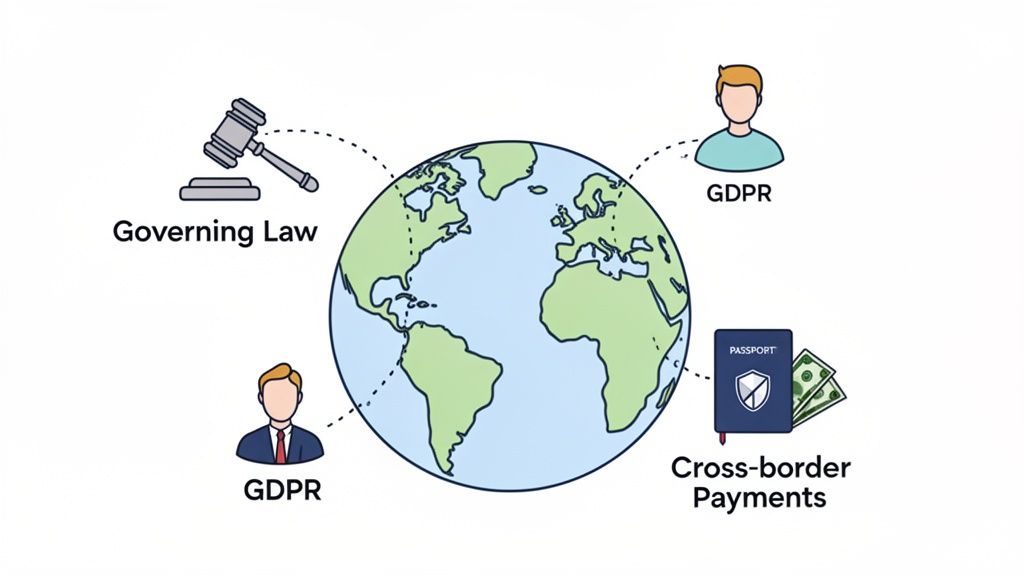
Hiring global talent can be a game-changer, opening up a massive pool of skilled developers. But let’s be honest, it also brings a whole new set of headaches—legal, financial, and logistical. A web development contract for someone halfway across the world isn’t just your standard agreement with a few names changed. It's a different beast entirely.
You’re suddenly dealing with a tangled web of international laws, tax rules, and data privacy regulations. The upside is huge, but without a solid plan, you could easily find yourself facing compliance penalties, frozen payments, or a legal battle in a court system you know nothing about.
Right out of the gate, you need to decide on the "governing law." This is the clause that dictates which country's laws will be used to interpret the contract if things go sideways. If you leave this out, you're rolling the dice on having to navigate a foreign legal system. Trust me, that's a nightmare you want to avoid.
Your first instinct should be to nominate the laws of your own country or state. This gives you home-field advantage with a legal framework you actually understand. Of course, this can be a sticking point in negotiations, as the developer might push for their own jurisdiction.
A key takeaway is to decide this early. The governing law impacts every other clause in your contract, so it should be a foundational part of your agreement, not an afterthought.
If you’re working across language barriers, it’s not enough for the contract to just be translated; it needs to be legally sound in both languages. That’s where specialized legal document translation services become essential. They ensure the translated version holds up in court by preserving the original legal intent.
Paying an international developer is rarely as simple as a quick bank transfer. You’re juggling currency conversions, international wire fees, and, most critically, tax compliance. One of the biggest pitfalls is misclassifying an international contractor, which can trigger some serious tax and labor law violations.
This is where Employer of Record (EOR) services and global payroll platforms are worth their weight in gold. They take the administrative mess off your plate by managing:
These platforms act as the legal employer in the developer's home country, so you can focus on building great software while they deal with the bureaucratic red tape. To get a better sense of how this works, you can explore the models available when you hire developers offshore and see how these services can streamline everything.
When your team is global, so is your data footprint. If your project touches the personal data of users from different parts of the world, you absolutely must comply with their local data protection laws. This isn't optional in modern web development.
You've probably heard of the big ones:
Your contract needs a Data Processing Addendum (DPA). This document spells out exactly how the developer will handle, process, and secure personal data to meet these strict legal standards. Skipping this step can lead to massive fines and do serious damage to your company’s reputation.
Signing the contract might feel like the finish line, but the real work happens during negotiation. This is where you actually forge the partnership. Too many people treat it like a battle, but it's much better to think of it as your first collaborative project—a chance to get the roadmap right before the journey even begins.
The secret to a smooth negotiation is preparation. Before you even hop on a call, get crystal clear on what you need. What are your absolute non-negotiables? And where can you afford to be a little flexible? This isn't about scoring points; it's about building an agreement that works for both of you in the long run.
Walking into a negotiation without a plan is like trying to code a feature without a spec. It’s a recipe for confusion. You need to map out your most critical objectives first. Is hitting a specific launch date the most important thing? Or is it staying under a strict budget, or maybe securing total ownership of the intellectual property?
Once you know what matters most, you can talk about it with confidence. For instance, instead of just saying, "We need this done fast," try this: "A hard launch on October 15th is a business-critical deadline for our holiday marketing campaign." See the difference? One is a vague wish, the other is a concrete business need that a developer can plan around.
This level of clarity should apply to every piece of the web development contract:
Negotiation is simply the process of turning "what ifs" into "here's how." It’s your chance to iron out all the assumptions and build a foundation of trust before a single line of code is written.
Good negotiation is a bit of a dance. You have to know which issues are your "must-haves" and which are your "nice-to-haves." For example, you might be willing to offer a larger upfront payment if it means getting a longer warranty period after the site goes live.
Here’s a common real-world scenario: A developer wants to retain the rights to some generic utility scripts they use on all their projects. For your company, owning 100% of the final product code is a non-negotiable legal requirement. This is where you stand firm on the custom code written specifically for you, but you could compromise by agreeing to a perpetual license for their pre-existing tools.
The goal isn't to squeeze every last concession out of the other person. It's to find that sweet spot where both you and the developer feel like the deal is fair, respected, and protects your interests. A contract that starts from a place of mutual respect is the one that leads to a great outcome. You want an agreement you’re both genuinely excited to sign.
When you're getting ready to sign a web development contract, a lot of questions can pop up. It's smart to get these sorted out upfront, as it can save you from some serious headaches down the line. Let's walk through some of the most common questions I hear and break down what you really need to know.
Without a doubt, the single biggest mistake is a poorly defined Scope of Work (SOW). It's the number one reason projects go off the rails with scope creep, blown budgets, and frustrating arguments.
A vague SOW is a recipe for disaster. You have to be incredibly specific about every single feature, function, and deliverable.
For instance, don't just say, "build a user login system." Instead, spell it out: "The system will support email/password authentication, Google OAuth for single sign-on, and a password reset flow that sends a unique link to the user's registered email." Just as important is listing what's out of scope. This little step prevents assumptions from morphing into expensive change orders later.
This is a massive one. The answer needs to be explicitly stated in the Intellectual Property (IP) clause. You want the contract to clearly say that once you’ve made the final payment, all rights and ownership of the code, designs, and other project assets—often called the "work product"—transfer 100% to you. This is typically handled through a "work for hire" agreement.
Be warned: if this isn't clearly stated, the developer could legally own the code they wrote for you. That means they could potentially reuse it or even sell it to someone else, including a direct competitor. Make sure this clause is rock-solid.
Let's be realistic—even the most detailed plans change. That's why every good contract needs a "Change Order" process. This clause defines the exact procedure for proposing, quoting, and approving any work that isn't in the original SOW.
A standard Change Order process looks something like this:
This structured process is your best friend. It keeps you safe from surprise invoices and ensures the developer gets paid fairly for their extra effort, keeping everyone on the same page.
Tempting, right? While a free template can give you a basic structure, it's a risky shortcut for any serious project. These one-size-fits-all documents often lack the specific details your project needs, like robust acceptance criteria, post-launch warranties, or data protection clauses that comply with regulations like GDPR or CCPA.
Think of an online template as a very rough first draft. If you're investing any significant amount of money or time into your project, getting a legal professional to review and tailor the contract is non-negotiable. That small upfront cost is nothing compared to the financial and emotional toll of a legal dispute caused by a flimsy agreement. It’s an investment in peace of mind.
Careers in cryptography are high-stakes, high-reward. These are the people who build and break the digital codes that secure our world, protecting everything from your bank account to global decentralized networks. It's a field with massive growth and serious six-figure salary potential. Why Cryptography Careers Are Exploding Welcome to the new frontier of digital trust. […]

The demand for remote machine learning jobs isn't just a trend anymore; it's a fundamental shift in how AI talent is hired and deployed. For ML professionals, this opens up a world of possibilities, not just in terms of flexibility, but also significant financial upside. Companies are in a fierce competition for top talent, and […]

The software engineering field is constantly shifting, with certain specializations commanding unprecedented salaries. But which roles truly offer the highest earning potential, and what does it take to secure one? This data-driven guide breaks down the best paying software engineering jobs, moving beyond vague titles to offer a detailed roadmap for career advancement and strategic […]


