

The fundamental difference between staff augmentation vs managed services really comes down to this: are you looking for people or an outcome? Staff augmentation gives you individual experts who join your team and work under your direction. Managed services, on the other hand, deliver a complete, finished result, with the provider taking full ownership of […]

The fundamental difference between staff augmentation vs managed services really comes down to this: are you looking for people or an outcome? Staff augmentation gives you individual experts who join your team and work under your direction. Managed services, on the other hand, deliver a complete, finished result, with the provider taking full ownership of the entire process.
Think of it like building a deck. With staff augmentation, you’re hiring a few skilled carpenters to work alongside you, following your blueprints and under your supervision. With managed services, you’re hiring a contractor who agrees to build the entire deck for a set price, handling everything from materials to labor to cleanup.
Picking the right IT outsourcing strategy is a make-or-break decision for your budget, project timeline, and overall success. While both models bring in outside talent, they work in completely different ways. Getting a handle on these differences is the first crucial step to finding a partner that fits your company's culture and goals.
Staff augmentation is a perfect fit when you already have solid project management in place but just need to plug a few specific skill gaps or quickly add more hands for a big push. This approach gives you total control, as the new team members slot right into your existing team, report to your managers, and follow your processes. It’s the closest thing to hiring a full-time employee without the long-term HR overhead.
Conversely, managed services are the way to go when you'd rather hand off an entire IT function and focus purely on the results. You define the "what" in a Service Level Agreement (SLA), and the provider figures out the "how"—managing the people, technology, and workflows to get it done. This gives you predictable costs and frees up your internal leaders from day-to-day operational headaches.
Key Takeaway: Go with staff augmentation when you need to beef up your current team with specific expertise while keeping full control. Choose managed services when you want to outsource the responsibility for an entire function and lock in predictable costs.
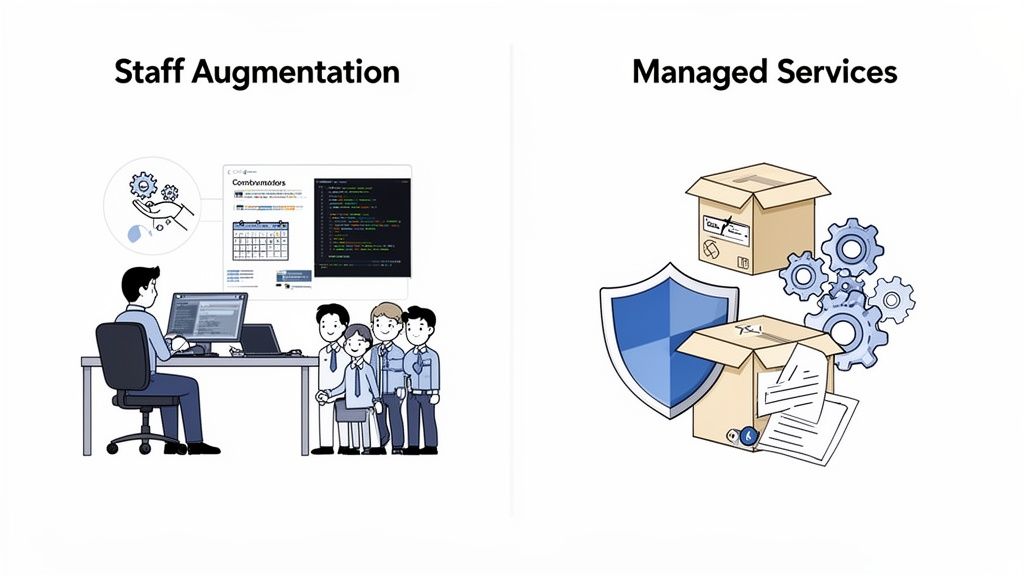
To make the choice even clearer, let’s break down the core differences head-to-head. This table lays out how each model stacks up against the most important factors you'll be considering.
| Criterion | Staff Augmentation | Managed Services |
|---|---|---|
| Control Level | High; you directly manage the talent and tasks. | Low; the provider manages the team and process. |
| Responsibility | You are responsible for the project outcome. | The provider is responsible for delivering the outcome. |
| Cost Structure | Variable; typically hourly or monthly rates per person. | Fixed; predictable monthly or annual fees for a service. |
| Best For | Short-term projects, filling skill gaps, and rapid scaling. | Long-term support, 24/7 operations, and compliance. |
Ultimately, the right model depends entirely on your needs. One gives you direct control over skilled individuals, while the other gives you a guaranteed outcome with less management overhead.
To really get to the heart of the staff augmentation vs. managed services debate, we need to move past the dictionary definitions. Let's look at how each one actually plays out in the real world, day-to-day. These are two completely different philosophies for bringing in outside help—one is about adding people to your team, and the other is about outsourcing a result.
The path you choose here will fundamentally shape your management overhead, how your teams are structured, and the very flow of your projects. One model bolts onto your existing team; the other takes over a whole function.
At its core, staff augmentation is all about people. You're essentially bringing in skilled professionals on a temporary basis who plug directly into your company. They become part of your team, answering to your managers and adopting your workflows and culture.
Think of it like adding a temporary, specialized branch to your organizational tree. These folks join your daily stand-ups, report to your project leads, and work inside your existing systems. The key takeaway is that your company keeps full control and responsibility. You’re in the driver's seat, directing their tasks and making sure the final output is up to your standards.
The typical process looks something like this:
The entire philosophy of staff augmentation boils down to one word: control. You own the how, the what, and the when. The success—or failure—of the project rests squarely on your internal leadership.
This model is built for agility and direct oversight. You can quickly add or remove people without the HR headaches and long-term costs of direct hiring. If you're wondering about the nitty-gritty, you can learn more about what https://hiredevelopers.com/what-is-staff-augmentation-services/ actually involves to see if it fits your management style.
Managed services is a completely different beast. It's an outcome-driven model. You're not hiring individuals; you're buying a pre-defined result. You hand over the keys for an entire project or business function to a specialized external company, often called a Managed Service Provider (MSP).
The entire relationship is built on a Service Level Agreement (SLA). This document is everything—it spells out the exact deliverables, performance metrics, and responsibilities. Operationally, you're not managing people; you're managing a partnership. The MSP is the one worrying about building the team, picking the tools, and running the process to hit the goals defined in the SLA.
Here’s what that looks like in action:
This model effectively lifts the operational weight off your shoulders and puts it onto the provider. To see just how specialized this world can get, a good vCISO vs. MSP comparison can be really eye-opening, especially when thinking about different IT outsourcing options.
Ultimately, the choice comes down to a strategic decision about where you want to spend your time and energy. Do you want to manage people to build a solution yourself, or would you rather manage a partnership that delivers a finished solution to your doorstep?
When you’re deciding between staff augmentation and managed services, you’re really asking a fundamental question about governance: Who’s in charge, and who’s on the hook if something goes wrong? This goes way beyond day-to-day project management. It’s a strategic decision that shapes how you protect your intellectual property, secure your data, and meet complex regulatory demands.
With staff augmentation, the answer is simple: you retain full control, which means you also carry the full responsibility. The developers you bring on are essentially temporary extensions of your in-house team. They operate within your security protocols, follow your processes, and work under your direct management. This is why it’s the go-to model for companies whose secret sauce is, well, a secret.
Think about a fintech startup building a proprietary trading algorithm. They’d almost certainly choose staff augmentation. By embedding developers directly into their team, they keep a tight grip on the codebase and enforce their own stringent security measures to prevent IP leaks. The buck stops with them for everything from code quality to data privacy.
In short, staff augmentation keeps the control—and the risk—in-house. The augmented engineers work under your direction, so you own the outcome, the IP governance, and the compliance. You can see more on how these models influence buying decisions over on vivasoftltd.com.
Of course, this level of control demands a mature internal structure. You need to have the team and processes in place to manage all your compliance obligations yourself, and that can be a heavy lift.
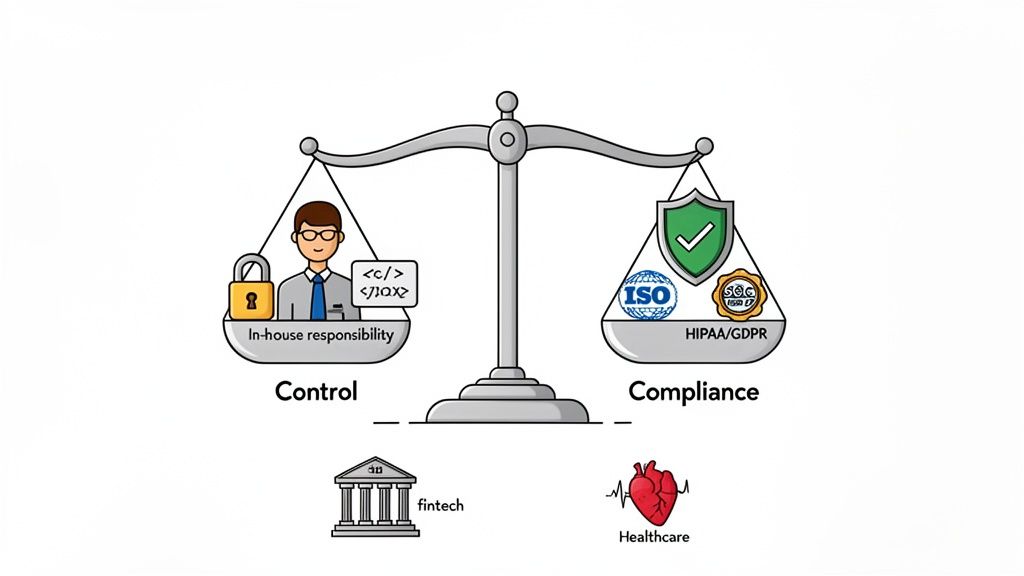
Managed services flips this dynamic on its head. You're not just outsourcing work; you’re transferring a significant chunk of the risk and compliance burden to a partner. Everything is governed by a detailed Service Level Agreement (SLA) that spells out exactly what the provider is responsible for, including security, uptime, and performance.
This is a game-changer for businesses in highly regulated fields. A good Managed Service Provider (MSP) comes armed with a suite of certifications like ISO 27001 for information security or SOC 2 for data handling. These aren't just badges; they are proof that the provider meets internationally recognized standards, giving you built-in assurance.
Imagine a healthcare company handling sensitive patient records. Instead of building and maintaining a HIPAA-compliant infrastructure from scratch—a massive undertaking—they can partner with an MSP that lives and breathes healthcare IT. That provider takes on the responsibility for meeting those tough HIPAA requirements, dramatically cutting the client's compliance overhead and audit-related headaches.
The choice isn't black and white, like "total control" versus "no control." It's really a trade-off between direct, hands-on oversight and the outsourced assurance you get from a qualified partner. Let's break down how governance really differs between the two.
Staff Augmentation Governance:
This model gives you maximum control but requires serious in-house expertise in security and legal compliance.
Managed Services Governance:
Ultimately, the right choice from a risk perspective comes down to your internal capabilities. If you have a solid compliance team and need granular control over a highly sensitive project, staff augmentation is the clear winner. But if your goal is to reduce operational risk and lean on a partner's certified expertise to navigate a maze of regulations, a managed service is often the smarter, safer bet.
When you get down to brass tacks, the decision between staff augmentation and managed services often comes down to money and speed. It’s not just about the invoice you get at the end of the month. You have to look at the total cost, how quickly you can ramp up or down, and—most importantly—how fast you start seeing real results. Each model takes a completely different path to get you there.
Think of staff augmentation as a pay-as-you-go, variable cost. You pay for individual people, usually by the hour or month, giving you fine-grained control over your budget. Managed services are the opposite; you’re on a predictable, fixed-fee plan where you pay for a guaranteed result or service level.
The biggest difference you'll see right away is on the bill. Staff augmentation is straightforward: you need three senior developers for six months, so your cost is their rate multiplied by their time. It's transparent and flexible, which is great for projects where the needs change on a dime.
But don't forget the hidden costs. The big one is your own team’s time. Your managers are the ones spending hours interviewing, onboarding, assigning tasks, and checking in on the augmented staff. That time is a real expense, even if it doesn't show up on the vendor's invoice.
Managed services give you a much cleaner financial forecast. You agree to a fixed monthly or yearly fee for a specific set of outcomes, all laid out in a Service Level Agreement (SLA). This predictability is a huge win for budgeting and long-term planning. To really grasp the potential ROI, it’s worth exploring the specific Managed IT Services Benefits that come with a fixed-cost, outcome-driven partnership.
Total Cost of Ownership Insight: With staff augmentation, your true cost is the vendor's bill plus the unbilled hours your own managers sink into day-to-day oversight. Managed services wrap that management overhead into their fixed fee, giving you a much clearer picture of the actual project cost.
How fast can you pivot when project needs change? This is where the two models really show their differences. Staff augmentation offers granular scalability. Need to add a single QA engineer for a two-week sprint? It's usually a quick and simple process. Need to scale back after a big launch? You can do it without getting bogged down in contract talks.
This kind of flexibility is perfect for agile teams where the scope can shift from one sprint to the next. You can match your team size to your immediate workload, so you're not paying for people to sit on the bench.
Managed services, on the other hand, scale at the service level, not the individual level. If you need more horsepower, you’ll typically adjust your SLA by moving to a higher service tier or renegotiating the agreement. That process isn't nearly as fast as just adding another developer to your Slack channel.
Time-to-value is all about how quickly your investment starts paying off. Staff augmentation often wins the race off the starting line. A good provider can have vetted candidates in front of you within days, meaning you could have a new developer pushing code in less than a week.
The catch? That initial speed can be slowed down by the internal learning curve. The new person still has to learn your way of doing things—your processes, your tools, your company culture—before they're truly firing on all cylinders.
A managed services engagement might take longer to get going. There's an initial setup phase for discovery, defining the SLA, and getting communication channels sorted. But once that foundation is built, the provider takes over and starts delivering without needing you to hold their hand. For companies exploring global hiring, it's vital to weigh these financial nuances; our guide on offshore software development costs breaks this down further. The outcome-focused approach means that while the first step might be slower, the journey to a finished, delivered product can be much more direct because the provider owns the entire process.
It's one thing to understand the definitions of staff augmentation and managed services, but it’s another thing entirely to see how they play out in the real world. Let's move past the theory and look at four common business situations. Seeing how each model performs in a specific context is the best way to figure out which one is right for you.
These examples will help translate the abstract comparisons into practical, decision-making clarity. By walking through them, you'll start to recognize the triggers and business needs that clearly point to one solution over the other.
This decision tree cuts right to the chase, boiling the choice down to its core question.
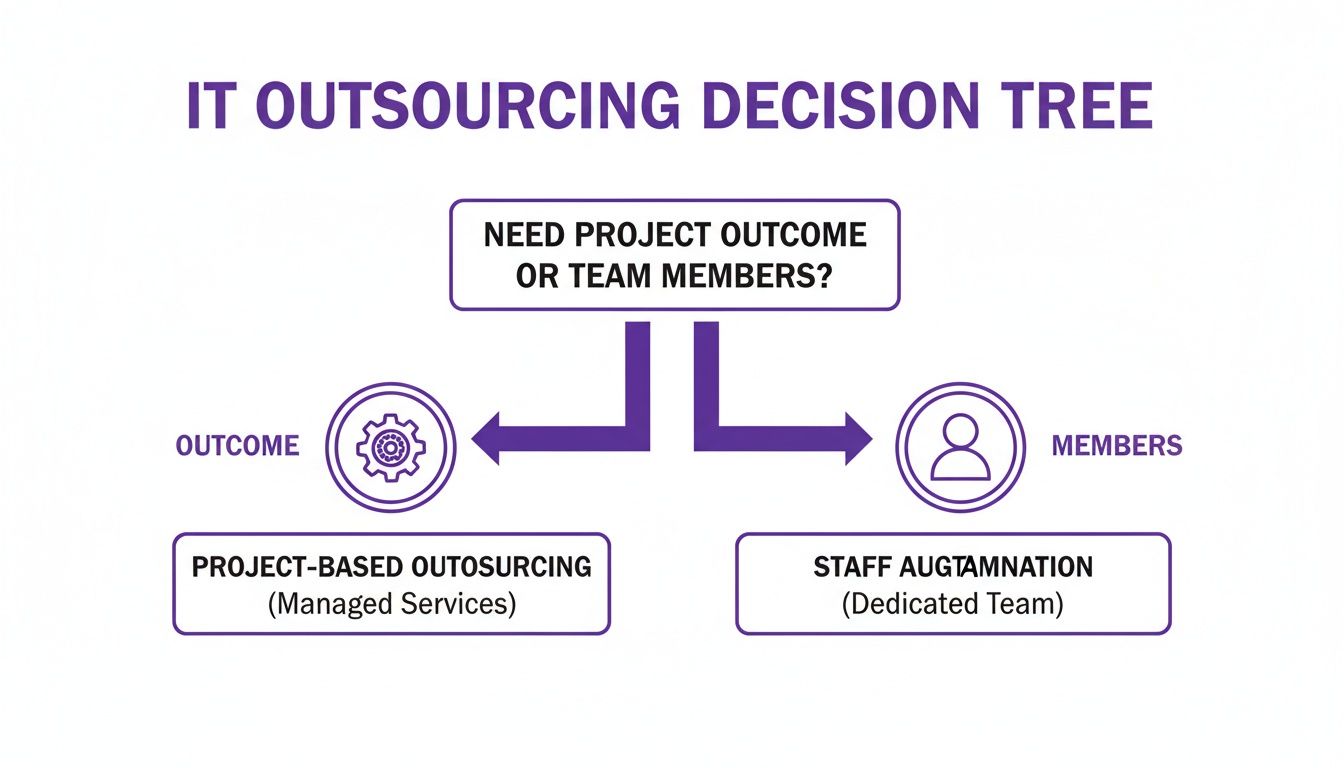
As the infographic shows, it often comes down to this: if you need skilled people to join your team and follow your lead, you're looking for staff augmentation. If you need a guaranteed result for a specific project or function, managed services is the way to go.
A startup just landed its first round of funding. The goal is simple but urgent: build a Minimum Viable Product (MVP) as fast as possible. The founding CTO has a crystal-clear vision for the product's architecture and user flow, but they just don't have the developers to bring it to life.
In this situation, staff augmentation is the ideal choice.
The startup’s success hinges on rapid iteration and direct control. The CTO needs to be in the weeds, guiding every feature and reviewing code to ensure the product perfectly matches their vision. Bringing in individual developers through staff augmentation provides the necessary technical muscle while keeping the project's direction firmly in the hands of the founding team.
Why it works: They aren't outsourcing their vision; they're renting the skills to build it. Staff augmentation gives the startup the exact talent it needs without surrendering strategic and creative control.
Picture a successful SaaS company with a major new feature planned for the next quarter. There’s a problem, though—their in-house development team is completely maxed out just maintaining the current platform. They need to add three senior backend engineers and a DevOps specialist to hit their deadline, but they can't afford the time and HR headache of a traditional hiring cycle.
Once again, staff augmentation is the clear winner.
This company already has a mature, well-oiled development machine with strong project management. They don’t need to hand off the project; they need to temporarily boost their team's bandwidth and inject very specific skills. Staff augmentation lets them quickly find and integrate pre-vetted engineers who can jump right into their existing Agile sprints and contribute from day one.
A large financial institution runs on a critical—but aging—legacy system. This system demands constant monitoring and maintenance to guarantee 24/7 uptime and meet strict compliance standards. The problem is, the in-house IT team is focused on building new, forward-thinking products and doesn't have the specialized (and often outdated) expertise to manage the old system effectively.
This is a textbook case for managed services.
The company's goal isn't to manage a team; it's to secure a reliable outcome: a stable, secure, and always-on legacy system. They want to set it and forget it. By signing a Service Level Agreement (SLA) with a managed service provider, they can lock in uptime guarantees, response times, and security protocols. The provider assumes full responsibility for the system, freeing up the internal team to innovate.
A savvy entrepreneur with a background in marketing, not code, has a brilliant idea for a new mobile app. They've secured the funding and have a solid business plan, but they have zero experience with software development, project management, or building a technical team.
For this founder, managed services is the only logical path.
They aren't looking for a few coders; they need an end-to-end partner to turn their concept into a polished, market-ready product. A managed service provider acts as their outsourced technology department, taking complete ownership of the project's success. The founder supplies the vision, while the provider handles everything else—from strategy and UI/UX design to development, testing, and deployment.
Whether you land on the hands-on control of staff augmentation or the outcome-driven model of managed services, success still boils down to one thing: the quality of the people doing the work. The real challenge isn’t just picking a model; it's making it work. This is where finding, vetting, and integrating the right professionals becomes the most important step.
This isn’t about just filling a seat. It's about finding a person or a team that can plug into your workflow and start creating value immediately. A good partner takes the risk out of this critical phase, turning what could be a months-long headache into a quick, efficient process.
When you go with staff augmentation, you’re looking for a direct line to elite, pre-vetted developers who can jump right into your existing team. The whole point is to speed things up, not get stuck in a hiring cycle that eats up your team's time. This is where a platform like HireDevelopers.com really shines, connecting you with rigorously screened engineers, often in as little as 24 hours.
This completely bypasses the usual gamble of using freelance sites or traditional recruiters. Forget sifting through stacks of resumes. You get a handpicked list of candidates whose technical chops and experience have already been verified, letting you bring top-tier talent on board in under a week.
Accessing a global talent pool means you can find specialists with rare, niche skills that might be impossible to find locally. This gives you a serious competitive advantage without the overhead and commitment of a full-time hire.
If you're leaning toward managed services, you don't have to lock yourself into a rigid, long-term contract with a traditional firm. There’s a more modern, flexible way: building a complete, dedicated team that operates as a self-managed unit. This hybrid strategy gives you the best of both worlds.
You get the main benefit of a managed service—less management and administrative burden on your end—but you keep the transparency and direct communication you’d have with an in-house team. A talent platform can help you do this by:
This approach lets you get the outcome you want without giving up all the control. You end up with a dedicated team whose only focus is your project's success, acting as a genuine extension of your company. For a deeper dive into sourcing technical experts, our guide on how to find developers lays out some proven strategies.
Ultimately, the right partner doesn’t just give you people; they deliver a solution that fits the way you want to work, making sure you have the talent you need to make your strategy a reality.
Even after breaking down the differences between staff augmentation and managed services, a few specific questions always seem to pop up. Let's tackle some of the most common ones that come up in real-world situations to help you make that final, confident choice.
These aren't just hypotheticals—they're the practical hurdles teams face when putting these models into action.
Absolutely. In fact, it's a pretty common move. Many companies kick things off with staff augmentation to get a new product or feature out the door quickly. Once the dust settles and the product is stable, they often transition to a managed service for the long haul of maintenance and support.
The trick is to plan the handoff carefully. You'll need a solid knowledge transfer process to make sure the new team understands the ins and outs of the project, preventing any major disruptions.
When you're looking at a managed services contract, a few things should make you pause. Be on the lookout for vague Service Level Agreements (SLAs). If they don't have concrete, measurable metrics for things like uptime and performance, that's a problem.
Also, watch out for contracts with fuzzy exit clauses, long lock-in periods that don't include performance reviews, and hidden fees for services you thought were part of the deal. A provider you can trust will be upfront and transparent about all of it.
Expert Tip: A solid managed services contract is all about the outcome, not just the tasks. If the SLA talks more about what the provider will do instead of what they will deliver, consider that a major red flag.
Managing a team spread across the globe isn't as daunting as it sounds, but it does demand a smart approach to communication.
Here’s what works:
Careers in cryptography are high-stakes, high-reward. These are the people who build and break the digital codes that secure our world, protecting everything from your bank account to global decentralized networks. It's a field with massive growth and serious six-figure salary potential. Why Cryptography Careers Are Exploding Welcome to the new frontier of digital trust. […]

The demand for remote machine learning jobs isn't just a trend anymore; it's a fundamental shift in how AI talent is hired and deployed. For ML professionals, this opens up a world of possibilities, not just in terms of flexibility, but also significant financial upside. Companies are in a fierce competition for top talent, and […]

The software engineering field is constantly shifting, with certain specializations commanding unprecedented salaries. But which roles truly offer the highest earning potential, and what does it take to secure one? This data-driven guide breaks down the best paying software engineering jobs, moving beyond vague titles to offer a detailed roadmap for career advancement and strategic […]


