

The real difference boils down to one simple question: do you need more hands on deck, or do you need to offload an entire function? Staff augmentation gives you direct control over individual experts who slot right into your existing team. Managed services, on the other hand, lets you hand off responsibility for a specific […]

The real difference boils down to one simple question: do you need more hands on deck, or do you need to offload an entire function? Staff augmentation gives you direct control over individual experts who slot right into your existing team. Managed services, on the other hand, lets you hand off responsibility for a specific outcome to a vendor who guarantees the result.
Your choice ultimately hinges on whether you'd rather keep your hands on the wheel or let someone else do the driving.
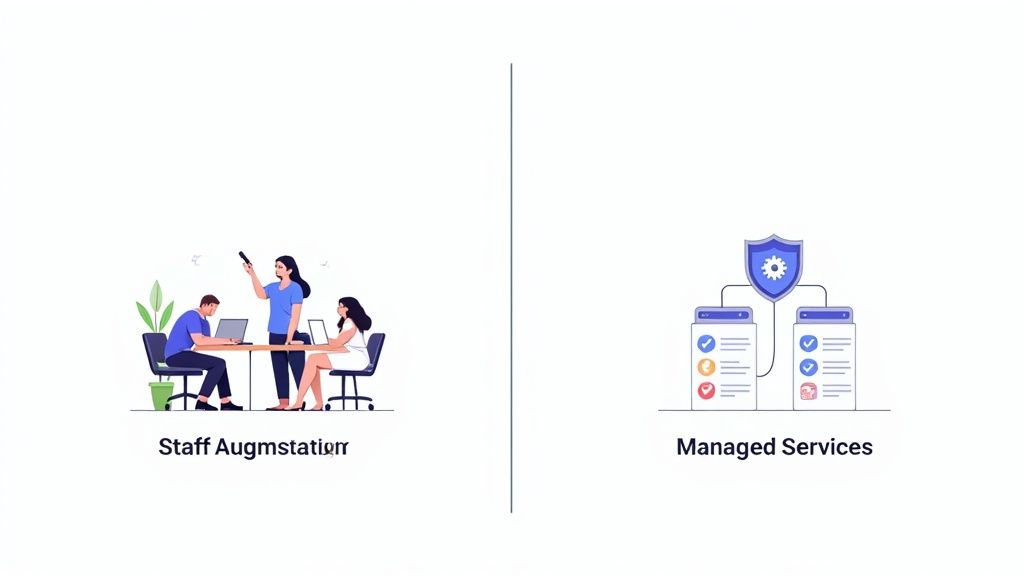
Picking the right talent model isn't just a small detail—it's a strategic decision that directly affects your budget, project control, and your ability to scale. While both staff augmentation and managed services bring in outside help, they solve completely different business problems. Getting to grips with how each one works is the first step to making the right call.
Staff augmentation is all about adding specific, skilled people to your team for a set period. Think of it as bringing on a specialized contractor who works under your direct management, follows your processes, and becomes a part of your daily workflow. This model is perfect when you have a temporary skill gap or just need more horsepower to get a project over the finish line.
The main characteristics are pretty straightforward:
The tech talent shortage has made this model incredibly popular. If you're looking for a deep dive, this comprehensive guide to team augmentation is a great place to start.
With managed services, you're not hiring people; you're buying a result. You outsource an entire business function—like IT support, cybersecurity, or cloud infrastructure management—to a third-party provider. This provider, often called a Managed Service Provider (MSP), uses its own team, tools, and processes to deliver a specific outcome defined by a Service Level Agreement (SLA).
This model is built on:
The core distinction is responsibility. With staff augmentation, you own the project and manage the people. With managed services, the provider owns the outcome and manages their own process to achieve it.
This approach is gaining ground fast. With U.S. employers only managing to fill 60% of available tech roles between 2016 and 2019, it's no surprise that the global staff augmentation market is projected to grow by a staggering $81.87 billion between 2021 and 2025.
Here's a quick look at how the two models stack up side-by-side.
This table offers a high-level summary of the fundamental differences between these two powerful outsourcing models.
| Decision Factor | Staff Augmentation | Managed Services |
|---|---|---|
| Control Level | High (Direct internal supervision) | Low (Focus on outcomes and SLAs) |
| Responsibility | Client owns the project outcome | Provider owns the service delivery |
| Cost Structure | Variable (Often hourly or daily rates) | Fixed (Predictable monthly fees) |
| Best For | Filling skill gaps, short-term projects | Long-term, non-core functions |
| Integration | Deeply integrated into your team | Operates as a separate, external partner |
Ultimately, the table makes it clear: if you need to maintain tight control and fill a specific role, augmentation is your answer. If you'd rather define a goal and let an expert team handle the "how," managed services is the way to go.
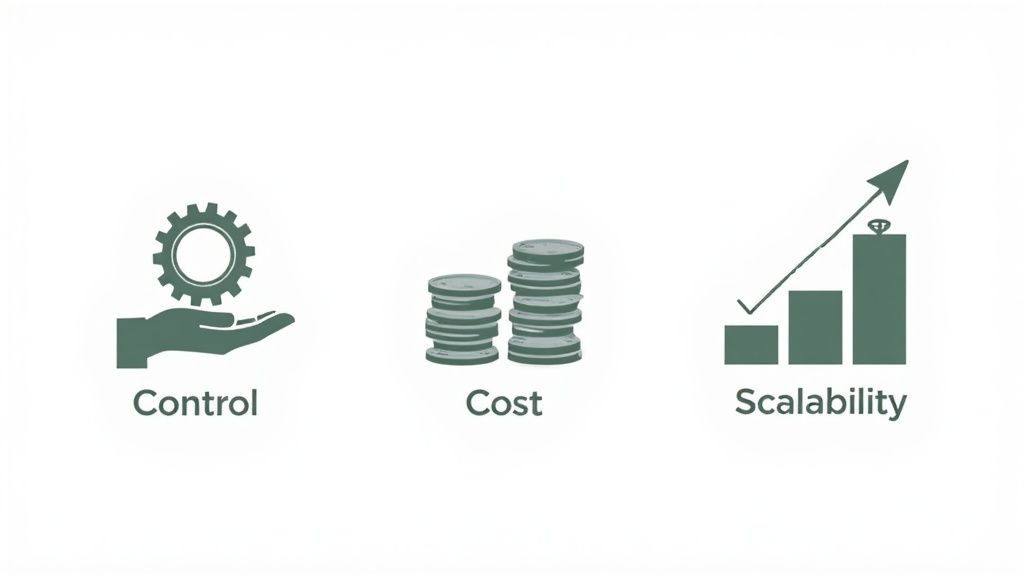
When you get down to the brass tacks of staff augmentation versus managed services, the conversation quickly shifts from definitions to what really matters: control, cost, and scalability. These three pillars will ultimately shape your daily operations, your budget, and how you plan for growth. The path you choose has a direct, tangible impact on your team’s agility and your company's financial health.
It's crucial to understand these operational differences to make sure your outsourcing strategy actually supports your business goals. One model gives you direct, hands-on command of individual talent, while the other lets you offload the responsibility for an entire business function.
With staff augmentation, you retain complete managerial control. It’s that simple. The developers or specialists you bring on are, for all intents and purposes, extensions of your in-house team. They join your daily stand-ups, use your project management tools, and report directly to your team leads.
This setup is perfect for leaders who need to be in the weeds, steering project direction day-to-day and making sure new talent blends seamlessly into the existing company culture and workflows. You aren’t just hiring a skill set; you're embedding a person directly into your team’s DNA.
Managed services, on the other hand, is built on a totally different philosophy of control. You delegate the full responsibility for a function—like IT security or cloud infrastructure—to your provider. Your job shifts from managing people to managing a partnership, with a Service Level Agreement (SLA) as your guide.
With staff augmentation, you manage the process and the people. With managed services, you manage the outcome, holding the provider accountable for hitting predefined metrics.
This hands-off approach frees your leadership from the daily operational grind. Instead of worrying about who’s doing what, you focus on the results. Is the provider delivering the promised 99.95% uptime? Are they meeting the security benchmarks you agreed upon?
The financial models for these two approaches are as different as their management styles. Staff augmentation almost always uses a variable, time-and-materials cost structure. You pay an hourly or daily rate for each person, making it a flexible operational expense (OpEx).
This gives you fantastic cost-efficiency for short-term projects or those with unpredictable needs. You can bring on extra firepower for a critical sprint and then scale back down immediately, all without the financial baggage of a permanent hire.
In contrast, managed services are based on a predictable, fixed-fee model. You pay a set monthly or annual fee for an entire package of services. For any business that needs to forecast IT spending with confidence, this predictability is a huge win.
When we talk about scalability, it’s not just about hiring more people. It’s about how quickly and efficiently your organization can react to new demands. Both models help you grow, but they’re designed for very different kinds of growth.
Staff augmentation delivers rapid, on-demand scalability. Need three more senior developers to hit a tight launch deadline? A strong partner like HireDevelopers.com can have vetted pros ready to plug into your team in just a few days. This kind of agility is invaluable for navigating the classic peaks and valleys of software development.
Managed services provides a more structured, strategic scalability. Growing here usually means renegotiating your SLA to cover more services or a larger user base. It’s less about adding individual bodies and more about expanding the provider’s scope of responsibility. It’s a slower, more deliberate way to grow, ensuring your core IT functions are rock-solid as the business expands. Often, this model works well with other talent strategies; for instance, you can learn more about how nearshore software development can complement both in-house and outsourced teams.
Deciding between staff augmentation and managed services really boils down to your specific situation. Staff augmentation isn't just a band-aid solution; it's a smart, strategic move when you need to plug a specific skill gap right into your current team. If your leadership is solid but you're just missing one key expert, this is often the perfect fit.
Think of it as precision hiring. You're not handing off a problem to someone else to solve. Instead, you're bringing the exact expertise you need in-house, giving you total control over the project's direction. The new team member slots right into your existing structure, using your tools and adopting your workflow from day one.
The classic use case for staff augmentation is the short-term project that requires a specialist your team just doesn't have. Let's say your company is moving its entire infrastructure to a new cloud platform over the next six months. Your IT crew is great, but nobody has deep, hands-on experience with this particular kind of migration.
Trying to hire a full-time cloud architect for a temporary gig is slow and expensive. Staff augmentation lets you bring in a veteran cloud engineer for exactly as long as you need them. They work alongside your team, share their knowledge, and once the migration is done, they move on. It’s a clean, cost-effective solution without the long-term overhead.
This approach works wonders for other scenarios too:
The core principle here is surgical precision. Staff augmentation is the right choice when you know exactly what skill you’re missing, the project scope is clear, and the timeline is finite. It’s about adding a specialist, not just another pair of hands.
Every business has its sprints and lulls. A software company might hit an "all hands on deck" phase during the final push for QA and bug-fixing before a major release. An e-commerce site might need extra backend engineers to keep things running smoothly during the holiday shopping frenzy.
In these moments, staff augmentation gives you the flexibility to scale your team up and down as needed. You can add three QA testers or two DevOps engineers for that critical two-month window without the red tape of traditional hiring and firing. This keeps your core team from burning out and helps you nail your deadlines without cutting corners on quality. For businesses looking into this model, exploring services for hiring dedicated resources can connect you directly with the right talent.
Staff augmentation is also a fantastic tool for business continuity. When a key developer goes on parental leave or a project lead takes a sabbatical, their absence can grind everything to a halt. This model lets you bring in a qualified professional to step into their role and keep projects moving forward.
Because the augmented team member works directly under your management, they can get up to speed quickly on your internal processes and maintain momentum. It's a much better solution than piling more work onto your already-busy team, which is a surefire way to kill productivity and morale. At the end of the day, it's all about keeping things stable and on schedule, even when your team composition changes temporarily.
While staff augmentation gives you a scalpel to add specific skills to your team, managed services is more like bringing in a fully equipped surgical team to handle an entire operation. You choose this route when you want to hand off a whole business function to an expert partner and focus your energy elsewhere. It’s the right call for companies that want guaranteed results without the day-to-day management headaches.
The core idea here is shifting from hiring individuals to partnering with a firm that owns the outcome. You're not just renting a developer; you're buying a result, all spelled out in a Service Level Agreement (SLA).
Managed services really shines when you need to outsource a function that demands constant attention and deep expertise. Imagine a mid-sized e-commerce business. Their website has to be up 24/7. Instead of hiring, training, and retaining an in-house team for server maintenance, security, and performance tuning, they can sign with a Managed Service Provider (MSP).
That MSP takes complete ownership of their cloud infrastructure. Their team guarantees that 99.99% uptime, handles security protocols, and manages every update. This frees the company’s own developers to do what they do best: build new features that actually make money.
Managed services is the go-to solution when a business function is critical but not a core competency. It allows you to leverage enterprise-grade expertise without the associated cost and distraction of building it yourself.
This model works exceptionally well for things like:
At its heart, the managed services model is all about predictability. You pay a consistent monthly fee and get a guaranteed level of service in return. This makes budgeting a breeze and gets rid of the financial roller coaster that often comes with managing complex IT systems on your own.
It's no surprise that the demand for this model is exploding, with MSPs projected to see a 56% increase in demand. The best providers also come with critical industry certifications like ISO and SOC, which gives you verified proof of their security and compliance standards. You can dive deeper into the trends in staff augmentation versus managed services on Multidots.com.
This outcome-based approach is a lifesaver for businesses in regulated industries. A healthcare startup, for instance, can partner with a managed services provider to ensure its entire IT infrastructure is HIPAA compliant. This doesn't just secure their data; it transfers the massive burden of managing compliance to an expert who is contractually on the hook for it.
Deciding between staff augmentation and managed services isn't about which one is "better" in a vacuum. It’s about which model fits the reality of your business right now. The best choice comes from an honest look at your team's capabilities, the specific needs of your project, and your company's long-term goals.
Get this decision wrong, and you could be looking at blown budgets, missed deadlines, or a frustrating loss of control. By weighing your situation against the core strengths of each approach, you can find a partner that genuinely fuels your growth instead of creating friction.
First things first: do you have the time, expertise, and frankly, the desire to manage more people? Your answer here is the biggest fork in the road.
Staff augmentation demands hands-on involvement. You're not just getting a developer; you're getting a new team member. You’ll be responsible for onboarding them, assigning their daily tasks, tracking performance, and making sure they gel with your existing team. If you have solid project managers with room on their plate, this model gives you incredible control over the day-to-day work.
But if your leadership team is already stretched thin, adding more direct reports will only slow things down. Managed services was built for this exact problem. You hand off the entire management headache to the provider, freeing your internal leaders to focus on the big picture instead of daily stand-ups and code reviews.
Key Takeaway: If your strength is project execution and you have the management bandwidth, staff augmentation is a fantastic tool. If you’re trying to slash management overhead and focus on your core business, managed services is the obvious choice.
Next, think about the work itself. Are you tackling a short-term, clearly defined project, or are you looking for help with an ongoing, critical business function?
Staff augmentation shines for projects with a distinct start and finish.
Managed services, on the other hand, is all about handling continuous, long-term operational needs. Think of the functions your business relies on daily but that aren't your core product—like 24/7 cybersecurity monitoring, ongoing application support, or running the entire IT helpdesk.
This is where you're buying an outcome, not just a person's time.
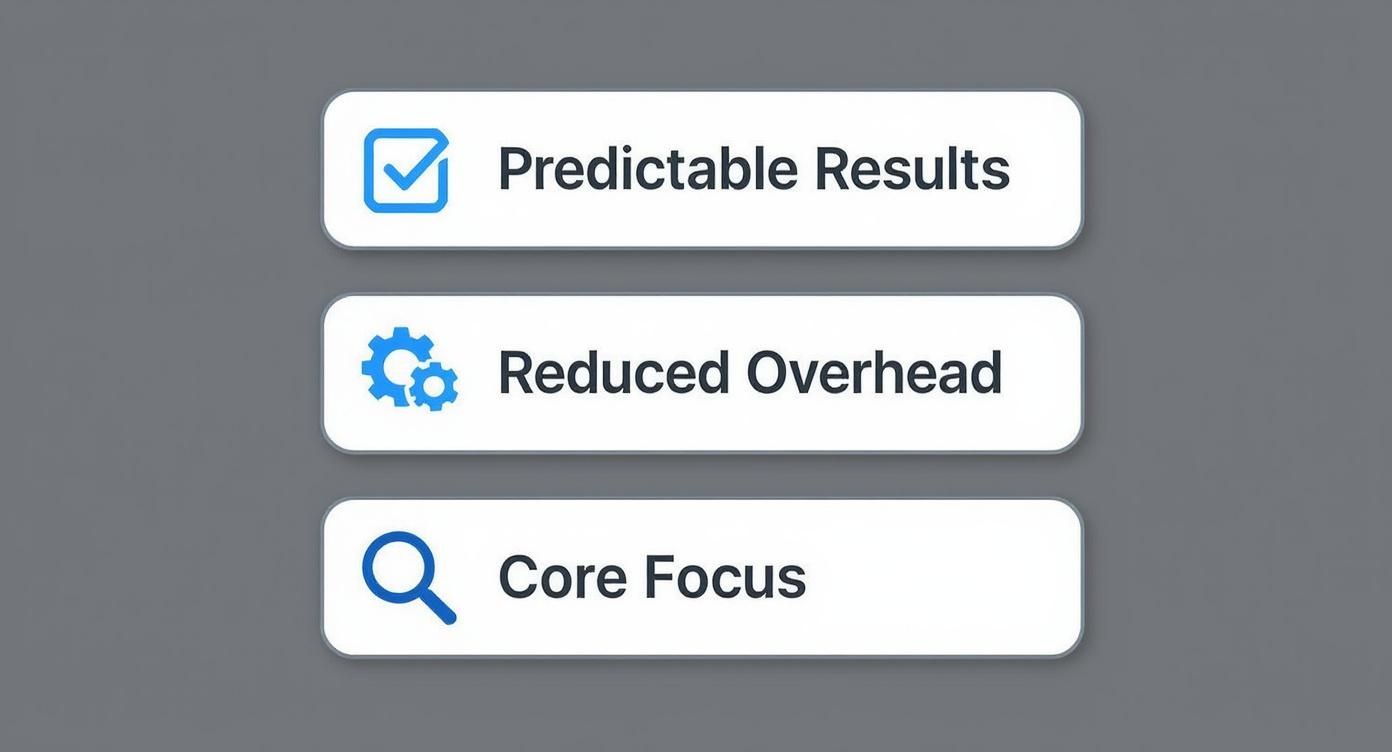
As the image shows, companies go this route to guarantee results, cut down on internal management, and sharpen their focus on what actually drives revenue.
Finally, take a hard look at your finances. What matters more right now: cost flexibility or budget predictability?
Staff augmentation works on a variable cost model, usually billed by the hour or day. This is fantastic for keeping a tight rein on project-specific expenses. You pay only for the exact talent you need, for exactly as long as you need them. It's a clean, flexible operational expense.
Managed services delivers the opposite: absolute budget predictability. You pay a fixed, recurring fee for a specific set of services and outcomes. This makes financial planning a breeze and kills the risk of surprise costs. For any business that needs to forecast its IT spending with confidence, that stability is a massive win. If this outcome-based model sounds right, you can dive deeper into the world of outsourcing custom software development in our comprehensive guide.
Picking between staff augmentation and managed services is just the first step. The real make-or-break decision? Choosing the right partner. A great partner feels like a natural extension of your own team, but a bad one just becomes a source of friction, draining time and money without delivering results.
You need to look past the sales pitch. It’s about digging into how they actually work, the quality of their people, and how they communicate. Taking the time to do this upfront is what prevents those costly mismatches everyone dreads.
When you’re looking at a staff augmentation firm, it all comes down to the talent. You’re essentially outsourcing your initial HR and technical screening to them, so you have to trust their judgment completely.
Here’s what to zero in on:
Here's the million-dollar question for any staff augmentation firm: "What percentage of candidates who apply actually make it through your screening?" A low number, like the top 1-3%, is a powerful sign that they don't compromise on quality.
Vetting an MSP is a completely different ballgame. You’re not just hiring a person; you’re handing over an entire business function and expecting guaranteed results. The focus shifts from individual skills to the provider's overall process, security standards, and reliability.
Your evaluation checklist should include:
No matter which path you take, a thorough vetting process is non-negotiable. To get a better sense of what a top-tier evaluation looks like, check out our deep dive into the developer vetting process at HireDevelopers.com, which details the high standards you should demand from any talent partner.
When you're weighing staff augmentation against managed services, a few key questions almost always come up. Here are some straightforward answers based on what we've seen work for hundreds of companies.
Absolutely. It’s actually a pretty common growth path. A company might start with staff augmentation to get a specific project off the ground. Once that project becomes a core, ongoing function, it makes sense to shift it to a managed service for better long-term stability and optimization.
The trick is to be upfront about this possibility with your potential vendors. Many of the best providers, like HireDevelopers, offer both models and can build a transition plan right into your initial agreement, making the handover seamless when the time comes.
There's no single right answer here; it really comes down to the problem you're trying to solve right now. Staff augmentation is often the go-to for startups because it’s flexible and light on the upfront investment. It’s perfect when you need a specific expert to help build your MVP or crush a short-term technical hurdle.
On the other hand, if you're missing an entire function—like you have no dedicated IT support or cybersecurity team—a managed service is a game-changer. It gives you a whole department's worth of expertise for less than the cost of hiring a full-time team from day one.
The question for a startup isn't about which model is "better," but what you need. Are you trying to fill one empty seat on the bus (staff augmentation), or do you need someone else to build and run the entire bus route for you (managed services)?
This is a big one, and the approach is fundamentally different between the two models. You need to get this right in the contract.
No matter which path you take, get your lawyer to review the IP clause. A little diligence here saves a world of headaches later on.
Fine-tuning is how you take a general-purpose Large Language Model (LLM) and teach it a specialized skill using your own data. The best analogy I’ve found is that it’s like teaching a brilliant, well-read graduate a specific job—whether that's writing marketing copy in your brand's voice or understanding niche medical jargon. Getting this right isn’t […]

At its core, mobile app UI/UX design is all about how your app looks, feels, and works for a real person. We're talking about two sides of the same coin: User Interface (UI), which covers all the visual elements like buttons and screens, and User Experience (UX), which is the overall feeling a person gets […]

Building data pipelines with Python for ETL has become the go-to approach for any team serious about modern data infrastructure. It shifts the entire process away from rigid, point-and-click tools and into a flexible, code-driven world where developers can build solutions that perfectly match their company's unique data challenges. Why Python Became the Standard for […]


