

In today's fast-paced tech landscape, the ability to scale development teams quickly without compromising on quality is a critical competitive advantage. Traditional hiring cycles, often spanning months, can stall momentum and lead to missed market opportunities. Staff augmentation has emerged as a powerful solution, but simply hiring temporary help is not enough. To truly succeed, […]

In today's fast-paced tech landscape, the ability to scale development teams quickly without compromising on quality is a critical competitive advantage. Traditional hiring cycles, often spanning months, can stall momentum and lead to missed market opportunities. Staff augmentation has emerged as a powerful solution, but simply hiring temporary help is not enough. To truly succeed, businesses need a strategic framework built on proven staff augmentation best practices.
This guide moves beyond generic advice to provide actionable strategies for transforming your approach to talent acquisition. We will explore a comprehensive set of best practices covering every stage of the process, from initial planning to long-term integration. A fundamental first step is identifying precisely where your internal team needs support. Conducting a comprehensive skills gap analysis is essential for pinpointing the exact expertise you need to source externally, ensuring you hire for impact rather than just headcount.
Throughout this listicle, you will discover how to implement sophisticated multi-stage vetting, structure flexible contracts that align with your project goals, and seamlessly onboard new members into your existing workflows. We will cover critical topics such as managing global teams across different time zones, ensuring robust security and IP protection, and establishing clear performance metrics for accountability.
Whether you're a startup CTO aiming to build an MVP on a tight budget, an enterprise leader needing specialized skills for a complex initiative, or a product manager looking to accelerate a feature release, these insights will help you leverage staff augmentation effectively. By mastering these principles, you can turn a temporary resourcing tactic into a powerful, long-term strategic asset that drives growth, innovation, and a significant return on investment.
One of the most critical staff augmentation best practices is moving beyond simple résumé reviews and embracing a rigorous, multi-stage vetting process. This approach layers multiple evaluation points to validate a candidate's technical prowess, problem-solving abilities, and soft skills before they ever meet your team. A comprehensive funnel ensures that the talent you augment your team with is not just qualified on paper but is a proven, high-caliber contributor ready to make an impact from day one.
A typical multi-stage process starts with an initial screening, often AI-powered, to match keywords and core qualifications, followed by automated coding challenges to establish a baseline of technical competency. The most promising candidates then advance to live technical assessments, deep-dive architectural discussions with senior engineers, and finally, a soft skills or cultural fit interview. This layered approach systematically filters out unqualified applicants, drastically reducing your team's interviewing burden and minimizing the risk of a bad hire.
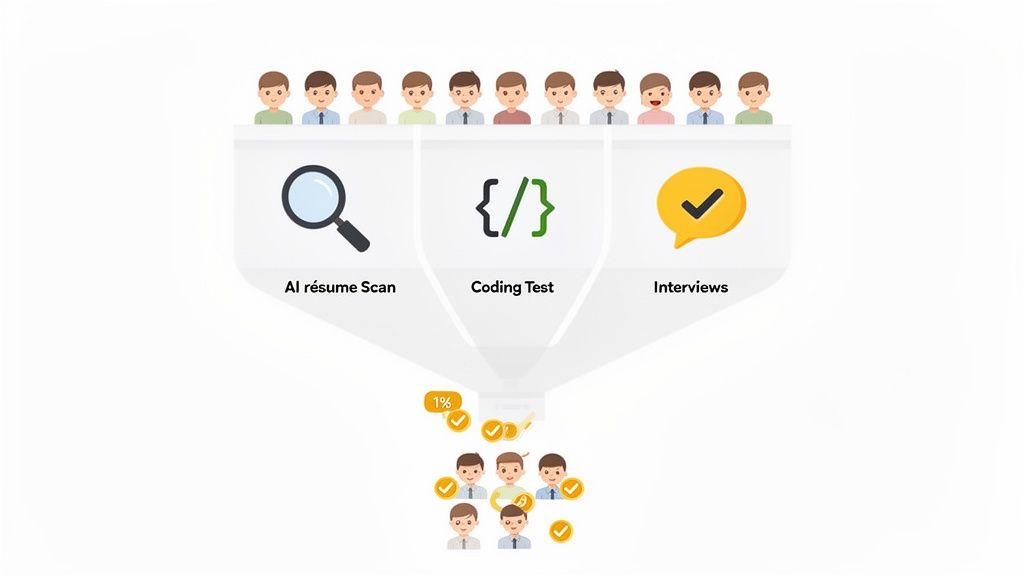
Platforms like HireDevelopers.com have built their entire model on this principle, utilizing a proprietary 4-stage vetting framework that ensures only the top 1% of applicants are presented to clients. This meticulous process is a key reason for their 98% client satisfaction rate. Similarly, services like Toptal are known for their exclusive network, accepting only the top 3% of talent that applies.
To implement this yourself or ensure a partner is doing it right, follow these actionable steps:
A core principle of modern staff augmentation best practices is to prioritize flexibility over rigid, long-term contracts. Opting for engagement models that eliminate minimum commitments, hefty upfront deposits, and long-term lock-ins provides the agility needed to scale your team in direct response to evolving project requirements and budget cycles. This approach empowers organizations to add specialized talent for a critical project phase and then scale down seamlessly, maximizing ROI without incurring unnecessary overhead.
This model is particularly advantageous for startups managing burn rates, agencies with fluctuating client workloads, and enterprises piloting new initiatives. By removing the friction of traditional hiring, flexible contracts allow you to access top-tier talent on a month-to-month basis. This significantly de-risks the investment, turning staff augmentation into a nimble, operational expenditure rather than a long-term capital commitment. It gives you the power to adapt your workforce in real time.
Leading platforms have made this model their standard offering. HireDevelopers.com, for instance, provides a month-to-month engagement model without minimum commitments, a feature leveraged by over 500 startups to manage their development needs with precision. Similarly, freelance marketplaces like Upwork and Fiverr offer hourly and project-based contracts that give businesses complete control over duration and spend.
To effectively leverage this flexibility, follow these actionable steps:
One of the most transformative staff augmentation best practices is to look beyond your local market and leverage a global talent pool. This approach unlocks access to a broader range of specialized skills, offers significant cost efficiencies, and can even enable a 24/7 development cycle. By strategically sourcing talent from regions like Europe, Latin America, and Asia, companies can find the exact expertise they need without being constrained by geographic boundaries or inflated local salaries.
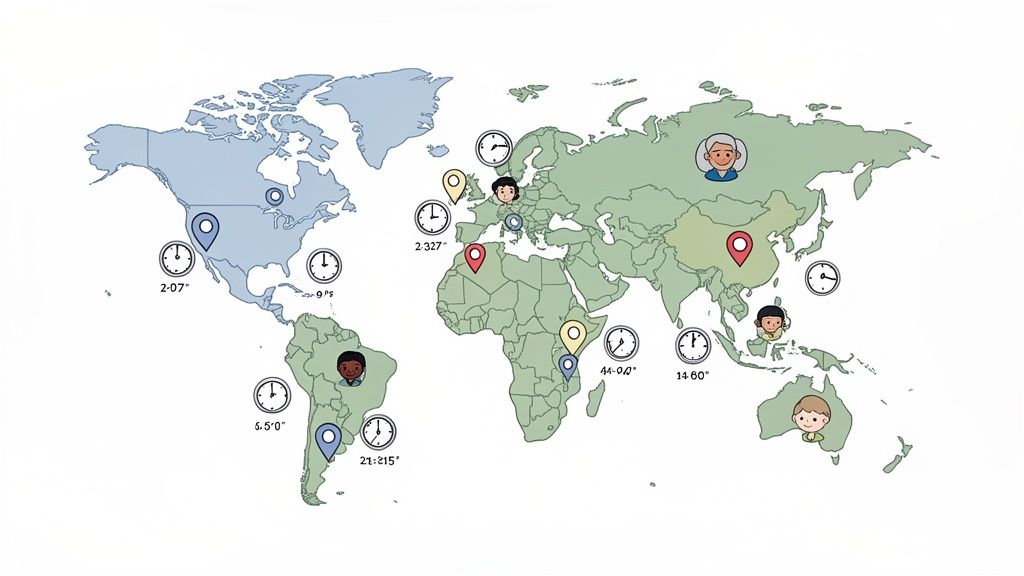
This global strategy is a proven model for success. Companies like GitLab and Automattic have built highly effective, fully distributed teams across dozens of countries, enabling continuous product development. Similarly, many US startups work with platforms like HireDevelopers.com to engage elite developers from Latin America, often reducing development costs by 60-70% while maintaining high-quality output. The key is a deliberate approach to time zone management and communication.
Tapping into a worldwide talent pool requires a remote-first mindset and robust processes. When executed correctly, it gives your organization a powerful competitive advantage by optimizing both budget and velocity. Explore more about the benefits and strategies when you hire offshore developers to see how it can fit your needs.
To ensure your global team integrates smoothly and productively, follow these actionable steps:
In a competitive market where project timelines are constantly shrinking, speed is a strategic advantage. One of the most impactful staff augmentation best practices is leveraging platforms that offer rapid candidate matching, delivering a curated shortlist of qualified, pre-vetted professionals within 24 hours. This model bypasses the weeks or even months of traditional sourcing, screening, and interviewing, allowing you to fill critical roles and kickstart projects almost immediately. It combines AI-powered matching with extensive, ready-to-deploy talent pools to dramatically compress your time-to-hire.
This accelerated process is not about cutting corners; it's about efficiency. By pre-vetting thousands of developers and using sophisticated algorithms to match your specific technical and cultural requirements, these services ensure that the candidates you see are already a strong fit. This allows your team to focus its energy on the final, high-value interview stages, making faster decisions without sacrificing quality. The result is a streamlined hiring workflow that gets the right talent integrated into your team in days, not months.

This practice is a core pillar of modern staff augmentation platforms. For example, HireDevelopers.com has built its reputation on its ability to deliver a shortlist of top-tier, vetted developers within 24 hours, a model successfully adopted by over 800 companies to accelerate their roadmaps. Similarly, platforms like Hired.com use auto-matching to reduce the average hiring cycle to just 10-14 days.
To get the most out of a rapid matching service and ensure a successful outcome, follow these actionable steps:
Engaging global talent through staff augmentation introduces significant operational complexities, including navigating international payroll, tax laws, and labor regulations. One of the most impactful staff augmentation best practices is to offload these burdens to a partner that provides comprehensive payroll and compliance support. This managed service model handles everything from currency conversions and tax withholding to benefits administration, effectively acting as an Employer of Record (EOR) and insulating your business from legal and financial risks.
This approach is crucial for companies scaling internationally without establishing local legal entities. It transforms a complex, resource-intensive HR function into a streamlined, predictable operational expense. By outsourcing these administrative tasks, your team can focus entirely on core business objectives and product development, rather than becoming experts in Brazilian labor law or Indian tax codes. This strategy ensures your global team members are paid accurately and on time while your company remains fully compliant with all local regulations.
Many modern talent platforms have integrated this service directly into their offering. For example, HireDevelopers.com offers free payroll and compliance support in over 40 countries, a significant value-add that removes major barriers to hiring global talent. Other platforms like Remote.com and Deel specialize in this area, providing robust EOR and payroll services that cover a vast number of countries, though typically as a premium, paid service.
To effectively leverage this practice, whether through a partner or by selecting a specialized vendor, follow these key steps:
One of the most compelling staff augmentation best practices involves leveraging direct-matching models that offer significant cost savings without compromising on talent quality. By connecting directly with pre-vetted nearshore and offshore talent, companies can bypass the exorbitant markups of traditional staffing agencies. This approach provides transparent pricing structures, leading to documented cost reductions of 50-80% compared to hiring locally.
The core principle is efficiency: these platforms streamline sourcing, vetting, and compliance, passing the operational savings directly to the client. Instead of opaque, bundled fees, you get a clear breakdown of the developer's rate and the platform's slim margin. This transparency allows businesses to reallocate budget toward core product development or expanding the team further, maximizing ROI on every engineering dollar spent.
Platforms like HireDevelopers.com are built on this model, enabling clients to achieve savings of 60-70% over equivalent US-based hires by providing direct access to top global talent with straightforward pricing. Similarly, providers like Andela focus on a cost-effective model that has been shown to reduce enterprise staffing expenses by over 50%. This direct-access approach is key to scaling engineering teams affordably.
To ensure you are maximizing savings while maintaining quality, follow these actionable steps:
One of the most powerful staff augmentation best practices is leveraging flexible engagement models to build a team that perfectly matches your project’s unique demands. Instead of being locked into a one-size-fits-all hiring approach, this strategy allows you to blend individual contractors, part-time specialists, and even entire augmented teams. This adaptability ensures you can right-size your resources, optimize costs, and access specific skill sets precisely when you need them without the overhead of traditional hiring.
This approach moves beyond simply adding headcount and transforms staff augmentation into a strategic tool for resource management. For instance, a project might require a full-time lead developer, a part-time DevOps specialist for initial setup and ongoing maintenance, and an individual contractor for a niche integration. This model allows organizations to scale resources up or down in response to project milestones, budget cycles, and shifting business priorities, ensuring maximum efficiency and ROI.
Partners like HireDevelopers.com are built to support this flexibility, offering engagement models that range from sourcing individual part-time experts to assembling complete, pre-vetted development squads. This allows companies to tailor their augmented team structure on demand. For example, Canva successfully maintains agility by supplementing its core team with a 20% augmented workforce, while Discord has used a hybrid model of full-time teams plus part-time specialists to tackle specific technical challenges.
To effectively implement a flexible team composition, follow these actionable steps:
One of the most powerful staff augmentation best practices is partnering with a service that maintains a deep, pre-vetted talent pool categorized by specific technologies. Instead of starting your search from scratch, this approach allows you to tap into a curated database of developers whose skills in Frontend, Backend, AI/ML, DevOps, and other niche areas have already been rigorously validated. This significantly accelerates the hiring timeline and minimizes the risk of a skills mismatch, ensuring you connect with precisely the right expert for your project.
This model moves beyond generic "Full-Stack Developer" labels to granular, verified expertise. When a partner has already confirmed a candidate’s proficiency in a specific framework like Svelte, a database like ScyllaDB, or a cloud platform like Google Cloud, your team can bypass foundational screening and focus directly on project-specific and cultural fit interviews. This is crucial for projects with tight deadlines or those requiring rare, specialized knowledge that is difficult to source through traditional channels.
Platforms like HireDevelopers.com have built their service around this principle, maintaining a talent network with validated expertise across more than 800 distinct technologies. This allows them to match clients with specialists in everything from mainstream languages to emerging tech stacks within days, not weeks. Similarly, platforms like Stack Overflow or GitHub offer insights into a developer's demonstrated skills through their public contributions and community engagement, serving as a form of passive validation.
To make the most of this best practice, consider these actionable steps:
One of the most impactful staff augmentation best practices is implementing a systematic onboarding and performance management framework. Simply giving a new developer system access is not enough; a structured process that accelerates knowledge transfer, integrates them into team culture, and continuously monitors performance is essential. This ensures augmented staff ramp up quickly, contribute meaningfully from the start, and remain aligned with project goals, maximizing the return on your investment.
A comprehensive approach combines a detailed onboarding plan with ongoing engagement and formal performance check-ins. It starts with a "Day 1" checklist covering tools and introductions, moves to a "Week 1" plan for codebase deep-dives, and transitions into a clear 30-60-90 day performance monitoring schedule. This proactive management model prevents augmented staff from feeling isolated, addresses issues before they escalate, and builds a foundation for a successful long-term partnership.
Platforms like HireDevelopers.com streamline this process by providing structured performance reviews at 30, 60, and 90-day intervals, ensuring both clients and developers have a clear feedback loop. This model is inspired by industry leaders like Google, which uses extensive onboarding to significantly reduce new hire ramp-up time. The goal is to make integration a deliberate, repeatable process, not an afterthought.
Follow these actionable steps to create a robust onboarding and monitoring system:
Choosing the right staff augmentation partner is as critical as selecting the right candidate. Strategic vendor evaluation involves moving beyond a simple cost comparison to a holistic assessment of a partner's reliability, quality, and long-term viability. This best practice ensures you build a sustainable partnership that can scale with your needs, mitigate risks, and consistently deliver high-caliber talent, preventing the costly cycle of switching vendors due to poor performance.
A systematic approach to vendor management treats the relationship as a strategic alliance rather than a transactional one. It begins with a rigorous due diligence process, assessing factors like their vetting procedures, client support responsiveness, compliance infrastructure, and cultural alignment. Once selected, ongoing relationship management through regular reviews and clear communication ensures the partner remains aligned with your evolving business goals, guaranteeing consistent value and minimizing potential disruptions.
Companies like Salesforce and AWS build robust, reliable ecosystems by holding partners to stringent, documented quality standards. Similarly, HireDevelopers.com has been selected by over 800 companies because its consistent delivery and transparent processes make it a dependable long-term partner. This level of trust is built on a foundation of verifiable quality and structured relationship management. To aid in identifying potential partners, explore this analysis of leading IT staff augmentation companies to create a shortlist.
Follow these steps to evaluate and manage your staff augmentation partners effectively:
| Solution | Implementation complexity | Resource requirements | Expected outcomes | Ideal use cases | Key advantages |
|---|---|---|---|---|---|
| Multi-Stage Technical Vetting and Skills Validation | High — multi-step workflows and specialized assessments | Assessment platforms, AI résumé tools, interview panels, SMEs | Higher match quality; faster time-to-productivity; improved retention | Senior or mission-critical hires; roles requiring deep technical fit | Objective, data-driven selection; reduces cultural/technical mismatches |
| Flexible Engagement Models and No Minimum Commitments | Low–Medium — contract management and renewals | Legal/contract templates, account managers, billing systems | Rapid scaling up/down; lower financial risk | Startups, MVPs, agencies, variable-budget projects | No long-term lock-ins; cost predictability; quick trial periods |
| Global Talent Pool Access Across Multiple Time Zones | Medium–High — cross-border coordination and compliance | Payroll/compliance partners, multilingual teams, async tools | Access to specialized skills; cost savings; extended development hours | Rapid scaling, 24/7 development, niche skill shortages | Larger talent pool; time-zone coverage; significant cost efficiency |
| Rapid Candidate Matching and 24-Hour Shortlist Delivery | Medium — AI matching plus human review and ATS integration | Large pre-vetted talent pool, matching algorithms, recruiting ops | Shortlists within 24h; shortened time-to-hire and reduced vacancy cost | Urgent hires, fast-moving projects, short deadlines | Speed and predictability; minimizes hiring cycle time |
| Free Payroll and Compliance Support for Global Operations | High — multi-jurisdiction legal and tax complexity | Payroll engines, legal experts, EOR services, payment rails | Reduced compliance risk; simplified international hiring | Companies expanding internationally or hiring remote staff | Removes HR/payroll burden; single invoicing; legal compliance |
| Transparent 50-80% Cost Savings Through Direct Matching | Low–Medium — pricing transparency and direct contracting | Regional pay data, cost calculators, direct contracts | Significant personnel cost reductions; improved ROI | Cost-sensitive startups, budget-constrained product builds | Measurable savings; transparent cost breakdowns |
| Team Composition Flexibility (FT, PT, Contractors, Teams) | Medium — coordination across engagement models | Diverse talent marketplace, account management, onboarding flows | Right-sized teams; flexible scaling; optimized budgets | Projects with changing scope, scaling phases, special initiatives | Precise resource allocation; supports hybrid staffing strategies |
| Pre-Vetted Specialized Expertise Across 800+ Technologies | High — continuous skill validation and maintenance | Validation frameworks, certification tracking, domain experts | Rapid matching for niche tech; reduced verification effort | Niche technology hires, complex technical projects | Deep specialization; faster time-to-productivity in specific stacks |
| Structured Onboarding, Knowledge Transfer, and Monitoring | Medium–High — process design and monitoring tooling | Documentation, mentors, automation scripts, PM tooling | Faster ramp-up (weeks); fewer onboarding errors; early issue detection | Integrating augmented staff, long-term engagements | Improves retention and productivity; measurable KPIs |
| Strategic Vendor Evaluation and Relationship Management | Medium — evaluation frameworks and governance | RFPs, audits, reference checks, SLA management | Consistent vendor quality; better negotiation leverage; lower risk | Enterprises managing multiple vendors or high-volume hires | Reduces vendor risk; enables scale and predictable outcomes |
Navigating the landscape of modern talent acquisition requires more than just filling an open role; it demands a strategic, agile, and forward-thinking approach. The staff augmentation best practices detailed throughout this guide are not merely suggestions but a comprehensive framework for transforming your hiring process from a reactive necessity into a proactive engine for growth and innovation. By moving beyond traditional hiring constraints, you can build a resilient, high-performing team capable of delivering exceptional results in a competitive market.
The journey begins with a fundamental shift in mindset. Instead of viewing augmented staff as temporary fixes, see them as integral, strategic contributors to your core objectives. This perspective reframes the entire process, emphasizing the importance of rigorous vetting, seamless integration, and long-term partnership over transactional, short-term engagements.
Mastering staff augmentation is about executing on a series of interconnected principles. Let's distill the most critical takeaways:
Implementing these staff augmentation best practices is an iterative process. Here’s how to start today:
The ultimate goal of strategic staff augmentation is not just to fill a seat, but to inject specialized expertise, accelerate your roadmap, and build a more dynamic, globally competitive organization.
By adopting a strategic, deliberate approach, you unlock the true power of the global talent pool. You gain more than just developers; you gain a sustainable competitive edge, a faster time-to-market, and the operational flexibility to build what's next. The future of team building is here, and it’s more accessible, efficient, and powerful than ever before. It's time to stop just hiring and start building strategically.
A lot of founders reach the same point at the same time. Revenue is starting to move. Customers want reliability. Engineers need direction. The product has outgrown ad hoc decisions, but the business still isn't ready for a permanent executive seat. That gap creates expensive mistakes. The team ships features without a clear architecture plan. […]

Cloud computing stopped being a hosting decision a while ago. It's now a board-level question about speed, margin, resilience, and whether your team can ship AI-enabled products without turning infrastructure into a bottleneck. The striking part is the scale. Global public cloud spending is projected to exceed $830 billion in 2026, with the overall market […]

A hiring manager has 30 minutes, a resume full of Spring buzzwords, and one job opening that cannot afford a weak hire. A candidate has the same 30 minutes to prove they understand more than annotations and starter-project patterns. This context defines Spring MVC interviews. Strong interviews usually turn on practical judgment. Can the candidate […]


