

A software engineering contract is the legally binding agreement that spells out the entire working relationship between a company and a software engineer. Think of it as the project's official blueprint—it details everything from the scope of work and payment terms to who owns the final code. More than just a formality, this agreement is […]

A software engineering contract is the legally binding agreement that spells out the entire working relationship between a company and a software engineer. Think of it as the project's official blueprint—it details everything from the scope of work and payment terms to who owns the final code.
More than just a formality, this agreement is your single best tool for preventing misunderstandings and keeping the project on track.
It's tempting to see contracts as a bit of a legal hurdle, but that’s the wrong way to look at it. A software engineering contract is really the architectural plan for your digital product. You wouldn't build a skyscraper without a detailed schematic, right? The same logic applies here. Without a contract defining the structure, timelines, and outcomes, you’re basically building on shaky ground, leaving the door wide open for confusion and expensive arguments down the line.
A well-written agreement is your first line of defense against the most common project killers. It gets you and your developer on the same page from day one, creating a crystal-clear, shared understanding of what "done" actually means. That clarity is gold, whether you're managing a massive, complex build or a more straightforward engagement like bringing on temporary help. To see how different contract models work in practice, you can explore resources that explain What is Staff Augmentation and where it fits.
The push to formalize these working relationships is a massive trend. The global market for contract management software is on track to hit USD 5.65 billion by 2030, growing at a steady clip of 12.7% each year. This isn't just a random spike; it shows how seriously companies are taking this as they juggle complex projects, global teams, and tricky regulations. For businesses that connect with talent all over the world, having standardized and efficient contracts isn't just nice—it's essential for survival.
At the end of the day, a strong contract gets a few critical jobs done:
Choosing the right software engineering contract is a lot like deciding on the right construction plan. You wouldn't build a skyscraper on a handshake and a rough sketch, and you wouldn't commission a multi-year build with the same rigid blueprint you'd use for a garden shed.
The contract you pick shapes the entire project. It dictates how you manage your budget, how you handle unexpected changes, and even the kind of relationship you'll have with your development team. Get it right, and you set yourself up for a smooth process. Get it wrong, and you're in for a world of scope creep, budget blowouts, and endless friction.
This decision tree can help you start mapping your project's needs to the right contract type.
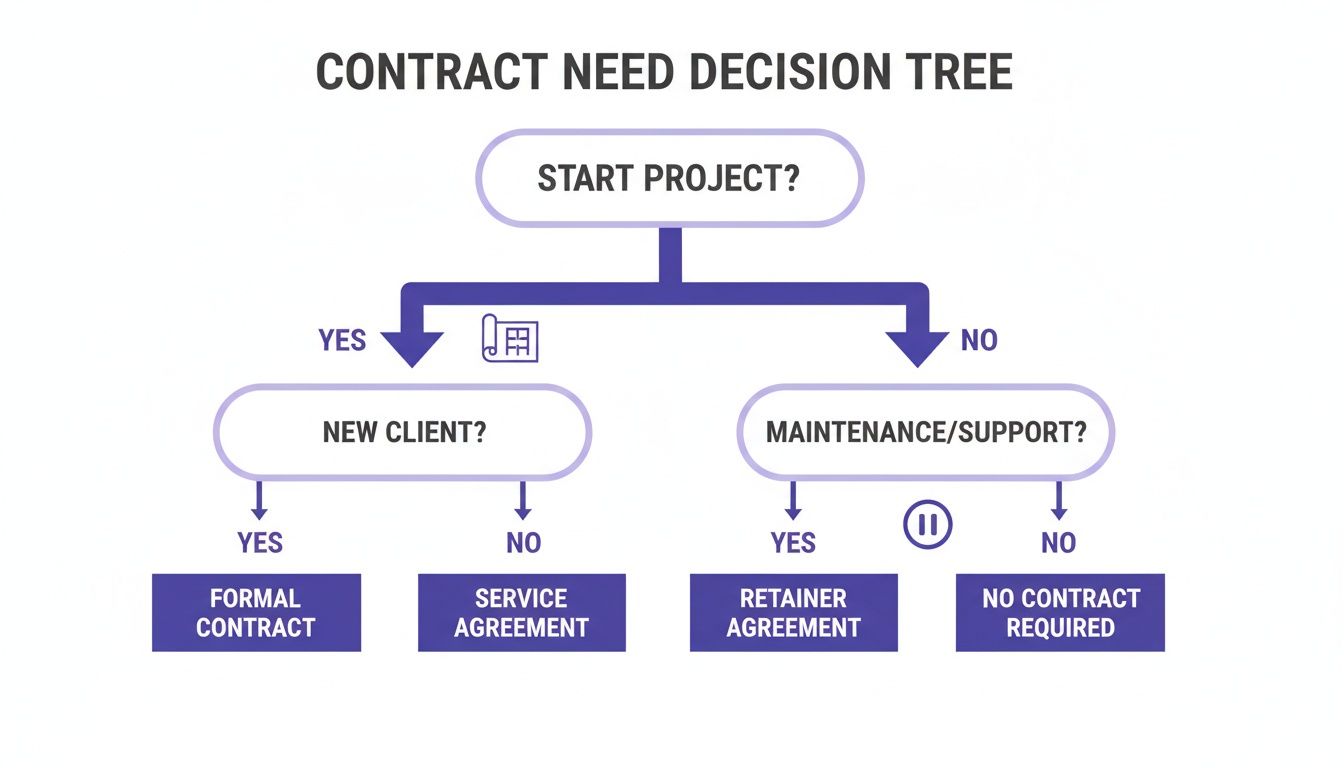
As you can see, the biggest fork in the road is how well you can define your project from day one. Let's break down the three most common models you'll encounter.
A Fixed-Price contract is exactly what it sounds like. You agree on a single, locked-in price for a very specific, pre-defined scope of work. Think of it like ordering a car from the factory with a set list of features—you know exactly what you’re getting and precisely how much it will cost before the work ever begins.
This model is a fantastic fit for smaller projects with requirements that are set in stone. We're talking about things like developing a straightforward Minimum Viable Product (MVP) or building a simple, well-understood feature. The biggest win here is total budget certainty. No surprises, no escalating costs.
The downside? Rigidity. Any change, no matter how small, typically requires a formal—and often costly—change request process. This model forces you to do a ton of detailed planning upfront and leaves almost no room for creative detours or pivots once development starts.
On the opposite end of the spectrum is the Time and Materials (T&M) contract. Here, you pay for the actual time developers spend on your project, plus the cost of any resources (the "materials"). This is your go-to model for a custom home build where you want to be involved in every decision and have the freedom to change the floor plan as you go.
T&M is the lifeblood of Agile development. It’s perfect for large, complex projects where the requirements are bound to evolve. You get maximum flexibility to adapt, refine, and respond to user feedback throughout the development lifecycle.
The trade-off, of course, is a lack of budget predictability. Without a firm hand on the tiller, costs can spiral.
The secret to a successful T&M project isn't really the contract—it's the trust and communication you build with your development team. You absolutely need regular check-ins, transparent time tracking, and clear milestones to keep everything on track and on budget.
This approach is extremely common when companies outsource custom software development, as it fosters a more collaborative, partnership-style relationship.
Finally, a Retainer Agreement isn't so much about building a new product as it is about maintaining and improving an existing one. Think of it as having an expert mechanic on call for your high-performance car. You pay a set monthly fee to secure a block of their time for whatever you might need—bug fixes, security patches, performance tuning, or just expert advice.
This is the ideal software engineering contract for post-launch support. It’s also a great fit for businesses that need consistent access to specialized skills but don't want the overhead of a full-time hire. A retainer provides peace of mind, ensuring you have dedicated, expert help the moment you need it.
Still on the fence? This table offers a side-by-side look at the most common contract types to help you decide which is best for your project's scope, budget, and flexibility needs.
| Contract Type | Best For | Key Advantage | Potential Risk |
|---|---|---|---|
| Fixed-Price | Small, well-defined projects (e.g., MVPs, simple features) with an unchanging scope. | Budget Predictability: You know the total cost upfront. | Inflexibility: Changes are difficult and expensive to implement. |
| Time & Materials (T&M) | Large, complex, or long-term projects where requirements are expected to evolve. | Maximum Flexibility: Easily adapt to new requirements and feedback. | Budget Uncertainty: Costs can escalate without close project management. |
| Retainer | Ongoing maintenance, support, and long-term improvements for existing software. | Guaranteed Availability: Secures dedicated expert time each month. | Underutilization: You might pay for hours you don't use in a given month. |
Ultimately, the goal is to choose the model that aligns with your project's reality. A clear scope calls for a clear price, while an evolving vision needs the breathing room that a T&M or retainer model provides.
A software engineering contract is more than a formality; it's the operational manual for your entire project. While every word matters, a handful of core clauses do the real heavy lifting to protect your interests, define the relationship, and keep disagreements from derailing your progress.
Getting these right isn't just a good idea—it's non-negotiable.
Think of these clauses like the critical support beams in a building. Without them, the whole structure is unstable, ready to collapse the moment any real pressure is applied. Let's cut through the dense legal jargon and create a practical checklist you can use to review any contract with confidence.
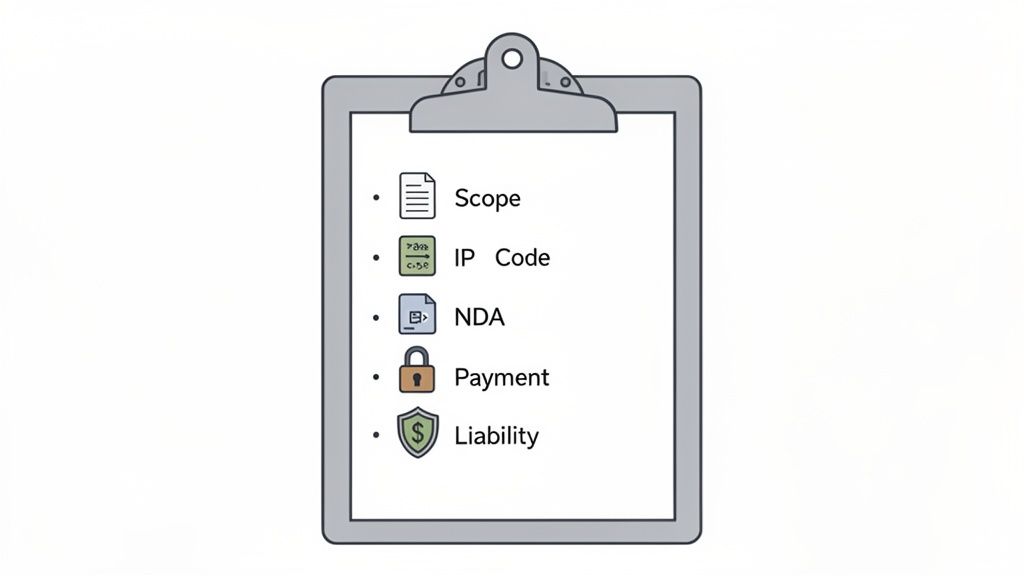
The Scope of Work (SOW) is arguably the most critical piece of the entire contract. It’s the blueprint. It details exactly what will be built, how it will be built, and what success actually looks like. A vague SOW is a direct invitation to scope creep, budget overruns, and endless arguments over what "done" really means.
Your SOW needs to be painstakingly specific. It’s not enough to write, "build a user login system." A solid SOW would break it down:
When a question comes up about a feature, a well-defined SOW acts as the neutral source of truth that everyone can refer back to.
This part is simple: who owns the final product? For most businesses, the answer must be an unequivocal "you do." The Intellectual Property (IP) Rights clause is what makes that legally true, ensuring all code, designs, and other materials created for the project become your exclusive property once the final payment is made.
Without this, you could face a nightmare scenario where you’ve paid for a product you don't legally own. The developer could potentially turn around and sell the code to your biggest competitor. This is no place for ambiguity.
Look for specific language that clearly states:
This single clause is what turns your financial investment into a tangible, ownable asset. It's the deed to your digital property—it has to be airtight.
Over the course of a project, you're going to share sensitive information. We're talking business plans, user data, trade secrets, and proprietary algorithms. A Confidentiality Clause, often structured as a Non-Disclosure Agreement (NDA), legally binds the developer to keep all of it secret.
This clause needs to clearly define what "confidential information" actually is and specify that the duty to protect it continues long after the project is finished. This is your shield against leaks and the misuse of your company's private data.
Nothing sours a professional relationship faster than misunderstandings about money. The Payment Terms clause takes all the guesswork out of the equation.
It needs to spell out the entire financial arrangement, including:
Clarity here ensures developers are paid fairly and on time, and you stay in complete control of the budget.
Hopefully, you'll never need it, but a Termination Clause is your essential exit strategy. It defines how either party can legally end the contract before the work is done, protecting both sides from being trapped in a failing partnership.
A fair clause should allow for termination "for cause" (like a breach of contract or missed deadlines) and "for convenience" (a no-fault separation). Crucially, it must also spell out the consequences, like payment for work already completed and the immediate handover of all project materials. When you're thinking about the complexities of ending a project, especially with a global team, it helps to understand the full picture of what IT outsourcing development entails.
Finally, a Limitation of Liability clause is a standard risk-management tool. It caps the amount of financial damages either party can be on the hook for if something goes wrong. This is a prudent measure that prevents a single project dispute from becoming an existential threat to either business.
Hiring internationally gives you access to a world of talent, but it also throws you into the deep end of global legal and financial rules. When you sign a software engineering contract with a developer overseas, you're not just agreeing on scope and deadlines. You're also stepping into a minefield of local labor laws, tax codes, and currency exchange.
Mess this up, and you could be looking at serious fines and legal headaches.
The biggest tripwire right out of the gate is worker classification. Every country has its own non-negotiable rules for what separates an independent contractor from an employee. If you get this wrong and misclassify an employee as a contractor, the penalties can be severe—think back taxes, hefty fines, and being forced to pay for benefits. This one distinction impacts everything from how you handle taxes to social security payments.
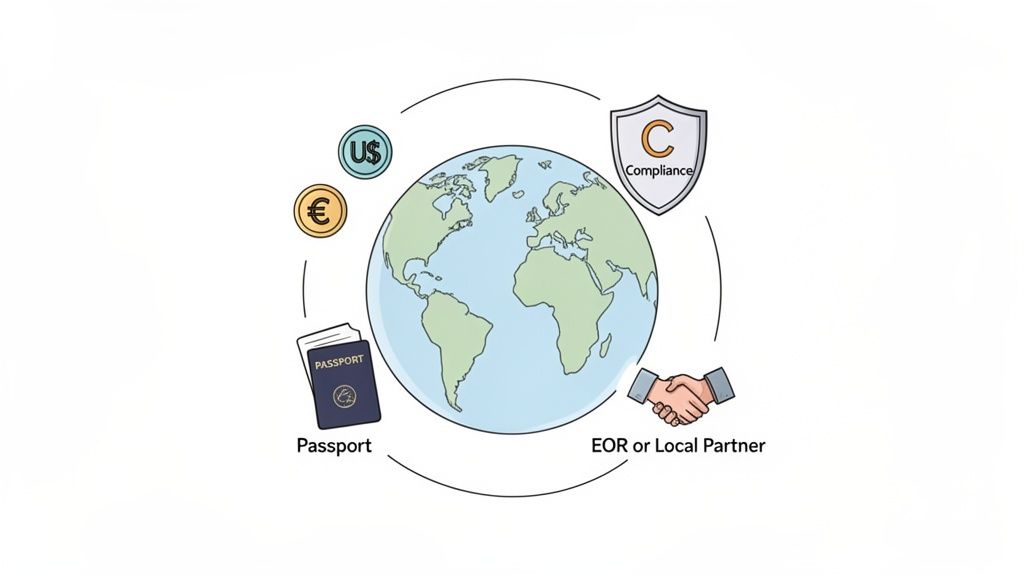
So, how do you tell the difference? It almost always boils down to control and independence. Tax authorities around the world look at a few key things to figure it out, though the specifics vary wildly from place to place.
Ask yourself these questions:
Getting this classification wrong is easily one of the costliest mistakes you can make when hiring talent from another country.
Trying to manage all this on your own is a massive undertaking. You’d need a legal and financial expert for every single country you hire from. Thankfully, you don't have to. Specialized services have popped up to turn this major headache into a simple, manageable process.
You generally have two great options:
These services basically absorb all the administrative pain. This frees you up to focus on what you do best—building a great product—instead of becoming an amateur expert in international labor law. They make sure your team gets paid correctly, on time, and in their own currency.
Of course, the developer’s rate is just one piece of the puzzle. To get a complete financial picture, it helps to understand the true https://hiredevelopers.com/offshore-software-development-costs/ and all the factors that go into it.
The business world is taking this seriously. The market for contract lifecycle management (CLM) software hit USD 1.1 billion in 2024 and is expected to keep climbing. This isn't surprising, given the need to juggle complex regulations like GDPR and HIPAA. It shows just how critical solid, compliant contract management has become for any company operating globally.
As you draft your contract, don't forget to include clauses for data security and compliance. For example, if your project will handle sensitive customer information, knowing about a framework like What Is SOC 2 can help you write the necessary security protocols right into your agreement.
Ultimately, using the right platforms and services can transform global hiring from a daunting legal maze into a massive strategic advantage.
Think of contract negotiation not as a battle, but as the first collaborative project you and your developer tackle together. It’s not about one side winning; it’s about building a shared understanding that prevents headaches down the road. A good negotiation weeds out misunderstandings and aligns everyone’s expectations before a single line of code gets written.
The real goal here is to land on a win-win agreement. You want a contract where both you and the engineer feel the terms are fair, the goals are clear, and the whole setup is designed for success. This requires honest, upfront conversations about the nitty-gritty details that will define your working relationship.
Before anyone signs on the dotted line, it's time to get specific about how you'll work together. This isn't about applying pressure; it's about achieving clarity.
Here are a few key points to hammer out during your discussion:
A great software engineering contract isn’t just a legal shield; it’s a communication tool. The negotiation process itself is the first test of how well you and your developer can work together to solve problems.
Knowing what to look for is just as important as knowing what to ask for. Some contract clauses are blaring sirens, warning you of potential trouble ahead. Catching these early is a crucial part of protecting your project and your investment.
Keep a sharp eye out for any agreement that contains:
At the end of the day, a true professional will appreciate a detailed negotiation. They get that clarity and fairness are what great partnerships are built on. If a candidate resists defining the scope, clarifying IP, or setting fair terms, take it as a sign to keep looking.
Alright, you've hammered out the details and the contract is sitting in your inbox. Before you sign, it's time for one last, careful pass. Think of this as the final pre-flight check before your project gets off the ground.
This isn't about starting negotiations all over again. It's about making absolutely sure the document in front of you matches the handshake agreement. A meticulous final review gives you the peace of mind to dive into a productive partnership.
First things first, let's zoom in on the foundational clauses. These are the pillars holding up the entire agreement, and they protect your most important assets. Don't just skim this part—make sure the language is crystal clear.
Next, put the financial and ownership details under a microscope. A simple typo or a vague phrase here can snowball into a massive headache down the line.
Getting these details right is all about ensuring a smooth working relationship. It's the mechanism that makes sure the developer gets paid fairly for their work, and you get full ownership of what you paid for. A clear, fair exchange.
Finally, take a step back and look at the whole picture. The software development market is booming—it's projected to hit an incredible USD 1.04 trillion by 2030. That massive growth means competition for great engineers is fierce, which makes having a rock-solid contract more important than ever. You can dig into the software development market's growth on Mordor Intelligence.
Before you put pen to paper (or click "sign"), ask yourself these three simple questions:
When you're dealing with software engineering contracts, a few common questions always seem to pop up, especially when things don't go exactly to plan or you're hiring across borders. Let's tackle some of the most frequent ones I hear from founders and hiring managers.
It happens. In fact, you should probably expect it. The key isn't to prevent changes but to manage them cleanly with a formal Change Request Process outlined right in the contract.
Here’s how it usually works in practice:
Following a process like this is your best defense against "scope creep." It makes sure every change is accounted for, budgeted, and scheduled transparently.
Think of a warranty period as your "bug-fix" guarantee. It’s a clause that commits the developer to fixing defects in their code for a certain amount of time after the project is considered "done." While there isn't one universal standard, most warranties last between 30 and 90 days after launch.
This clause is your safety net. It ensures the engineer will squash any bugs that pop up from their original work, without billing you more for it. It’s all about making sure the final product is as solid as you both agreed it would be.
Yes, you can, but how you can do it needs to be spelled out in the Termination Clause. A well-drafted contract gives both sides a clear exit path under specific circumstances.
Your termination clause should cover two main scenarios:
The most critical part? The clause must clearly state what happens next. This includes settling up payment for all work done up to that point and the immediate handover of all project files, source code, and assets.
Careers in cryptography are high-stakes, high-reward. These are the people who build and break the digital codes that secure our world, protecting everything from your bank account to global decentralized networks. It's a field with massive growth and serious six-figure salary potential. Why Cryptography Careers Are Exploding Welcome to the new frontier of digital trust. […]

The demand for remote machine learning jobs isn't just a trend anymore; it's a fundamental shift in how AI talent is hired and deployed. For ML professionals, this opens up a world of possibilities, not just in terms of flexibility, but also significant financial upside. Companies are in a fierce competition for top talent, and […]

The software engineering field is constantly shifting, with certain specializations commanding unprecedented salaries. But which roles truly offer the highest earning potential, and what does it take to secure one? This data-driven guide breaks down the best paying software engineering jobs, moving beyond vague titles to offer a detailed roadmap for career advancement and strategic […]


