

Software engineering project management is a whole different beast. It’s the art and science of guiding a software project from a spark of an idea all the way to a finished product. This means you’re not just applying generic project management rules; you’re blending them with the specific, often chaotic, realities of building software. It's […]

Software engineering project management is a whole different beast. It’s the art and science of guiding a software project from a spark of an idea all the way to a finished product. This means you’re not just applying generic project management rules; you’re blending them with the specific, often chaotic, realities of building software. It's all about juggling timelines, budgets, and—most importantly—the people doing the work, to ship great software that actually works as intended.
Let's be real for a moment: getting software projects over the finish line is tough. Even with a brilliant team and the best of intentions, projects often get bogged down by shifting goalposts, ballooning budgets, and deadlines that fly by. This isn't a rare occurrence; it’s a constant battle for teams everywhere. The fallout is real, too—wasted money, frustrated clients, and a serious hit to your competitive edge.
The data tells a sobering story. Inadequate project management is a primary reason why a shocking 25% of all software projects outright fail or deliver disappointing results. When you dig into the details, you find that 70% of projects end up costing more than planned—with IT projects overshooting their budgets by 75% on average. Schedules aren't much better, with projects running 46% behind, ultimately delivering 39% less value than what was promised. These aren't just numbers; they represent real-world headaches.
So, what’s really going on here? Projects don't usually implode because of one big disaster. Failure is more often a slow burn, a series of small, interconnected problems that snowball over time. The first step to avoiding this fate is knowing what to look out for.
Here are a few of the usual suspects:
Before we dive deeper, it's helpful to see how these core management principles fit together. I've found that thinking about them as distinct "pillars" provides a solid foundation for any project.
This table breaks down the essential areas you need to master. Get these right, and you're already ahead of the game.
| Pillar | Core Focus | Impact on Project |
|---|---|---|
| Scope & Milestones | Clearly defining what needs to be built and breaking it down into achievable steps. | Prevents scope creep and provides a clear roadmap for the team. |
| Team & Roles | Assembling the right mix of talent and ensuring everyone knows their responsibilities. | Fosters accountability and ensures all necessary skills are covered. |
| Process & Methodology | Choosing a workflow (like Agile or Lean) that fits the project and team culture. | Creates a predictable rhythm for development, feedback, and delivery. |
| Tooling & Integration | Selecting and connecting the right software for communication, coding, and tracking. | Automates repetitive tasks and creates a single source of truth for project status. |
| Quality & Delivery | Implementing practices like code reviews, testing, and CI/CD to ensure a reliable product. | Reduces bugs, minimizes technical debt, and enables faster, safer releases. |
| Metrics & Performance | Tracking key indicators to measure progress, identify bottlenecks, and make data-driven decisions. | Provides objective insights into project health and team efficiency. |
Mastering these pillars helps you build a resilient process that can withstand the inevitable challenges that pop up during development.
A lot of these small, unaddressed issues pile up and create something we call technical debt. Think of it as a hidden tax on your codebase that makes every future change slower and more expensive. To see how all these pieces fit into a larger puzzle, it's worth understanding the entire mobile app development lifecycle, which maps out the journey from concept to launch and beyond.
Every great software project I’ve ever seen started with a crystal-clear vision, not a 100-page spec document. Without that sharp focus, you’re setting yourself up for failure. You either build something nobody actually wants, or you fall victim to the dreaded "scope creep"—that quiet, project-killing habit of adding just one more feature, and then another, until your budget and timeline are completely shot.
Your first job is to build a strong defense against that chaos.
The best way to do this is to define what you're not building. Seriously. Get ruthless about prioritizing the absolute core functionality that gives your user immediate value. That’s your Minimum Viable Product (MVP). Instead of a massive document, create a simple project charter that answers three questions: What problem are we solving? Who are we solving it for? What does success actually look like? This becomes your North Star, the thing you point to when distractions pop up.
This simple flow really captures the essence of it: get the goals right, and you're halfway there.
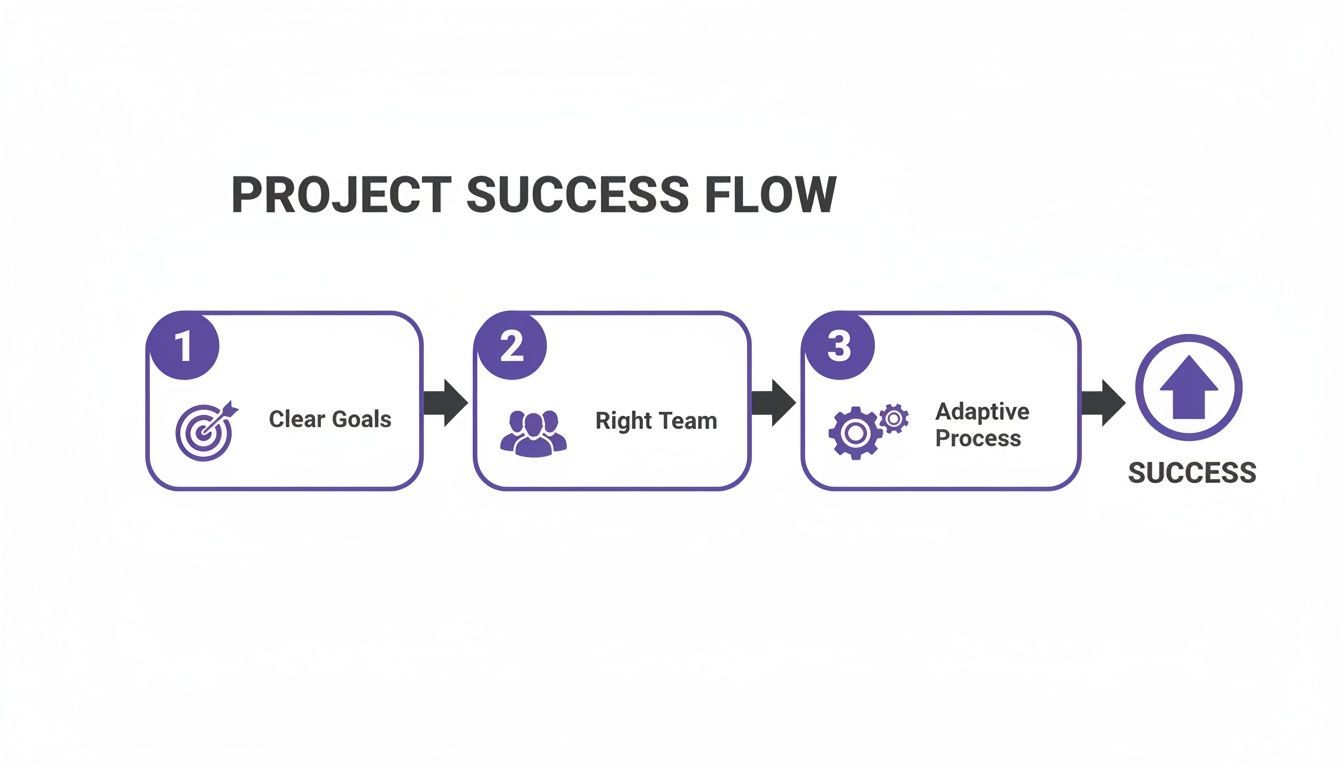
It’s a powerful reminder that even the slickest process won't save a project with fuzzy goals or the wrong people on board.
Once your scope is tight, it's time to assemble your crew. How you structure your team—whether they're all in one office, spread across the globe, or a mix of both—will have a massive impact on everything from communication to your bottom line. There’s no silver bullet here; the best setup depends entirely on your project's needs.
No matter where your team members are, role ambiguity is a project killer. When people don't know who owns what, tasks get dropped, and decisions get stalled. Clear ownership is everything.
Two roles, in particular, are absolutely non-negotiable for success.
The Product Owner is the voice of the customer, period. They own the product backlog, relentlessly prioritize features, and make sure the dev team is always building what matters most to the business. They answer the "what" and the "why."
A classic mistake I see all the time is making the Product Owner a committee or giving the title to someone who's already swamped. That’s a recipe for indecisiveness. This role needs one dedicated person with the authority to make the tough calls.
The Tech Lead is all about the "how." This is your senior engineer who guides technical architecture, upholds code quality, and mentors the rest of the team. They are the ultimate guardian of the codebase's long-term health.
Getting these roles right from the start is fundamental. For a closer look at how these and other roles fit together, check out our guide on the key roles in Agile software development. When everyone knows their part, you create the conditions for a team that just works.
Okay, so you’ve got your team assembled. Now for the million-dollar question: how are you all actually going to work together? The world of software engineer project management is littered with methodologies, and one of the biggest mistakes I see is teams blindly adopting a rigid framework.
The goal isn't to follow a rulebook to the letter. It's about finding a rhythm that helps your team ship great software, consistently.
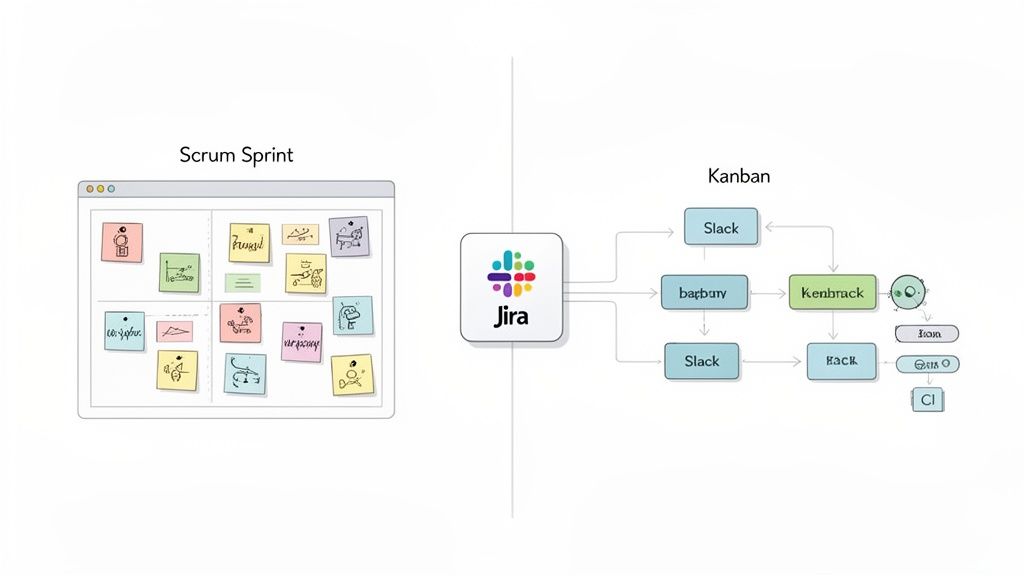
Two of the most battle-tested approaches out there are Scrum and Kanban. They both come from the Agile family, but they have very different personalities.
Think of Scrum as a series of short, focused races. All the work is organized into fixed-length "sprints"—usually two weeks—where the team commits to delivering a specific chunk of functionality. This structure creates a predictable cadence, which is fantastic for projects with clear milestones and for teams who thrive on routine.
For instance, if a team is building a new e-commerce checkout flow, they might use a two-week sprint to deliver the "add to cart" and "view cart" features. Everyone knows exactly what's on the line by the end of the sprint, which drives some serious focus.
Kanban, on the other hand, is more like a continuous river. It’s all about visualizing work and limiting the amount of work in progress (WIP) at any given time. Tasks flow from a "To Do" column to "Done" without the strict boundaries of a sprint. This makes it a perfect fit for teams handling a steady stream of incoming tasks, like a support team squashing bugs or a crew maintaining an existing product. Its flexibility is its superpower, allowing you to pivot as priorities shift.
The real secret is that you don't have to pick a side. Many of the best teams I've worked with practice "Scrumban," a hybrid that borrows Scrum's roles and meetings but pairs them with Kanban's visual workflow and WIP limits. My advice? Start with one and don't be afraid to borrow elements from the other as you figure out what clicks for your team.
A great process falls apart without the right tools to back it up. The project management software market is absolutely exploding, projected to hit $15 billion by 2030 as more than 88% of organizations bring these platforms into their workflow.
But here’s the reality check: even with Jira leading the market with 41.96% usage, just having the tool doesn't guarantee success. Plenty of projects still miss their budgets, which you can read more about in these project management software trends on Mosaicapp.com.
Your toolkit needs to create a single source of truth, not more chaos. Here’s what every software team needs at a minimum:
Choosing the right project management platform is a big decision, as it becomes the hub for your team's day-to-day work. Here’s a quick comparison to help you narrow down the options.
| Tool | Best For | Key Features |
|---|---|---|
| Jira | Established teams needing powerful, highly customizable Agile workflows. | Customizable Scrum/Kanban boards, advanced reporting, deep integration with developer tools, extensive marketplace. |
| Linear | Startups and product teams who value speed, simplicity, and a beautiful UI. | Keyboard-first design, cycles (sprints), roadmap planning, automated workflows, and fast performance. |
| Zenhub | Teams that want to manage projects directly within the GitHub interface. | Native GitHub integration, automated workflows, multi-repo support, and robust reporting inside GitHub. |
| Asana | Teams that need a balance of project management and general work coordination. | Multiple project views (list, board, timeline, calendar), task dependencies, and strong collaboration features. |
| Trello | Small teams or projects that benefit from a simple, visual Kanban-style board. | Highly intuitive drag-and-drop interface, power-ups for added functionality, and a simple learning curve. |
Ultimately, the best tool is the one your team will actually use.
The real magic happens when you integrate these tools. When your issue tracker automatically updates because a developer pushed new code to GitHub, you eliminate tedious manual work and keep everyone on the same page. Similarly, setting up a solid CI/CD pipeline to automate testing and deployment can be a game-changer.
A connected toolkit frees up your team's mental energy, letting them focus on what they do best: building incredible software.
You can have the most brilliant process on paper, but it’s useless without a team that actually talks to each other and works together. When you’re managing a mix of in-house folks, remote engineers, and specialized contractors, getting that connection right is everything. Real success comes from being intentional about how your team communicates and how you build quality into every step.
Great collaboration isn't magic; it's a system you build. The classic Agile ceremonies—sprint planning, daily stand-ups, retros—are your building blocks. But you have to run them with a purpose, or they quickly become just another meeting everyone dreads.
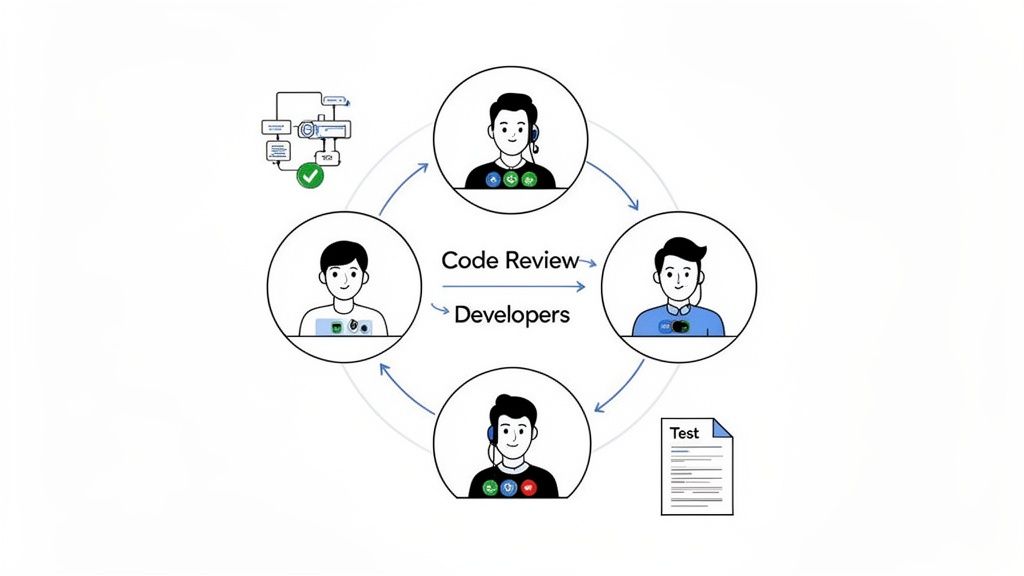
This really just means running meetings that respect people's time. A daily stand-up, for instance, isn't a status report for a manager. It’s a quick sync for the team to flag blockers. If you keep it laser-focused on "what I did, what I'm doing, and what's stuck," you avoid it spiraling into a long, drawn-out problem-solving session that kills momentum.
Quality isn't a gate you pass through at the end of the line. It has to be part of your team's DNA, baked into the daily workflow. This culture is built on a sense of shared ownership and a genuine commitment to shipping code that works and is built to last. This is where your technical practices become non-negotiable project management tools.
Solid code reviews are your first and best line of defense. They’re not just about catching bugs; they’re a fantastic way to share knowledge and maintain consistent coding standards across the whole team. The trick to making them work? Keep pull requests small and focused on one specific change. This makes the review process infinitely faster and way more effective.
Beyond manual checks, automation is your best friend. Setting up a Continuous Integration/Continuous Deployment (CI/CD) pipeline to automate your build, test, and deployment processes is a game-changer. It creates a super-fast feedback loop, letting developers spot and squash bugs almost instantly instead of discovering them weeks later.
A strong CI/CD pipeline does more than just automate tasks—it builds confidence. When your team trusts that every code merge is automatically tested and validated, they can move faster and with less fear of breaking things. It turns quality from a manual chore into an automated safety net.
When your team isn't sharing an office, you lose those spontaneous "hallway conversations." That means you have to get deliberate about how information flows so that everyone is in the loop, no matter their location. You need a clear playbook for how and where you communicate.
Here's a simple, practical way to organize it:
By defining these channels, you cut down on constant context switching and ensure every team member—from your full-time staff to a vetted contractor you found on a platform like HireDevelopers.com—has what they need to do their best work. This structured approach is what turns a group of talented individuals into a truly high-performing team.
So, how can you tell if your project is actually on track? Gut feelings won't get you very far. Neither will counting the number of tasks marked "done." If you want a real read on your project's health, you need to look under the hood and track the metrics that actually mean something.
Good data doesn't just tell you that you're behind schedule; it tells you why. It lets you walk into a stakeholder meeting with objective facts, not just subjective opinions, and pinpoint the exact bottleneck that's holding things up. It’s about moving from guessing to knowing.
You don't need a hundred different charts to get a clear picture. In my experience, a few powerful metrics are all it takes to understand what's really going on. This isn't about watching over your team's shoulder; it's about understanding the system so you can make it better for everyone.
Team Velocity: This is a simple measure of how much work your team consistently gets done in a sprint. Once you've tracked it for a few cycles, it becomes an incredibly reliable tool for forecasting. You can finally give stakeholders timelines you can actually stand behind.
Cycle Time: Forget just tracking start and end dates. Cycle time measures the actual time it takes for a task to go from "in progress" to "shipped." A short, stable cycle time means your workflow is humming along. If it starts creeping up, you've likely got a hidden bottleneck somewhere in your process that needs attention.
Bug Density: This one is a direct reflection of your code quality. By tracking the number of bugs per feature (or per 1,000 lines of code, if you prefer), you can spot problems early. A rising bug count might mean your testing isn't thorough enough, or that technical debt is starting to cause real problems.
Think of these metrics as the dashboard for your project. They tell you what's working well and what needs a tune-up before it breaks down completely.
Knowing your numbers is half the battle. The other half is using that knowledge to dodge the common traps that sink even the most talented teams.
One of the sneakiest problems is the slow, silent buildup of technical debt. It’s the price you pay later for taking shortcuts now. Every time you opt for the quick fix instead of the right one, you're taking out a high-interest loan on your codebase. Ignore it for too long, and the "interest payments" in the form of bugs and slow development will cripple you.
An experienced engineering manager once told me, "Technical debt is inevitable, but bankruptcy is optional." The key is to manage it proactively. A practical way to do this is to dedicate a fixed portion of every sprint—say, 20% of your team's time—to paying it down. Use that time for refactoring old code, improving documentation, or upgrading libraries.
Another classic pitfall is team burnout. It’s the predictable result of constant pressure, unrealistic deadlines, and inefficient processes that force engineers to constantly switch gears. You'll see the signs in your metrics first: velocity drops, bug counts spike, and morale plummets. The only way to prevent it is with a sustainable pace. Use your velocity data to set realistic goals and be ruthless about protecting your team from distractions.
Finally, never underestimate the damage caused by poor stakeholder communication. When stakeholders are left in the dark, they get nervous. That nervousness often turns into micromanagement or sudden, disruptive changes in direction. The fix is simple: be transparent and communicate regularly. A quick weekly update summarizing progress, roadblocks, and what’s next is often all it takes to build trust and keep everyone pulling in the same direction.
Even with the best frameworks in place, running a software project always throws a few curveballs. Real-world situations rarely fit neatly into a textbook. Let's tackle some of the most common questions and sticking points that engineering leaders and founders run into on the ground.
Your biggest asset as a non-technical founder is your vision. You own the "what" and the "why," so lean into that. Your primary job isn't to get bogged down in the technical details but to be the unwavering champion of the customer and the business goals.
The most critical move you can make is to bring in a technical expert you trust and empower them completely. This might be a technical co-founder, a seasoned lead engineer, or a senior contractor who can translate your vision into a technical roadmap.
Your role is to be the voice of the user, not the voice of the architect. Focus on defining the problem and what success looks like. Let your tech lead and their team figure out the how. Show up for demos, give clear feedback, and trust them to build it right.
Going from zero to a full-blown Agile framework like Scrum is a surefire way to create chaos and alienate your team. The key is to introduce change incrementally, not all at once. Start small.
Pick one or two practices that will deliver immediate, tangible benefits. A couple of great places to start are:
Try these out on a small, low-risk project or for a single sprint. Afterward, run a retrospective to see what the team actually thought. You're not trying to become a textbook Agile shop overnight; you're trying to adapt proven principles to what makes your team more effective.
Scope creep is less about demanding stakeholders and more about a lack of clear process and communication. Your best defense is a well-defined project scope or MVP that everyone has agreed on from the start. That document becomes your single source of truth.
When a stakeholder comes to you with a "quick" new feature request, resist the urge to give a flat "no." Instead, walk them through the impact. Show them exactly how it affects the timeline, the budget, and the current sprint's goals.
This turns a simple request into a strategic conversation about trade-offs and priorities. Is this new feature more important than what the team is currently building? By presenting the data, you empower the stakeholder to make an informed decision. All new ideas should go into a product backlog, where they can be properly prioritized for future development cycles instead of derailing the current one.
Careers in cryptography are high-stakes, high-reward. These are the people who build and break the digital codes that secure our world, protecting everything from your bank account to global decentralized networks. It's a field with massive growth and serious six-figure salary potential. Why Cryptography Careers Are Exploding Welcome to the new frontier of digital trust. […]

The demand for remote machine learning jobs isn't just a trend anymore; it's a fundamental shift in how AI talent is hired and deployed. For ML professionals, this opens up a world of possibilities, not just in terms of flexibility, but also significant financial upside. Companies are in a fierce competition for top talent, and […]

The software engineering field is constantly shifting, with certain specializations commanding unprecedented salaries. But which roles truly offer the highest earning potential, and what does it take to secure one? This data-driven guide breaks down the best paying software engineering jobs, moving beyond vague titles to offer a detailed roadmap for career advancement and strategic […]


