

Choosing the right software development team structure isn’t just an HR exercise—it’s the architectural blueprint for your entire project. It fundamentally defines how your people communicate, collaborate, and ultimately, create value. Get it right, and you'll see a boost in everything from development speed to team morale. Get it wrong, and you'll be fighting friction […]

Choosing the right software development team structure isn’t just an HR exercise—it’s the architectural blueprint for your entire project. It fundamentally defines how your people communicate, collaborate, and ultimately, create value. Get it right, and you'll see a boost in everything from development speed to team morale. Get it wrong, and you'll be fighting friction at every turn.
Think of it like running a professional kitchen. You have specialists—a pastry chef, a saucier, a grill master—and you wouldn't ask one to do another's job. The kitchen's success depends on its structure: the chain of command, the flow of communication from server to chef, and the well-defined workflows that ensure every dish in a multi-course meal comes out perfect and on time. A chaotic kitchen delivers cold food and frustrated customers.
Your software team is no different. The structure is the operational design that dictates how your project "kitchen" runs. It's far more than just an org chart; it's the framework that can mean the difference between seamless collaboration and a tangled mess of bottlenecks.
A thoughtfully designed structure delivers tangible benefits:
The need for a solid team structure has only grown more critical in today's global, remote-first world. The number of professional developers is expected to reach a staggering 36.5 million by early 2025.
With 41.41% of developers working fully remotely and another 42.18% in hybrid setups, the old-school, in-office management styles just don't cut it anymore. This global talent pool demands intentional, flexible structures that support real collaboration across time zones and cultures. You can explore more data on global developer population trends to see just how profound this shift is.
A team's structure is a direct reflection of the communication patterns you want to encourage. If you want speed and autonomy, you structure for it. If you need deep expertise and stability, you structure for that instead. The mistake is not choosing one consciously.
To help you find the right fit, let’s dive into the most common models out there. Each one offers a different way to organize your talent, with its own distinct pros and cons. Understanding these is the first step toward building a team that doesn't just ship code, but consistently delivers outstanding products.
Here's a quick rundown of the most popular software development team structures to help you see which might be the best fit for your needs.
| Structure Model | Core Principle | Best For | Key Benefit |
|---|---|---|---|
| Functional Team | Grouping specialists by their function (e.g., all backend developers together). | Companies needing deep technical expertise and skill development. | Mastery of a specific domain |
| Cross-Functional Team | Assembling all required skills (dev, QA, UX) into one team focused on a feature. | Agile environments that prioritize speed and end-to-end ownership. | Faster delivery and collaboration |
| Squads & Pods | Small, autonomous, cross-functional teams acting like mini-startups. | Product-led companies aiming for high autonomy and rapid iteration. | Agility and strong ownership |
| Matrix Structure | Individuals report to both a functional manager and a project manager. | Large organizations balancing functional excellence with project goals. | Resource flexibility |
This table is just a starting point. The real magic happens when you understand the nuances of each model and how to apply them to your specific context, which we'll explore next.
Picking the right software team structure isn’t about finding a single "best" answer. It’s about matching the model to your company's unique DNA. Each approach offers a different way to organize talent, manage communication, and define ownership. Getting this right is fundamental to building a team that can actually deliver on your vision.
Think of these models as different blueprints for a high-performance engine. One might be engineered for raw power and deep specialization, while another is built for agility and rapid adaptation. Let's break down the four most common blueprints to see which one fits your project and your organization's goals.
The structure you land on will have a direct and massive impact on your project's speed, quality, and ability to innovate.
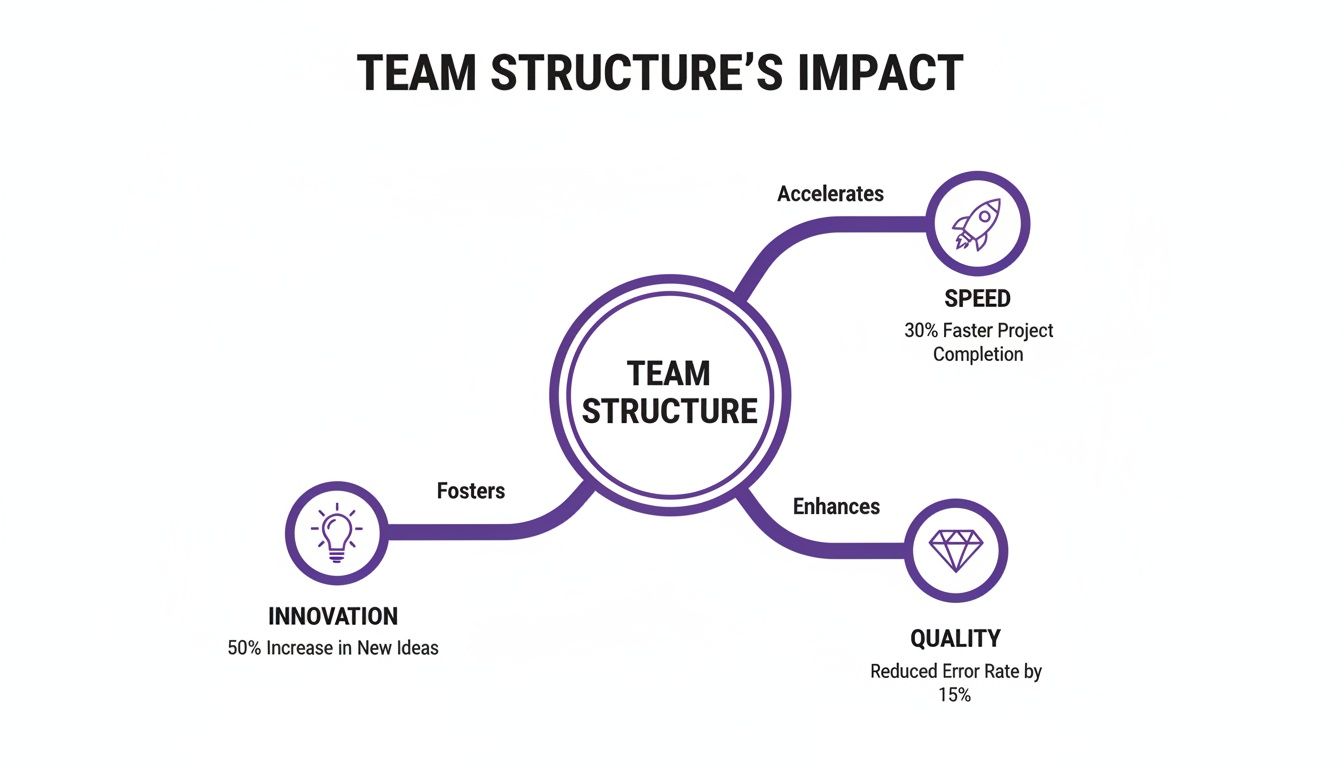
As the visual makes clear, a team structure that’s in sync with your goals acts as a force multiplier, boosting every part of the development cycle.
The Functional Team is the classic, old-school model. It groups specialists by their expertise, much like departments in a university—all the backend engineers work together, all the frontend developers form another group, and QA has its own department.
This structure is all about cultivating deep, specialized knowledge. Junior engineers learn directly from senior experts in their field, creating a natural pipeline for mentorship and skill mastery. It also drives high standards and consistency within each discipline, since everyone is guided by a functional manager who is an expert in that specific domain.
But that specialization comes with a price. Communication between these groups can grind to a halt, creating frustrating silos. A seemingly simple feature might require a formal handoff from the backend team to the frontend team, and then another to QA. Each handoff is a potential point of failure, introducing delays and misinterpretations that kill momentum.
When to Use It: The Functional model often works best for organizations where technical depth and stability are valued over rapid iteration. It's a solid choice for companies with mature products that need meticulous maintenance or for projects in heavily regulated industries where specialized oversight is non-negotiable.
In complete contrast, the Cross-Functional Team (often called a Feature Team) operates like a special ops unit assembled for a specific mission. It brings all the necessary skills—backend, frontend, design, QA, and product—into a single, self-sufficient team. This group has everything it needs to take a feature from an idea all the way to launch without waiting on other departments.
This model is the heart and soul of most modern agile methodologies. By tearing down the silos, communication becomes instant and fluid. The backend dev can literally turn to the designer sitting next to them (physically or virtually) to solve a problem on the spot. This tight feedback loop dramatically speeds up development and creates a powerful sense of shared ownership over the final product.
The main challenge here is maintaining consistency across the entire organization. Since an engineer on one feature team is isolated from their peers on other teams, you have to be intentional about sharing best practices. This is often done through "guilds" or "communities of practice" where, for example, all mobile developers can get together to align on standards.
Made famous by Spotify, the Squads Model is an evolution of the cross-functional concept. A squad is an autonomous, cross-functional team that acts like a mini-startup within the larger company. Each squad owns a specific area of the product long-term, like the search experience or the user profile section. This gives them incredible freedom and ownership to innovate within their domain.
Squads are built for one thing: maximum autonomy and speed. By designing the system to minimize dependencies between teams, they can iterate, test, and release features independently. For large, complex products, this is a game-changer. The tricky part is managing all that freedom. Without strong alignment mechanisms like "Tribes" (groups of related squads) and "Guilds" (cross-squad knowledge-sharing groups), the organization can feel disconnected and chaotic.
Finally, the Matrix Structure is a hybrid model that tries to give you the best of both worlds. In this setup, an employee reports to two different managers: a functional manager (like the Head of QA) and a project or product manager. It creates a dual-reporting system.
The idea is to maintain deep functional expertise while also keeping a laser focus on project delivery. The functional manager guides career growth and technical standards, while the project manager directs the day-to-day work. In theory, this provides amazing resource flexibility, as specialists can be moved between projects as business needs change.
The biggest drawback is its inherent complexity. Reporting to two bosses can easily lead to conflicting priorities and confusion. This structure demands an extremely high level of communication and coordination between managers to work smoothly. If roles aren't crystal clear, it can descend into internal politics and sluggish decision-making, completely undermining the benefits it was meant to provide.
To make sense of it all, let’s lay out the pros, cons, and best-fit scenarios for each model side-by-side.
| Model | Pros | Cons | When to Use It |
|---|---|---|---|
| Functional | – Deep skill development and mentorship – High technical consistency – Clear career progression |
– Slow communication between departments – Prone to silos and bottlenecks – Can struggle with agile workflows |
Best for stable, mature products or in highly regulated industries where specialized oversight is critical. |
| Cross-Functional | – Fast communication and decision-making – Strong team ownership of features – High agility and quick iterations |
– Risk of inconsistent practices across teams – Can be difficult to manage individual career growth – Requires deliberate effort to share knowledge |
The default for most agile environments, startups, and companies focused on rapid product development. |
| Squads | – Extreme autonomy and speed – Fosters a "mini-startup" culture of innovation – Scales well for large, complex products |
– Requires high organizational maturity – Can lead to fragmentation without proper alignment – High overhead to manage tribes and guilds |
A great fit for large tech companies with complex products that can be broken into independent domains. |
| Matrix | – Blends functional expertise with project focus – Flexible allocation of specialists to projects – Supports both individual and project goals |
– Dual reporting can cause confusion – Potential for conflicting priorities and politics – High communication overhead is required |
Works in large, complex organizations that need to balance deep specialization with dynamic project needs. |
Choosing a model isn't a one-time decision. The best structure for your company today might not be the best one a year from now as you scale and your priorities shift. The key is to understand these trade-offs and pick the blueprint that gives your team the best chance to succeed right now.
Building a high-performing software team is a lot like casting a movie. You can't just throw a bunch of famous actors in a room and expect a blockbuster. Success hinges on getting the right people in the right roles, each bringing a specific talent to the table. Simply hiring a group of brilliant coders isn’t a strategy; it’s a recipe for chaos. Modern software development demands a balanced crew of specialists who can work together to turn a great idea into a product people actually love using.
It all starts with answering a few fundamental questions. The first is "why?" That's the domain of the Product Manager (PM). They are the champion for both the customer and the business, tasked with defining the product's vision, prioritizing what gets built, and making sure the team is solving a real problem. The PM owns the product roadmap and has the final say on what the team tackles next.
Then comes the "how and when." This is where the Scrum Master or Project Manager steps in. Think of this person less as a traditional boss and more as a facilitator or a coach. Their job is to protect the team's process, clear any roadblocks that pop up, and run the essential agile ceremonies like daily stand-ups and retrospectives. They keep the engine humming smoothly.
Of course, the Software Engineers are the ones in the trenches, actually building the thing. They're the architects and craftspeople who write the code that brings the vision to life. Whether they specialize in frontend, backend, or full-stack development, they work hand-in-hand to transform designs and requirements into working software. To make sure their time is well spent, many teams rely on specialized tools like Time Tracking Software For Developers to keep projects on track.
Working right alongside them is the UI/UX Designer, the advocate for the end-user. They're the ones doing user research, sketching out wireframes, building interactive prototypes, and designing an interface that’s not just functional but genuinely intuitive and pleasant to use. Without their input, even the most powerful software can feel clunky and unusable.
Finally, you have two crucial guardian roles that protect the integrity of the entire system:
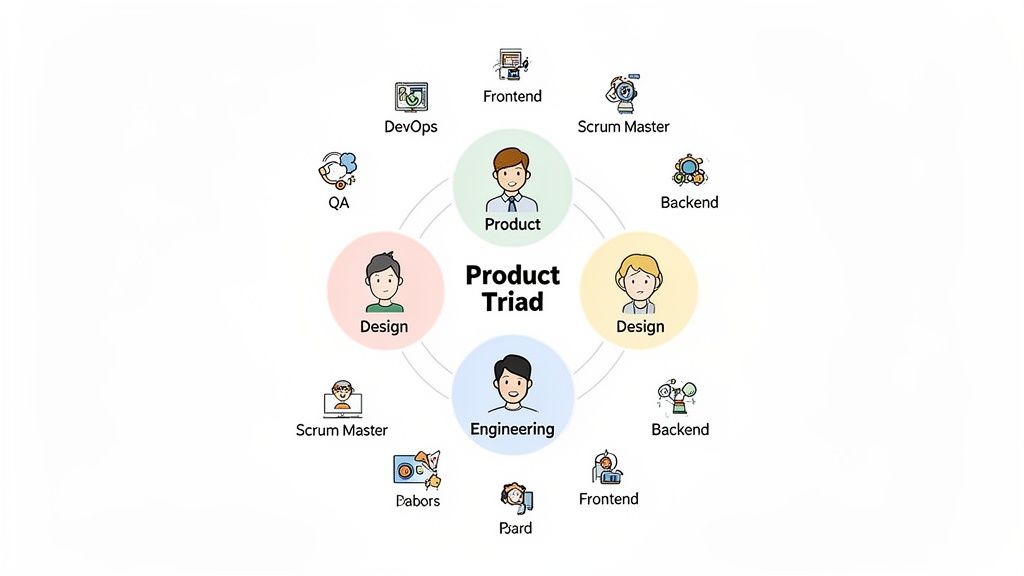
At the very core of many successful modern teams is a concept called the Product Triad. This is the central leadership group, made up of the leads from product, design, and engineering. This trio collaborates constantly to strike the right balance between business goals, user needs, and what's technically possible to build.
The Product Triad ensures every major decision gets looked at through three critical lenses: Is it valuable for the business? Is it usable for the customer? Is it feasible to build? This tight-knit core prevents teams from working in silos and keeps everyone aligned on a single, clear vision.
This really drives home why you need such a diverse skill set. It's not just theory; studies show that 85% of development teams use multiple programming languages and 90% use functional testing, highlighting the need for deep, varied expertise. The Product Triad has become a standard because it weaves this expertise into the decision-making process from the very start.
Pulling together this entire cast of characters is a huge challenge for most companies. That's where a platform like HireDevelopers.com makes a real difference. It gives you access to pre-vetted professionals across every single one of these roles. So instead of just looking for a coder, you can build a complete, well-rounded team that's ready to go. For a deeper dive, check out our guide on the key roles in agile software development.
The scrappy, all-hands-on-deck team that gets a startup off the ground won’t be the one that carries it to the next level. That flat hierarchy and say-it-as-it-happens communication style work wonders when you can fit the whole team around one table, but they descend into chaos once you hit fifty people. Scaling isn't just about hiring more developers; it's about deliberately redesigning your organization as your company grows up.
One of the most common traps is clinging to a structure long after its expiration date. Founders often fight adding layers of management, terrified it will suffocate the culture they built. But that refusal to adapt is a classic scaling anti-pattern. It leads directly to communication silos, redundant work, and total decision paralysis as the original team becomes a bottleneck for every little thing.
Another classic mistake is hiring too fast without a real plan to bring new people into the fold. Throwing more engineers at a broken process just makes the chaos louder. The trick is to stay ahead of the curve—to see the breaking points before they happen and transition to a new model that can handle what's next.
In the very beginning, your whole company is basically one big, cross-functional team. Everyone, from the CEO to the first engineer, has their hands deep in the product. This tight-knit group is built for one thing: speed. You can pivot on a dime based on what your first few customers are telling you.
The entire focus is on survival and hitting product-market fit. The structure is as simple as it gets:
This model is perfect for its time, but it’s not built to last. The minute you need to tackle more than one big project at a time, you’ll feel the cracks start to show.
Once your company finds its footing and starts to grow, you need a way to add people without grinding to a halt. This is the perfect moment to look at the "squads and tribes" model made famous by companies like Spotify.
You break your growing team into smaller, cross-functional "squads," where each one owns a specific feature or slice of the product. These squads act like little startups within the larger company, with the power to make their own decisions. To keep everyone rowing in the same general direction, you group related squads into "tribes," which provides just enough alignment on a shared mission.
This shift lets you keep that startup-like agility within each team while allowing the whole organization to take on much bigger, more complex work. It's a smart way to push decision-making down and keep up the momentum.
At the enterprise level, the game changes again. You’re now juggling a complex portfolio of products, protecting established revenue, and managing a much, much larger organization. Giving every team total freedom can lead to chaos, but a rigid, top-down command structure will kill the very innovation that got you here.
This is where a Matrix Structure often enters the picture. An engineer might belong to a functional home base (like "Mobile Engineering") to keep their skills sharp and see a clear career path, but they're also assigned to specific product teams or business units. This hybrid model tries to give you the best of both worlds: deep technical expertise and focused product delivery. At this scale, effective software development capacity planning is non-negotiable for allocating those specialists wisely.
Making it through these stages successfully demands flexibility. This is where bringing in on-demand talent can be a game-changer. Staffing platforms like HireDevelopers.com let you bring in specialists for a single project, quickly expand a team to hit a critical deadline, or tap into expertise you don't have in-house—all without the overhead of a permanent hire. It gives you the agility to evolve your team structure intelligently, no matter what stage your company is in.
Your company's physical address shouldn't define the boundaries of your talent pool. Long gone are the days when the best person for the job had to live within a 30-mile radius of your office. The right software development team structure is less about who reports to whom and more about accessing top-tier skills, no matter where they are in the world.
This isn't just a trend; it's a fundamental shift in how development teams operate. Think about it: only 16.41% of developers work fully onsite anymore. The vast majority are either fully remote (41.41%) or in a hybrid model (42.18%). With a projected 140,100 job openings for developers popping up each year through 2033, companies clinging to a local-only hiring model are simply leaving talent on the table.
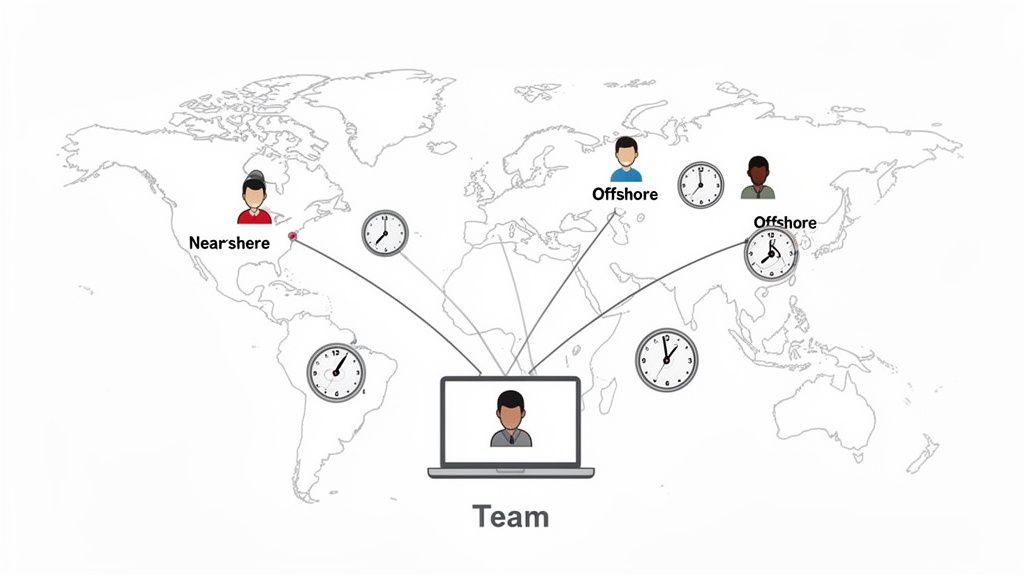
Before you start posting jobs globally, it helps to know the lingo. These terms just describe where your remote team members are located relative to you, and each one has its own strategic playbook.
Each model strikes a different balance between cost, collaboration, and access to talent. The key is choosing the one that aligns with your project needs and team culture.
Running a successful distributed team takes more than a Slack subscription and a few Zoom licenses. It requires being intentional about how you communicate, build culture, and handle the administrative side of things.
Time zones are a huge piece of the puzzle. If your team thrives on spontaneous brainstorming and quick sync-ups, a nearshore model is probably your best bet. If you have a rock-solid asynchronous workflow with incredible documentation, an offshore team can be a massive productivity booster.
Don't underestimate the impact of cultural communication styles, either. What comes across as direct and helpful feedback in one culture can feel blunt or even rude in another. The secret is to foster an environment of genuine curiosity and establish clear communication ground rules that everyone understands and respects.
Tapping into a global talent pool is one of the most effective ways to scale efficiently. It unlocks access to specialized skills you can't find locally and introduces diverse perspectives that fuel innovation.
Let’s be honest—navigating international payroll, taxes, and labor laws can feel like a minefield. This is where a modern hiring partner becomes invaluable. Platforms like HireDevelopers.com, for example, take care of all the compliance and payroll headaches for you. This frees you up to do what you do best: build great software with great people.
These platforms also de-risk the process of hiring someone you've never met in person. By rigorously pre-vetting every candidate for technical expertise and soft skills, they connect you with world-class professionals who are ready to contribute from day one. If you're ready to explore this, our guide on how to hire remote developers is a great place to start.
Picking the right team structure is just the starting point. The real magic—and the real challenge—comes from filling those roles with exceptional talent. Let's be honest, the traditional hiring process for elite developers can be a brutal, months-long grind. This is where a dedicated talent partner can make all the difference.
At HireDevelopers.com, we’ve designed our entire process to connect you with the top 1% of global tech talent, and to do it fast. You tell us what you need, and we deliver a handpicked shortlist of pre-vetted candidates in as little as 24 hours. From that point, you can interview and get your new developer working in under a week.
How can we move that quickly without sacrificing quality? It all comes down to an incredibly thorough, multi-stage vetting system that filters out 99% of applicants before you ever see a resume.
By the time a candidate reaches your inbox, their technical chops and professional skills are already proven. This saves you countless hours of sifting through applications and conducting preliminary interviews.
The goal isn't just to find a developer; it's to find the right developer without stalling your project. A fast, reliable hiring pipeline is a powerful competitive edge.
For a CTO or hiring manager, this isn't just about speed. It's about minimizing risk. We handle the complexities of global payroll and compliance, and you get the flexibility of month-to-month contracts. So whether you need to augment your team or hire remote Angular 6 developers for a niche project, you can build your dream team with confidence.
You've got questions, we've got answers. When you're trying to figure out the best way to structure your software team, a lot of the same challenges pop up. Here are some of the most common questions we hear, with practical answers to help you get it right.
If you're a startup just getting your first product off the ground, the answer is almost always a small, cross-functional team. Think of it as your own little mission control, with everyone you need—backend, frontend, design, product management—in one tight-knit group.
Why does this work so well? Speed. Everyone is laser-focused on the same goal, and you don't have to navigate layers of bureaucracy to get a simple question answered. This setup is built for rapid iteration, which is exactly what you need to find product-market fit before the runway gets short.
Managing a remote team isn't about having more meetings; it's about being more intentional with how you communicate. Just hoping everyone stays in sync via chat is a recipe for disaster. You need a real strategy.
This is a common point of confusion. While both are cross-functional, the main distinction comes down to long-term ownership.
A feature team is often temporary. They're brought together to build and launch a specific feature, and once it's shipped, the team might dissolve or get re-assigned. Their focus is on the project.
A squad, on the other hand, is in it for the long haul. They own a whole area of the product—like the "Search Experience" or "User Authentication"—indefinitely. This long-term ownership gives them the autonomy to operate like a mini-startup, constantly improving their corner of the world.
You've probably heard of the “two-pizza rule,” made famous by Amazon's Jeff Bezos. The idea is that a team should be small enough to be fed by two large pizzas. It’s not really about the food—it’s a great rule of thumb for keeping communication simple and the team agile.
Most people in the industry will tell you the magic number for an agile team is somewhere between 3 and 9 members. That's enough people to have a good mix of skills but small enough to avoid getting bogged down.
Once a team gets bigger than nine, communication starts to break down. The lines of communication get tangled, decision-making slows to a crawl, and it's easier for people to fade into the background. Keeping teams small keeps everyone accountable and moving forward.
Hiring an engineer is about more than matching keywords on a résumé to a job description. The real challenge is identifying an individual who not only possesses technical skill but can also solve ambiguous problems, design robust systems, and communicate effectively within a team. How do you uncover that genuine capability in a brief interview? […]

Software engineering project management is all about steering a software project from a great idea to a finished product. It’s the practical art of guiding developers, defining features, and wrangling technology to get things done on time and on budget. The Art of Building Digital Products Think of a software project manager like a film […]

Developer productivity isn't just about coding faster; it's about eliminating friction across the entire software development lifecycle. From the first line of code to the final deployment, small inefficiencies compound into major delays, frustrated engineers, and missed deadlines. The right developer productivity tools act as a force multiplier, automating tedious tasks, streamlining collaboration, and allowing […]


