

The global shortage of software developers isn't just a minor hiring headache anymore. It has become a significant business risk that slows down innovation, blows up budgets, and puts a hard ceiling on growth for companies in every single industry. This talent gap is the bottleneck holding you back from launching new products, scaling your […]

The global shortage of software developers isn't just a minor hiring headache anymore. It has become a significant business risk that slows down innovation, blows up budgets, and puts a hard ceiling on growth for companies in every single industry. This talent gap is the bottleneck holding you back from launching new products, scaling your operations, and simply keeping up with the competition.

Think of your company's growth plan as a high-speed train, racing toward market leadership. Your technology is the track, and your developers are the crew laying it down just ahead of the engine. The problem is, the train is moving way faster than the crew can work, creating a dangerous gap that keeps getting wider. That’s a pretty accurate picture of what’s happening in business today—ambition is far outpacing the available talent.
This guide is designed to unpack the real story behind the shortage of software developers. We'll look at it not just as a recruiting problem, but as a strategic obstacle you have to navigate. We'll dig into what’s causing the scarcity and, more importantly, give you a practical playbook of solutions to find the talent you need. The goal is to help you turn this crisis into a competitive edge.
The numbers are genuinely alarming. All the data points to a talent gap that isn't just sticking around—it's getting wider.
By 2030, the global shortage of software developers is projected to hit a staggering 85.2 million. The economic fallout from this is almost hard to comprehend: an estimated $8.4 trillion in lost revenue. This isn't some far-off problem; the talent deficit is expanding right now, and the costs are piling up every day.
You can dive deeper into the research here: https://hiredevelopers.com/are-software-engineers-in-demand/.
The ripple effects of this talent crunch touch every part of your business, from the product roadmap to the finance department. When you can't find the engineers you need, you’re looking at some very real consequences:
Recognizing these risks is the first step. It clarifies why the demand for skilled software engineers is so incredibly high and why finding a solution is mission-critical.

To get a handle on the shortage of software developers, we need to dig into its roots. This isn’t a simple supply-and-demand issue; it’s a perfect storm of interconnected problems constricting the talent pipeline, making life incredibly difficult for anyone trying to hire. The gap we're all feeling is the result of deep-seated issues in education, the whiplash pace of technology, and fundamental shifts in how we all work.
Think of the talent pool as a reservoir. For years, multiple drains have been pulling water out faster than the single stream feeding it can keep up. Now, businesses are feeling the effects of a dangerously low water level. To fix it, we have to look at both the drains and the stream.
The problem really starts at the source. While plenty of people are interested in tech careers, the traditional education system just can't keep up with the industry’s voracious appetite for talent. The numbers tell a story of a major disconnect between what academia produces and what the real world needs.
For example, the U.S. Bureau of Labor Statistics projects a deficit of over 1.2 million software and IT professionals by 2026. At the same time, universities are graduating about 100,000 computer science students each year, who are walking into a market with roughly 1.48 million open jobs. That’s a staggering 11:1 job-to-graduate ratio. You can dig into more data on the developer talent shortage on beon.tech. It’s clear the educational pipeline isn’t just leaking; it’s fundamentally too small for the job.
But it's not just about the numbers. It's also a quality-of-skills issue. Many graduates come out with solid theoretical knowledge but are missing the practical, specialized skills companies are desperate for right now.
The challenge isn't just a shortage of people with "developer" on their résumé. It's a critical scarcity of professionals with up-to-date expertise in the specific technologies that drive modern business, from advanced cloud architecture to applied AI.
Technology evolves at a blistering pace, and this is the second major force driving the talent shortage. The skills that were red-hot just three or four years ago can quickly become yesterday's news, creating a constant, urgent need for reskilling.
This "Great Skills Mismatch" is glaringly obvious in a few key areas:
This relentless evolution means a computer science degree is just the starting line. The real challenge for businesses is finding people who have managed to keep up with this breakneck pace.
The global shift to remote and hybrid work has been a double-edged sword. On one hand, it blew the doors open on the talent pool, letting a company in Ohio hire a brilliant developer from Brazil. In theory, that should have eased the shortage.
In reality, it has also cranked up the competition to a global scale. Now, that same company in Ohio isn't just competing with local businesses; it's up against every well-funded tech giant from Silicon Valley to Singapore for the exact same talent. This globalization of hiring has sent salaries soaring and made it even tougher for smaller companies to land top-tier engineers.
At the same time, the rise of AI is changing what it even means to be a developer. Sure, AI coding assistants can boost productivity on routine stuff, but they also create a massive new demand for the specialized engineers who can build and manage these very AI systems. Instead of making developers obsolete, AI is raising the bar. It's putting an even greater premium on high-level strategic and architectural skills, which only adds to the shortage of software developers with that kind of advanced expertise.
An empty developer seat on your team is more than just a gap on the org chart. It's a silent drag on your company's momentum, budget, and future. The abstract idea of a shortage of software developers creates very real, tangible, and often painful consequences that ripple across the entire organization, from the product roadmap all the way to the bottom line.
Think of it like a slow leak in a tire. It might not seem like a big deal at first, but over time it slows you down, puts stress on everything else, and can eventually bring your whole journey to a standstill. Each day a critical engineering role remains open, the costs—both the obvious and the hidden—start to stack up, making it harder for you to compete and innovate.
In this market, speed is currency. An understaffed development team is, by definition, a slow team, and that has a direct and brutal impact on your time-to-market. For a startup, this can be fatal. A six-month delay in launching your MVP could mean a competitor gets there first, making your great idea old news before anyone ever sees it.
The stakes are just as high for established companies. While your team is struggling to ship a critical new feature, a nimbler competitor can swoop in, win over your customers, and chip away at your market share. These delays aren't just frustrating; they represent lost revenue, missed opportunities, and a weaker position in the market. Every week a project gets pushed back is another week you're giving your competition a head start.
The financial hit from the developer shortage comes from two directions. The most obvious cost is the inflated salary you have to offer to attract top talent in a market this tight. When demand completely outpaces supply, bidding wars are common, driving compensation to levels that can strain even the healthiest budgets.
But beyond the salary, a whole host of hidden costs creep in during a long hiring process:
A single senior developer role left unfilled for six months can easily cost a company over $100,000 in combined recruitment fees, lost productivity, and project delays—and that’s before you even try to calculate the lost revenue from the work that never happened.
Perhaps the most damaging long-term cost of an understaffed team is the buildup of technical debt. When your developers are overworked and stretched thin, they're forced to take shortcuts just to keep their heads above water. They might skip writing automated tests, opt for a quick hack instead of a scalable solution, or put off documentation for "later."
It's like building a house and using glue instead of nails to save time. It might stand up for a little while, but you're creating a fragile, unstable structure that will be a nightmare to fix down the road. That’s technical debt.
This "debt" collects interest. A small shortcut today becomes a massive, time-sucking refactoring project a year from now. New features that should take a few days to build end up taking weeks because the team has to navigate a maze of brittle, undocumented code. This not only kills productivity but also makes your system fragile and prone to bugs, which ultimately leads to a terrible customer experience and damages your reputation.
If you're feeling the pain of the shortage of software developers, you know that just throwing more money at recruiting won't solve the problem. It’s time for a different playbook. Instead of getting into bidding wars over the same tiny pool of local talent, savvy leaders are looking beyond their city limits and tapping into a global wellspring of engineers.
This isn't about just hiring faster; it's about hiring smarter. By embracing a more flexible, worldwide approach, you can build a resilient engineering team that isn't at the mercy of your local market. The trick is to understand your options and pick the right play for your team’s specific needs.
The single biggest shift you can make is to stop drawing a 50-mile circle around your office on a map. When you open up your search to include nearshore and offshore talent, you’re suddenly fishing in an ocean instead of a pond.
Failing to adapt your hiring strategy isn’t just an inconvenience; it’s a direct threat to your business. Unfilled roles create a domino effect of delays, bloated costs, and accumulating technical debt.
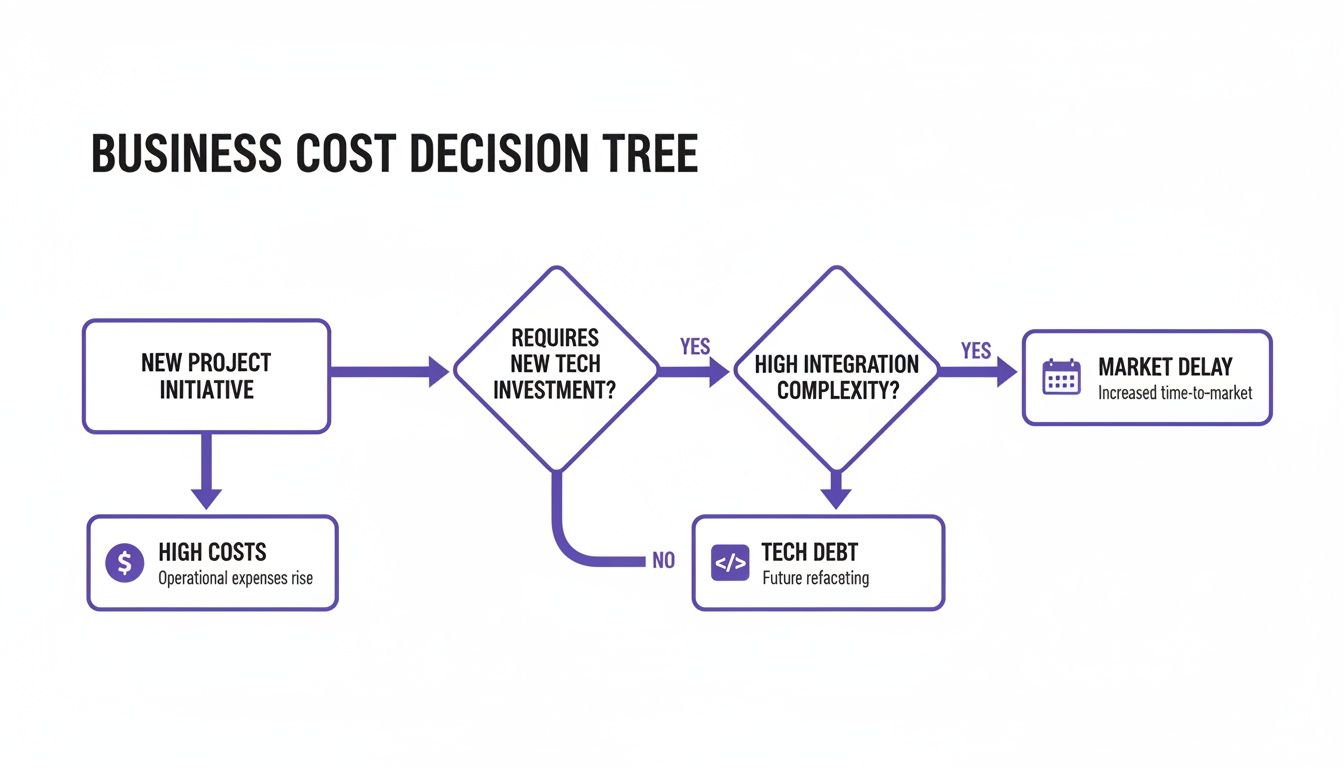
As you can see, sticking with an outdated, localized hiring model almost guarantees you’ll run into one of these painful outcomes. A global talent strategy is no longer a luxury—it's essential for staying in the game.
Choosing the right approach depends entirely on your company's immediate needs, budget, and long-term goals. Here’s a quick breakdown to help you decide which path makes the most sense.
| Strategy | Speed to Hire | Cost Efficiency | Talent Pool Access | Best For |
|---|---|---|---|---|
| Traditional Local Hiring | Slow (Months) | Low (High Salaries) | Very Limited | Niche roles requiring in-person presence. |
| Vetted Talent Platforms | Very Fast (Days) | High | Global (Top 1-5%) | Startups and scale-ups needing speed and quality. |
| Nearshore / Offshore | Moderate | Very High | Large / Global | Cost-sensitive projects with defined scopes. |
| Upskilling Internal Team | Slow (Long-term) | Moderate | Internal Only | Building deep, domain-specific expertise. |
Each strategy has its place. The key is to build a flexible plan that allows you to pull the right lever at the right time, rather than relying on a single, outdated method.
The modern answer to the global hiring challenge is the rise of vetted talent platforms. Think of them as a highly specialized filter for the world’s talent market. Instead of you spending months sifting through thousands of résumés, these platforms do the heavy lifting and present you with a shortlist of pre-qualified, top-tier developers who are ready to go.
By 2025, there will be an estimated 28.7 million developers worldwide, yet a staggering 76% of IT leaders report struggling to find people with the right skills. For a CTO trying to ship a product, that mismatch translates directly into missed deadlines and spiraling costs. This is exactly the gap platforms are built to fill. They provide access to deeply experienced, pre-vetted engineers in critical fields, often at 50-80% cost savings thanks to their global networks.
These platforms cut through the noise by solving several problems at once:
Hiring externally isn't always the answer. Sometimes, the best talent you can find is already on your payroll. A smart, long-term strategy involves a serious commitment to upskilling and reskilling your current team.
Upskilling isn't just a retention tool; it's a strategic investment in building the exact skills your company will need tomorrow, using the loyal and knowledgeable team you have today.
When you create clear pathways for growth, offer training, and give your team chances to work with new technologies, you cultivate the exact expertise you need in-house. This not only fills critical skills gaps but also does wonders for morale and loyalty.
Of course, the most direct way to deal with a talent shortage is to hang on to the amazing people you already have. High turnover is a silent killer, draining your company of resources, productivity, and invaluable institutional knowledge.
This means going way beyond just offering a competitive salary. A real retention strategy is about creating an environment where developers actually want to stay—where they feel valued, challenged, and supported.
Some key pillars include:
One of the most powerful—and often overlooked—tools in your retention and recruiting toolkit is a well-run program for referral recruiting. Great engineers know other great engineers.
Protecting your current team is the bedrock of any successful hiring plan. You can find more in-depth strategies in our guide to recruiting software developers. By weaving together a smart global hiring approach with a genuine commitment to internal growth and retention, you can build a world-class engineering team that thrives, no matter how tight the market gets.
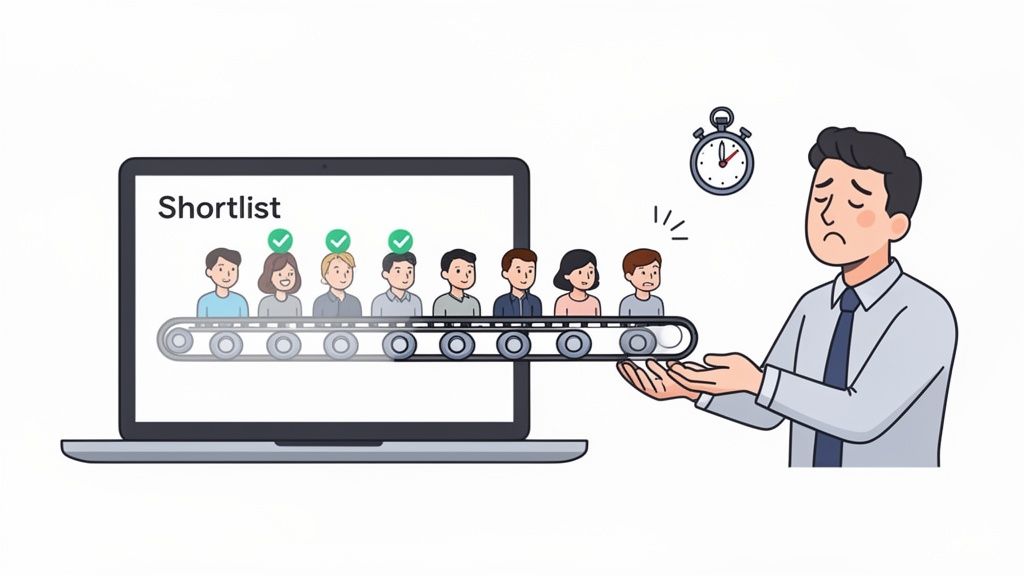
If you've ever tried to hire a developer, you know the drill. It often feels like you're searching for a needle in a global haystack. Faced with a persistent shortage of software developers, companies can spend months buried in resumes and endless interview cycles, only to come up empty-handed.
Vetted talent platforms flip this broken model on its head. Instead of you hunting for qualified candidates, these platforms bring expertly curated talent directly to you. Think of them as a powerful filter that removes all the noise and administrative headaches, letting you focus on what really matters: choosing the best fit for your team.
The magic of a vetted platform is its rigorous, multi-stage screening process. Before a candidate’s profile ever lands in your inbox, they've already been thoroughly evaluated for technical prowess, communication skills, and professional experience. For a busy team, this pre-qualification is a lifesaver.
It’s like skipping the first 99% of the hiring funnel. Rather than waiting weeks or months to even build a shortlist, you can get a hand-picked list of top-tier, interview-ready developers in as little as 24 hours. This multi-stage vetting process (you can learn more about it here: https://hiredevelopers.com/vetting/) is what ensures you only meet the absolute best. That kind of speed is a game-changer, whether you're a startup racing to build an MVP or a large enterprise that needs to scale a team now.
Vetted talent platforms transform hiring from a lengthy, unpredictable gamble into a fast, reliable supply chain for elite engineering talent. You don't just hire faster; you hire with far greater confidence.
A huge part of the developer shortage isn't a lack of people—it's a skills mismatch. Sure, there are millions of developers out there, but finding someone with deep, niche expertise in AI, cloud security, or embedded systems can feel impossible.
This is where a global talent platform really shines. By sourcing and vetting engineers from every corner of the world, they give you access to a much deeper and more diverse skills pool. Need a machine learning wizard from Eastern Europe or a DevOps guru from Latin America? These platforms make that connection seamless.
They also de-risk the whole process of hiring globally by handling the tricky parts:
By blending speed, intense quality control, and global reach, these platforms offer a powerful solution. If you're looking for tools to navigate this competitive landscape, check out this review of the best talent acquisition software platforms. They can give you the fast track you need to build a world-class team.
Let’s be honest: the shortage of software developers isn't a temporary storm we can just wait out. It's the new normal. If you're still relying on frantic, last-minute hiring to fill roles, you're playing a losing game. The real win comes from building a deliberate, forward-thinking talent strategy.
Success today isn’t about snagging that one perfect developer in your city. It's about creating a resilient system for finding, hiring, and keeping great people, no matter where they are.
This all starts with a mental shift. You have to start thinking globally. Instead of fighting over the same handful of engineers in a saturated local market, open your search to the entire world. This single change massively expands your talent pool and brings a flood of new perspectives and skills into your organization.
Of course, hiring globally comes with its own headaches. That’s where modern solutions like vetted talent platforms come in. Think of them as a strategic partner that handles the heavy lifting—vetting candidates, navigating international compliance, and managing payroll. They give you the confidence to build a world-class team with precision, filling critical roles in a matter of days instead of months.
But here’s the most powerful move you can make: invest in the people you already have. A rock-solid retention strategy is your best defense against the constant churn. When you focus on providing meaningful work, clear paths for growth, and a culture people actually want to be a part of, you build loyalty that no competitor can easily poach.
The developer shortage presents a clear choice: keep fighting over scarce resources, or use this as a chance to build a more agile, diverse, and globally-connected team.
Ultimately, this challenge is an invitation to build something better. By moving past outdated hiring models and embracing a smarter, more holistic talent strategy, you can assemble an engineering team that isn't just built to survive—it's engineered to thrive for years to come.
Let's tackle some of the most common questions that come up when leaders are trying to navigate the developer shortage. These are the practical, on-the-ground concerns we hear all the time.
It’s the classic startup dilemma: you need elite talent to build a game-changing product, but your budget can't match what the big tech giants are offering. So, how do you win? You stop playing their game and start playing yours.
The smart move is to look beyond your local talent pool. Global talent platforms are a startup's best friend, giving you direct access to world-class developers in regions where your budget suddenly looks a lot more competitive.
But it's not just about cost. Startups have a unique culture that money can't buy, and top engineers are often looking for more than just a paycheck.
Hiring talent from another country can feel daunting. Concerns about communication barriers, time zone headaches, and inconsistent quality are completely valid—if you’re just posting a job ad and hoping for the best.
But modern hiring platforms are built specifically to solve these problems before they ever reach you.
The biggest risk isn't hiring globally. The biggest risk is sticking to outdated hiring methods while your competition builds a stronger, more diverse team by tapping into the world's talent.
Think of vetted talent platforms as your risk-mitigation partner. Here’s how they de-risk the process:
It's a hot topic, but the answer is no. While AI is a fantastic tool for boosting productivity—it's great at writing boilerplate code, automating tests, and spotting bugs—it isn't going to eliminate the shortage of software developers.
What AI is doing is shifting the demand. It's automating the routine tasks, which in turn creates a massive need for highly skilled senior engineers who can architect, oversee, and troubleshoot these complex AI-driven systems.
In other words, AI isn't replacing the best developers. It's making them more essential than ever. The demand for strategic thinking, creative problem-solving, and high-level system design has never been higher.
You found a strong backend engineer in Poland, a mobile developer in Brazil, or an ML specialist in India. The interviews went well. The budget works. The candidate wants to start soon. Then a problem shows up. Your company does not have a local entity there. You still need a compliant employment contract, payroll in […]

Your product roadmap is full. Your hiring pipeline is not. A release slipped because you still have no senior backend engineer. Your frontend lead is covering architecture reviews. Product wants an MVP in market before a competitor closes the window. Finance wants headcount discipline. Legal wants cleaner contracts. Engineering wants help yesterday. That is usually […]

When you start looking into the cost of outsourcing software development, you'll see a massive range—from a few thousand dollars for a simple app to millions for a complex enterprise system. Here's the good news: smart outsourcing can often slice your total costs by 50-80% compared to hiring an in-house team. The final price really […]


