

When people talk about a remote-first company, they're describing an organization built from the ground up to operate with a distributed team. It's not just a perk; it's the core operating system. This model is designed so that every single team member has the exact same access to information, opportunities, and influence, no matter where […]

When people talk about a remote-first company, they're describing an organization built from the ground up to operate with a distributed team. It's not just a perk; it's the core operating system.
This model is designed so that every single team member has the exact same access to information, opportunities, and influence, no matter where they clock in from.
Let's cut through the jargon. A truly remote-first company doesn't just allow people to work from home—it completely re-engineers its structure, culture, and processes for a world where the office is no longer the center of gravity. Every decision, from how teams communicate to how people get promoted, is made with the assumption that no one is in the same physical room.
Here’s an analogy: think of a remote-first company as a modern software application built with a powerful, open API. Anyone, from anywhere, can plug in and contribute on an equal footing. A "remote-friendly" company, on the other hand, is like an old desktop program with a clunky web feature bolted on as an afterthought. It works, but it creates two very different user experiences, and the remote user often gets the short end of the stick.
Going remote-first demands a serious commitment to a few key principles: asynchronous communication, obsessive documentation, and judging performance based on outcomes, not hours spent at a desk. Those quick "hallway conversations" get replaced by transparent, written discussions in shared digital spaces like Slack or Microsoft Teams.
This shift completely levels the playing field. Suddenly, geography becomes irrelevant to an employee's ability to succeed and make an impact.
The payoff for this intentional design is huge. For starters, it unlocks a global talent pool that was previously out of reach, letting you hire the best person for the job, not just the best person within a 30-mile radius.
The numbers don't lie. By early 2025, fully remote jobs in the U.S. had shot up from ~4% pre-pandemic to over 15% of all professional roles. And what's more, remote job postings consistently attract 2.6 times more applicants than their in-office counterparts. The demand is undeniable.
The lines between these models can get blurry, but the underlying philosophies are worlds apart. One is a deliberate strategy, while the others are often just accommodations. Nailing down these differences is critical before you start building your distributed team.
To make it crystal clear, here’s a quick breakdown of how these three models stack up against each other.
| Attribute | Remote-First | Remote-Friendly | Hybrid |
|---|---|---|---|
| Core Philosophy | The office is an optional resource; the "digital HQ" is the primary workplace. | The physical office is the primary hub; remote work is a flexible perk. | Employees are expected to split time between the office and a remote location. |
| Communication | Asynchronous and written-first is the default. Everyone has equal access to information. | Synchronous, in-person meetings are common. Remote workers often have to "catch up." | A mix of in-person and digital, often leading to communication silos. |
| Decision-Making | Key decisions are made transparently in shared digital spaces. | Major decisions are often made in person by those physically present. | Can create an "us vs. them" culture between in-office and remote days. |
| Career Growth | Promotions are location-agnostic and based on merit and outcomes. | Prone to "proximity bias," where in-office employees are favored for opportunities. | Opportunities can be tied to office attendance and face-time with leadership. |
Ultimately, a "remote-friendly" or "hybrid" approach still tethers the company's culture and power structure to a physical location. A "remote-first" model cuts that cord completely.
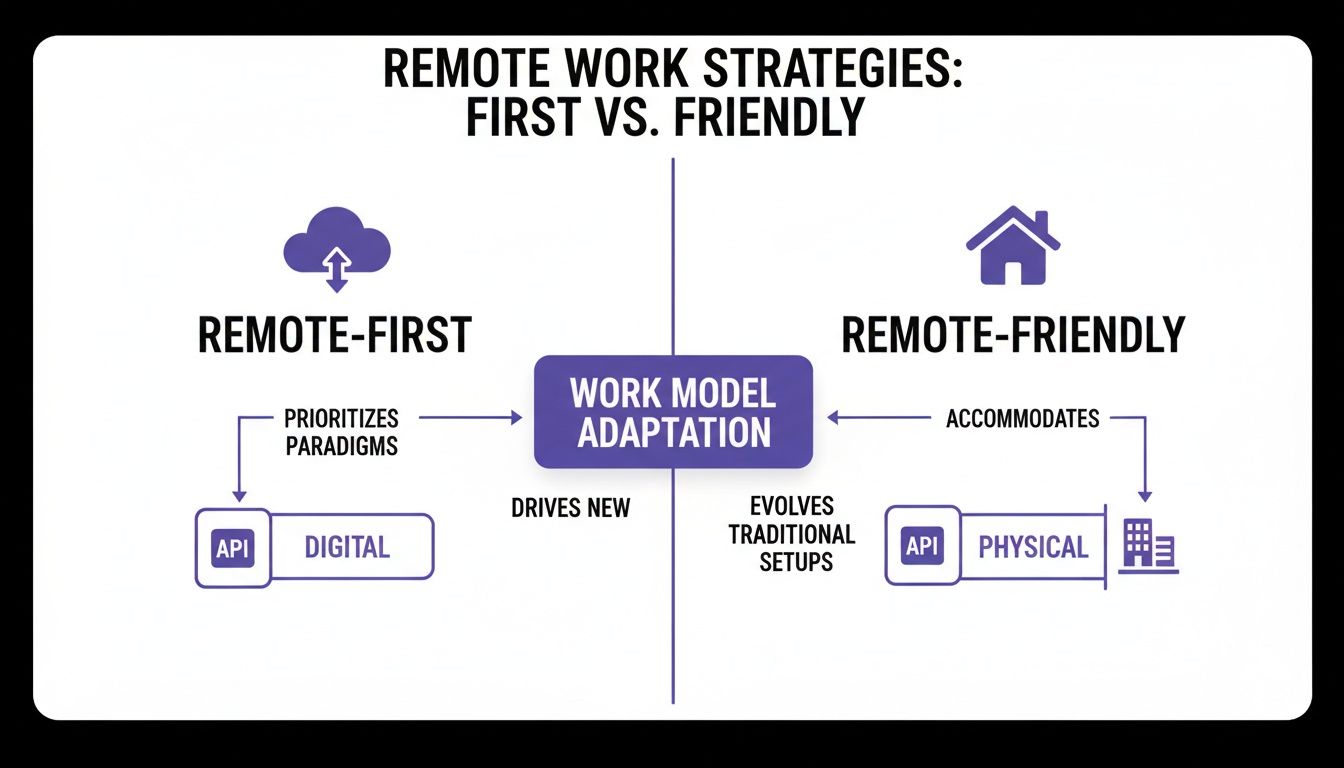
The key takeaway here is that remote-first is a complete system overhaul, not just an HR policy. It's about intentional design—building a company that is truly location-independent from its DNA outward.
Making the leap to a remote-first model isn’t just about ditching the office lease. It's about completely rebuilding your company's operating system from the ground up. The mission is to design a framework where every single process works flawlessly, regardless of where your team members are located. This blueprint becomes the new foundation, ensuring everyone operates with clarity, fairness, and efficiency.
Think about it: a traditional office runs on proximity. Information flows through hallway chats, overheard conversations, and quick desk-side huddles. A remote-first blueprint has to deliberately replace that spontaneous—and often exclusive—way of working with something far more intentional and inclusive. You're building a digital headquarters where access to information and opportunities is equal for all.
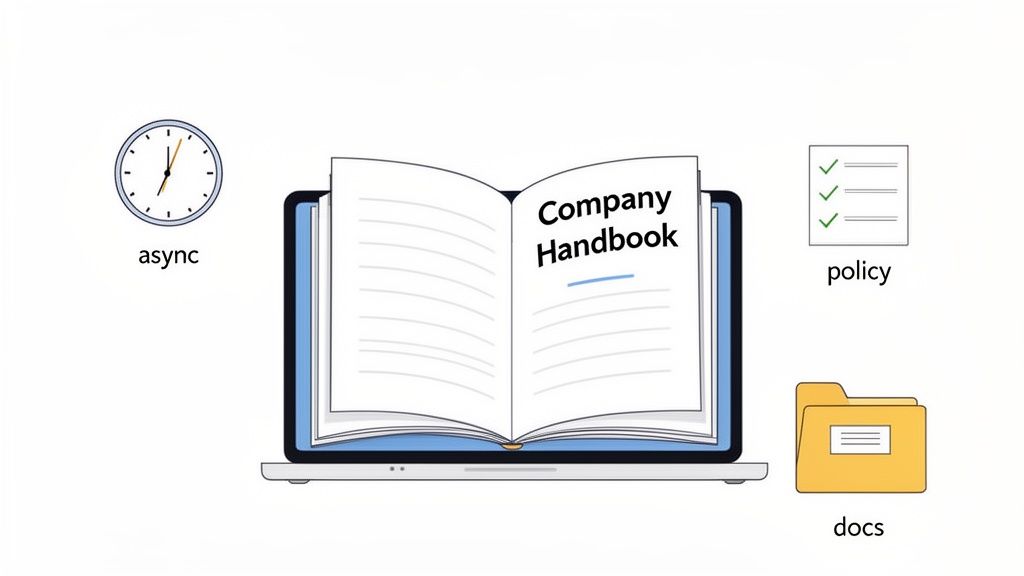
The absolute bedrock of any successful remote-first company is a single source of truth (SSoT). This is your central nervous system—usually a detailed, constantly updated company handbook or internal wiki. It's the one place where everything lives, from company values and communication norms to project workflows and HR policies.
Without an SSoT, you get information chaos. People waste precious time hunting for answers or, even worse, working off old, inaccurate information. Your handbook should be the first place anyone goes when they have a question.
A well-maintained single source of truth isn't just a document; it's an act of cultural engineering. It codifies your company's way of working and demonstrates a commitment to transparency and equality, regardless of an employee's time zone.
Tools like Notion, Confluence, or even a meticulously organized Google Drive can get the job done. The trick is making it easy to search and assigning clear owners to keep the content fresh.
A true remote-first culture runs on asynchronous communication. This doesn't mean you ban meetings entirely. It just means that real-time collaboration becomes the exception, not the default. This shift is non-negotiable for teams spread across multiple time zones, as it separates productivity from the traditional 9-to-5 grind.
To make this work, you need the right tools and, more importantly, the right mindset.
Getting async communication right slashes meeting fatigue, which impacts a staggering 70% of remote workers, and gives people the long stretches of uninterrupted time they need for deep work. As you design your blueprint, a guide on How to Manage Remote Teams can be an invaluable resource.
In a remote world, you can't manage people by watching them work. You have to manage by outcomes. This means building systems that give your team freedom while ensuring everyone stays accountable.
1. Structure Projects for Transparency: Every project needs a clear owner, well-defined goals, and documentation that’s open for anyone to see. You should be able to grasp a project's status, next steps, and key decisions without having to tap someone on the shoulder.
2. Implement Clear Ownership: Define roles and responsibilities with extreme clarity. Frameworks like RACI (Responsible, Accountable, Consulted, Informed) are great for wiping out any confusion about who is supposed to do what.
3. Focus on Outcomes, Not Hours: Your performance metrics need to change. Stop tracking hours logged and start measuring results achieved. This shift builds trust and empowers your team to manage their own time to get the job done. You can learn more about getting new hires into this system with our guide on how to onboard remote employees.
By baking these pillars into your operational blueprint, you create a resilient and scalable remote-first company where people can do their best work, no matter where they are.
Going remote-first gives you the incredible advantage of tapping into a global talent pool. But let's be clear: this isn't just about posting jobs in more places. You have to fundamentally rethink how you find, vet, and welcome new people. You can no longer lean on the crutches of in-person interviews or office tours to gauge a candidate's fit or get them up to speed.
Every single step, from the first job post to the 30-day check-in, needs to be intentional. The goal is to build a system that not only spots brilliant engineers but also identifies those who will truly thrive in an environment built on autonomy and clear documentation.
Your job description is your first handshake. For top-tier remote engineers, a generic, office-centric description is an immediate red flag. They're looking for specifics that show you get remote work.
To make your posts stand out from the noise, make sure they include:
This level of detail does more than just describe a role; it signals that you've built a thoughtful remote culture. It acts as a filter, attracting candidates who are looking for the right remote job, not just any remote job.
In a remote-first company, the interview has to do more than just test someone's coding chops. You have to rigorously evaluate how well they communicate, manage their own time, and collaborate when no one is in the same room. A disorganized interview process will send top talent running for the hills.
Your process should be deliberately structured to test these core skills:
By designing each stage with purpose, you build a much more reliable system for finding engineers who will succeed over the long haul. For a deeper look at the nuts and bolts, you can learn more about how to hire remote developers in our detailed guide.
A great onboarding experience makes a new person feel like part of the team, productive, and empowered from day one. In a remote setup, you can't just hope this happens organically. A structured, well-documented plan is the only way to set them up for success. After defining your hiring flow, it’s just as important to streamline their entry into the company; specialized HR software onboarding can make that first impression seamless.
A great remote onboarding isn't just about sending a laptop and a welcome kit. It’s a structured 30-day journey designed to build connections, clarify expectations, and enable a new hire to make a meaningful contribution quickly.
Your onboarding checklist should be a living document that guides them through that critical first month.
A Sample 30-Day Onboarding Checklist:
When you're running a remote-first company, your tech stack is more than just a list of software subscriptions—it’s your digital headquarters. It serves as your hallway for quick chats, your conference room for big decisions, and your library for critical information. Piecing this digital office together requires more than just grabbing a few popular apps; it's about deliberately building an ecosystem that supports focused work and smooth collaboration, without all the digital noise.
Think of your tech stack as the foundation that your operational blueprint is built on. If your blueprint dictates how people work together, the tech stack provides the tools to make it happen efficiently. Without the right tools, even the best-laid plans for asynchronous work and total transparency will crumble.
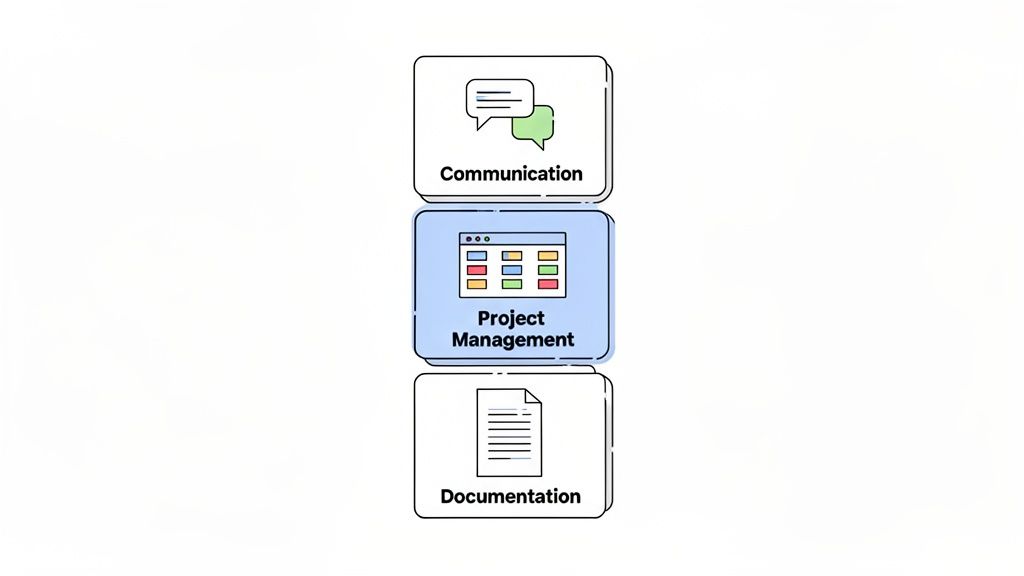
Every truly remote-first company needs to master three fundamental areas, and each one relies on a specific category of tools. You can think of these as the essential pillars holding up your entire digital workspace.
The real power isn't in the individual tools, but in how they connect. A task in Jira should link directly to the full project brief in Notion. Updates on that task's progress should automatically flow into the right Slack channel. This creates a predictable, low-friction environment where finding information is effortless.
Choosing your tech stack isn't about finding the "best" tools—it's about finding the right tools that work together to reinforce your desired culture of transparency, accountability, and asynchronous communication.
A poorly planned tech stack can be just as distracting as a chaotic open-plan office. The goal is to build a digital environment that fiercely protects focus time and minimizes interruptions. This all comes down to setting clear rules of engagement for each tool.
For example, you need to establish firm communication guidelines. Is instant messaging for emergencies only, or for casual banter? All important project discussions must happen within the project management tool to create a permanent, searchable record. A simple rule like this prevents the notification fatigue and "fear of missing out" that kills deep work.
This intentional approach to building a digital workspace is a hallmark of a successful remote-first organization. It’s a key reason why the remote workplace services market is projected to skyrocket from $20.1 billion in 2022 to $58.5 billion by 2027. Companies that get this right understand that flexibility is a massive competitive advantage. In fact, over 52% of remote-first businesses hire outsourced or contract talent—double the rate of non-remote firms—allowing them to find the best people anywhere and operate more cost-effectively. You can discover more insights about the growth of remote work statistics.
Going global with your team is one of the biggest perks of being remote-first, but it also opens a Pandora's box of legal, tax, and payroll headaches. Every country has its own rulebook for labor laws, required benefits, and how taxes are handled. One small slip-up can lead to massive fines, legal battles, and a serious blow to your company’s reputation.
This isn't as simple as wiring money overseas. You've got to classify workers correctly, juggle different currencies, and follow local employment standards. It can feel like you need a Ph.D. in international law just to stay afloat. Trying to DIY this without a dedicated expert is a huge gamble that can easily negate the benefits of hiring the best talent, wherever they are.
The good news? You don't have to build a global compliance department from the ground up. There are a few well-trodden paths for hiring internationally, each with its own mix of cost, risk, and administrative effort.
The right model for you really comes down to your company's size, appetite for risk, and where you see yourself in a few years. Getting a handle on the three main options is the first step toward making a smart, scalable choice.
Here’s an analogy: think of it like entering a new market. Hiring contractors is like using a local distributor—it’s fast, but you have less control. Setting up your own entity is like building your own factory from scratch—a massive, long-term investment. An EOR is like partnering with a full-service logistics firm that takes care of all the local complexity for you.
For a remote-first company that needs to move fast and stay flexible, an Employer of Record is almost always the most strategic choice. It takes the risk out of global expansion and ensures you're fully compliant from day one, all without the massive upfront cost of setting up your own shop.
The legal jungle of global employment can quickly become a full-time distraction, pulling you away from your real job: building a great product and a great team. This is where leaning on a specialized partner can be a game-changer.
Platforms like HireDevelopers.com build EOR services right into their platform, effectively taking the entire compliance burden off your shoulders. They manage the whole process—from vetting and hiring to payroll and local compliance—so you can focus on what actually matters: finding the perfect person for the job. This kind of integrated approach means your remote-first company can grow globally not just quickly, but safely and correctly.
When your team is distributed, you can't rely on old-school productivity metrics. Forget about "time in seat" or how fast someone replies to a Slack message. Those are vanity metrics that tell you nothing about actual performance. In a remote-first world, success is all about tangible outcomes and the value delivered.
This is a fundamental mindset shift. You have to move away from tracking activity and start focusing entirely on results. It’s not about how long it took; it’s about what got done. This is the bedrock of a high-trust, high-performance remote culture.
One of the best ways to get everyone aligned is with the Objectives and Key Results (OKRs) framework. OKRs are fantastic for remote teams because they create a transparent, shared understanding of what matters most, connecting everyone's work directly back to the company's big-picture goals.
Think of it this way:
When you make these OKRs public across the company, you foster a culture of radical transparency. Everyone knows what their colleagues are working on and, more importantly, why. This builds accountability without the need for micromanagement, which is absolutely crucial for keeping a distributed team moving in the same direction.
For engineering teams, in particular, you need metrics that give you real insight without resorting to invasive tracking like keystroke logging or screen monitoring. The best metrics focus on the health and velocity of your development process.
In a remote-first environment, you manage the process, not the people. Strong metrics give you a clear, objective view of how the system is working, allowing you to identify bottlenecks and celebrate real wins.
Instead of watching the clock, track data points that actually reflect efficiency and quality:
Looking beyond team metrics, the business case for going remote-first is incredibly strong, delivering real financial and operational returns. This isn't just a theory; it’s about concrete savings and a massive competitive advantage in hiring.
Companies that ditch the traditional office model see huge savings on commercial real estate and all the associated overhead. But the bigger win often comes from lower employee turnover. The flexibility and autonomy of remote work are massive retention drivers. Plus, studies consistently show that remote roles attract a much larger pool of applicants, opening the doors to a diverse, global talent base that your office-bound competitors simply can't access.
Going remote-first isn't just a policy change; it’s a fundamental shift in how your company operates. Naturally, that brings up some big questions. Leaders often ask about keeping the culture alive, avoiding the obvious traps, and managing technical teams when you can't just walk over to their desk. Getting these answers right from the start is what separates the companies that thrive from those that merely survive.
The question I hear most often? It always comes back to culture. How do you build a real sense of team when nobody is in the same room?
You don't get a great remote culture by accident. It's not about hoping people connect during random hallway conversations—because there are no hallways. A strong remote culture is built with deliberate, consistent effort. Think of it less like a physical campus and more like a thriving, well-moderated online community.
It all starts with writing down your values and operating principles in a public handbook that everyone can see. Then, you over-communicate everything with radical transparency. Instead of relying on spontaneous chats, your team becomes masters of asynchronous communication, which gives everyone, not just the loudest people in the room, a chance to contribute.
A strong remote culture isn't a happy accident. It’s the direct result of intentional rituals—like celebrating wins in public channels, creating virtual water coolers for shared interests (think #dogs or #cooking channels), and using occasional in-person retreats to supercharge bonds, not create them from scratch.
By far, the biggest and most destructive mistake is trying to shoehorn your old office habits into a remote setting. This is a recipe for disaster. It leads to back-to-back Zoom calls, a constant barrage of notifications, and a team that's completely burned out. A remote-first company needs its own operating system, not a digital photocopy of its old one.
A few other major pitfalls to steer clear of include:
This one feels daunting for a lot of founders, but it's more achievable than you think. Your success hinges on focusing on process and outcomes, not on the code itself. Your job isn't to review pull requests; it's to clear roadblocks and make sure the engineering team is building something that moves the business forward.
First, hire a technical lead you trust implicitly and empower them to own the technical execution. Your role is to give them the "what" and the "why," and their role is to figure out the "how." Use project management tools like Jira or Linear to get high-level visibility into progress, not to micromanage individual tasks.
Get comfortable asking questions about business impact and timelines, not about specific architectural choices. And finally, set up a predictable communication rhythm—like weekly async check-ins and regular product demos—that keeps everyone aligned without needing constant meetings.
The global shortage of software developers isn't just a minor hiring headache anymore. It has become a significant business risk that slows down innovation, blows up budgets, and puts a hard ceiling on growth for companies in every single industry. This talent gap is the bottleneck holding you back from launching new products, scaling your […]

If you're trying to pin down a typical back end developer salary in the United States, you'll find it lands somewhere between $101,000 and $175,000 per year. The national average usually hovers around $120,000. But let's be honest, that's just a starting point. Your actual paycheck is a mix of where you live, how many […]

A freelance software engineer isn't just a temporary coder; they're a strategic specialist you bring in for specific, mission-critical tasks. Think of them as a highly skilled operative for getting a product launched faster, plugging a critical knowledge gap, or just giving your team the extra firepower it needs without the long-term commitment of a […]


