

Recruiting software developers isn't just an HR task; it's a core business strategy. To succeed, you have to move beyond just posting on job boards. It’s about creating a well-oiled machine that includes active sourcing, a developer-centric interview process, and an employer brand that actually means something to engineers. You need to understand just how […]

Recruiting software developers isn't just an HR task; it's a core business strategy. To succeed, you have to move beyond just posting on job boards. It’s about creating a well-oiled machine that includes active sourcing, a developer-centric interview process, and an employer brand that actually means something to engineers. You need to understand just how competitive the tech talent market is and build a system that top engineers will want to be a part of.

Let's be honest: finding and hiring the right software developer is one of the toughest challenges for any business right now. We're in a market defined by fierce competition, where the best engineers often juggle multiple offers and can afford to be incredibly picky. This isn't a simple numbers game anymore. It's a strategic fight for the very people who will build and innovate your products.
The old "post and pray" method on job sites is dead. The most talented developers are almost always passive candidates—they're skilled, currently employed, and not scrolling through job listings. To get their attention, you need to be proactive and treat recruiting with the same seriousness you give to your core business operations.
At its heart, this is a classic supply-and-demand problem. The tech industry is grappling with a massive talent shortage that's only getting worse. By 2030, some estimates predict a staggering 85.2 million unfilled jobs across the globe.
This isn't just an inconvenience; it has huge economic implications. Businesses could potentially lose out on $8.5 trillion in revenue simply because they can't find the skilled engineers they need.
This reality means companies have to work much harder to attract talent. It takes more than just a big salary. Today's developers are looking for a complete package:
The real challenge isn't just finding someone who can write code. It's about finding the right person who fits your team's culture, understands your technical needs, and believes in your long-term vision. If your hiring process doesn't reflect these modern expectations, you'll consistently lose great candidates to the companies that get it.
To win in this environment, you need to explore powerful hiring and recruiting strategies. This guide is your playbook for building a hiring process that not only attracts but also keeps top-tier talent. We’ll walk through everything from defining the role with pinpoint accuracy to designing an interview experience that engineers actually respect, giving you the foundation to build the team you need.
Your job description is your opening pitch. It's the first thing a potential hire sees, and if it reads like a generic HR template, the best developers will simply scroll right past it. You have to stop thinking of it as a formal list of requirements and start treating it like a sales page for an incredible opportunity.
Top engineers are driven by solving interesting problems. They want to know what they'll be building and, more importantly, why it matters. Before you write a single line, get your engineering manager and a couple of team leads in a room. The goal is to figure out what you really need and how to make that sound exciting.
The best job descriptions tell a story. They paint a picture of the role, the team, and the mission. Instead of a dry list of technologies, you need to weave those skills into the context of the actual work. This helps a candidate see themselves in the role, tackling the challenges you're presenting.
One of the biggest mistakes I see is the "kitchen sink" approach—listing every conceivable technology you might ever touch. This is a great way to scare off perfectly good candidates who have 80% of what you need but see a wish list they can't possibly meet.
You have to be crystal clear about what's essential versus what's a bonus.
Must-Haves: These are the absolute deal-breakers. The skills someone needs to hit the ground running. For a senior backend engineer, that might be "5+ years building and shipping products with Python and Django" or "proven experience designing and scaling RESTful APIs." Be specific.
Nice-to-Haves: These are the skills that would be great but aren't mandatory. Think "familiarity with GraphQL," "experience with CI/CD tools like Jenkins," or "a working knowledge of front-end frameworks."
Making this distinction shows you've actually thought about the role and respect a candidate's time. It also signals that you have a culture of learning, which is a huge plus for talented developers.
A great job description doesn’t just filter people out; it actively pulls the right ones in. It should get an engineer genuinely excited about the technical challenges, the growth path, and the team they'll be working with every day.
To cut through the noise, your description has to showcase what makes your company a place worth working for. Be authentic, be clear, and give them the details they actually care about.
Here’s what every great job description should cover:
The Mission and the "Why": Hook them from the start. What does your company do, and how does this specific role push that mission forward? Explain how their code will make a real impact on the business or for your users.
The Real Tech Stack: Don't be vague. List the core languages, frameworks, databases, and tools they’ll be using day-to-day. Honesty here is crucial for avoiding a mismatch down the line.
Real Growth, Not Vague Promises: "Room for growth" is a meaningless platitude. Get specific. Talk about mentorship programs, a dedicated conference budget, or opportunities to lead new projects. Show them a real career path.
Team and Culture: Give them a feel for the daily reality. Is the team highly collaborative and into pair programming? Or do developers have more autonomy and ownership? For a deeper dive, check out our guide on creating a job description for a front-end developer for some concrete examples.
The Salary Range: This is non-negotiable in today's market, and it’s required by law in many states. Putting the salary range upfront shows you're transparent and saves everyone a ton of time.
Nailing these elements transforms your job description from a simple posting into one of your most powerful recruiting tools.
Let's be honest: the old "post and pray" model for hiring developers is broken. The best engineers aren't scrolling through job boards; they're busy building cool stuff. If you want to find them, you have to go where they are.
This means getting proactive. Stop waiting for the talent to come to you and start seeking them out in the digital communities, projects, and platforms where they spend their time. This isn't about spamming inboxes—it's about making real connections in the places they genuinely hang out.
LinkedIn is a start, but it's also incredibly noisy. Every recruiter is sending the same templated messages, and developers have learned to tune them out. To get an edge, you have to look deeper.
Think like a developer for a minute. Where do they go to solve a tough coding problem, learn a new framework, or just geek out on a passion project?
/r/programming or language-specific forums gives you a direct line to highly engaged experts.When you're looking at candidates from all these different places, it's easy to get bogged down in a long list of "wants." This quick decision tree can help you stay focused on what truly matters.
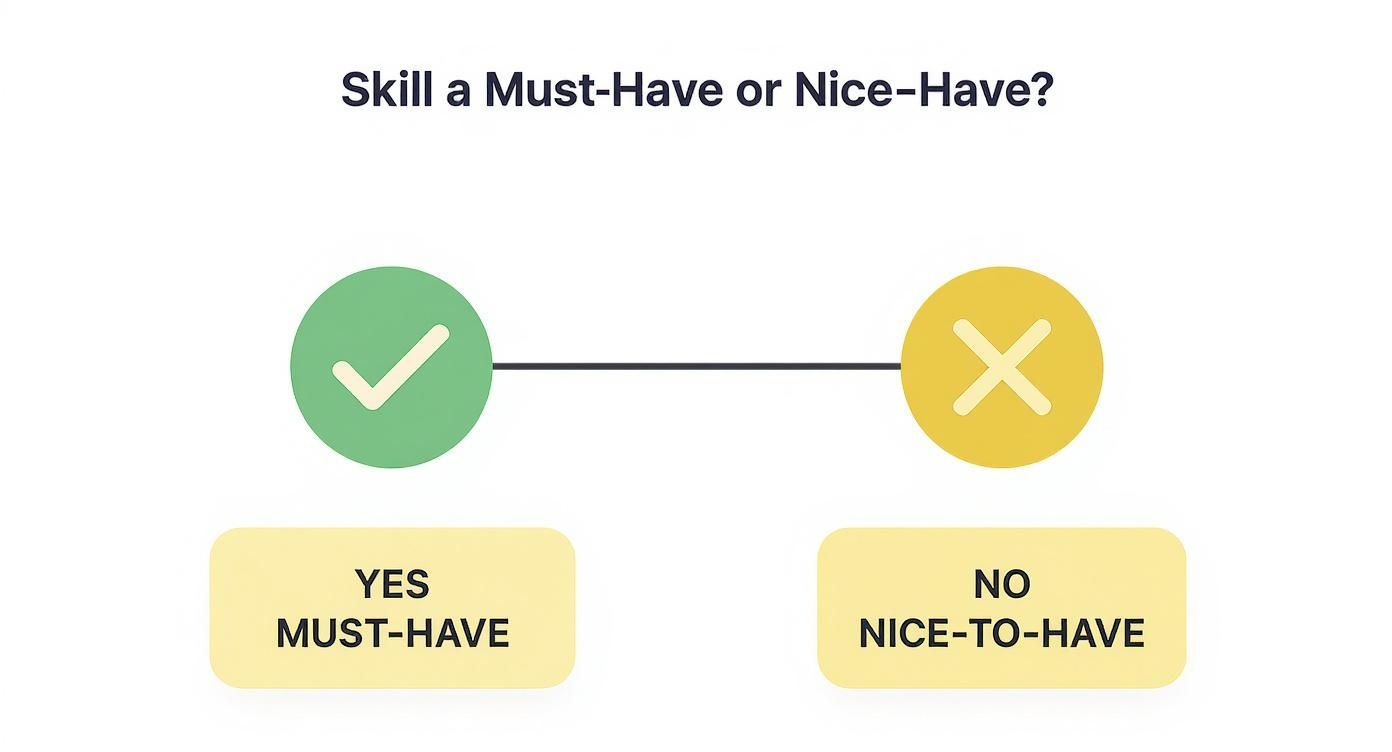
Using a framework like this helps you zero in on candidates with the non-negotiable skills while keeping an open mind about those who bring other valuable, but not essential, expertise to the table.
Once you know where to look, you need to decide how you're going to hire. Each approach has its own mix of pros and cons when it comes to cost, speed, and the level of control you have over the process. Getting this right is about aligning your hiring strategy with your immediate business goals.
Let's break down the three main models you can choose from.
| Sourcing Model | Best For | Cost | Hiring Speed | Level of Control |
|---|---|---|---|---|
| In-House | Building core, long-term teams; roles requiring deep company knowledge. | Highest | Slowest | Full |
| Talent Marketplace | Startups, specific projects, and filling roles with in-demand skills quickly. | Medium | Fastest | Moderate |
| Nearshore/Offshore | Scaling teams rapidly, accessing specialized skills, and cost optimization. | Lowest | Fast | High (with the right partner) |
The right choice really depends on your situation. A startup racing to build an MVP might lean on a talent marketplace for pure speed, whereas a large enterprise building a core product will likely invest the time and money to build out a dedicated in-house team.
Don't box yourself in by only looking in your own backyard. You'd be missing out on a massive, global community of skilled engineers.
As of 2025, there are roughly 47.2 million software developers worldwide. While North America and Western Europe are home to about 9.5 million each, the real growth is happening elsewhere. South Asia has nearly doubled its developer population to 7.5 million, and South America is on the rise with 3.4 million talented engineers.
You've found a promising candidate. Now what? Your first message is everything. A generic, copy-pasted outreach email is the fastest way to get ignored.
Great outreach is personal. It shows you’ve actually done your homework.
[Project Name] repo, especially how you handled the caching layer."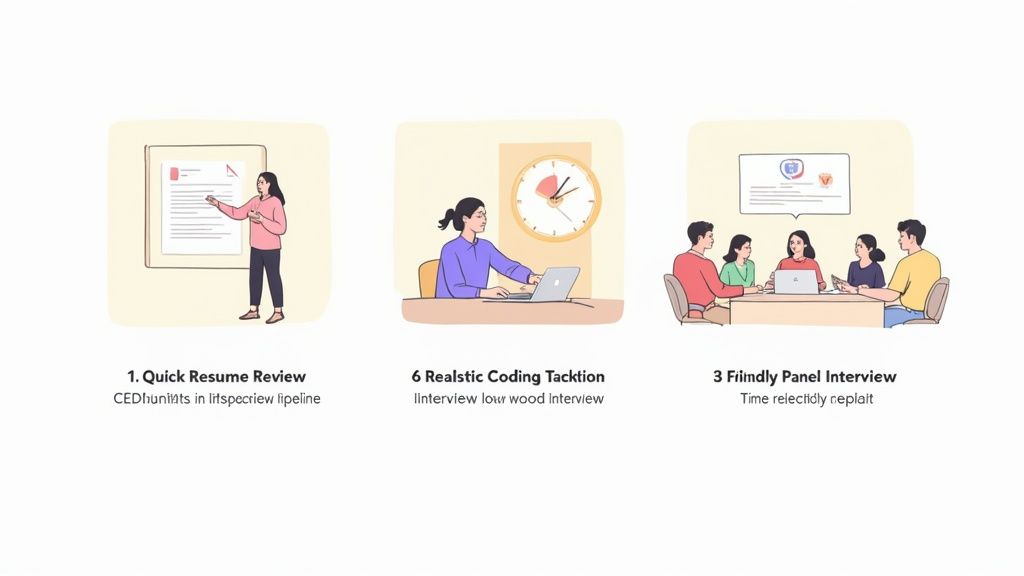
This is where so many great recruiting efforts completely fall apart. A bad interview process doesn't just filter out the wrong people—it actively drives away the right ones. Top-tier developers have plenty of options, and they simply won't put up with a process that feels slow, disorganized, or disrespectful.
Your interview process has to be a direct reflection of your engineering culture. Think efficient, technically relevant, and, most importantly, respectful of a candidate's time and expertise. A fantastic interview experience is a huge competitive advantage, leaving every single person—even those you don't end up hiring—with a genuinely positive view of your company.
Let's be clear: the days of asking developers to invert a binary tree on a whiteboard or solve abstract brain teasers are over. These kinds of tests rarely have anything to do with the actual day-to-day work of a software engineer. They tend to test for niche algorithmic knowledge rather than the practical, real-world problem-solving skills you actually need.
The best technical assessments are the ones that mirror actual tasks. This approach not only gives you a much clearer picture of how a candidate will perform on the job, but it also gives them a sneak peek into the kinds of challenges they’d be tackling with your team.
A solid interview workflow usually has a few key stages:
The single most important rule is to make every stage of the interview valuable. If a step doesn't give you a unique and critical piece of information, it’s just adding friction to the process. Ditch it.
The whole point of a technical challenge isn't to stump the candidate; it's to see how they think. A great challenge is just a small, self-contained version of a problem your team has actually solved.
For instance, instead of some abstract algorithm, you might ask a backend candidate to build a simple API endpoint that does something specific. This lets you assess their skills on multiple levels at once.
From just one practical task, you can evaluate several things:
This gives you a much richer signal than a simple pass/fail on a puzzle. It shows you how a developer works, not just what they happen to know. The insights you gather are also crucial for understanding how a candidate might fit within your team, which you can further explore through a work style assessment during the final stages.
Technical chops are table stakes, but they're only half the equation. Soft skills—things like collaboration, communication, and resilience—are what make someone a truly great teammate. The best way to get a read on these is through well-crafted behavioral questions.
Ditch the generic stuff like, "Are you a team player?" Instead, dig into their past experiences with situational prompts.
Questions like these force candidates to pull from real-life situations, giving you a much more authentic look at how they handle the human side of building software.
Unconscious bias is one of the biggest dangers in any hiring process. If you don't train your interviewers, they can easily fall into the trap of favoring candidates who are just like them, instead of the most qualified person for the job.
With the software engineer job market booming, competition for talent is intense. The San Francisco Bay Area, for example, is home to about 32% of all AI engineering roles in the world. To even have a chance at landing top people, your process has to be impeccably fair.
The best way to fight bias is with a structured interview plan. Every single candidate for a role should be asked the same core questions and be evaluated against the exact same rubric. This consistency ensures you're comparing apples to apples and making decisions based on skill and qualifications, not just a gut feeling. When you design a process that developers actually respect, you don't just get better hiring outcomes—you build a stronger, more inclusive engineering team.
You've spent weeks sifting through resumes, conducting interviews, and running technical deep dives. You’ve found your developer. This is it—the final play. But be careful. This is the moment where all that hard work either pays off spectacularly or unravels in an instant.
Extending an offer is far more than just throwing a number out there. It’s your final sales pitch, your first real move in building a long-term relationship, and the foundation for keeping that new hire happy for years to come.
Getting to a "yes" means putting together a thoughtful, competitive, and completely transparent package. In a market where top engineers are often fielding multiple offers, a well-crafted offer isn't just a nice-to-have; it's the tiebreaker that gets them to choose you.
The offer you put on the table is a direct signal of how much you value the candidate. A lowball number or a vague, confusing package tells them one of two things: you're out of touch with the market, or you aren't serious about bringing on top talent.
So, where do you start? With data. Benchmark your salary against real-time market rates for that specific role, tech stack, and location. Don't pull numbers from a six-month-old salary survey. You need current data to prove your offer isn’t just fair—it’s genuinely compelling. For the best engineers, "competitive" usually means landing in the top 25% of the market range.
Of course, salary is only part of the story. Equity can be a massive draw, but only if you explain it properly. Let's be honest, outside the Silicon Valley bubble, equity can be incredibly confusing.
A killer offer is about the whole picture. It’s the cash, the equity, and all the intangibles that make your company a place people actually want to work—like a great engineering culture, tough problems to solve, and a real respect for work-life balance.
Even if you put forward a stellar offer, you should expect some back-and-forth. The best developers know their value and aren’t afraid to ask for it. The key is to treat this as a collaborative chat, not a battle. You're trying to find a win-win that makes everyone excited to start working together.
What about the dreaded counteroffer from their current job? This is a critical moment. It's tempting to just open the wallet and match it, but you need to dig deeper. A counteroffer isn't just about money; it's a sign that their current company values them.
Instead of just upping the salary, circle back to why they wanted to leave in the first place. Remind them about the new challenges, the team they clicked with, and the career growth you offer. Reconnect them to the excitement they felt during the interview process.
Getting that signed offer is a huge win, but the clock is ticking. A new hire’s first few weeks are make-or-break for their long-term success. A clunky, disorganized onboarding can sour their excitement and plant seeds of doubt before they’ve even pushed their first line of code.
A structured onboarding plan is absolutely essential. It’s the roadmap that helps your new developer get plugged into the team, the codebase, and the company culture.
At the end of the day, the single best way to keep your developers is to create an environment they don't want to leave. Retention isn't about fancy perks or one-off bonuses; it’s the sum of all the small, consistent things that create a healthy, supportive engineering culture.
It means giving people a clear path for growth through mentorship and challenging work. It means creating a space where engineers feel safe enough to take risks, make mistakes, and learn from them. When you genuinely invest in your team's development and well-being, you build a kind of loyalty that no counteroffer can ever truly touch.
Even with the best playbook, you're going to have questions. The tech hiring world moves fast, and what worked last year might get you crickets today. Let's tackle some of the most common questions and sticking points that pop up when you're trying to hire great developers.
Think of this as your quick-reference guide for those tricky situations that inevitably arise. These are the practical, in-the-trenches answers you need to make smart decisions and avoid the common traps that cause companies to lose out on top talent.
Look, every company is different, but a competitive hiring process for a software developer really needs to wrap up within three to six weeks. That’s from the moment they apply to the day they sign the offer. If you let it drag on any longer, you’re practically handing your best candidates over to your competitors.
Here's what a healthy timeline might look like:
Pulling this off means your hiring team has to be in lockstep. Everyone—from the recruiter to the hiring manager—needs to make giving feedback a priority. Delays kill deals.
It’s surprisingly easy to sabotage your own recruiting efforts without even realizing it. The good news is that the most damaging mistakes are also the easiest to fix once you know what they are.
The absolute biggest errors I see companies make are:
The common thread here is a failure to create a process that respects the developer. Remember, you're being interviewed just as much as they are. Sidestepping these mistakes is one of the single most effective things you can do to land better hires.
Technical chops are essential, but they're only half the story. The soft skills—communication, teamwork, how they solve problems with others—are what separate a good developer from a great teammate. You have to get creative to assess these qualities.
A pair programming session is one of the best ways to do this. You get to see firsthand how they talk through their ideas, how they take feedback, and if they can actually work with someone to get something done.
Behavioral questions are also your best friend here. Don't ask, "Are you a team player?" Instead, get specific:
"Tell me about a time you had a technical disagreement with a colleague. How did you handle it, and what was the result?"
The story they tell you will reveal more about their real-world collaboration skills than any generic question ever could.
Ah, the classic debate. Honestly, both have their place. A live coding session is fantastic for seeing how a candidate thinks on their feet, but the pressure-cooker environment can make some really sharp developers freeze up.
On the other hand, a take-home assignment lets someone show you their best work without you breathing down their neck. The downside? They can take up a lot of a candidate's free time, and you can never be 100% sure they did all the work themselves.
I’m a big fan of a hybrid approach. Start with a small, clearly defined take-home project—something that shouldn't take more than a couple of hours. Then, use that project as the centerpiece of a live interview. Ask them to walk you through their code, explain why they made certain design choices, and maybe even add a small feature. This way, you get the best of both worlds: you see their thoughtful, polished work and their real-time problem-solving skills.
The demand for skilled IT professionals, from AI/ML engineers to cybersecurity experts, has never been higher. Yet, the cost of a bad hire can exceed 30% of their first-year salary, not to mention the project delays and team disruption. This makes your choice of recruitment partner a critical strategic decision. A generic approach won't work; […]

In modern software development, speed and quality are non-negotiable. Continuous Integration (CI) is the bedrock practice that enables elite teams to deliver reliable software faster by automating the integration of code changes from multiple developers. Adopting robust best practices for continuous integration transforms development from a series of error-prone manual steps into a streamlined, automated, […]

It’s easy to get tangled up when comparing Agile, Kanban, and Scrum. People often treat them like three competing options, but the relationship is much simpler. Think of it this way: Agile is a philosophy—a set of guiding principles—while Scrum and Kanban are the frameworks you use to put that philosophy into practice. The core […]


