

At its core, project management for software engineering is the game plan for how you plan, build, and ship software on time and on budget. But it's so much more than just ticking off tasks on a to-do list. It’s the critical discipline that turns complex code into real business value and makes sure your […]

At its core, project management for software engineering is the game plan for how you plan, build, and ship software on time and on budget. But it's so much more than just ticking off tasks on a to-do list. It’s the critical discipline that turns complex code into real business value and makes sure your team is building the right thing, not just building things right.
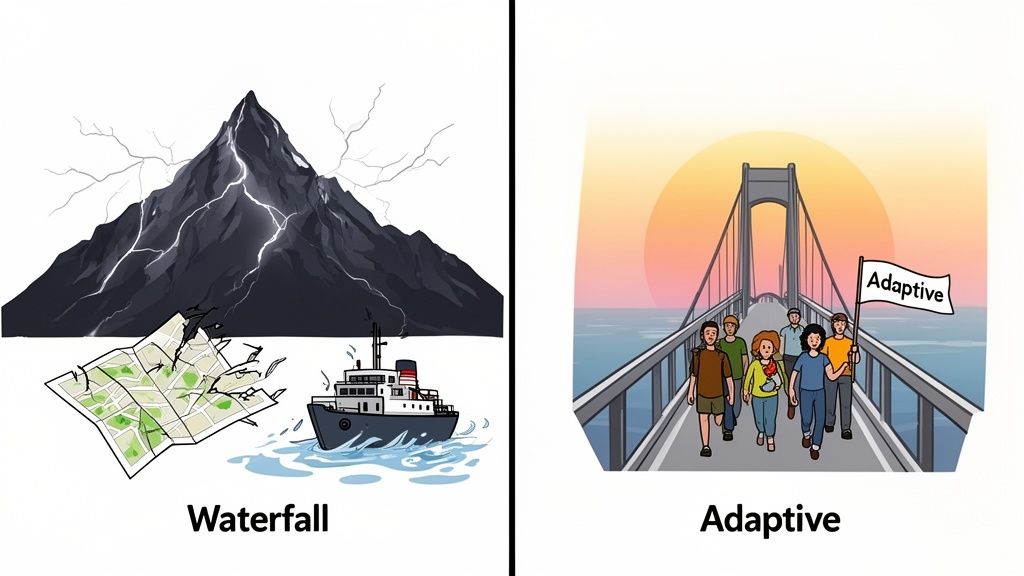
Starting a big software project can feel like you're about to trek into uncharted territory. You know where you want to end up—a killer product that users love—but the path is guaranteed to have twists, technical traps, and changing market winds. The old maps just don't work anymore.
Traditional project management, often called the "waterfall" method, was born from predictable fields like manufacturing and construction. It makes sense there. You wouldn't pour the roof before the foundation is set, and the blueprints are locked in before a single nail is hammered. This rigid, step-by-step process requires you to define everything upfront, create a master plan, and execute it perfectly with very little room for change.
In the software world, that approach is a recipe for disaster.
Picture a team spending a year meticulously building an app based on a plan they made on day one. By launch day, a new competitor has eaten their lunch, user expectations have completely shifted, and a core technology they used is now obsolete. They followed the plan perfectly but built a product nobody wants.
In software development, change isn't a problem to be avoided; it's a constant to be managed. The failure rate for projects using rigid methodologies can be alarmingly high because they treat software like a static object, not a living system.
This old-school approach almost always leads to a few familiar problems:
This is why effective project management for software engineering needs a modern playbook—one built on adaptive principles. Instead of one big, fragile plan, you use a compass and a series of smaller, achievable goals. This approach accepts a simple truth: the best path is discovered by walking it, not by trying to predict it from the start.
Let's go back to that app. An adaptive team would start by building a Minimum Viable Product (MVP)—just the core features—and get it into the hands of real users fast. They'd obsess over feedback, watch the usage data, and use those fresh insights to decide what to build next. They aren't just building software; they are learning and steering the project in real-time.
This agile, iterative cycle changes everything. It turns development from a high-stakes, all-or-nothing bet into a series of smart, calculated steps toward a product that actually succeeds. It’s the bridge that connects a brilliant idea to a valuable product that customers truly need. In the sections ahead, we’ll break down the specific methodologies and practices that make this modern approach a reality.
Picking a software development methodology is a lot like choosing a game plan for your team. It's not just a dusty rulebook; it's the living framework that shapes how your team talks, plans, and ultimately, gets work done. The right choice can feel like a tailwind, pushing your project forward, while the wrong one can create constant friction, kill momentum, and lead to serious team burnout.
Think of it this way: the blueprint for a skyscraper looks wildly different from the sketch for a custom-built treehouse. Both are construction projects, sure, but their scale, complexity, and ability to handle last-minute changes are worlds apart. Your methodology has to fit your project’s unique DNA—its goals, your team's size, and how much you really know about what you’re building from the start.
Let’s break down the most popular and effective frameworks out there to help you find that perfect fit.
Before we get into specific methods, we need to talk about Agile. It’s not a single, rigid methodology but more of a mindset, a philosophy grounded in building things step-by-step and constantly getting feedback. Instead of one massive "big bang" release at the end, Agile breaks projects down into small, manageable pieces.
This entire approach is built on a few core beliefs:
Scrum, Kanban, and Lean are all just different ways of putting these Agile ideas into practice.
Scrum is easily the most popular Agile framework out there, used by a whopping 66% of Agile teams. The best way to think of Scrum is as a series of short, focused training camps called sprints. Each sprint, which usually lasts two weeks, has a crystal-clear goal, like building out a specific feature.
The team commits to a chunk of work from a prioritized to-do list (the product backlog) and focuses on nothing else for that sprint. When it’s over, they deliver a small, potentially shippable piece of the final product. This cycle of planning, doing, and reviewing gives the project a steady, predictable rhythm and forces the team to frequently check their work and adjust course.
Scrum is a fantastic choice for complex projects where you expect the requirements to change. Its defined structure—with clear roles (Product Owner, Scrum Master, Development Team), events (Sprint Planning, Daily Stand-up), and artifacts (Product Backlog)—provides a sturdy container for managing uncertainty. Each role is vital, and you can learn more about how they work together by exploring the roles in agile software development.
If Scrum is a series of sprints, Kanban is more like a continuous marathon. Picture a busy restaurant kitchen. Orders (tasks) come in, get slapped on a board, and move through different stations—prep, cooking, plating—before heading out to the customer. The goal isn't to finish a big batch of orders all at once; it's to keep a smooth, steady flow from start to finish.
Kanban makes this workflow visible on a Kanban board, where columns represent different stages of your process. Tasks travel from left to right as they get closer to completion. The absolute key to Kanban is limiting Work in Progress (WIP) for each column. This simple rule prevents bottlenecks and stops team members from juggling too many things at once, which is a notorious productivity killer.
By limiting WIP, Kanban shines a spotlight on process problems in real-time. If tasks are piling up in the "Testing" column, you have an instant visual cue that there’s a bottleneck in your QA process that needs attention.
This methodology is perfect for teams that manage a constant stream of work with shifting priorities, like IT support, maintenance teams, or DevOps. It gives you incredible flexibility without the strict, time-bound deadlines of Scrum.
Lean development’s origins trace back to the Toyota Production System, and it’s laser-focused on one thing: delivering maximum value to the customer by ruthlessly eliminating waste. In the software world, "waste" isn't just about money; it’s anything that doesn't directly add value for the end user.
This could be anything from:
Lean pushes teams to deliver value as fast as possible, often by building a Minimum Viable Product (MVP), getting it in front of real users, and then iterating based on their feedback. It’s less of a prescriptive "do this, then that" framework and more of a guiding mindset you can layer on top of other methodologies like Scrum or Kanban. The goal is always to build, measure, and learn as efficiently as you possibly can.
Choosing the right methodology is crucial for setting your team up for success. This table breaks down the core differences between Agile, Scrum, Kanban, and Lean to help you identify the best fit for your project's unique needs and your team's workflow.
| Methodology | Best For | Key Principle | Cadence | Primary Metrics |
|---|---|---|---|---|
| Agile | Projects with evolving requirements and a need for flexibility. | Iterative development & continuous feedback. | Adaptive cycles (sprints, continuous flow). | Customer satisfaction, working software. |
| Scrum | Complex projects that benefit from structure, clear roles, and rhythm. | Time-boxed sprints and defined team roles. | Fixed-length sprints (typically 1-4 weeks). | Velocity, Burndown Charts. |
| Kanban | Teams with continuous workflow and variable priorities (e.g., support, ops). | Visualizing workflow & limiting work in progress. | Continuous, event-driven flow. | Cycle Time, Lead Time, Throughput. |
| Lean | Teams focused on rapid delivery and maximizing customer value. | Eliminating waste & delivering value fast. | Continuous improvement cycles (Build-Measure-Learn). | Value Stream Mapping, Cycle Time. |
Ultimately, the best methodology is the one that your team understands, believes in, and can execute consistently. Don't be afraid to start with one and adapt it over time. The most successful teams are the ones that continuously inspect their own processes and aren't afraid to change what isn’t working.
Every piece of software you use, whether it’s a simple mobile game or a sprawling enterprise platform, follows a predictable path. It starts as a spark of an idea and evolves into a fully functioning application. We call this journey the Software Development Lifecycle (SDLC).
For a project manager, understanding these phases isn't just helpful—it's essential. It provides the roadmap you need to guide your team, manage expectations, and make sure nothing important gets missed along the way. Think of it like building a house: you wouldn't start hammering up walls without a blueprint, and you definitely wouldn't install windows before the frame is secure. Each stage logically builds on the last, turning an abstract concept into real, high-quality software.
Let's walk through this process with a practical example: building a new mobile app for a local coffee shop.
The lifecycle kicks off long before anyone writes a single line of code. It all begins with a core concept and a clear problem to solve.
Getting this upfront planning right is the foundation for everything that follows. It saves you from costly rework and headaches down the line.
Once you have a solid plan, the creative and technical work can begin. This is where the abstract idea starts to take on a visible, functional shape.
The design phase is all about the user's experience. UI/UX designers will create wireframes (which are like basic structural sketches) and then mockups (detailed visual designs) to map out how someone will actually use the app. Their goal is to make it intuitive, efficient, and nice to look at. For our coffee app, this means making sure the "Order Now" button is easy to find and the menu is a breeze to browse.
Next up, the software engineers take those designs and turn them into a working application. This is the hands-on coding part of the process, where the features you defined in the planning stage get built. Developers write, test, and integrate code, transforming the static designs into a functional product, piece by piece.
The image below shows a few different ways this development flow can be structured.
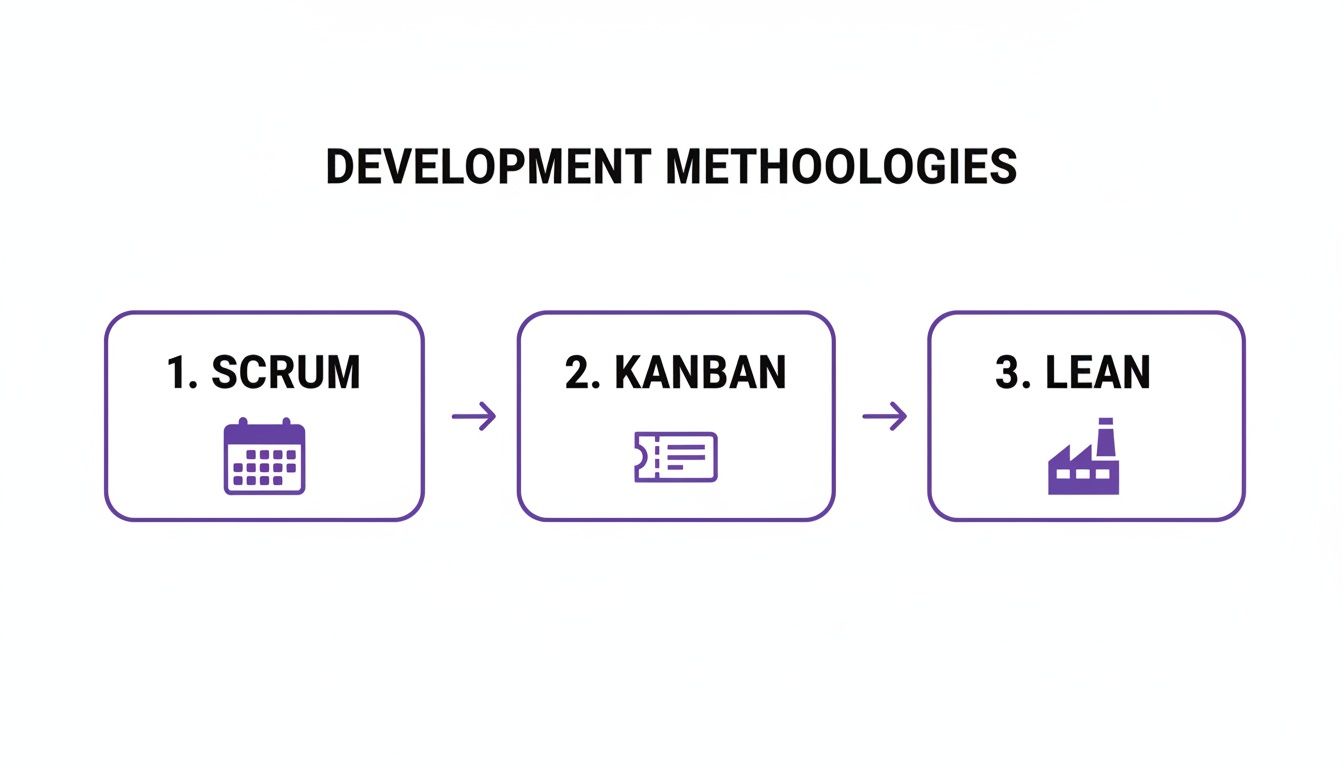
Whether it's the structured sprints of Scrum, the continuous flow of Kanban, or the waste-reduction focus of Lean, these methodologies provide a framework for organizing the complex work of development and testing.
Just building the software is only half the battle. Making sure it works perfectly is just as critical.
This is where Quality Assurance (QA) testing comes in. It’s a rigorous process of finding and squashing bugs before they ever reach a user. Testers go through every single feature, trying to break the app in creative ways to ensure it’s stable, secure, and performs as it should. For our coffee shop app, they’d check if ordering a latte works on different phones, on slow Wi-Fi, and under all sorts of conditions.
A project isn’t "done" when the code is written. It's done when the code has been thoroughly tested and proven to deliver a quality experience to the end user.
Finally, with a well-tested product, the app is ready for deployment. This is the moment it goes live in the app stores for customers to download. Many modern teams use Continuous Integration/Continuous Deployment (CI/CD) pipelines to automate this process, making releases faster and much more reliable.
But the journey doesn’t end at launch. Maintenance and support are the ongoing phases where the team fixes any new bugs that pop up, adds small improvements, and keeps the app running smoothly. This cyclical nature—build, test, deploy, maintain—is a hallmark of modern software project management.
Great software doesn't just happen. It’s built by a team of people who know exactly what their job is and how it connects to everyone else's. Think of it like a well-oiled machine—every gear has a specific function, and when they all turn in sync, the machine runs smoothly.
Without clearly defined roles, you get chaos. Tasks fall through the cracks, people work on the same thing without realizing it, and progress grinds to a halt. When everyone knows who owns what, you create a culture of accountability where people can focus on what they do best.
Let’s look at the key players you need to bring a software project to life.
A top-tier software team is way more than just a collection of programmers. It's a balanced group of specialists, each bringing a crucial piece of the puzzle to the table.
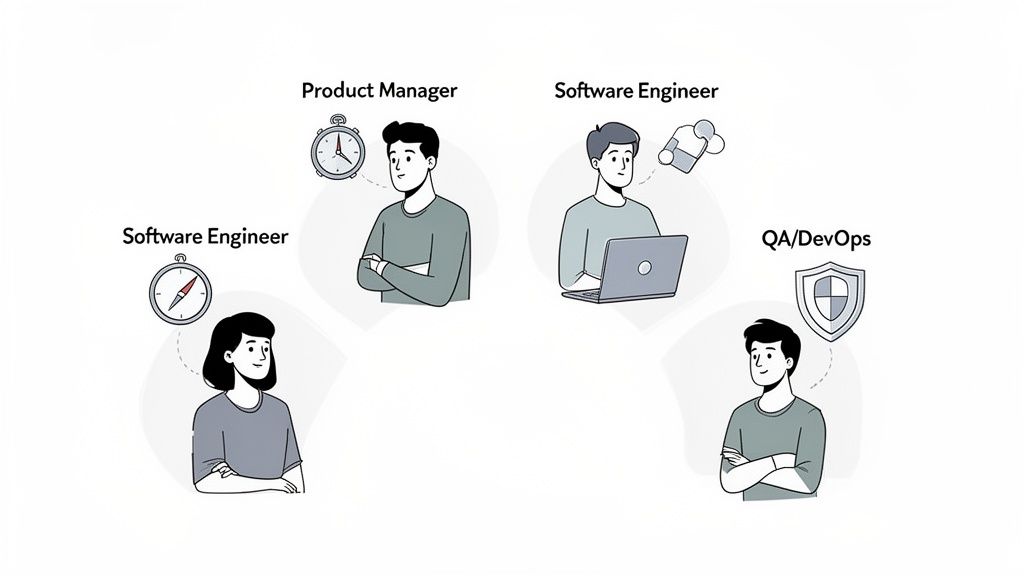
Here are the core roles you’ll find on almost any successful project:
These two roles are a classic partnership. One defines the what and why, while the other manages the how and when.
While the managers steer the ship, the engineers are the ones in the engine room, turning plans into working software. This is where the magic really happens, and it involves a few different kinds of expertise.
Software Engineers (The ‘What’)
These are your builders. They take the ideas, user stories, and designs and translate them into clean, reliable, and scalable code. They're the ones in the trenches every day, collaborating to crack tough technical challenges and deliver the product piece by piece.
It's a common mistake to think of engineers as just "coders" who take orders. The best engineers are creative problem-solvers. They often see technical possibilities and solutions that can fundamentally improve the product in ways a non-technical person never would.
QA and DevOps Engineers (The Guardians)
These roles are your project's safety net, ensuring that what you build is solid, secure, and dependable.
To keep this finely-tuned team running at its peak, applying the best practices for performance management is a must for nurturing growth and keeping everyone engaged. When every single person understands their part and how it contributes to the big picture, the entire operation moves with more speed, focus, and purpose.
Great software doesn't just happen; it's planned. This is where a brilliant idea gets its hands dirty and meets the real world. A project without a solid plan is like a ship leaving port without a map—it’s moving, but no one has a clue where it’s going or when (or if) it’ll ever get there.
The point isn't to lock your team into a rigid, step-by-step blueprint. Far from it. The goal is to build a flexible framework that gives everyone direction but also leaves room to adapt when things inevitably change. You start with the big picture and then gradually zoom in on the specific tasks your developers will be picking up each day.
Everything kicks off with the product roadmap. Think of this as a high-level, visual summary that lays out the major features and strategic goals for the next few quarters. It's not a laundry list of chores; it's the 30,000-foot view that gets the entire team aligned and pointing in the same direction.
From that roadmap, you start breaking down the big, chunky initiatives into smaller, more digestible pieces called user stories. A user story is just a simple, plain-English explanation of a feature from the perspective of the person who'll actually use it. The classic template works wonders: "As a [type of user], I want [some goal] so that [some reason]."
For instance, a big-ticket roadmap item like "Implement User Authentication" could be broken down into stories like these:
See what happened there? We just translated a vague concept into clear, concrete work items that the development team can actually sink their teeth into.
Once you have a backlog full of user stories, the inevitable question comes up: "So, how long is this going to take?" In the world of Agile, we've learned to stop guessing at hours and days. Instead, we focus on estimating the relative effort, complexity, and uncertainty of a task. This shift is a game-changer in modern software development. For a deeper dive, our guide on how to approach software development cost estimation is a great resource.
Two of the most popular ways to do this are Story Points and Planning Poker.
Story Points are simply a unit of measure for the overall effort needed to get a user story completely "done." A story that gets 2 points is expected to be roughly twice the work of a 1-point story. The number itself is arbitrary—it's the relationship between the numbers that matters.
Planning Poker is how you get to that number. It’s a consensus-based game where the team discusses a story, and then everyone privately picks a card with a point value. On the count of three, everyone reveals their card. This instantly highlights any big differences in opinion and sparks a conversation that helps everyone get on the same page, fast.
This whole approach is so effective because it embraces the fact that software development is messy and full of unknowns. It focuses the team on creating a shared understanding of complexity, not on manufacturing a false sense of precision about time.
With your stories estimated and prioritized, you can start tracking a few key metrics. This isn't about micromanaging people; it's about building a predictable rhythm for your team.
Here are the essentials:
By getting a handle on these planning, estimation, and tracking techniques, you can shift your team from a reactive state of constant guessing to a proactive one where decisions are driven by real data.
Let's be honest: the most brilliant project plan in the world is just a piece of paper without the right people to bring it to life. Finding and integrating top-tier software engineers is often the single biggest bottleneck that stalls progress, turning ambitious roadmaps into a series of frustrating delays. The old way of hiring—slow, expensive, and often a total gamble—just doesn't cut it anymore.
If you want your software projects to succeed, you have to get smarter about how you build your team. Instead of sinking months into a search, you need a way to tap into a pool of pre-vetted, elite talent fast. This is where partnering with a specialist makes all the difference, letting you shift from the high-risk game of hiring to the high-impact work of integration. Platforms like HireDevelopers.com were built to solve this exact problem.
The secret to building a great team quickly is a vetting process that goes way deeper than a resume scan. You can't see true skill on a piece of paper. Real excellence is uncovered by looking at a candidate from every angle:
This kind of meticulous screening is how you filter for the top 1% of global engineering talent, connecting you with senior developers who are ready to make an impact from day one.
The struggle to find the right talent has a direct, measurable impact on project outcomes. In software engineering, less than 50% of projects consistently finish within budget. This problem is only getting worse, with 72% of teams now working in remote or hybrid models that introduce a whole new set of coordination challenges. You can dig into more data on project management effectiveness over on ElectroIQ.com.
When you start with a pool of pre-vetted candidates, the whole hiring game changes. What used to be a months-long marathon becomes a quick sprint. You get to skip the most agonizing parts and jump straight to building your team.
The process is refreshingly simple:
This approach gives you the agility to scale your team up or down as your project demands. By tapping into a global talent pool, you get access to world-class expertise without the headache and overhead of traditional recruiting. If you're ready to scale your team, check out our guide on recruiting software developers for more practical tips.
Diving into project management for software engineering brings up a lot of the same questions time and again. Whether you're a founder trying to build your first app, a new manager, or a developer on the team, getting straight answers to these common hurdles can save you a world of headaches. Here are some of the most frequent questions we get, along with some practical advice.
For a startup, the best tool is all about finding the right balance between power, simplicity, and cost. It's tempting to jump straight to a powerhouse like Jira, and it’s certainly the industry standard for serious Agile management. But honestly, its complexity can be a real momentum-killer for a small team just starting out.
Often, the smarter move is to start with something more visual and intuitive. Tools like Trello or Asana are fantastic for getting a Kanban board up and running and just tracking who’s doing what. Something like Monday.com offers a nice middle ground—it’s super customizable and can scale as you grow.
The golden rule? The best tool is the one your team will actually use every day. Start simple. You can always migrate later.
Scope creep is the silent killer of many projects, but in Agile, we don’t try to eliminate change—we build a process to manage it. The Product Owner is your first and last line of defense here. They are the sole gatekeeper of the project's scope.
Here's how it works in practice: any new idea or feature request, no matter how brilliant, goes straight into the product backlog. It absolutely does not get shoehorned into the current sprint.
From there, the new item is prioritized against everything else waiting to be done. If a request is so urgent it just can't wait, the Product Owner has to make a tough call: they can swap it for an existing sprint item of roughly the same size. This keeps the sprint goal intact and prevents the team from getting constantly sidetracked. It’s all about embracing flexibility without sacrificing focus.
Yes, 100%. A non-technical founder’s strength isn't in writing code; it’s in championing the product vision. Their job is to own the "why"—why are we building this? What problem are we solving for our customers? What experience do we want them to have?
In an Agile setup, this kind of founder often makes an excellent Product Owner, someone who can curate the backlog and make sure every feature aligns with the business goals.
The key is to pair that vision with a strong technical lead who owns the "how." This partnership is everything. The founder steers the ship, and the tech lead manages the engine room. To learn more about this dynamic, you can explore some foundational product management principles that show how to connect vision with execution. When a founder trusts their technical counterpart, that’s when the magic happens.
Careers in cryptography are high-stakes, high-reward. These are the people who build and break the digital codes that secure our world, protecting everything from your bank account to global decentralized networks. It's a field with massive growth and serious six-figure salary potential. Why Cryptography Careers Are Exploding Welcome to the new frontier of digital trust. […]

The demand for remote machine learning jobs isn't just a trend anymore; it's a fundamental shift in how AI talent is hired and deployed. For ML professionals, this opens up a world of possibilities, not just in terms of flexibility, but also significant financial upside. Companies are in a fierce competition for top talent, and […]

The software engineering field is constantly shifting, with certain specializations commanding unprecedented salaries. But which roles truly offer the highest earning potential, and what does it take to secure one? This data-driven guide breaks down the best paying software engineering jobs, moving beyond vague titles to offer a detailed roadmap for career advancement and strategic […]


