

Let's be blunt: the real reason companies look to offshore software development isn't just about finding talent—it's about cutting costs. Drastically. We're talking about the potential to slash your development budget by more than 50% compared to hiring in your own backyard. This isn't just a minor financial perk; it's a strategic move that can […]

Let's be blunt: the real reason companies look to offshore software development isn't just about finding talent—it's about cutting costs. Drastically. We're talking about the potential to slash your development budget by more than 50% compared to hiring in your own backyard.
This isn't just a minor financial perk; it's a strategic move that can make or break a project, turning a "maybe one day" idea into a "let's build it now" reality.
The core appeal of offshoring is simple economics. You get access to a global pool of highly skilled developers without paying the sky-high rates common in places like the United States or Western Europe.
Think about it. A senior developer in San Francisco might bill at $150 per hour or even more. In another part of the world, a developer with the exact same skill set could cost less than half of that. It’s not about finding "cheap" labor; it's about finding incredible value by tapping into different economic markets.
Our own analysis of over 200 offshore projects reveals that companies save, on average, a whopping 52% on development costs. For a startup trying to get an MVP off the ground, that kind of saving is a lifeline. For a larger company, it’s a powerful way to scale teams without letting the budget spiral out of control.
To put this into perspective, let's look at the raw numbers. The cost difference isn't just a few dollars here and there; it's a fundamental shift in what you can achieve with your budget.
Here’s a high-level look at just how dramatic the difference in hourly rates can be between a high-cost market like the US and popular offshore destinations.
| Region | Average Hourly Rate (Senior Developer) |
|---|---|
| United States | $120 – $180+ |
| Eastern Europe | $50 – $85 |
| Latin America | $55 – $90 |
| South Asia | $30 – $55 |
As you can see, the numbers speak for themselves. The money you'd spend on a single local developer could potentially fund a small, well-rounded offshore team.
This shift changes everything. Suddenly, your budget isn't a limitation; it's a strategic asset. You can reallocate the savings to accelerate your development timeline, build out more features, or pour more resources into crucial areas like marketing and sales.
But the hourly rate is just the tip of the iceberg. The true cost includes everything from the complexity of your project and the structure of your team to the administrative overhead. For instance, things like your IT & Software Offshore Setup for Tax & Banking Efficiency can also play a major role in your final bottom line.
In this guide, we'll peel back the layers and look at every single factor that contributes to your total investment, so you can build a budget with confidence.
When you start pricing out offshore software development, one factor trumps all others: geography. It's a common mistake to view the world as one big talent pool with a single price tag. The reality is far more nuanced. The global market is a mosaic of different regions, each with its own economic drivers, talent specialties, and unique advantages.
The location you choose will have a direct and powerful impact on the hourly rates you pay. But it's about more than just the numbers. It also determines the skills you can tap into and even the day-to-day rhythm of your project. The goal isn't just to find the lowest price, but to strike the right balance between cost, expertise, and operational ease.
As this chart clearly shows, the cost difference between hiring locally and going offshore can be dramatic.
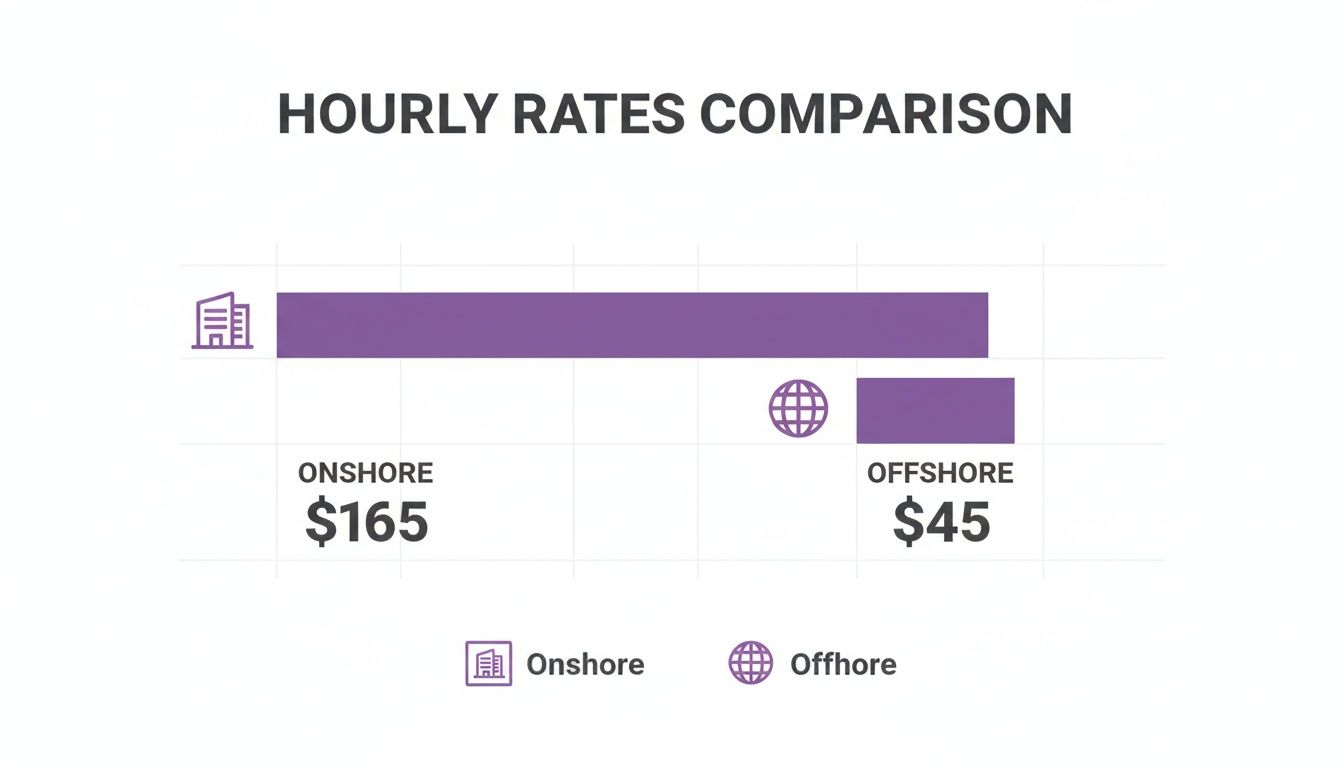
This simple comparison drives home a critical point: offshoring can put world-class talent within reach for a fraction of what you'd pay at home. It completely changes the math on how you can build your product.
Countries like Poland and Ukraine have become true powerhouses in the global tech scene. This region is known for producing developers with rock-solid educational foundations in computer science and mathematics. The result? A talent pool that excels at tackling complex architectural problems and sophisticated backend development.
While you'll find their hourly rates are a bit higher than in Asia, they are still significantly lower than what you'd pay in the US or Western Europe. Many companies find that premium is well worth it, thanks to the high-quality code, proactive problem-solving, and minimal hand-holding developers from this region typically provide.
If budget is your main concern, Asia remains an incredibly compelling choice. Countries like India and the Philippines have mature, well-established IT outsourcing industries with a massive supply of tech talent. That sheer volume helps keep rates highly competitive.
This region is an especially strong fit for:
The massive talent pool also gives you a ton of flexibility. Scaling a team up or down is often much easier here than anywhere else in the world.
For businesses based in the Americas, Latin America offers a powerful "nearshore" alternative. The single biggest benefit here is timezone alignment. Having your offshore team working the same—or very similar—business hours as your in-house staff eliminates the communication delays that can bog down projects.
Countries like Mexico and Colombia have fast-growing tech hubs full of skilled developers, particularly in popular web and mobile stacks. This real-time collaboration can feel just like working with a domestic team, but at a much more accessible price point. To dig deeper, check out our guide on the best countries to hire remote developers in 2025.
To make this more concrete, let's look at the numbers. The table below breaks down the typical hourly rates you can expect across these key regions, segmented by experience level.
| Region | Junior Developer Rate | Mid-Level Developer Rate | Senior Developer Rate | Key Strengths |
|---|---|---|---|---|
| Asia | $20 – $35 | $30 – $45 | $40 – $50 | Unmatched cost-effectiveness, massive talent pool, ideal for scale. |
| Eastern Europe | $30 – $40 | $40 – $50 | $48 – $58 | Deep technical expertise, strong problem-solving, high-quality code. |
| Latin America | $25 – $40 | $38 – $50 | $45 – $55 | Timezone alignment with the Americas, strong real-time collaboration. |
As you can see, the rates can vary significantly. Asia, led by countries like India and the Philippines, offers junior developers starting around $20 per hour and seniors up to $50. Eastern Europe commands a higher rate, from $30 for juniors to $58 for seniors, reflecting its reputation for top-tier skill. Latin America sits comfortably in the middle, from $25 for juniors to $55 for seniors, with its key advantage being that nearshore convenience.
This data really highlights why you can't just look at a single "global average." You have to dig into the economics of each region to find the perfect fit for your project's specific needs and budget.
Picking the right pricing model is one of the most important calls you’ll make. It’s not just about the numbers; it’s about setting the rules of the road for your relationship with your offshore team. This decision directly shapes your budget, your ability to adapt, and ultimately, your project's success.
The financial structure you agree on can either be a launchpad for great collaboration or a constant source of friction. In the world of offshore development, two models dominate the conversation: Fixed Price and Time & Materials (T&M). Let's dig into how they work and, more importantly, when to use each one to your advantage.

Think of a Fixed Price model like hiring someone to build a custom shed. You agree on the exact dimensions, materials, and final price before a single nail is hammered. The cost is locked in, giving you total budget predictability from day one.
This model is all about meticulous planning. To pull it off, you need a crystal-clear picture of the final product, with every feature, user journey, and technical detail documented upfront. Any change to that original blueprint—no matter how small—usually triggers a formal change request, which almost always means more time and more money.
The big win here is cost certainty, which is a lifesaver for companies on a tight budget. But that predictability comes at a price: flexibility. If you get a brilliant idea for a new feature or receive market feedback halfway through, changing course can be a slow, expensive process.
With a Fixed Price contract, the development agency takes on most of the financial risk. To cover their bases, vendors typically bake a contingency buffer of 15-30% into the total price to handle any unexpected hiccups.
On the other side of the coin is the Time & Materials (T&M) model. This is more like hiring a general contractor for a home renovation. You have a vision—a modern kitchen with an island—but you expect the specifics to evolve. Maybe you’ll swap out the countertops or add under-cabinet lighting as you see things come together. You simply pay for the hours your contractor works and the cost of the materials they use.
This approach is the heartbeat of agile development. It gives you the freedom to pivot based on user feedback, adapt to new requirements, and constantly improve the product. You're billed for the actual time your team spends working, usually on a weekly or monthly cycle.
The T&M model shines for complex, long-term projects where you can't possibly know the full scope from the start. It creates a genuine partnership, where everyone is focused on building the best product possible, not just checking boxes on a rigid spec sheet. The trade-off, of course, is that the final cost isn't set in stone, which demands disciplined budget tracking and crystal-clear communication.
So, which one is right for you? It all comes down to the nature of your project. There's no single "best" answer, but you can align the model to your specific goals and realities.
Here’s a simple way to think about it:
At the end of the day, understanding these models is key to controlling your offshore software development cost. The right choice creates a financial framework that helps you build a fantastic product without blowing your budget. The wrong one, however, can quickly lead to blown budgets, missed deadlines, and a lot of headaches for everyone.
Thinking that a developer's hourly rate is your total cost is a classic rookie mistake. It’s like planning a road trip and only budgeting for gas—sure, it's the main expense, but you'll be in for a shock when you have to pay for tolls, food, and lodging. The sticker price for an offshore developer is just where the conversation starts. A truly accurate budget for your offshore software development cost needs to account for all the other expenses that quietly creep in.
If you don't plan for them, these "hidden" costs can easily add 15-20% to your total project budget. Suddenly, a well-planned initiative turns into a financial scramble. These aren't red flags or signs of a bad partner; they're just the operational realities of managing a global team. Let's pull back the curtain on what they are so you can get ahead of them.
These are the recurring monthly costs that keep your distributed team running smoothly. They might seem small individually, but they add up fast when you're paying for an entire team.
Communication and Collaboration Tools: Your team needs a digital office. Think subscriptions for tools like Slack for messaging, Jira for project management, and Confluence for documentation. You should plan on spending around $50-$100 per developer per month just for this core software stack.
Security and Compliance Infrastructure: Protecting your intellectual property isn't optional. This means paying for secure cloud infrastructure, VPNs, and other security measures to keep your code and data locked down. This can run anywhere from $100-$200 per developer per month, especially if you're working on a sensitive project.
Payment and Transfer Fees: Getting money from your bank account to your developer's isn't always free. When you're working with international talent, the way you pay can tack on frustrating fees and administrative headaches. It's worth exploring the best ways to pay international contractors to find methods that save you money and time.
Before a single line of code gets written, you'll need to make some initial investments to get the partnership off the ground. These are one-time expenses, but they’re critical for setting your project up for long-term success.
A few key setup costs to plan for:
Not every hidden cost shows up on an invoice. Some are subtle drags on productivity that have a very real financial impact over time. The global IT outsourcing market is booming, projected by Gartner to hit $731 billion by 2025, largely because of the cost savings. But smart managers know to factor in potential productivity dips.
For instance, a significant timezone difference can easily cause a 10-15% productivity loss if you don't have clear communication rules and some overlapping work hours. It's just harder to get quick answers when your lead developer is asleep.
The key takeaway is this: A successful offshore budget isn't just about multiplying an hourly rate by the number of hours. It's about building a complete financial model that sees the whole picture—direct costs, indirect costs, and everything in between.
When you account for these hidden costs, you shift from wishful thinking to realistic financial planning. This foresight not only saves you from surprise bills but also makes sure your team has everything they need to hit the ground running from day one. To help you build that complete picture, check out our guide on software development cost estimation, which digs even deeper into the variables that shape your final price tag.
Alright, we've talked about hourly rates, hidden costs, and all the variables. But what does this look like in the real world? Let's ground these concepts in some practical, everyday scenarios. Seeing how the numbers stack up for different types of projects will help you get a much clearer picture of the real offshore software development cost.
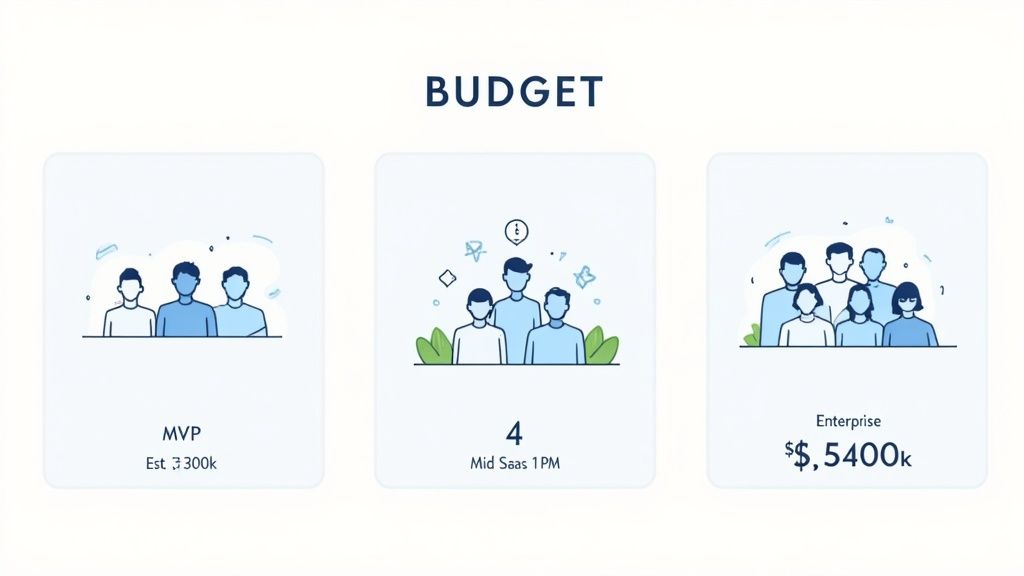
To keep things consistent, we’ll base these examples on a blended rate of $50 per hour. This is a realistic figure for a solid team in a top-tier region like Eastern Europe, giving you a great mix of senior expertise and mid-level talent without breaking the bank.
When you're building an MVP, the name of the game is speed. The goal isn't perfection; it's getting a working product with core features into the hands of real users as fast as possible to see if your idea has legs. This calls for a small, nimble team that can move quickly.
A classic MVP team might include:
With a lean crew like this, you're looking at a three to four-month timeline from start to launch.
Here’s how the math shakes out:
This budget gives a startup enough runway to launch, gather that all-important user feedback, and hopefully secure more funding—all without a massive upfront capital burn.
Now, let's level up. This scenario is for building a full-fledged Software-as-a-Service (SaaS) product. We're talking more complex features, user accounts, third-party integrations, and an architecture built to scale. This is a bigger job that requires a larger, more specialized team.
For a project like this, your team might look more like:
A build of this complexity will naturally take longer, typically around six to nine months.
This is where the offshore model really flexes its muscles. Building a product of this scale onshore would be financially out of reach for many businesses. Offshoring makes it a realistic goal.
Let's run the numbers:
For big companies, the challenge is often different. They might have a mature product that needs constant attention—new features, maintenance, and ongoing improvements. The goal here is to build a stable, dedicated team that becomes an extension of their in-house staff and develops deep product expertise over time.
This kind of team is usually larger and more diverse:
This is a long-term partnership, so you'd be looking at a monthly retainer. Of course, rates vary wildly depending on location. While a US-based developer can easily cost $80-$150 per hour, you'll see rates of $20-$45 per hour in Asian hubs like India or the Philippines, and $30-$58 in Eastern Europe. You can learn more about these global software development trends.
Using our blended rate, here's what a monthly retainer would look like:
As you can see, the offshore model is incredibly flexible. It can be tailored for a scrappy startup launch, a mid-market product build, or a full-scale enterprise team, making even the most ambitious software projects financially possible.
Going it alone in the global talent market is a massive undertaking, and it's loaded with hidden costs you might not see coming. Think hefty recruitment agency fees, endless hours sifting through unqualified résumés, and the legal maze of international payroll. This is where a vetted talent platform isn't just a nice-to-have; it's a strategic move that fundamentally changes the math on your offshore software development cost.
These platforms are much more than just a directory of names. They’re a built-in filtration and logistics engine. They do the heavy lifting—sourcing, screening, and rigorously testing candidates—long before you ever see a profile. Right off the bat, this helps you dodge the massive expense of a bad hire, a mistake that can easily cost over 30% of an employee's first-year salary.
Picture what it takes to hire directly. Your own senior engineers are pulled off product development to spend dozens of hours in technical interviews. Your HR team is trying to get up to speed on unfamiliar international labor laws. A vetted platform takes all of that off your plate.
The whole process gets simplified. You're presented with a pre-qualified shortlist, often in as little as 24 hours. The value here is crystal clear:
By handling the intensive vetting and administrative work, these platforms can shrink your hiring timeline from months to a matter of days. That speed isn't just convenient—it translates directly into saved money and gets your project started faster.
At first glance, the hourly rate on a platform might seem a bit higher than what you'd pay a direct freelance hire. But that's a misleading comparison. The platform’s rate has already absorbed all the costs you'd otherwise pay for separately: recruitment, administrative overhead, and the financial risk of hiring the wrong person.
For any company trying to scale smart, this model delivers a much lower total cost of ownership. The power to tap into top-tier, pre-vetted talent is a game-changer. To see this in action, you can hire developers offshore and see just how much simpler it is compared to the tangled web of direct hiring.
Ultimately, the investment in a vetted platform pays for itself by cutting risks and letting your team focus on what they do best: building great software.
Even with a comprehensive guide, it's natural to have questions pop up when you're planning a major investment like offshore development. Here are some of the most common ones we encounter, with straightforward answers to help you lock in your budget and strategy.
Most companies see their development costs drop by 50-70% when they go offshore compared to hiring locally in places like the US or Western Europe. The final number will hinge on the region you pick, how complex your project is, and the makeup of your team, but that massive potential for savings is what gets most businesses interested in the first place.
To put it in perspective, a project that might cost you $500,000 with a local team could very well be completed for $150,000 to $250,000 with an offshore partner—without cutting corners on quality. It's not just about cheaper hourly rates; it’s about making your budget stretch further in a global talent market.
Definitely not. It's one of the most tempting traps to fall into, but choosing a partner just because they have the lowest price is a classic—and expensive—mistake. An unusually low rate can be a huge red flag signaling problems down the road:
Paying a slightly higher rate for a partner with a proven track record almost always leads to a lower total cost. You're investing in efficiency, experience, and reliability, which pays for itself by getting a better product to market faster.
The cost that sneaks up on everyone is the loss of time and productivity due to poor management and communication. This won't show up on any invoice, but it will absolutely drain your budget. If your internal team is constantly putting out fires, re-explaining requirements, or wrestling with time zone differences, you're bleeding money in lost development hours.
Your best defense is a rock-solid communication plan and a partner who excels at project management. Investing in a good process will do more to control your offshore software development cost than haggling over a few dollars on the hourly rate.
First things first: define the scope of your Minimum Viable Product (MVP). Make a list of only the absolute must-have features you need for launch. Once you have that, start researching the average hourly rates in the regions you're considering, like Eastern Europe or Latin America.
Here’s a simple formula to get you started:
(Estimated Hours to Build MVP) x (Average Blended Hourly Rate) + 20% Contingency = Initial Budget
That 20% buffer is non-negotiable. It's your safety net for unexpected issues, changes in scope, and all those smaller ancillary costs we talked about, from collaboration tools to compliance checks.
Careers in cryptography are high-stakes, high-reward. These are the people who build and break the digital codes that secure our world, protecting everything from your bank account to global decentralized networks. It's a field with massive growth and serious six-figure salary potential. Why Cryptography Careers Are Exploding Welcome to the new frontier of digital trust. […]

The demand for remote machine learning jobs isn't just a trend anymore; it's a fundamental shift in how AI talent is hired and deployed. For ML professionals, this opens up a world of possibilities, not just in terms of flexibility, but also significant financial upside. Companies are in a fierce competition for top talent, and […]

The software engineering field is constantly shifting, with certain specializations commanding unprecedented salaries. But which roles truly offer the highest earning potential, and what does it take to secure one? This data-driven guide breaks down the best paying software engineering jobs, moving beyond vague titles to offer a detailed roadmap for career advancement and strategic […]


