Blog

Top 10 Interview Questions for Engineering Manager Roles in 2026

Chris Jones
by Chris Jones Senior IT operations
8 January 2026

Top 10 Interview Questions for Engineering Manager Roles in 2026

Hiring an engineering manager is one of the most critical decisions a company can make. The right leader accelerates growth, mentors talent, and delivers on the product vision. The wrong one can derail teams, drain morale, and sink projects. A generic interview process focused solely on past achievements is insufficient to predict future success, especially […]

Hiring an engineering manager is one of the most critical decisions a company can make. The right leader accelerates growth, mentors talent, and delivers on the product vision. The wrong one can derail teams, drain morale, and sink projects. A generic interview process focused solely on past achievements is insufficient to predict future success, especially in dynamic, distributed team environments.

This guide provides a comprehensive list of the most crucial interview questions for engineering manager candidates, organized into 10 core competencies. We move beyond simplistic, surface-level inquiries to provide a strategic framework for deeply evaluating leadership philosophy, technical oversight, and cultural alignment. The goal is to equip you with the tools to distinguish between candidates who manage tasks and those who truly build and inspire high-performing teams.

For any organization, from a startup building its MVP to an enterprise scaling globally, these questions provide a blueprint for a more rigorous and insightful hiring process. They are particularly vital when integrating pre-vetted, remote talent, a common scenario for companies using platforms like HireDevelopers.com. Asking the right questions ensures you find a leader capable of building cohesive, productive teams, regardless of geographical distance.

This framework will help you identify managers who possess the rare combination of skills required to not only build great software but also to cultivate great engineers. You will learn how to probe for specific examples, identify red flags, and ultimately select a leader who will be a force multiplier for your entire engineering organization.

1. Leadership & Team Management

This foundational category of interview questions for engineering manager candidates probes their ability to inspire, guide, and grow a high-performing engineering team. It moves beyond technical prowess to evaluate their core management philosophy, conflict resolution skills, and capacity to foster an environment of psychological safety. This is especially crucial for companies leveraging global talent, as managers must unite and motivate distributed teams across diverse cultures and time zones.
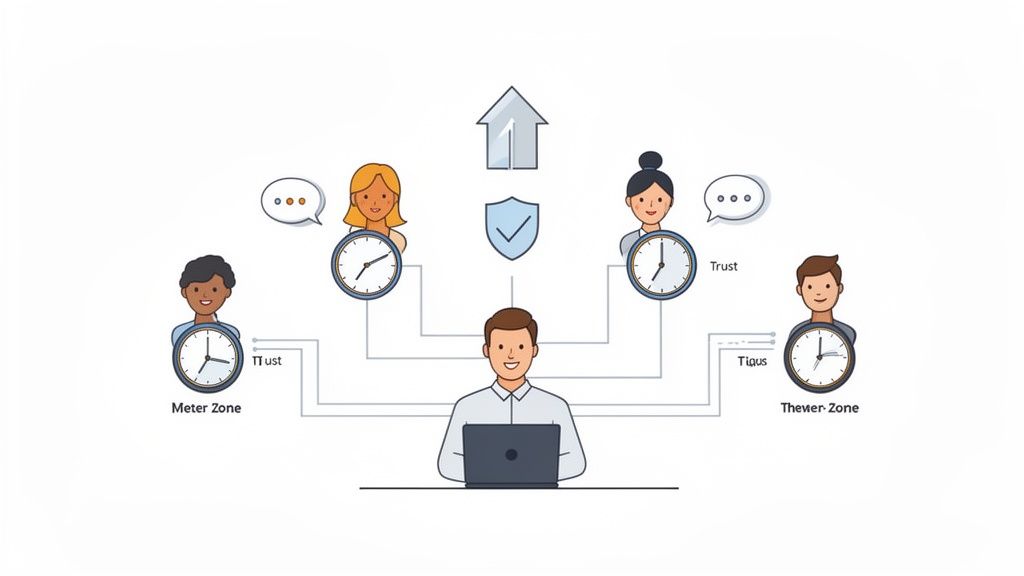
Illustration of a central man on a laptop connecting to four individuals in 'Meter Zone' and 'Thewer-Zone', symbolizing trust and time management.

A great engineering manager acts as a "servant leader," removing blockers and empowering their team to do their best work. Their success isn't just measured by project delivery but by the growth and retention of their engineers. For platforms like HireDevelopers.com, where you might be onboarding pre-vetted nearshore or offshore talent, a manager's ability to quickly build trust and integrate new members is a direct indicator of future success.

Sample Questions & What to Look For

  • "Describe your process for onboarding a new remote developer to get them productive within their first two weeks."
    • Look For: A structured plan that includes a dedicated onboarding buddy, clear documentation, early small wins, and regular check-ins. They should emphasize cultural integration, not just technical setup.
  • "Tell me about a time you had to manage a high-performing but disruptive team member. What was the situation and how did you handle it?"
    • Look For: Evidence of direct, private feedback based on specific behaviors, not personality. The candidate should demonstrate empathy while upholding team values and protecting psychological safety.
  • "How do you adapt your management style when leading a team distributed across multiple time zones (e.g., US, LATAM, and Eastern Europe)?"
    • Look For: A focus on asynchronous communication, intentional meeting scheduling to rotate inconvenience, and strategies for creating team cohesion despite the distance. For more details on this, explore these helpful remote team management tips.

Red Flags to Watch Out For

  • Vague Philosophies: Answers like "I have an open-door policy" without concrete examples of how they put it into practice.
  • Taking Credit: Using "I" when describing team achievements and "they" when discussing failures.
  • Avoiding Conflict: A history of letting performance or interpersonal issues fester rather than addressing them proactively.

2. Technical Acumen & Architecture Decisions

This category of interview questions for engineering manager candidates assesses their ability to maintain technical credibility and guide sound architectural choices. An effective manager doesn't need to be the best coder on the team, but they must possess enough technical depth to understand complex trade-offs, challenge assumptions, and command the respect of senior engineers. This is critical when leading specialized teams, such as those with deep expertise in AI/ML or DevOps, often sourced from global talent pools.
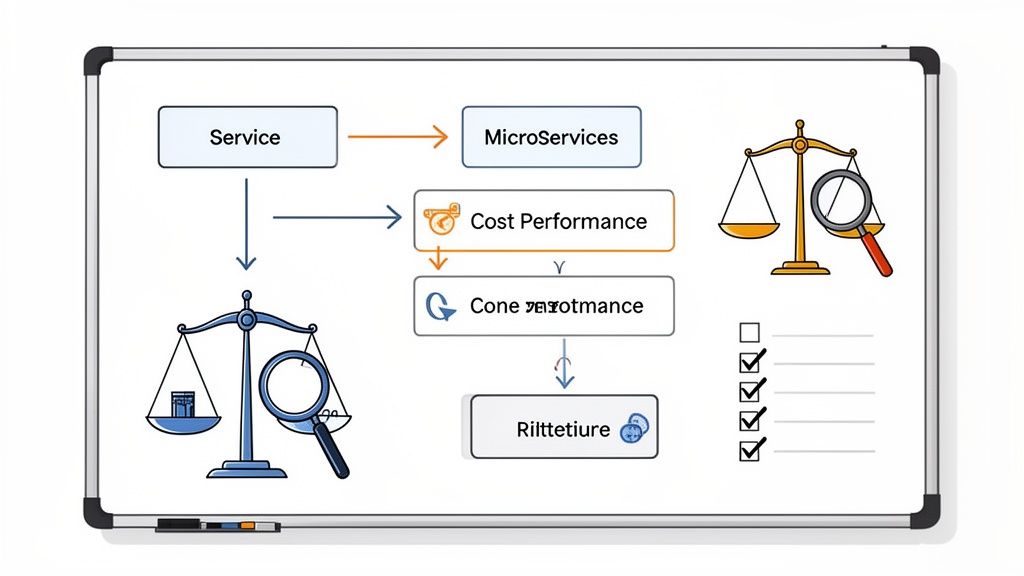
Flowchart illustrating Service evolution to Microservices, focusing on Cost and Core Performance evaluation.

They act as a crucial bridge between product requirements and technical reality, ensuring the team builds scalable, maintainable systems without over-engineering. For companies building an MVP with a tight budget, a manager’s skill in evaluating cost versus performance is paramount. When integrating pre-vetted nearshore developers who bring diverse technical backgrounds, a manager's strong architectural compass ensures everyone aligns on a cohesive technical strategy.

Sample Questions & What to Look For

  • "Walk us through a significant architectural decision you were responsible for. What were the alternatives and the trade-offs you considered?"
    • Look For: A clear articulation of the business problem first, followed by technical options. They should discuss trade-offs involving scalability, cost, developer velocity, and operational complexity, not just the "coolest" technology.
  • "Describe your approach to managing technical debt. How do you balance shipping new features with paying down debt?"
    • Look For: A pragmatic, strategic approach. The candidate should mention quantifying the impact of debt, creating a business case for refactoring, and integrating debt repayment into the regular development cycle, not just as a one-off "fix-it" sprint.
  • "How do you stay technically current, and how do you encourage your team to do the same?"
    • Look For: Specific, actionable habits like reading tech blogs, attending conferences, building side projects, or participating in architecture review meetings. They should also describe concrete ways they foster learning, like tech talks, book clubs, or dedicated R&D time.

Red Flags to Watch Out For

  • Outdated Knowledge: Mentioning technologies or practices that are more than 5-7 years old as their primary examples without acknowledging modern alternatives.
  • Deferring Too Much: Answers suggesting they always let senior engineers make all technical decisions without providing any input, challenge, or oversight.
  • Focus on a Single Stack: Inability to discuss architectural principles outside of one specific programming language or framework, showing a lack of versatility.

3. Hiring & Talent Evaluation

A manager's ability to build the team is as critical as their ability to lead it. This category of interview questions for engineering manager candidates evaluates their entire talent acquisition lifecycle, from sourcing and interviewing to closing and integrating new hires. It reveals their ability to identify not just technical skill but also team fit, potential, and alignment with company values.
An illustration of a man reviewing candidate skills and global reach on a desk.

Great engineering managers are active partners with recruiting, not passive participants. They understand that hiring is a core responsibility and have a defined, repeatable process to ensure fairness and quality. This is particularly vital when leveraging global talent pools like HireDevelopers.com, where a manager must be adept at assessing candidates from diverse backgrounds and integrating them effectively into a distributed team.

Sample Questions & What to Look For

  • "How do you assess technical skills beyond a résumé or a standard coding challenge?"
    • Look For: A multi-faceted approach. They should mention things like system design discussions, pair programming sessions on a real-world problem, or portfolio reviews where the candidate explains their architectural choices.
  • "Walk us through your last three hires. Why did you choose them, and how did they perform in their first six months?"
    • Look For: An ability to connect their hiring decisions to business impact. They should be able to articulate the specific skills or qualities they sought and whether their evaluation proved correct, demonstrating self-awareness and learning.
  • "How would you evaluate a candidate with a non-traditional background or international experience?"
    • Look For: A focus on core competencies and potential over credentials. The candidate should demonstrate a commitment to reducing bias and an understanding of how to value diverse experiences. For interviewers looking to gather deep insights and foster rich dialogue, explore this resource with an extensive open-ended questions examples.

Red Flags to Watch Out For

  • Over-reliance on "Gut Feel": Statements like "I just know a good engineer when I see one" without a structured process to back it up.
  • Delegating Responsibility: Treating hiring as solely HR's job rather than a partnership they own and drive for their team.
  • Vague or Inconsistent Criteria: An inability to articulate what a "good" candidate looks like for a specific role, which often leads to biased or inconsistent hiring. For more on this, discover the best practices for how to hire software engineers.

4. Project & Delivery Management

This set of interview questions for engineering manager candidates evaluates their ability to translate strategic goals into tactical execution. It assesses their skills in planning, estimating, executing, and delivering complex projects on time and within scope. A manager's competency here is crucial, whether for a startup racing to an MVP or an enterprise managing fixed budgets and stakeholder expectations across various departments.
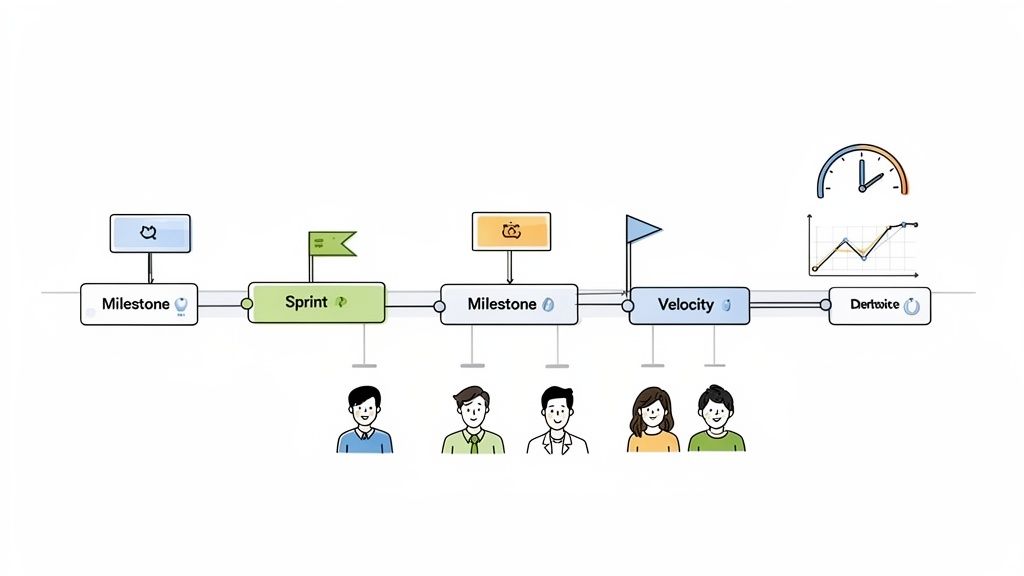
An agile project management timeline with milestones, sprints, velocity, and team members.

Great engineering managers are masters of predictable delivery. They don't just track tasks; they manage risk, eliminate blockers, and communicate progress effectively. In a remote or nearshore setting, like those facilitated by HireDevelopers.com, this skill is magnified. A manager must be adept at running efficient sprints and prioritizing roadmaps for a distributed team, ensuring everyone is aligned and productive despite not being in the same room.

Sample Questions & What to Look For

  • "Tell us about a project that shipped late. What happened, how did you handle the situation, and what did you learn?"
    • Look For: Ownership and accountability, not blame. A great answer details the root cause analysis, the communication strategy with stakeholders, and the specific process changes they implemented to prevent a recurrence.
  • "How do you balance the pressure to ship features quickly with the need to maintain long-term code quality and address technical debt?"
    • Look For: A pragmatic framework for making trade-offs. They should discuss allocating a percentage of capacity to tech debt, using data to inform decisions, and communicating the risks of a "features-only" mindset to product partners.
  • "Describe your approach to managing a critical project with a fixed deadline and a distributed team."
    • Look For: A clear process for scope negotiation, proactive risk identification, and communication cadence. They should emphasize creating a tight feedback loop and using metrics to track progress. For a data-driven approach, a deep dive into understanding DORA metrics for high-performing teams is a strong indicator of a sophisticated candidate.

Red Flags to Watch Out For

  • Process for Process's Sake: Overly rigid adherence to a specific methodology (e.g., Scrum) without adapting it to the team's or project's needs.
  • Poor Stakeholder Management: Stories where product, design, or business partners were constantly surprised by delays or changes.
  • Lack of Metrics: Inability to discuss project delivery in terms of concrete data like cycle time, lead time, or team velocity.

5. Communication & Stakeholder Management

This category of interview questions for engineering manager candidates assesses their ability to act as a crucial bridge between the technical team and the wider business. It evaluates how they translate complex engineering concepts for non-technical stakeholders, manage expectations, and ensure alignment across different departments and time zones. An engineering manager's communication skills directly impact project velocity and stakeholder satisfaction.

Effective communication is the lifeblood of any successful engineering project, especially in distributed teams. A great manager ensures that business requirements are clearly understood by engineers and that technical trade-offs are clearly explained to product owners, executives, and other stakeholders. For companies using platforms like HireDevelopers.com to engage nearshore or offshore talent, a manager's proficiency in clear, asynchronous communication and stakeholder management is non-negotiable for keeping everyone aligned on goals and progress.

Sample Questions & What to Look For

  • "Tell us about a time you had to explain a complex technical trade-off to a non-technical executive. What was the situation and what was the outcome?"
    • Look For: The ability to use analogies and focus on business impact (cost, timeline, user experience) rather than technical jargon. They should demonstrate empathy for the stakeholder's perspective and a goal of collaborative decision-making.
  • "How do you ensure clarity and alignment when your team is in one time zone and your key product stakeholder is in another?"
    • Look For: A strong emphasis on documentation, such as well-maintained decision logs and project briefs. They should mention proactive communication strategies, like sending concise weekly summaries, and utilizing tools that support asynchronous collaboration effectively.
  • "Describe your approach to communicating bad news, such as a significant delay or a critical production issue, to stakeholders."
    • Look For: A proactive, no-surprises approach. The candidate should communicate issues early and often, presenting the problem, its impact, and a clear plan of action with potential solutions. They should take ownership rather than placing blame.

Red Flags to Watch Out For

  • Blaming Stakeholders: Describing past conflicts by saying things like, "The product manager just didn't understand the technical side."
  • Overly Technical Explanations: An inability to simplify concepts, suggesting they will struggle to align with business or product leaders.
  • Reactive Communication: A pattern of only communicating when things go wrong, rather than providing regular, proactive updates.

6. Problem-Solving & Strategic Thinking

This category of interview questions for engineering manager candidates evaluates their ability to move beyond day-to-day tactical execution and engage in higher-level strategic planning. It assesses how they analyze complex challenges, identify root causes, weigh trade-offs, and make sound, data-informed decisions that align with broader business objectives. Their strategic thinking directly impacts a team's direction, resource allocation, and long-term success.

A strong engineering manager doesn't just solve the problems in front of them; they anticipate future obstacles and build resilient systems and teams. This foresight is invaluable, especially when making critical decisions like scaling infrastructure or deciding whether to build a new feature in-house versus leveraging a specialized nearshore team from a platform like HireDevelopers.com to accelerate time-to-market.

Sample Questions & What to Look For

  • "Walk us through a major technical or organizational challenge you solved. What was your approach from identification to resolution?"
    • Look For: A structured problem-solving framework (like STAR or 5 Whys). They should clearly articulate the problem, the data they gathered, the stakeholders they involved, the options considered, and the final outcome, including specific metrics that prove success.
  • "Describe a time you had incomplete information but needed to make a high-stakes decision. What did you do?"
    • Look For: An understanding of risk assessment and mitigation. The candidate should explain how they identified knowns and unknowns, made calculated assumptions, and created a plan to validate those assumptions and pivot if necessary.
  • "How would you decide between building a complex feature in-house versus outsourcing it to a pre-vetted nearshore team?"
    • Look For: A balanced analysis of key decision criteria: cost, speed to market, long-term maintenance, and the strategic value of the feature. They should consider the core competencies of their current team and recognize when external expertise provides a clear advantage.

Red Flags to Watch Out For

  • Analysis Paralysis: A tendency to get stuck gathering data without ever making a decision.
  • Purely Intuitive Decisions: Relying solely on "gut feeling" without seeking data or stakeholder input to back it up.
  • Short-Term Focus: Consistently choosing the quickest or easiest path without considering the long-term technical debt or strategic implications.

7. Diversity, Inclusion & Cultural Fit

This category of interview questions for engineering manager assesses a candidate's commitment to building a team that is not only talented but also diverse and inclusive. It evaluates their understanding that a variety of perspectives leads to better problem-solving, innovation, and overall team health. A manager's ability to recognize and mitigate unconscious bias, actively foster a sense of belonging, and hire for value-add rather than "culture fit" is paramount.

For organizations that leverage global talent platforms like HireDevelopers.com, this skill is non-negotiable. An effective manager must be adept at integrating engineers from different cultures, countries, and backgrounds, ensuring everyone has an equal voice and opportunity to contribute. Their role is to build a cohesive unit where diversity is seen as a strategic advantage, not a challenge to be managed.

Sample Questions & What to Look For

  • "How do you ensure your hiring process is equitable and attracts a diverse pool of candidates, especially when hiring internationally?"
    • Look For: Specific strategies like anonymizing resumes, using inclusive language in job descriptions, ensuring diverse interview panels, and sourcing from non-traditional channels. They should talk about process, not just good intentions.
  • "Tell us about a time you advocated for someone from an underrepresented background on your team. What was the situation and the outcome?"
    • Look For: A concrete example of sponsorship or mentorship. The candidate should demonstrate proactive effort in creating opportunities, providing visibility, or removing barriers for a team member.
  • "How do you cultivate an inclusive culture on a fully remote team with members from different countries (e.g., LATAM, Eastern Europe, Southeast Asia)?"
    • Look For: Awareness of cultural nuances in communication, creating shared rituals, and actively soliciting feedback from all team members. They should mention practices that promote psychological safety across borders.

Red Flags to Watch Out For

  • Tokenism: Viewing diversity as a numbers game or a box-checking exercise without a genuine commitment to inclusion.
  • "Culture Fit" as a Crutch: Using vague terms like "not a good culture fit" to reject candidates, which can often mask unconscious bias.
  • Dismissiveness: Downplaying the importance of D&I initiatives or seeing them as a distraction from "real" engineering work.

8. Learning, Adaptability & Growth Mindset

This category of interview questions for engineering manager candidates evaluates their commitment to continuous improvement for themselves and their team. In a field where technologies evolve at a dizzying pace, a manager's ability to learn, adapt, and foster a growth mindset is a powerful leading indicator of long-term success. It reveals their resilience in the face of change and their capacity to keep their team's skills sharp and relevant.

A manager with a strong growth mindset views challenges as opportunities, not threats. They cultivate an environment where experimentation is encouraged and failures are treated as valuable learning events. For companies that leverage global talent from platforms like HireDevelopers.com, this is critical. A manager must be adaptable enough to integrate new work styles, embrace different cultural perspectives, and champion the upskilling of their remote engineers to meet new project demands.

Sample Questions & What to Look For

  • "Tell us about a significant mistake you made as a manager. What was it, and what specific lesson did you learn from it?"
    • Look For: Humility, ownership, and a clear, actionable takeaway. The candidate should be able to articulate how the experience changed their future behavior or processes, not just express regret.
  • "How do you stay current with rapidly evolving technologies and engineering best practices?"
    • Look For: A proactive, multi-faceted approach. They should mention specific sources like industry publications, tech blogs, personal projects, conferences, or peer groups, not just a vague "I read a lot."
  • "Describe a time you received difficult feedback that led you to change your management style."
    • Look For: An ability to receive criticism without defensiveness and translate it into concrete action. They should be able to describe the "before" and "after" of their approach, demonstrating genuine adaptability.

Red Flags to Watch Out For

  • Blaming Others: Attributing mistakes or failures to external factors, former colleagues, or "the system" instead of taking personal responsibility.
  • Stagnant Skillset: Expressing a belief that their current knowledge is sufficient or showing disinterest in new frameworks, languages, or management methodologies.
  • Dismissing Feedback: Describing feedback they received as "wrong" or "misguided" without showing any attempt at introspection.

9. Budget Management & Cost Optimization

A modern engineering manager’s role extends beyond code and people; it deeply involves financial stewardship. This category of interview questions for engineering manager candidates evaluates their ability to operate within financial constraints, make sound economic decisions, and maximize the value delivered by their team’s efforts. Financial acumen is no longer just a "nice-to-have" but a core competency, especially in environments focused on lean operations and ROI.

Successful managers understand the total cost of ownership (TCO) for their projects, from developer salaries and cloud infrastructure to software licenses. For companies using platforms like HireDevelopers.com, a manager's ability to accurately forecast costs and leverage the economic advantages of a global talent pool is a significant asset. They must be able to balance quality, speed, and cost to meet business objectives effectively.

Sample Questions & What to Look For

  • "Walk us through how you would approach building a Minimum Viable Product (MVP) with a $50K budget and a small nearshore team."
    • Look For: A clear, prioritized plan. The candidate should mention ruthless feature scoping, leveraging cost-effective technologies, and a focus on core value delivery. They should demonstrate an understanding of the cost benefits of nearshore talent and how to manage that budget allocation.
  • "Tell me about a time you had to make a significant 'build vs. buy' decision. What factors influenced your choice and what was the outcome?"
    • Look For: A multi-faceted analysis. They should consider initial cost, long-term maintenance, developer opportunity cost, strategic importance, and speed to market. A great answer balances immediate needs with the long-term technical and financial roadmap.
  • "How would you approach optimizing your team’s composition and tooling to reduce overall costs by 20% without impacting velocity or morale?"
    • Look For: Strategic, not just tactical, thinking. They should discuss auditing SaaS subscriptions, optimizing cloud spend, and structuring the team to align with budget goals (e.g., a blended model of onshore and offshore talent). Their plan should protect team health and productivity. For more on this, a detailed guide on software development cost estimation can provide deeper insights.

Red Flags to Watch Out For

  • Financial Disinterest: A candidate who sees budget management as "someone else's job" and cannot speak to the financial impact of their team's work.
  • Cost-Cutting at All Costs: Prioritizing short-term savings over long-term stability, such as by accumulating massive technical debt or burning out the team.
  • Inability to Quantify Value: Difficulty connecting engineering initiatives to business revenue or cost savings, showing a disconnect from the company's financial goals.

10. Crisis Management & Resilience

This crucial set of interview questions for engineering manager candidates assesses their ability to navigate high-stakes, high-pressure situations. Engineering is not just about building features; it's about maintaining stability and recovering gracefully when things inevitably break. An engineering manager's response to a critical production outage, a security breach, or a sudden project crisis reveals their true leadership capabilities, decision-making clarity under stress, and ability to maintain team morale.

A manager's composure and process during a crisis directly impacts system uptime, customer trust, and engineer burnout. For companies utilizing remote talent from platforms like HireDevelopers.com, this skill is magnified. A manager must orchestrate a response across different time zones, often with asynchronous communication, keeping everyone calm, focused, and aligned on the recovery plan. Their ability to turn a crisis into a learning opportunity is what separates a good manager from a great one.

Sample Questions & What to Look For

  • "Walk me through the last major production incident you managed. What was the issue, what was your role, and what was the outcome?"
    • Look For: A clear, blameless narrative. They should describe a structured process: identifying the issue (triage), establishing a communication channel (war room), delegating tasks effectively, and communicating with stakeholders. Bonus points for mentioning a blameless post-mortem process.
  • "Describe a time your team was facing burnout due to high pressure or a prolonged crisis. How did you support them and manage morale?"
    • Look For: Proactive, empathetic actions. The candidate should mention things like enforcing time off, reprioritizing work to reduce cognitive load, openly acknowledging the team's stress, and celebrating small wins to rebuild momentum.
  • "How do you prepare your distributed team to handle incidents effectively when key members might be in different time zones and offline?"
    • Look For: A focus on preparation and process. They should talk about creating clear on-call rotations, robust documentation (runbooks), automated alerting systems, and empowering any on-call engineer to take initial containment steps without waiting for approval.

Red Flags to Watch Out For

  • Blame-Oriented Language: Attributing failures to specific individuals ("a junior dev pushed a bad commit") rather than systemic process flaws.
  • Hero Mentality: Describing how they swooped in to fix everything themselves, which indicates a lack of trust and delegation.
  • Lack of a Post-Mortem Process: Seeing incidents as one-off fires to be extinguished, rather than valuable opportunities to learn and harden systems.

Engineering Manager Interview: 10-Topic Comparison

Category Implementation complexity Resource requirements Expected outcomes Ideal use cases Key advantages
Leadership & Team Management Medium–High (culture & processes) Ongoing coaching, HR support, time from leaders Higher retention, stronger team performance Scaling distributed/multicultural teams quickly Better morale, faster onboarding of vetted talent
Technical Acumen & Architecture Decisions Medium (expertise, reviews) Senior technical time, architecture reviews, tooling More scalable, cost-effective architectures Choosing stacks, managing technical debt, specialized hires Credible technical direction, fewer costly reworks
Hiring & Talent Evaluation High (process design & bias mitigation) Interviewers, assessment tools, sourcing channels Higher hire quality and fit, reduced churn Building teams from pre-vetted/global talent pools Consistent evaluation, better hire predictability
Project & Delivery Management Medium (process + tooling) PM tools, sprint cadences, stakeholder time Improved delivery predictability and ROI MVPs, tight deadlines, distributed teams Faster shipping, clearer priorities and scope control
Communication & Stakeholder Management Low–Medium (training & templates) Documentation tools, meeting discipline, coaching Clearer alignment, fewer misunderstandings Cross-functional teams, non-technical founders Better stakeholder buy-in, smoother cross-team work
Problem-Solving & Strategic Thinking Medium–High (data + time) Analytics, senior decision makers, scenario planning Smarter long-term choices, balanced trade-offs CTO strategy, scaling and build-vs-buy decisions Reduced strategic risk, improved scaling outcomes
Diversity, Inclusion & Cultural Fit High (policy + recruitment changes) DEI programs, diverse sourcing, training More innovative teams, improved retention Global hiring, inclusive remote teams Broader perspectives, stronger global hiring outcomes
Learning, Adaptability & Growth Mindset Low–Medium (programs & incentives) Training budget, mentoring, learning time Faster skill growth, better adaptability Rapidly evolving tech stacks, junior-heavy teams Continuous improvement, better retention of talent
Budget Management & Cost Optimization Medium (finance integration) Finance collaboration, cost-tracking tools Lower TCO, better ROI on hires and tools Startups/agencies with tight budgets Cost savings, optimized resource allocation
Crisis Management & Resilience Medium–High (process + tooling) Incident response plans, on-call rotas, monitoring Faster recovery, reduced business impact Mission-critical systems, distributed ops Clear incident handling, stronger team resilience

Hire Your Next Engineering Leader with Confidence

Navigating the hiring process for an engineering manager is a high-stakes endeavor. The right leader can amplify your team's output, foster a culture of innovation, and drive technical excellence. The wrong hire can create bottlenecks, lower morale, and derail critical projects. The comprehensive list of interview questions for engineering manager candidates detailed in this guide is designed to move your evaluation beyond surface-level qualifications and into the core of what makes a leader effective.

By systematically probing into the ten key areas, from leadership philosophy and technical acumen to crisis management and budget optimization, you are building a multi-dimensional profile of each candidate. This isn't about finding someone who has a perfect, pre-rehearsed answer for every scenario. It’s about identifying the individual who demonstrates a robust, adaptable framework for thinking through complex challenges and empowering others.

Key Takeaways for a More Effective Hiring Process

To distill the essence of this guide, remember these core principles as you structure your interviews:

  • Focus on Frameworks, Not Just Answers: The most valuable insights come from understanding how a candidate thinks. Look for structured approaches to problem-solving, decision-making, and people management rather than just the final answer.
  • Context is King: Always tailor your questions to your company’s specific stage, challenges, and culture. A question that’s critical for a seed-stage startup might be less relevant for a large enterprise, and vice versa.
  • Behavioral Questions Reveal Truth: Past behavior is the most reliable predictor of future performance. Prioritize questions that start with "Tell me about a time when…" to ground the conversation in tangible experience.
  • Consistency is a Signal: Evaluate a candidate’s responses across different interview stages and interviewers. Consistent themes in their approach to leadership, conflict resolution, and technical strategy are a strong positive signal.

Your Actionable Next Steps

Armed with these questions and evaluation frameworks, your next step is to put them into practice. Don't simply copy and paste this list. Instead, use it as a blueprint to build a customized interview plan that reflects your team's unique needs.

  1. Define Your Ideal Profile: Before you post the job description, meet with key stakeholders to define the non-negotiable skills and leadership attributes your new engineering manager must possess. Which of the ten categories are most critical for your immediate goals?
  2. Create a Structured Interview Loop: Assign specific areas of focus to each interviewer. One person might focus on technical oversight, another on people management, and a third on strategic thinking. This ensures comprehensive coverage without asking repetitive questions.
  3. Implement a Scoring Rubric: Use the sample rubrics provided as a starting point to create a consistent evaluation system. This minimizes bias and facilitates a more objective debrief session with the hiring panel.

Ultimately, mastering the art of asking the right interview questions for engineering manager candidates is a strategic advantage. It empowers you to look past the resume and identify leaders who will not only manage tasks but also inspire teams, cultivate talent, and steer your technology organization toward its most ambitious goals. Finding this pivotal leader is the first step. The next is empowering them with the resources to build a world-class team. This is where a strategic approach to talent acquisition becomes a game-changer, allowing your new manager to scale efficiently with vetted, global talent, turning their vision into reality.

... ... ... ...

Simplify your hiring process with remote ready-to-interview developers

Already have an account? Log In