

Partnering with an external team to handle your software development isn't just a trend; it's a strategic move that gives you instant access to a global pool of experts. It’s how you can scale your team on demand, plug critical skill gaps, and get your product to market faster, all without the drawn-out process and […]

Partnering with an external team to handle your software development isn't just a trend; it's a strategic move that gives you instant access to a global pool of experts. It’s how you can scale your team on demand, plug critical skill gaps, and get your product to market faster, all without the drawn-out process and heavy costs of traditional hiring.
The trick is knowing how to do it right. Success hinges on matching your project's needs with the right outsourcing model, rigorously vetting your partners, and locking in crystal-clear communication from day one.
Staring at an ambitious roadmap with a team that’s already stretched thin? You’re not the only one. Outsourcing has evolved from a simple cost-cutting tactic into a core strategy for driving growth, accelerating timelines, and fostering innovation. For many businesses, it’s the most practical way to keep up and get ahead.
The tech industry is in the grips of a serious talent crunch. Companies everywhere are finding it nearly impossible to hire skilled developers, especially for specialized roles in fields like AI and cloud computing. This scarcity inflates salaries and drags out hiring for months, creating huge roadblocks for anyone trying to launch an MVP, scale a platform, or simply build new features.
This is where outsourcing completely changes the game. It breaks down geographical barriers, giving you access to a worldwide talent pool. Instead of battling for a few local experts, you can connect with highly skilled engineers from different regions who bring fresh perspectives and deep technical know-how to your project. To learn more about the different approaches, check out our IT outsourcing in our detailed guide.
The numbers tell a compelling story. The software development outsourcing market is on a massive upward trajectory, expected to rocket from USD 564.22 billion in 2025 to a staggering USD 977.04 billion by 2031. This isn't just a slow burn; it's explosive growth, which explains why smart leaders are using platforms like HireDevelopers.com to find pre-vetted talent.
Post-pandemic, 45% of companies are planning to increase their outsourcing, largely to combat the 74% talent gap hitting US and European markets for critical skills. This isn't just a lifeline for big corporations, either. For a startup, it can be the difference between launching this year or next. For an agency, it provides the agility to take on bigger, more complex client work without the risk of permanent hires.
Outsourcing is fundamentally about strategic leverage. It allows you to tap into specialized expertise precisely when you need it, converting a fixed overhead cost into a variable operational expense that scales with your business needs.
Before you jump in, it’s crucial to understand the different ways you can engage an external team. Each model is built for a specific scenario, and picking the right one is one of the most important decisions you'll make. For a comprehensive look at the entire process, this ultimate guide to outsourcing software development is an excellent resource.
Here’s a high-level comparison to help you match your project needs with the right engagement model.
| Model | Best For | Typical Engagement | Primary Benefit |
|---|---|---|---|
| Staff Augmentation | Filling specific skill gaps; short to mid-term projects. | Adding 1-3 specialists (e.g., a DevOps engineer, a UX designer). | Flexibility. Quickly add expertise without long-term commitment. |
| Dedicated Team | Long-term projects; building a product from scratch. | A full, cross-functional team that acts as an extension of your own. | Control. Deep integration and alignment with your company culture. |
| Project-Based | Well-defined projects with a fixed scope and budget. | Handing off a specific deliverable (e.g., a mobile app, a website). | Predictability. A fixed price and deadline for a known outcome. |
Think of these as different tools in your toolkit. You might use staff augmentation to get through a tough deadline, while a dedicated team builds the next generation of your core product. The key is aligning the model with your immediate business goals.
Picking the right way to outsource your software development is one of the most critical calls you'll make. This isn't just about hiring a few developers; it’s about structuring a partnership that truly clicks with your goals, timeline, and budget. Get this wrong, and you're looking at missed deadlines, busted budgets, and a whole lot of frustration.
Before you even start looking for a partner, you need to get your own house in order. That means moving past a vague idea and creating a rock-solid project brief. Think of this document as your North Star. It needs to clearly define the project's scope, detail the tech stack you need, map out a realistic timeline, and, of course, set the budget. A great brief doesn't just guide your search—it attracts the right kind of partners who get what you're trying to build from day one.
This quick decision tree can help you see which model fits your situation best.
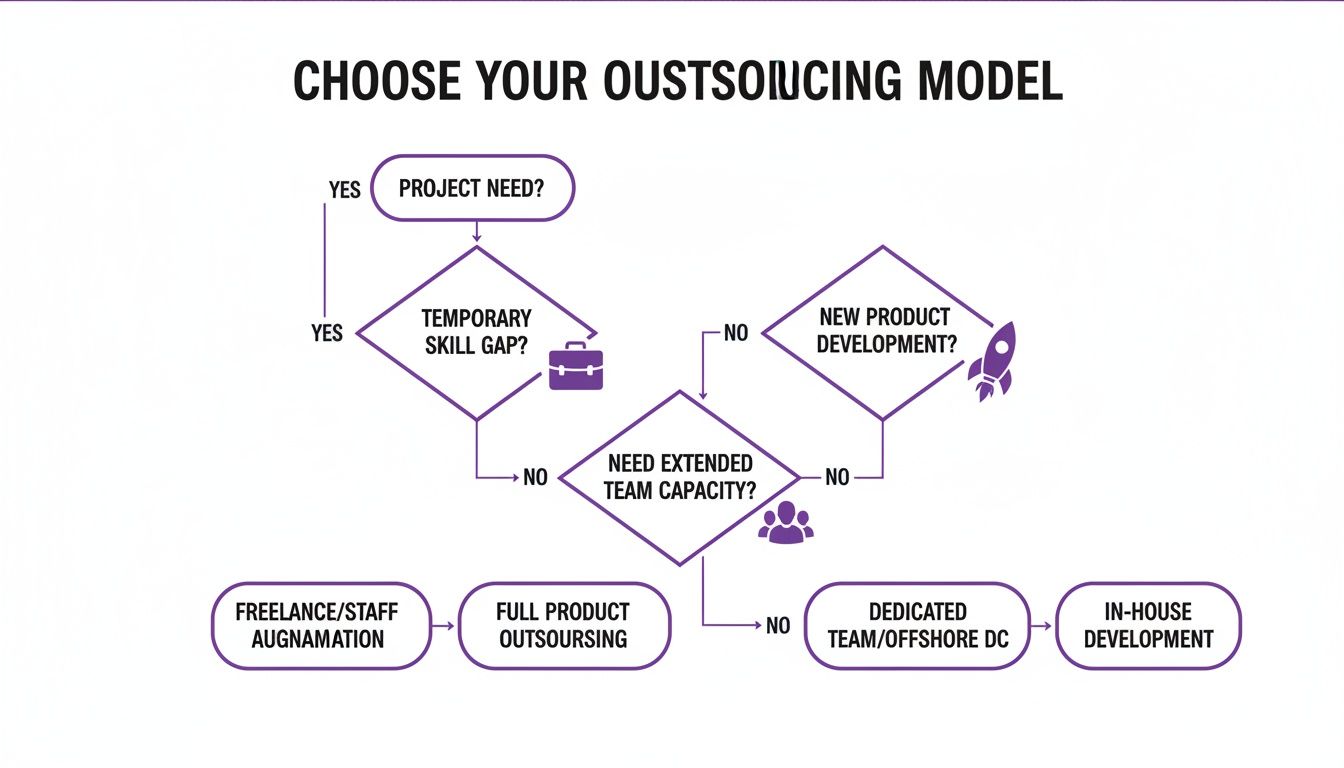
As you can see, the right path really depends on whether you're trying to patch a temporary skills gap, build a brand-new product from scratch, or simply add more horsepower to your existing team for the long haul.
Let’s say your agency just landed a huge client. They need a new microsite built in React, but your in-house team is all WordPress experts. The deadline is tight—just three months. This is the classic case for staff augmentation.
You don't need a whole new team; you just need one or two killer React developers who can jump in, mesh with your current crew, and start contributing immediately. Staff augmentation gives you incredible flexibility. You can bring on the exact talent you need for a specific project and then scale back down without the long-term costs of a full-time hire.
Now, picture a different scenario. A fintech startup is ready to build its entire trading platform from the ground up. This isn't a quick three-month project; it's a multi-year effort that involves complex architecture, ironclad security, and a constant stream of new features. For something this ambitious, a dedicated team is the way to go.
With this model, you’re not just hiring individuals—you’re essentially building a whole new, cross-functional squad that acts as an extension of your company. This team, complete with developers, QA engineers, and a project manager, becomes deeply embedded in your product, your culture, and your long-term vision. It’s a bigger investment upfront and requires more of your management time, but the payoff is total control and deep integration.
A dedicated team is all about building a strategic, long-term partnership. These developers aren't just coding to a spec sheet; they become genuine stakeholders in your product's success, contributing to the roadmap and aligning with your business goals.
What if your project is completely defined with a crystal-clear scope? Imagine an e-commerce company that needs a mobile shopping app. They have a detailed list of features, a fixed budget of $50,000, and a non-negotiable four-month deadline. This is a perfect fit for a project-based model.
In this setup, you hand the entire project over to your outsourcing partner. They take full responsibility for delivering the final product on time and on budget. You agree on the scope, timeline, and cost right at the start, and the vendor handles everything from there.
This approach offers the most predictability, which is a huge plus for businesses that need a specific outcome without getting bogged down in the day-to-day management of the development process. The secret to making this work? An incredibly detailed Statement of Work (SOW) that leaves absolutely no room for interpretation.
Each of these models has its place, and you might even find yourself using a hybrid approach. For a deeper look at the nuances, check out our guide comparing staff augmentation vs. managed services in our guide. At the end of the day, the right choice always comes down to your project's complexity, your timeline, and how much control you want to keep.
So, you’ve decided on an outsourcing model that fits your needs. Now comes the hard part: finding the right people to bring your project to life. This is where the rubber meets the road. You’re not just looking for a pair of hands to write code; you need a true partner who gets your vision and has the chops to execute it.
The first step is to really nail down what you’re looking for. Do you need a boutique agency with deep, specialized knowledge in something like FinTech or HIPAA compliance? Or are you better off with a talent platform that gives you access to a global pool of engineers with diverse skills? Let your project requirements be your north star.
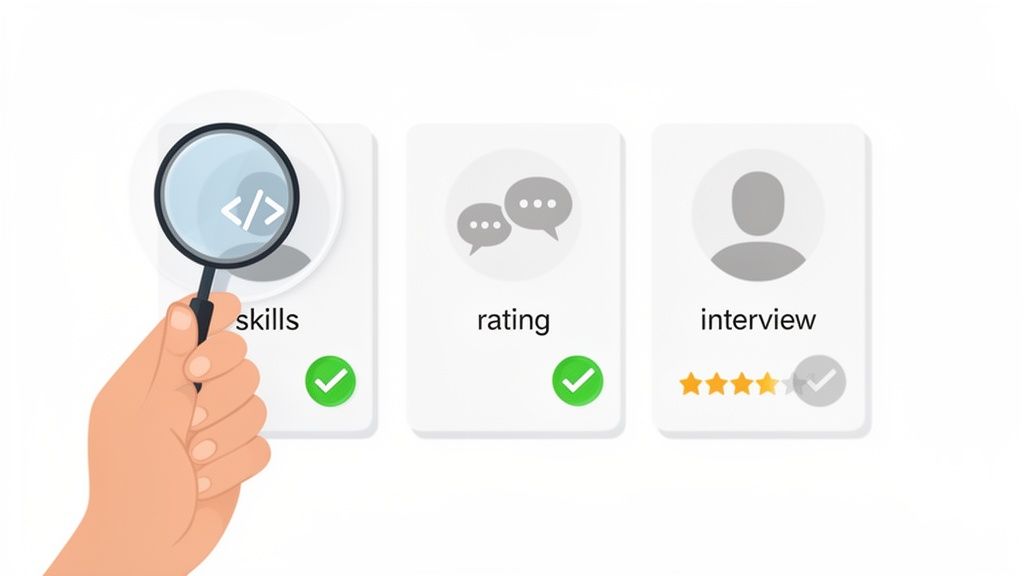
Knowing where to start your search can save you a ton of time and headaches. Your options generally fall into a few camps:
This hunt for talent isn’t just about saving money; it’s a direct response to a massive skills gap. There’s a crippling 74% developer shortage in the US and Europe, making it incredibly tough to find experts in hot fields like AI and cloud computing. It's a key reason the outsourcing market is expected to rocket past $800 billion by 2026. Talent platforms like HireDevelopers.com tackle this head-on by connecting companies with the top 1% of engineers who’ve cleared multi-stage technical and behavioral interviews. You can dig into more of these outsourcing statistics on Agilie.com.
Looking at a résumé or a GitHub profile only tells you part of the story. A truly effective vetting process needs to dig into three key areas: technical ability, communication style, and cultural fit.
First things first, you have to validate their technical skills. A simple Q&A won't cut it. Give them a practical coding challenge that reflects the actual work they’ll be doing. A small, self-contained problem with a clear deadline will show you everything you need to know about their problem-solving process, code quality, and how they handle pressure.
Next, you need to gauge their communication. A brilliant developer who can't explain a complex idea simply is a liability. Do they ask smart, clarifying questions or just make assumptions? Proactive communication is the lifeblood of any remote project.
A partner’s portfolio shows what they’ve done. Their communication style predicts how they’ll do it with you. Look for clarity, transparency, and a willingness to push back constructively.
The goal of an interview is to understand how a candidate thinks, not just what they know. Ditch the generic trivia and focus on questions that reveal real-world experience.
Here are a few of my go-to questions to get the conversation rolling:
Questions like these require candidates to pull from genuine experience, giving you a clear window into their problem-solving skills, collaborative attitude, and professionalism. The answers you get will be far more telling than any brain teaser and will help you avoid a bad hire, setting your project up for success from the very beginning.
You’ve found a development partner you’re excited about. That’s a huge win, but it’s only half the battle. Now comes the critical part: building the framework that lets that talent actually deliver. This is where we shift from vetting and interviews to the brass tacks of contracts, communication rhythms, and project management—the systems that turn a collection of skilled people into a high-octane team.
Before anyone writes a single line of code, you have to get the legal and operational foundation sorted. Think of it as pouring the concrete before you build the house. Skipping this stage is probably the fastest way to invite chaos and risk into your project.
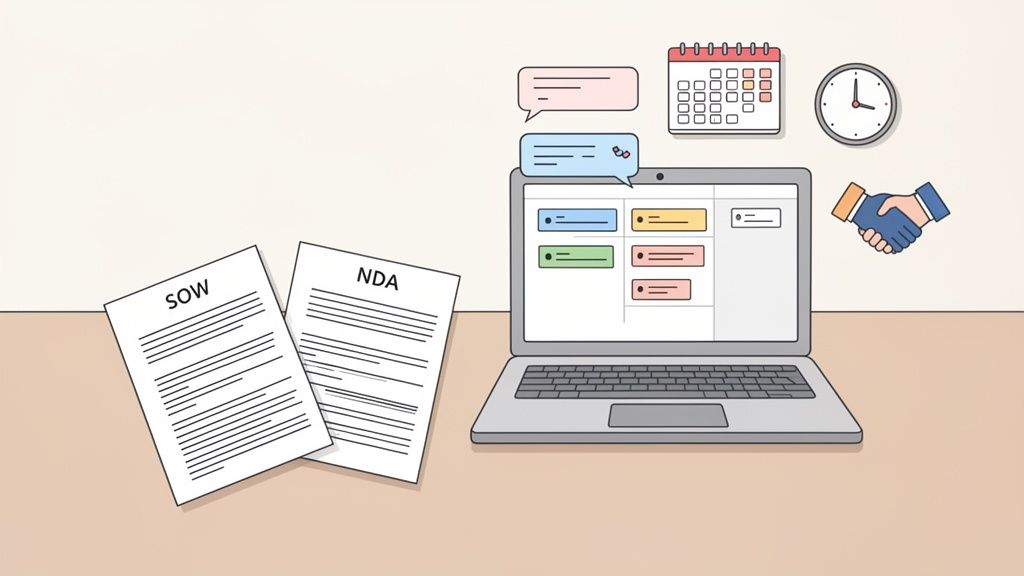
Don’t think of the legal side as just a box to tick. It’s about building a shared understanding from day one. There are two documents I consider absolutely non-negotiable.
Your SOW should be the ultimate source of truth. Whenever a question pops up about a feature or a deadline, this is the document everyone turns to for a clear answer we all agreed on.
If you're new to this, it’s worth getting familiar with the essential clauses. You can dive deeper into the nuts and bolts of a software engineering contract to make sure you’ve got all your bases covered.
Once the paperwork is signed, your focus needs to pivot to workflow. When your team is distributed, you can't just bump into someone in the hallway to ask a quick question. You have to be deliberate about how you communicate, establishing a cadence that keeps everyone in sync without drowning them in meetings.
This means picking the right tools for the right job. A classic, battle-tested stack usually looks something like this:
The real trick isn't just having these tools—it's defining how to use them. For instance, create specific Slack channels like #dev-bugs or #feature-new-login to keep conversations focused and easily searchable.
Making remote collaboration work is a skill, not an accident. It all boils down to creating a culture of transparency and proactive communication, no matter how many time zones separate you.
One of the most effective habits you can build is the daily stand-up. It's just a quick 15-minute sync-up each morning where everyone answers three questions: What did I do yesterday? What will I do today? Am I blocked by anything? This simple ritual is invaluable for spotting problems early.
Beyond that, make code reviews a non-negotiable part of your process. A good code review isn't about pointing fingers; it’s a collaborative effort to improve code quality, share knowledge across the team, and even mentor more junior developers. By setting up these structured touchpoints, you build a remote team that feels connected and operates with the precision of an in-house crew.
So, you’ve onboarded your new outsourced team, and the work is underway. Great! But how do you really know if it’s working? Success isn't just about shipping on time or on budget. It's about seeing a real return—in quality, efficiency, and ultimately, business growth.
To get the real story, you need to look past vanity metrics like hours billed. The focus should be on Key Performance Indicators (KPIs) that actually reflect your project's health and your team's output. These are the numbers that tell you what's truly going on.
Tracking the right metrics keeps everyone on the same page and proves you're getting the value you signed up for. Here are a few KPIs I always recommend to get a balanced view of your project's health:
By focusing on these KPIs, you shift the conversation from, "Are they busy?" to, "Are we building the right thing, the right way?" It’s a data-backed approach that builds accountability and helps you sniff out trouble before it snowballs.
Even with a killer team, outsourcing has its classic tripwires. The trick is to see them coming and build a process to sidestep them from day one. Don't wait for fires to start; build a fireproof system.
One of the most notorious culprits is scope creep. We've all been there—a "small" feature request here, a "quick" change there, and suddenly your timeline and budget are shot. The fix? A non-negotiable change request process. Every new idea gets documented, estimated, and formally approved before it ever touches the backlog.
Then there's the dreaded communication gap, which is almost inevitable when you're dealing with different time zones. The key is to be overly prescriptive about how you communicate. Set fixed times for daily stand-ups, insist on detailed ticket descriptions in your project management tool (like Jira), and make sure you have enough overlapping work hours for those crucial real-time conversations.
You're not just managing a project; you're building an integrated team that just happens to be remote. Getting proactive about scope, communication, and expectations is what separates a successful partnership from a frustrating mess.
Hidden costs can also bite you. The financial benefits of outsourcing are often the main attraction, but you have to look at the total cost of ownership.
It’s no secret that cost savings are a huge motivator. In fact, it's the number one reason 70% of companies outsource, with many slashing labor costs by up to 60% by hiring from global talent pools. The rate differences are stark—you might pay $25–$45 an hour in Eastern Europe versus $120–$200 in North America. Platforms like HireDevelopers.com tap into this by connecting businesses with vetted engineers, helping startups and agencies save 50-80% on developer salaries. If you're curious, you can discover more insights about these global hiring trends and see the regional breakdowns for yourself.
To avoid getting blindsided, make sure your contract is crystal clear about all potential expenses. This includes things like software licenses, infrastructure costs, or third-party services. Total transparency here builds trust and keeps your budget predictable. By measuring what matters and planning for the inevitable bumps in the road, you set yourself up to manage your outsourced project with confidence and get the results you need.
Even with the best-laid plans, outsourcing your software development is going to bring up some tough questions. It’s natural. Getting straight answers is the only way to move forward with confidence, so let's tackle some of the biggest concerns I hear from leaders and CTOs time and again.
This one is non-negotiable, and the answer needs to be crystal clear: you do.
Your contract, especially the Statement of Work (SOW), must have an ironclad intellectual property (IP) clause. It should explicitly state that every line of code, every design file, and all related work belongs 100% to your company.
Don't ever assume this is standard procedure. A good partner will have this built into their contracts, but it’s ultimately your job to verify it's there in black and white before a single keystroke is typed. If that clause is missing, you could be walking into a legal nightmare over who actually owns the product you paid to build.
Don't treat intellectual property as a footnote to sort out later. It's the cornerstone of your agreement. Your contract needs an unambiguous clause stating that all work product is yours, full stop.
Working across oceans doesn't have to be a deal-breaker. In fact, it can be a huge advantage if you get the communication rhythm right. The trick isn't forcing your offshore team to work your 9-to-5; it's about establishing a few hours of overlap for real-time collaboration.
The best remote teams are experts at both. They use their precious synchronous time for high-level problem-solving and spend the rest of their day in deep, focused work.
Worrying about code quality is completely normal. The good news is that you can manage it proactively instead of just hoping for the best. It all starts with who you hire.
Your vetting process has to be rigorous. This is where pre-vetted talent platforms like HireDevelopers.com can be a game-changer, as they’ve already done a lot of that initial heavy lifting for you.
Once the project is underway, you need to build a quality assurance framework right into your workflow.
If you want to explore more on this, a practical guide to software development outsourcing provides some excellent additional detail. By setting up these clear quality gates, you shift from hoping for quality to building a process that requires it.
Hiring an engineer is about more than matching keywords on a résumé to a job description. The real challenge is identifying an individual who not only possesses technical skill but can also solve ambiguous problems, design robust systems, and communicate effectively within a team. How do you uncover that genuine capability in a brief interview? […]

Software engineering project management is all about steering a software project from a great idea to a finished product. It’s the practical art of guiding developers, defining features, and wrangling technology to get things done on time and on budget. The Art of Building Digital Products Think of a software project manager like a film […]

Developer productivity isn't just about coding faster; it's about eliminating friction across the entire software development lifecycle. From the first line of code to the final deployment, small inefficiencies compound into major delays, frustrated engineers, and missed deadlines. The right developer productivity tools act as a force multiplier, automating tedious tasks, streamlining collaboration, and allowing […]


