

Before you even think about posting a job ad for an ecommerce developer, you need a solid game plan. This isn't just about having a vague idea; it's about translating your business goals into a detailed technical roadmap. Get this right, and you'll attract candidates who have the exact skills you need to win. Defining […]

Before you even think about posting a job ad for an ecommerce developer, you need a solid game plan. This isn't just about having a vague idea; it's about translating your business goals into a detailed technical roadmap. Get this right, and you'll attract candidates who have the exact skills you need to win.
Jumping into the hiring process without a clear vision is one of the most common—and costly—mistakes I see. It almost always leads to mismatched expectations, wasted time and money, and an end product that just doesn't deliver.
To sidestep that mess, you have to meticulously define your project's scope, lock in your technology choices, and identify the specific developer skills required. Think of it as building the foundation. You're not just hiring someone to write code; you're bringing on a partner who can turn your vision into a reality.
The demand for talented ecommerce developers is through the roof, and it's easy to see why. The global ecommerce market is absolutely booming. Projections show sales hitting a massive $7.4 trillion in 2025, with some estimates climbing as high as $8.1 trillion by 2026. This explosive growth means businesses are scrambling to build and scale online stores that can handle huge traffic volumes and deliver a perfect user experience.
First things first: get crystal clear on what you're actually building. Are you a founder with a great idea, needing a Minimum Viable Product (MVP) to test the waters? Or are you a CTO responsible for taking a massive, existing platform to the next level? The developer you need for each of those scenarios is completely different.
A well-defined project scope is your North Star. It guides every single hiring decision you make from here on out. Nail down these points:
If you're at the very beginning, focusing on an MVP is the smartest move. You can learn more about how to scope that initial build in our guide on how to build an MVP: https://hiredevelopers.com/how-to-build-mvp/
By translating business needs into technical requirements, you create a clear profile of your ideal developer. This not only helps you write a better job description but also enables candidates to understand if they are the right fit for the role.
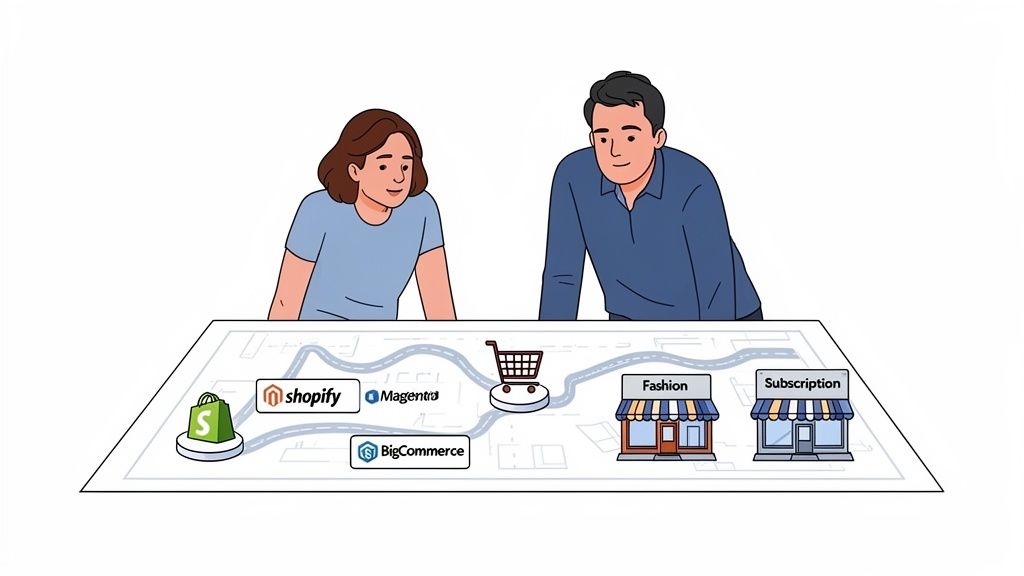
Your choice of ecommerce platform directly shapes the kind of developer you need to hire. Whether you go with Shopify, Magento (now Adobe Commerce), BigCommerce, or a fully custom solution, each comes with its own required tech stack. A Shopify pro who lives and breathes Liquid and React won't be much help on a complex Magento project that demands deep PHP expertise.
For instance, a fast-growing fashion brand might lean on Shopify Plus for its scalability and massive app ecosystem. On the other hand, a B2B distributor with complicated, tiered pricing structures would probably need a seasoned Magento developer to build out custom modules.
Deciding on your platform is a critical first step. It dictates the entire technology stack and, consequently, the skillset you'll need in a developer. This table breaks down some of the most popular options to help you align your project needs with the right talent.
| Platform | Best For | Key Technologies | Required Developer Skills |
|---|---|---|---|
| Shopify | Startups, SMBs, and high-growth D2C brands looking for ease of use and a rich app ecosystem. | Liquid, Ruby, React, GraphQL | Frontend (Liquid, HTML/CSS, JS), Shopify APIs, React for custom storefronts (Hydrogen). |
| Magento | Established B2B and B2C businesses with complex catalogs, custom features, and scalability needs. | PHP, MySQL, JavaScript, XML | Deep PHP knowledge (especially Zend/Laminas), Magento architecture, module development, PWA Studio (React). |
| BigCommerce | Mid-market and enterprise businesses wanting a SaaS solution with powerful built-in features and API flexibility. | Stencil (Handlebars.js), PHP, React | Frontend templating (Stencil), JavaScript, experience with REST APIs for headless implementations. |
| WooCommerce | Businesses of all sizes that want full control and prefer to build on the WordPress platform. | PHP, MySQL, JavaScript, HTML/CSS | Strong WordPress & PHP skills, WooCommerce hooks/filters, custom plugin development, and theme customization. |
| Custom Build | Enterprises with unique business models or requirements that no off-the-shelf platform can meet. | Varies (e.g., Node.js, Python, Ruby on Rails) | Expertise in the chosen framework (e.g., Express.js, Django), database management, cloud infrastructure (AWS/GCP), DevOps. |
Ultimately, your platform choice creates the blueprint for your developer's technical profile.
A detailed Job Description Analysis is crucial for translating these technical requirements into a clear, compelling role. By mapping your chosen tech stack to specific candidate skills, you dramatically increase your odds of finding someone who can hit the ground running and avoid a painful—and expensive—hiring mistake.
Alright, you've got a solid project blueprint. Now comes the real challenge: finding the developer who can bring it to life. Let’s be honest, the old method of posting on a generic job board and crossing your fingers just doesn’t cut it anymore. If you want to hire ecommerce developers who can actually make an impact, you need a smart sourcing strategy that goes where they are.
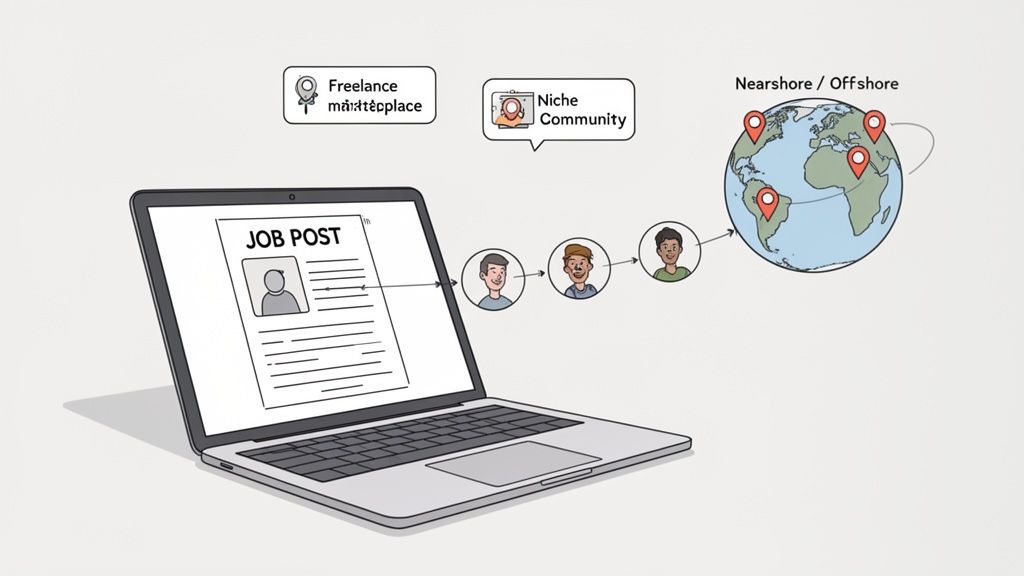
This means looking beyond the usual suspects. I'm talking about a mix of modern hiring channels, from specialized global talent platforms to the niche online communities where developers actually hang out. A multi-channel approach is your best bet for building a strong, diverse pipeline of candidates.
And you'll need it. The competition for skilled developers is fierce. The global software development services market, valued at $80.6 billion in 2025, is on track to hit $125.4 billion by 2030, all fueled by the very tech that powers modern ecommerce. Here in the US, web developer roles are set to grow by 7% between 2024 and 2034, which is way faster than the average job growth. The market is hot.
Freelance marketplaces have come a long way. General sites like Upwork or Fiverr can be okay for small, one-off tasks, but you often have to wade through an ocean of low-quality bids to find a real professional. It can be exhausting.
For any serious project, I always recommend focusing on curated platforms that pre-vet their talent. These are built specifically for hiring high-caliber developers.
Using these specialized platforms saves a ton of time. They connect you with candidates who already have deep, verifiable experience with your exact tech stack. If you're looking for more ways to connect with talent, you can learn more about how to find developers using a variety of strategies.
One of the most powerful strategies for finding world-class talent without a massive budget is to look beyond your own backyard. Expanding your search to nearshore (Latin America) and offshore (Eastern Europe, Asia) talent pools opens up a whole new world of possibilities.
Tapping into a global talent pool isn't just about saving money; it's a strategic advantage. It gives you access to a wider range of skills, diverse perspectives, and dedicated professionals who are often specialists in specific ecommerce technologies.
This approach gives you a direct line to developers with deep expertise in platforms like Magento or custom headless solutions—skills that might be rare or incredibly expensive locally. A brilliant developer from Poland or Brazil can often deliver the same (or better) quality of work for a much more competitive rate.
Your job description is your number one marketing tool in this process. A generic, bland post will attract generic, bland candidates. To grab the attention of a real expert, you need to be specific, compelling, and, most importantly, honest.
Don't just list a bunch of required skills. Instead, paint a clear picture of the problems they'll get to solve.
To really speed up your search, using specialized tools can be a game-changer. For finding and managing highly skilled ecommerce developers, checking out resources like the Top 5 Talent Sourcing Tools For Tech Recruiters can help you build and manage your candidate pipeline way more effectively. These tools can automate some of the outreach and screening, which frees you up to focus on talking to the best people.
Finding a pool of candidates is one thing; figuring out who can actually deliver is the real work. When you're ready to hire ecommerce developers, you need a process that digs deeper than a polished resume. A slick CV can easily hide a lack of real-world problem-solving skills.
This isn't about stumping developers with abstract puzzles. It’s about creating a series of practical evaluations that show you how a candidate thinks, communicates, and tackles the kinds of challenges your ecommerce business faces every day. Without a solid vetting process, you risk hiring someone who looks great on paper but crumbles under pressure.
Think of the initial screen as your first, most important filter. Its job is to quickly identify candidates who are clearly not the right fit, saving everyone valuable time. I focus on two things here: a portfolio review and a quick chat to gauge their soft skills.
First, I get hands-on with their portfolio or GitHub. Don't just look at the pretty pictures. Dig into the live sites they’ve built and ask some pointed questions:
After that, a short 15-20 minute video call reveals more than any email ever could. This isn't a technical grilling. It's a vibe check. Can they clearly explain a project they're proud of? Do they sound genuinely curious about your company? If a developer can't simply articulate their own past work, that's a huge red flag.
Once a candidate passes the initial screen, it’s time to see their skills in action with a practical assessment. Forget those generic algorithm tests that have nothing to do with building an online store. A well-designed, take-home challenge is a far better predictor of on-the-job success.
A good technical test should be:
The goal of a technical test isn’t just to see if the code works. It's a window into their problem-solving process, code quality, and attention to detail. How they get to the solution is often more telling than the solution itself.
When you get their submission back, you're looking for clean, commented code and a logical structure. Did they follow the instructions? Did they account for potential edge cases? This single step is the most effective way to separate the talkers from the doers.
The final interview is a more in-depth conversation, usually with your senior developer, tech lead, or CTO. This is where you connect the dots between the practical skills shown in the test and their higher-level strategic thinking. You need to move past "What do you know?" and get to "How would you solve this?"
I’ve found the most effective approach is to blend architectural questions with behavioral ones for a complete picture.
Questions like these reveal if they can think at a system level and anticipate future problems. For more inspiration, our guide on web developer interview questions has plenty of great examples to get you started.
By combining these practical, architectural, and behavioral checks, you get a 360-degree view. You’re not just hiring a coder; you're bringing on a thoughtful, collaborative team member who can help your ecommerce business thrive.
Before you even think about posting a job description, you need to get real about your budget. How much you can spend to hire an ecommerce developer isn't just a number—it dictates the type of talent you can attract, where you can look for them, and how you’ll engage them. Misjudge this, and you could end up with a stalled project or a hire whose cost spirals out of control.
There's a world of difference between bringing on a full-time, salaried employee and hiring a freelancer for a three-month gig. Each path comes with its own financial footprint, well beyond just the base pay.
The model you choose will shape your budget, your flexibility, and how hands-on you'll need to be. A non-technical founder might find the all-in-one support of an agency to be a lifesaver, whereas a CTO looking to expand their in-house team will probably lean toward a direct, full-time hire.
Let's break them down:
There’s also a middle ground. Global talent platforms like HireDevelopers.com offer a compelling hybrid approach. You get access to pre-vetted, full-time developers who work exclusively for you, but on flexible month-to-month contracts. It’s the dedication of an employee with the agility of a contractor.
Below is a quick-glance table to help you weigh the pros and cons of each model based on your specific needs.
| Hiring Model | Typical Cost Structure | Best For | Key Considerations |
|---|---|---|---|
| Freelancer | Hourly Rate ($50 – $150+) or Fixed-Price per project | Short-term projects, specialized tasks, quick turnarounds | Requires strong self-management; quality can be inconsistent |
| Agency | Project-based fee ($25k – $250k+) or monthly retainer | Complex, end-to-end builds; companies needing a fully managed team | Highest cost option; less direct control over individual developers |
| Full-Time Hire | Annual Salary ($95k – $180k+) plus benefits, taxes, overhead | Long-term core development, deep integration with company culture | Highest long-term commitment; lengthy and costly recruitment process |
| Talent Platform | Monthly Retainer ($5k – $10k+) | Scaling teams quickly, long-term roles with more flexibility | Requires clear communication and integration with your in-house team |
Ultimately, the right model depends entirely on your project scope, timeline, and how much you're willing to invest in management overhead versus direct development costs.
Once you've picked a hiring model, you'll run into two main ways to pay for the work: hourly or a fixed price. Knowing which to use can save you a lot of headaches and money.
The Hourly Rate Model
This is your best bet when the project scope is a bit murky or you know it will evolve. Paying for the exact hours worked is perfect for ongoing site maintenance, adding new features over time, or any project using an agile approach. You get maximum flexibility, but you have to keep a close eye on timesheets to prevent costs from ballooning.
The Fixed-Price Model
If you have a project with a rock-solid scope, a detailed creative brief, and a non-negotiable deadline, this is the way to go. You agree on a total cost for a specific list of deliverables right from the start. It gives you budget certainty but can be very rigid if you need to pivot or make changes down the line.
A fixed-price contract is great for protecting your budget, but an hourly model protects your flexibility. If there's any uncertainty at all in your project scope, an hourly rate is almost always the safer and more realistic choice.
One of the smartest moves you can make to stretch your hiring budget is to look beyond your own backyard. Tapping into the global talent pool, especially in regions like Latin America and Eastern Europe, can unlock massive cost savings without asking you to compromise on quality.
Seriously, the savings can be dramatic. By hiring nearshore or offshore experts, companies often save 50-80% compared to the $95K+ median salary for a US-based developer. With 98% of ecommerce brands expecting their global orders to grow by 2026, finding affordable, top-tier talent is no longer a luxury—it's essential for scaling your tech without breaking the bank. If you want to dive deeper, you can explore the latest research on how global hiring is reshaping ecommerce.
This whole process of finding the right person can feel overwhelming, but a structured vetting funnel makes it manageable.
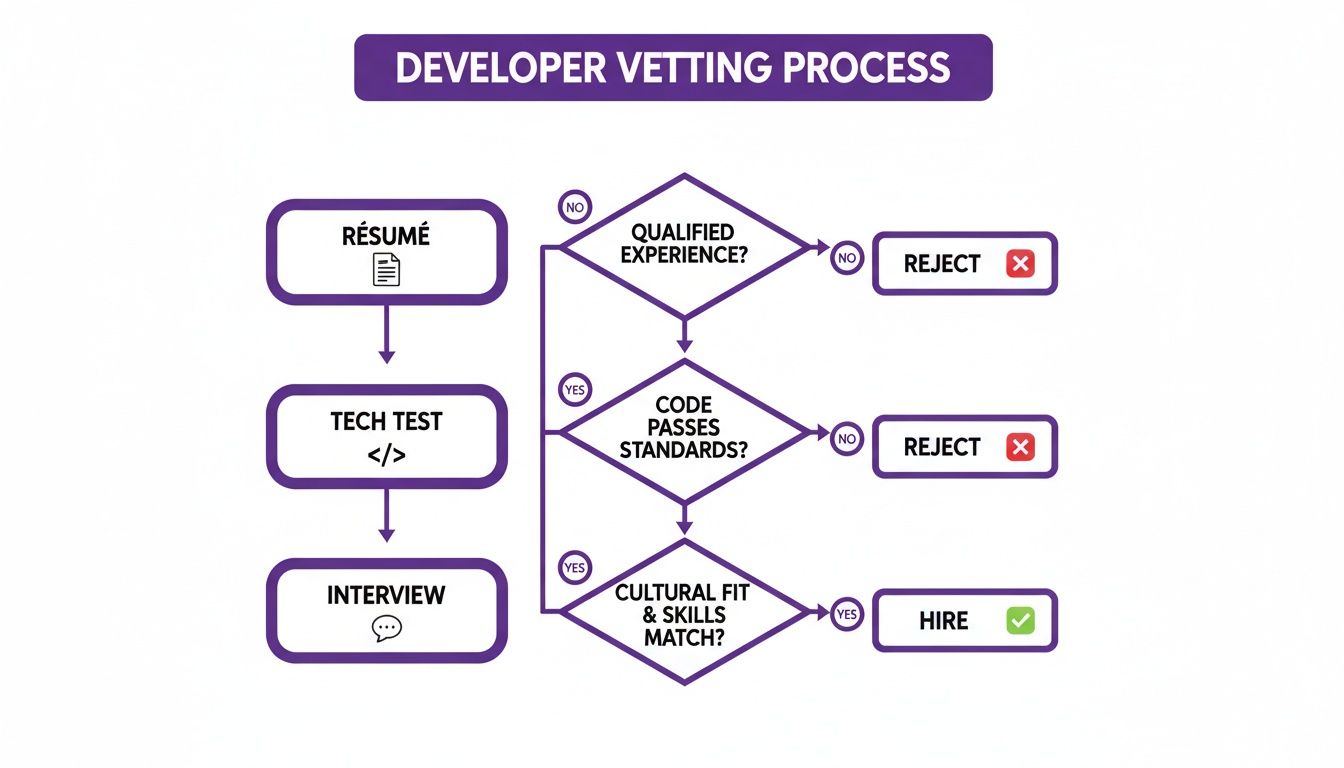
As the flowchart shows, you start broad with a resume screen, then narrow the pool with a hands-on tech test, and finally make your decision after a deep-dive interview. This multi-stage approach is the most reliable way to filter for genuine A-players.
The numbers speak for themselves. A senior Magento developer in North America can easily charge $120-$180 per hour. A developer with the exact same skill set in a nearshore location might only cost $60-$90. This isn't about a race to the bottom for "cheap" labor; it's about smart access to a global market of highly skilled professionals where your budget simply goes further.
The moment the contract is signed isn't the finish line; it’s the starting line. I’ve seen too many companies drop the ball right here, assuming a talented developer will just figure things out. But a structured, thoughtful onboarding process is what really turns a great hire into a productive team member who ships code fast.
Neglecting this can be a huge misstep. Think about it: up to 20% of staff turnover happens within the first 45 days. That's often a direct result of a chaotic or unwelcoming start. When you’ve invested so much in finding the right ecommerce developer, especially a remote one, you can't afford that kind of churn.
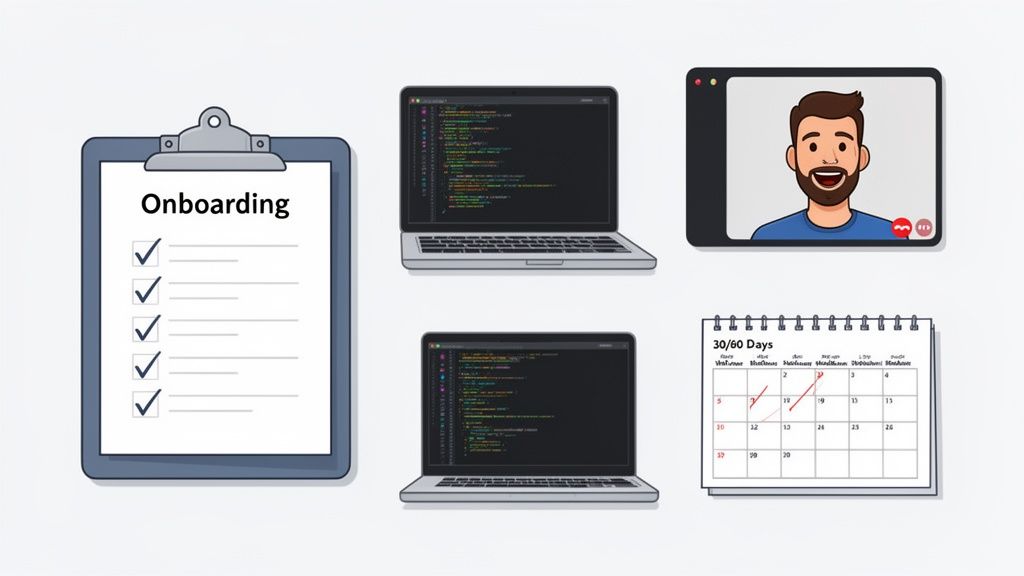
Those first couple of days set the entire tone. Your main job is to remove every ounce of friction so your new developer can dive into the codebase, not waste time chasing down login credentials. This means preparing everything before their first day.
Get a welcome kit ready that includes:
This isn't just a checklist; it’s about making them feel like part of the crew from the jump. A simple "Welcome aboard!" message in the main Slack channel from the team lead makes a world of difference, especially for a remote developer who can’t just walk over to someone’s desk.
Onboarding isn't a one-day event; it's a structured process that systematically integrates a new hire into your team's technical workflows and cultural norms. A well-executed plan dramatically shortens the time to productivity.
With the initial setup out of the way, the first month is all about immersion. The goal is to get them contributing to the codebase quickly—even with small, low-risk tasks. This builds their confidence and helps them learn your processes hands-on, which is far more effective than just reading docs.
Here’s what your 30-day plan should cover:
This structured approach avoids that classic pitfall where a new developer spends their first few weeks feeling totally lost. By giving them a clear path, you empower them to start adding value right away, turning a new hire into an integrated and impactful team member as fast as possible.
When you're ready to hire an ecommerce developer, a lot of questions probably pop into your head. It doesn't matter if you're a founder launching your first store or a seasoned CTO scaling a massive platform—getting straight answers is key.
Let's dive into some of the most common questions we hear. This isn't just theory; it’s practical advice pulled from years of experience to help you sidestep the usual hurdles and build your team the right way.
This is the big one, isn't it? The honest answer is: it depends entirely on how you go about it.
If you stick to the old-school method of posting on job boards, you’re looking at a long haul. You'll spend weeks sifting through hundreds of résumés (many of them irrelevant) and then navigating multiple interview rounds. That whole process can easily drag on for six to ten weeks. For highly specialized roles, you can bet it'll take even longer.
On the flip side, using a global talent platform completely changes the game. These platforms do the heavy lifting for you by maintaining a pool of pre-vetted, high-quality candidates. This means the sourcing and initial screening is already done. You can often get a hand-picked shortlist of developers in just 24 to 48 hours and have someone onboarded in as little as a week.
So, what influences your timeline? It boils down to a few things:
Knowing a specific platform like Shopify or Magento (Adobe Commerce) is table stakes. A truly valuable ecommerce developer brings more to the table—they have a unique mix of deep technical skills and a genuine understanding of how online retail actually works. They’re not just shipping code; they're building tools that make you money.
Beyond the basics, here are the skills that really make a difference:
Must-Have Technical Chops
The "Soft" Skills That Drive Hard Results
The most valuable ecommerce developers are those who think like business strategists. They connect every line of code back to a core business objective, whether it's increasing average order value or reducing cart abandonment.
Absolutely, and you should. The old way of thinking—that every hire has to be a full-time, permanent employee—is dead. Modern, flexible engagement models make it incredibly easy to bring in an expert for a specific project without getting tangled in long-term commitments.
This is exactly where many talent platforms shine. You can hire a developer on a month-to-month basis, giving you the power to scale your team up for a big push and then scale back down when things are quiet. This model is a lifesaver for:
This approach lets you avoid the hefty deposits and rigid, long-term contracts that many traditional agencies demand. You get the same top-tier, pre-vetted talent, but you only pay for the time you actually need. It’s a smarter way to build your team and react quickly to whatever the market throws at you.
If your job posts are getting the silent treatment or attracting all the wrong candidates, the problem isn't the talent pool—it's your sales pitch. A vague or uninspired frontend web developer job description is one of the biggest reasons top-tier talent scrolls right past your opening. In a market this competitive, clarity and a compelling […]

The real difference between a contractor and a full-time employee comes down to one simple question: are you looking for specialized skills and flexibility for a specific project, or are you building a stable, deeply integrated team for the long haul? The first points to a contractor, the second to a full-time employee. Your answer […]

Let's be clear: "offshore development" isn't a piece of software you buy. It's a strategic way of thinking about building your team. Simply put, it means hiring software developers from another country—often one far away—to build your products. Think of it as global talent acquisition. Instead of being stuck with the engineers available in your […]


