

When you’re trying to scale your engineering team, you quickly run into a few common roadblocks: sky-high local salaries, a shallow talent pool for the specific skills you need, and a hiring process that moves at a snail's pace. This is where bringing on offshore developers can completely change the game. It's not just about […]

When you’re trying to scale your engineering team, you quickly run into a few common roadblocks: sky-high local salaries, a shallow talent pool for the specific skills you need, and a hiring process that moves at a snail's pace. This is where bringing on offshore developers can completely change the game.
It's not just about finding cheaper labor; it's a strategic move to tap into a global reservoir of talent, slash your development costs, and build your team on your own terms.
Let's be honest, the initial pull for most companies is the cost savings, and the numbers don't lie. Going offshore can be roughly 50% more cost-effective than hiring a comparable in-house team.
Think about it: a senior developer in the United States can easily command a salary well over $100,000. In a tech hub like India, you could find a similarly skilled developer for anywhere between $9,000 to $25,000 annually. That’s a massive difference. For more data on this, check out the offshore development trends at AZ Big Media.
That kind of financial breathing room lets you reallocate funds to other critical areas like marketing, sales, or product research, giving you a much longer runway to succeed.
But the real magic happens when you look past the budget and see offshoring as a strategic weapon. Here are a few situations where it makes perfect sense:
You're Building an MVP: Got a brilliant idea but a shoestring budget? Offshoring is your best friend. It lets you get a Minimum Viable Product built and into the hands of users without burning through your entire seed round just to hire one or two local engineers.
You Need Niche Skills: What if your project demands deep expertise in something like machine learning, blockchain, or a niche programming language? The odds of finding that perfect person in your immediate vicinity can be slim. The global talent pool, on the other hand, is vast.
You're in a Race to Market: To outpace the competition, you need to move fast. By setting up a "follow-the-sun" workflow with teams in different time zones, you can create a nearly 24-hour development cycle. While your US team sleeps, your offshore team is pushing code.
You Need to Scale—Yesterday: When a new project lands or user demand explodes, you can't afford to wait months to hire. Offshore partners are built for speed. They can source, vet, and onboard qualified developers in a fraction of the time it takes to do it all yourself.
The smartest companies don't just see offshoring as a way to save money. They use it to gain a powerful operational advantage and a serious competitive edge.
Of course, offshoring is just one piece of the global hiring puzzle. It's also worth exploring other models to see what truly fits your needs. Our guide on what nearshore software development is breaks down an alternative that might be better for teams who need closer time-zone alignment.
Jumping into the global talent pool without a solid plan is a classic mistake. I've seen it lead to wasted time, blown budgets, and a lot of frustration. Before you even think about posting a job ad to hire developers offshore, you need to lay the groundwork with a clear hiring blueprint. Think of this as your north star—it will guide every decision you make, from defining the role to picking the right way to pay your new team members.
This isn't about writing a vague project description. You need to get specific. What exact features are you building? What's your tech stack? A detailed scope lets you write a technical job description that does the first round of filtering for you, attracting candidates who actually have the skills you need.
The world is your oyster when it comes to developer talent, but some regions are better suited for certain needs than others. Your choice here impacts everything: your budget, how you communicate, and even your daily workflow.
As of 2025, the cost savings are still a huge driver. In Asia, powerhouse hubs like India and the Philippines offer incredible value, with hourly rates typically between $20 and $50. India alone boasts the world's largest developer population, with around 5.8 million skilled professionals.
Look towards Eastern Europe, and you'll find countries like Ukraine and Bulgaria. While the rates are a bit higher—usually $25 to $85 per hour—you often get exceptional engineering talent and much better timezone overlap with US and European teams.
The cost difference is really what stops people in their tracks. It’s not just a small saving; it's a game-changer for most businesses.
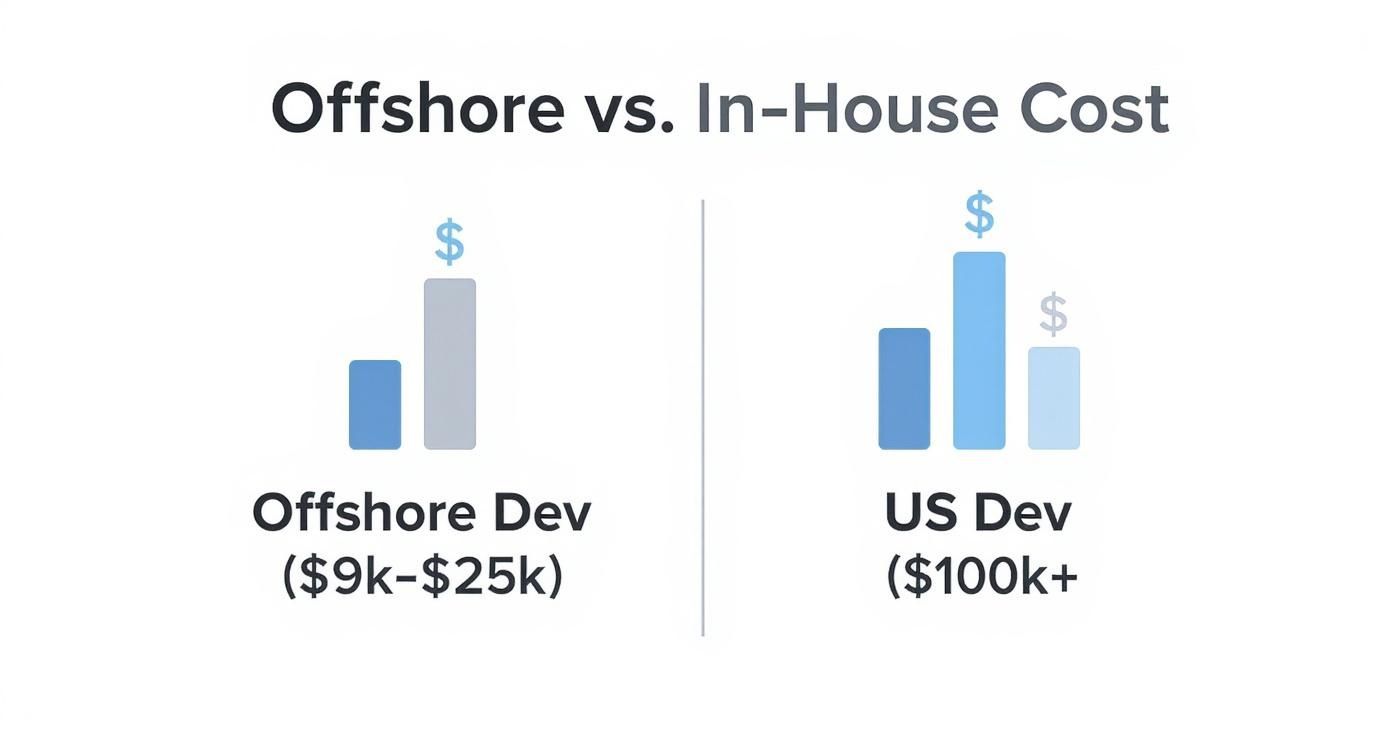
When you see it laid out like that, it's clear that even a top-tier offshore developer costs just a fraction of a US-based equivalent. This is what allows startups to compete and established companies to scale their engineering efforts without breaking the bank.
To help you narrow down your options, I've put together a quick comparison of the most popular regions. This isn't exhaustive, but it gives you a good starting point based on what I've seen work for different types of companies.
| Region | Average Hourly Rate (USD) | Key Strengths | Timezone Overlap (vs. US/EU) |
|---|---|---|---|
| Eastern Europe | $25 – $85 | Strong in complex backend (Java, Python, .NET), AI/ML, and DevOps. Excellent English proficiency. | Good overlap with EU; partial with US East Coast. |
| Latin America | $30 – $75 | Expertise in modern front-end (React, Angular), mobile (iOS/Android), and nearshore convenience. | Excellent overlap with all US timezones. |
| Southeast Asia | $20 – $50 | Massive talent pool for web/mobile development, QA, and support roles. Unbeatable cost-effectiveness. | Limited overlap with US/EU; requires async workflows. |
| India | $20 – $60 | Versatile skills across virtually all technologies, from enterprise software to e-commerce. Great for large-scale teams. | Limited overlap with US/EU; best for 24/7 operations. |
Each region has its own unique flavor. Latin America is fantastic if you need real-time collaboration with your US team, while Eastern Europe is a go-to for deep, complex technical challenges. Asia remains the king for cost and scale.
Okay, so you've got a potential region in mind. Now, how are you actually going to work with these developers? The engagement model you choose defines the entire relationship.
Your engagement model isn't just a contractual detail; it dictates your day-to-day management responsibilities and how integrated the offshore talent will be with your core team.
Getting the legal and financial infrastructure right from the start is also crucial. For companies going all-in, figuring out how to open an offshore company and bank account can be a necessary step. It smooths out everything from payroll to compliance, ensuring you're ready to operate legally and efficiently once you find your ideal candidates.

Once you’ve defined the role, the real hunt begins. Finding talented developers isn't the hard part—the global market is brimming with them. The challenge is finding the right ones, the engineers who have both the technical chops and the soft skills to truly become part of your team. This is where a smart, multi-channel sourcing strategy pays off.
When you decide to hire developers offshore, you’re not limited to one path. You have a few solid options, and the best one for you depends on your budget, timeline, and how hands-on you want to be.
It’s worth getting a feel for how different models work. For example, understanding how a marketplace helps business owners hire top freelance talent can give you a clearer picture of the freelance platform landscape.
A resume shows you what a candidate has done; a great vetting process reveals what they can do. If you just ask trivia-style technical questions, you’ll hire someone who’s great at memorizing answers, not at solving real-world problems. The goal should always be to simulate the work they'll actually be doing.
Live coding challenges are incredibly effective, but not the abstract algorithm puzzles. Give them a simplified version of a real problem your team has tackled. Ask them to build a small API endpoint with specific requirements or debug a piece of intentionally buggy code.
Pay close attention to their process. Are they asking smart, clarifying questions? Can they articulate their thought process as they go? How they approach the problem tells you more about their problem-solving skills than a perfect, polished answer ever could.
A candidate's ability to communicate their thought process during a technical challenge is often a stronger indicator of future success than the final code itself. It shows collaboration, clarity, and problem-solving in real-time.
Technical skill is only half the equation. When you hire developers offshore, soft skills—communication, proactivity, cultural fit—are what make or break the engagement. A brilliant coder who can't communicate effectively will just end up being a bottleneck.
Weave soft skill assessments right into your interview process. Don't ask generic questions like, "Are you a good communicator?" Instead, use behavioral prompts that force them to give you specific examples from their past.
Here are a few questions I've found to be incredibly revealing:
Keep an eye out for proactive and curious candidates. The best offshore developers don't just sit back and wait for a ticket. They ask thoughtful questions, suggest improvements, and take real ownership of their work. That proactive mindset is the secret ingredient for building a truly high-performing distributed team.
So, you’ve found the perfect developer. Awesome. Now comes the part that trips a lot of companies up: the legal and financial setup. This is where you cross the t's and dot the i's on international labor laws, tax rules, and payment systems.
Honestly, it can feel like a minefield if you’re not prepared. Messing this up isn't just a headache; it can lead to some pretty serious compliance issues and financial penalties down the road. The path you take really boils down to your company's structure and how much risk you're willing to handle yourself.
You basically have two main options here, each with its own pros and cons.
The most direct route is to hire the person as an independent contractor. You create a contract, they send you an invoice, and you pay it. Simple, right? This approach gives you a ton of flexibility and is usually the quickest way to get started. But there's a catch: the entire compliance burden lands squarely on you. You have to be incredibly careful not to misclassify them as an employee, which could open a huge can of worms with tax and legal problems in their country.
The other option is to partner with an Employer of Record (EOR). Think of an EOR as your local HR and legal department on the ground in that developer's country. They become the legal employer, handling all the tricky stuff for you.
An EOR essentially acts as a protective shield. It absorbs the legal and administrative chaos of global employment so you can focus on what actually matters: managing your developer and building great software.
No matter which path you choose, you need an ironclad contract. This isn't something to take lightly, especially when it comes to your intellectual property (IP).
Make sure your agreement has rock-solid clauses on confidentiality, non-disclosure, and—this is the big one—a crystal-clear statement that all IP rights for any work created belong exclusively to your company.
When it's time to pay your developer, don't just default to a standard international bank transfer. You'll get killed on the fees and terrible exchange rates. Instead, look at modern global payroll platforms like Deel or Remote. These services are built for this exact scenario, offering much better rates and making the whole process secure and predictable.
Nailing the payment process is a huge part of understanding your true offshore software development costs and keeping the budget in check. By getting these formalities right from the start, you build a professional relationship based on trust and clarity—the perfect foundation for a long-term partnership.

The contract is signed and your new developer is on board. Now for the hard part. Just hiring someone is never enough; how you bring them into your team and workflow is what truly determines if the partnership will sink or swim. A sloppy, disorganized start can sap all the initial excitement and momentum.
From day one, your mission is to get your new hire productive as quickly as possible. This means having all their tools and access lined up before they even log on. I always recommend a simple onboarding checklist: access to code repos, project boards like Jira, and communication channels like Slack. A simple welcome doc with key links and who to contact for what is a lifesaver.
A chaotic first week is a surefire way to make a new developer feel lost and disengaged. You need a clear plan to immerse them in the project and the team culture. This isn't about hand-holding; it's about providing the clarity they need to start contributing real value.
Here's a first-week plan that has worked well for my teams:
This approach takes the guesswork out of their first few days and lets them build confidence by scoring an early win.
When you hire developers offshore, you're managing more than just tasks and deadlines. You’re navigating time zones, languages, and cultural nuances. You simply can't afford to be passive about communication.
Find a few hours of overlap time each day. This is your golden window for real-time collaboration, quick sync-ups, or pair programming sessions. For everything else, clarity is king. A ticket can't just say, "Fix login." It needs detailed steps to reproduce the bug, what the correct behavior should be, and maybe a quick screenshot or screen recording to leave no room for ambiguity.
A unified team culture doesn't just happen; you have to build it intentionally. Virtual coffee chats, celebrating wins in a shared channel, making inside jokes—these small things make everyone feel like they're on the same team, not just a name on a screen.
The global offshore software development market was valued at around $122 billion in 2025, and it's not hard to see why. Modern agile practices and remote-first tools have made it easier than ever to collaborate across borders. To dig deeper, check out these offshore software development trends on HireWithNear.com.
At the end of the day, you need to know if this is working. Vague expectations only lead to frustration on both sides. You have to define what success looks like by setting clear Key Performance Indicators (KPIs) that are tied to your actual business goals.
We’ve found a few metrics to be particularly useful:
Regular one-on-ones are the perfect place to discuss these KPIs. But these meetings are more than just status updates; they're your chance to give feedback, clear up roadblocks, and build the trust that leads to long-term success.
Stepping into the world of global hiring always brings up a few key questions. It's a big move for any company, and it's smart to get the real story before you dive in. Getting straight answers to your concerns is the best way to feel confident about finding the right developer, no matter where they are.
Let’s tackle some of the most common questions I hear from leaders who are considering going offshore for the first time.
I've seen this play out many times, and the big worries almost always come down to three things: communication breakdowns, protecting your intellectual property (IP), and making sure the quality of work is top-notch. The good news? With a solid game plan, all of these are completely manageable.
Here's how you get ahead of them:
This one really boils down to your project's complexity and how much time you can dedicate to managing someone directly.
Hiring a freelancer can be perfect for smaller, clearly defined tasks. If you have a specific feature you need built and you can provide direct oversight, it's a wonderfully flexible and cost-effective route for short-term projects.
For anything bigger, more complex, or long-term, you’re almost always better off partnering with an offshore agency or a specialized talent platform. They take the entire headache of recruiting, HR, and global admin off your plate.
Think of it this way: an agency gives you a stable, ready-to-scale team. They handle the messy parts like international compliance and payroll, freeing you up to focus purely on building a great product.
This is the big one, and you can't afford to get it wrong. Protecting your IP starts with an ironclad legal agreement. There can be zero ambiguity—the contract must clearly state that your company owns 100% of the work product, period.
But a contract alone isn't enough. You need to back it up with practical security measures. This means using secure development environments and being disciplined about who has access to what.
Working with a reputable Employer of Record (EOR) or a vetted talent platform adds a powerful layer of security here. They have the legal muscle and local know-how to enforce your agreements in the developer’s home country, which is something you definitely don't want to figure out on your own.
Careers in cryptography are high-stakes, high-reward. These are the people who build and break the digital codes that secure our world, protecting everything from your bank account to global decentralized networks. It's a field with massive growth and serious six-figure salary potential. Why Cryptography Careers Are Exploding Welcome to the new frontier of digital trust. […]

The demand for remote machine learning jobs isn't just a trend anymore; it's a fundamental shift in how AI talent is hired and deployed. For ML professionals, this opens up a world of possibilities, not just in terms of flexibility, but also significant financial upside. Companies are in a fierce competition for top talent, and […]

The software engineering field is constantly shifting, with certain specializations commanding unprecedented salaries. But which roles truly offer the highest earning potential, and what does it take to secure one? This data-driven guide breaks down the best paying software engineering jobs, moving beyond vague titles to offer a detailed roadmap for career advancement and strategic […]


