

When you're building a startup, your first technical hire is everything. Seriously. This person isn't just another employee clocking in to write code. They are laying the literal foundation of your entire product, shaping your engineering culture, and embedding the architectural DNA that will define your company for years to come. Get this right, and […]

When you're building a startup, your first technical hire is everything. Seriously. This person isn't just another employee clocking in to write code. They are laying the literal foundation of your entire product, shaping your engineering culture, and embedding the architectural DNA that will define your company for years to come.
Get this right, and you can jump ahead on your roadmap by months. Get it wrong, and you'll be buried in technical debt before you even have a chance to find product-market fit.
Every founder gets that hiring is important, but it's hard to overstate just how much weight those first few technical hires carry. They aren't just staff; they're co-architects of your vision. The choices they make today will echo for years, impacting everything from your ability to scale to how fast you can react to customer feedback.
The ripple effect of this first hire goes way beyond their code. They’ll be the one making the early, critical calls on your tech stack, database design, and deployment pipeline. Those decisions, made when you’re just a small team, create paths that are incredibly difficult and expensive to back out of later on.
Think of your first developer as wearing two hats: one of an architect and the other of a cultural ambassador.
A bad hire, on the other hand, just creates chaos. They might push for an obscure tech stack they love but no one else can work with, or leave behind a trail of messy, undocumented code that grinds all future development to a halt. This is the birth of technical debt—a silent killer that quietly compounds, making every new feature a painful struggle to implement.
The wrong developer doesn't just deliver a bad product; they create an environment where a good product becomes impossible to build. Their legacy is a codebase that resists improvement and a culture that attracts similarly ineffective talent.
This whole challenge is amplified by how insanely competitive the hiring market is right now. You’re not just up against other startups; you’re fighting tech giants with bottomless pockets for compensation and perks. You can't win a bidding war.
Your edge has to be the vision, the opportunity to make a massive impact, and the chance to build something real from scratch.
This guide is your playbook for selling that dream and making the right call. We're skipping the generic fluff to give you a tactical framework for making smart, strategic hiring decisions. For a deeper dive into building your tech team from the ground up, this complete guide on how to recruit developers is an excellent resource. It will help you sidestep the common mistakes that sink promising startups before they even get a chance to float.
Deciding how you hire developers is just as important as who you hire. The model you choose—be it a freelancer, a full-time employee, or a nearshore agency—is a strategic bet that directly impacts your burn rate, product speed, and your startup's ability to grow. This isn't just an HR checkbox; it's a foundational decision.
For an early-stage company, every dollar and every day is precious. Pick the wrong model, and you could blow your seed round on a hire you don't need yet or lose months searching for the "perfect" full-timer when a contractor could have shipped your MVP. But when you get it right, it's a force multiplier. You get the exact expertise you need, right when you need it.
To help you navigate this, let's break down the main options and when they make the most sense.
The best choice always depends on your immediate goals, your budget, and how much control you need over the product's DNA. This table lays out the core trade-offs at a glance.
| Model | Best For | Cost | Speed to Hire | Control & Integration |
|---|---|---|---|---|
| Freelancer | Specific, short-term projects (e.g., MVP, prototypes, feature sprints). | Low (Pay-per-project/hour) | Very Fast (Days) | Low (External contributor) |
| Full-Time | Building core product, long-term ownership, and shaping engineering culture. | High (Salary, equity, benefits) | Slow (Weeks to months) | High (Core team member) |
| Agency | Complex projects requiring a full team (devs, UX, PM); non-technical founders. | Very High (Retainer/Project fee) | Fast (Weeks) | Medium (Managed team) |
| Global/Remote | Scaling the team cost-effectively and accessing specialized talent pools. | Variable (Lower than local) | Moderate (Varies by region) | High (If hired directly) |
Each of these has its place in a startup's journey. It’s rare for one model to be the answer for everything.
Think of freelance developers as your startup's special forces. They're perfect for hitting specific, short-term objectives with crystal-clear outcomes.
Need to build a proof-of-concept to show investors? A freelancer is your fastest route. Need a quick landing page or an API integration before a big launch? Again, a freelancer gets it done.
The big win here is speed and flexibility. You can often find and hire a great freelance developer in a few days—not months—and you only pay for the time you actually need. It’s an incredibly capital-efficient way to tap into senior talent without the long-term overhead of salary, benefits, and equity. The trade-off? Integration. They are outside contributors, not core team members, which means they aren't the right choice for making foundational architectural decisions your company will live with for years.
Once you’ve validated your idea and you're ready to build the real, scalable version of your product, it's time for a full-time hire. This person—often your first or second engineer—is doing more than just writing code. They're taking ownership of the product's soul.
A full-time hire lives and breathes your vision. They're the ones who will make the critical architectural decisions that set the stage for everything that comes next. It’s an investment in long-term ownership and culture. They become part of the business, helping shape the roadmap, mentor future engineers, and define how you build things. This commitment costs more in salary, equity, and a much longer recruiting cycle, but for building a lasting company, there's no substitute.
This flowchart can help you think through whether that first crucial hire should be a big-picture architect or a more focused specialist.
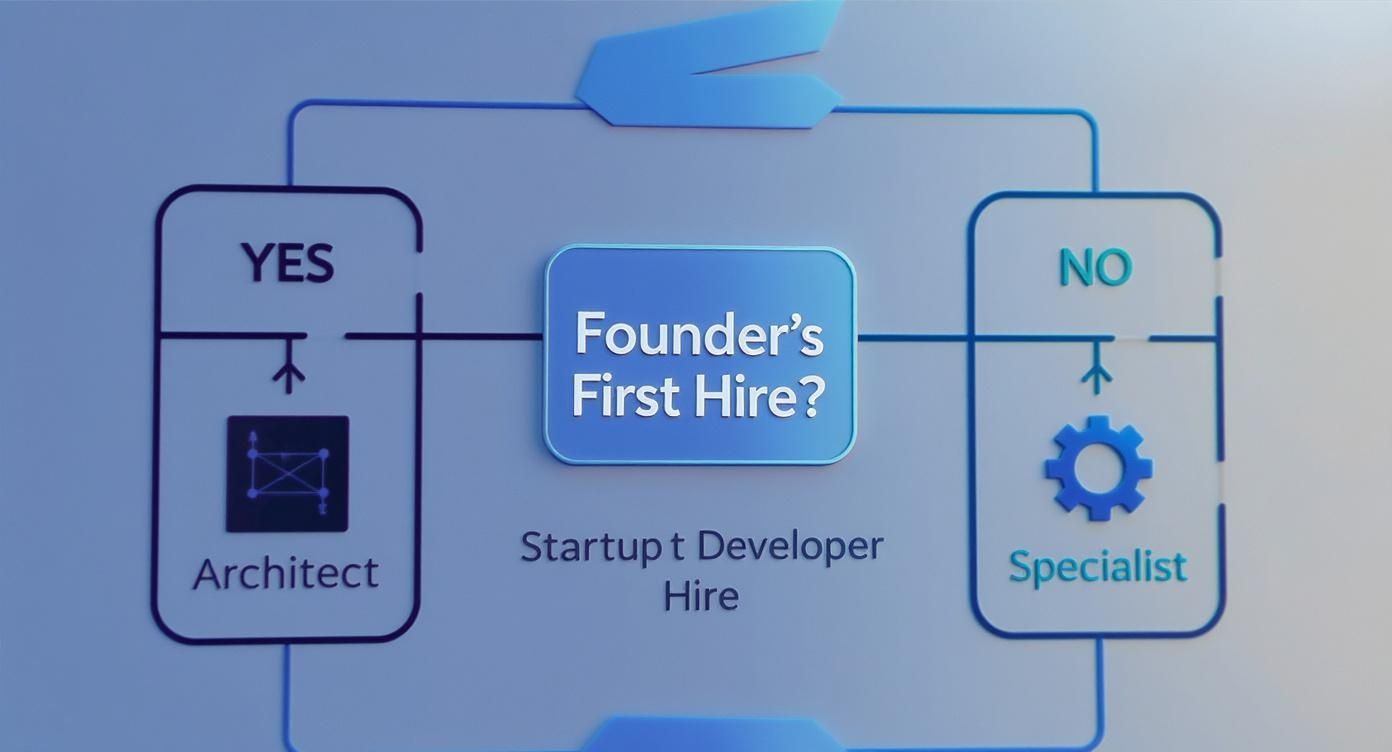
The key takeaway is that your very first technical hire often needs to be a strategic thinker who can lay a solid foundation. You can fill in the specialized roles after that's in place.
Sometimes one developer isn't enough. You need a whole squad—backend, frontend, UI/UX, and a project manager to keep it all together. This is where development agencies shine.
Hiring an agency is like renting a fully-formed, experienced team that knows how to take a project from an idea to a finished product. This is a game-changer for non-technical founders who need a partner to manage the entire process. Agencies bring proven workflows and deep experience, which helps de-risk a complex build. While they are usually the most expensive option per hour, they can actually be cost-effective for big projects by preventing the costly mistakes and delays that happen when you try to wrangle multiple individual freelancers.
The shift to remote work has completely changed the game for startups. You're no longer limited to the talent in your city. Tapping into global talent pools means you can find incredible developers for a fraction of what you'd pay in a major tech hub.
This isn't a small advantage—it's how you can dramatically extend your runway and scale your team without breaking the bank. With 40% of new job postings now offering remote flexibility, the world is truly your oyster.
The economic case is hard to ignore. For example, a senior software developer in the US might command an average salary of $132,000, while an equally talented developer in Latin America could be around $31,000. Of course, it adds complexity with things like international payroll and compliance, but the savings are massive.
Your hiring model should be as dynamic as your startup. Start with a freelancer for validation, hire a full-time engineer to build the core, and look to global talent to scale. The key is to match the model to your current stage and funding reality.
Most successful startups end up using a hybrid approach, combining a core full-time team with remote contractors for specialized skills. To get more into the nitty-gritty, check out our practical guide on how to hire remote developers for a step-by-step playbook.
Let’s be honest: just tossing a job description onto a generic job board and hoping for the best is a surefire way to get lost in the noise. For a startup, that approach is a death sentence. You're not just competing for any developer; you're trying to capture the attention of builders—the kind of people who are driven by impact, not just a list of perks.
If you want to hire great developers, you have to go where they are and speak their language. Drop the corporate jargon. Forget the endless bullet points about "synergy" and being a "team player." The best engineers want to know what they’ll be building, what tech they’ll get to use, and why their work will actually matter.
This means your entire sourcing strategy has to be fundamentally different from that of a massive corporation.

LinkedIn is a starting point, but it's incredibly crowded. The most engaged, truly skilled developers often hang out in communities where they’re learning, sharing, and collaborating. Your mission is to meet them on their own turf.
Your job description is your number one marketing asset. It needs to sell the why behind your startup, not just be a laundry list of technical skills. The best engineers are drawn to fascinating problems and the chance to make a real impact.
A great startup job description absolutely must include:
A job description focused on your mission attracts candidates who are motivated by purpose, not just a paycheck. These are the people who will stick with you through the inevitable startup challenges because they believe in what you're building.
The "build in public" movement is an incredibly powerful, organic way to get inbound interest from top-tier talent. When you share your journey—your wins, your struggles, and your learnings—on platforms like X (formerly Twitter), Indie Hackers, or a company blog, you create a story people want to join.
When developers see your passion and watch your product evolve in real time, they become invested. This approach builds a natural pipeline of candidates who already get your mission and culture. They don't just want a job; they want to work with you. The quality of these inbound candidates is almost always higher than what you'll find from cold outreach.
For more ideas on where to look, our guide on how to find developers dives into even more channels and tactics.
Finally, never, ever underestimate the power of your personal and professional network. I’ve found that the best hires almost always come from trusted referrals.
Reach out to former colleagues, your advisors, and mentors. Let them know what you’re building and exactly who you're looking for. A warm intro from someone you both respect is infinitely more powerful than a cold email. These referrals come with a built-in layer of trust, which can dramatically shorten your screening process and improve your odds of finding a great culture fit.
So, the résumés have started to roll in. Now the real work begins.
Screening and interviewing developers isn't just about ticking boxes on a skills checklist. For a startup, it's about finding a specific mindset. You aren't just looking for someone who can write clean code; you’re searching for a builder—someone who can think on their feet, adapt to chaos, and solve problems in an environment that changes by the hour.
You can forget the big-tech interview gauntlet of abstract brain teasers. Your process needs to be grounded in reality, designed to test for the qualities that actually predict success in an early-stage company. Think pragmatism, clear communication, and a genuine curiosity about what you're building and who you're building it for.
The hiring landscape is definitely shifting. We're seeing AI tools pop up everywhere, with about 55% of companies using them for everything from sorting résumés to initial screenings. What's even more telling is the skyrocketing demand for AI/ML specialists themselves—they're projected to make up 10-15% of all startup hires in 2025, making them the hottest ticket in town. You can get the full rundown on these trends over at Rise.io.
To cut through the noise, here's a practical, four-step framework to help you evaluate candidates effectively.
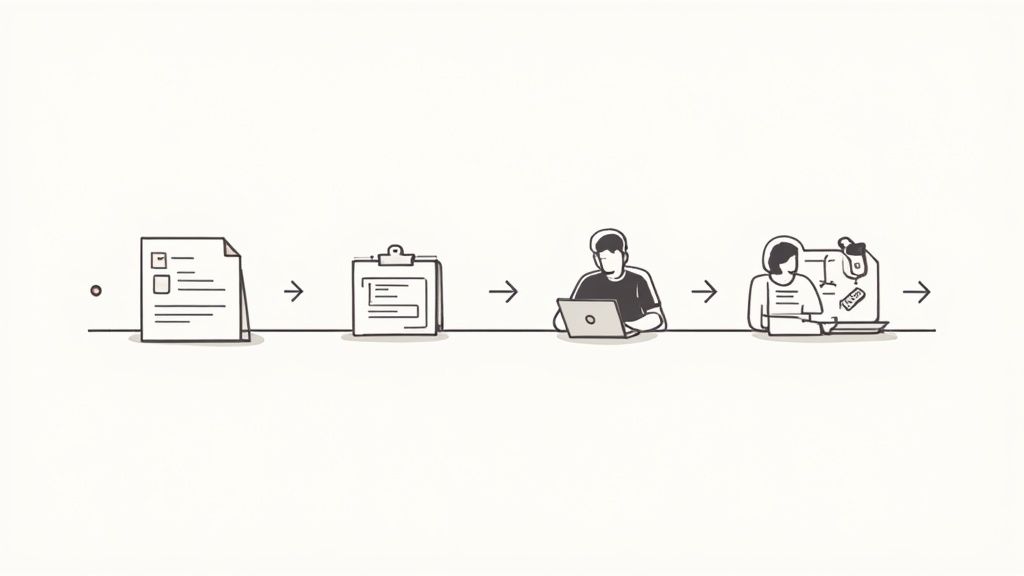
Each step is designed to peel back a different layer, moving from a broad sense of their mindset all the way to deep technical collaboration.
Before you even think about scheduling a call, the résumé can tell you a lot. You have to look past the bulleted list of programming languages and hunt for clues that reveal a builder’s mentality.
Your first conversation shouldn't feel like a technical grilling. Think of it as a vibe check—for both of you. As a founder, your goal is to gauge their passion and communication style. Are they genuinely excited by the problem you’re solving, or are they just looking for another job?
This is your chance to sell the vision, of course. But it's also your first real opportunity to see if they think like an owner. I like to ask questions that get them talking about their process.
Listen carefully to the questions they ask. If they're asking smart questions about the business model, the users, or the long-term goals, that’s a great sign. A lack of curiosity at this stage is a major red flag for me.
A well-designed take-home is the single best way to see how a developer actually works. The key is to make it small, realistic, and directly related to the kind of work they’d be doing every day. Please, avoid generic algorithm challenges.
Here’s a simple, effective example:
"Build a simple API endpoint that fetches data from a public API (like a weather or news API), transforms the data in some way, and returns it in a specific format. Provide clear instructions on how to run it and include a few simple tests."
This kind of task is a goldmine. It tests for:
The point of a take-home isn't to solve a brain-bending puzzle. It's to see how they approach building a small, real-world piece of software. It respects their time while giving you incredible insight into their craftsmanship.
The final technical step should be a collaborative pairing session, not an intimidating whiteboard interrogation. The perfect setup is to use their completed take-home assignment as a starting point. Ask the candidate to walk you through their code, and then work with them to add a small new feature or refactor a piece of it.
This session is less about getting a "right" answer and more about observing how they think, communicate, and collaborate in real-time.
This approach simulates a real day on the job far better than any abstract algorithm ever could. If your stack relies on something specific like TypeScript, this is also the perfect time to dig into their practical knowledge. For some great examples, check out our guide on essential TypeScript interview questions.
Ultimately, this step reveals the crucial soft skills that ensure a new developer can be a productive, collaborative part of the team from day one.
You’ve spent weeks sifting through resumes, conducting interviews, and running technical screens. Finally, you’ve found the one—the developer who not only has the right skills but also genuinely gets your vision. It’s a huge relief, but don't pop the champagne just yet. Getting a verbal "yes" is one thing; turning that candidate into a committed, productive team member is another.
This is where so many startups fumble the ball. The final stretch—the offer and the first week—is just as critical as the interview. A weak offer creates doubt, and a chaotic onboarding experience can extinguish a new hire's excitement before they even write a single line of code.
As a startup, you’re not just offering a job; you’re inviting someone to join a mission. You probably can't outbid Google on salary, and that’s okay. Your competitive edge lies in ownership, impact, and the thrill of building something from the ground up.
Your offer needs to tell that story. It should be a thoughtful package of cash and equity that reflects the market while highlighting the unique opportunity you’re presenting.
An offer isn't just a transaction. It’s the first concrete step in a long-term partnership. Treat it with the gravity it deserves by making a timely, transparent, and enthusiastic proposal.
The tech hiring market has certainly been a rollercoaster. The global hiring rate stabilized at 29% in 2025, holding steady from 2024 after dropping from the 34% peak in 2023. This points to a more deliberate hiring environment, but the demand for great engineers isn’t going away. Projections show nearly 328,000 new software engineering jobs will be added between 2023 and 2033. You can discover more insights about these tech hiring trends to keep your strategy sharp.
Once they say yes, it's time to make it official. This paperwork can feel like a chore, but getting it right from day one protects everyone involved. Don’t let these crucial legal steps become an afterthought.
You absolutely need these three things in place:
Onboarding isn't just about shipping a laptop and sending a welcome email. A great experience is about connection and integration, not just administration. The goal is to make your new developer feel productive, plugged-in, and confident as quickly as possible.
A well-planned first week sets the tone for their entire journey with you. Here’s a simple blueprint for building momentum right away:
Even with the best game plan, hiring your first developers can feel like navigating a minefield. Founders are always wrestling with a few specific, thorny questions. Let's tackle some of the most common ones I hear, so you can make those final calls with confidence.
When you're bringing on one of your first three engineers, equity is your most powerful tool. A typical range falls between 1% and 5%, usually vesting over four years with a one-year cliff.
Where you land in that range really depends on a few things: their experience, your funding situation, their salary, and just how much they'll have on their plate.
For engineers who join a bit later, say hires four through ten, that number naturally comes down. Expect to offer something in the 0.25% to 1% range. No matter the percentage, always position equity for what it is: a real stake in the mission, not just a financial perk.
Technical skill is one thing, but some red flags are unique to the startup world. A major one is a total lack of curiosity about your product or your users. The best developers are genuinely invested in why they're building something.
Poor communication is another immediate deal-breaker. If a candidate can't break down a complex technical idea in simple terms during the interview, how will they collaborate with your non-technical team members? It's a recipe for frustration.
Also, be wary of someone who seems obsessed with a single technology stack. Startups need adaptable problem-solvers, not dogmatic purists who only know one way to build.
A candidate's passion for problem-solving will always be a more valuable asset than their mastery of a specific framework. Look for the builder who is excited by your challenges, not just your tech stack.
Honestly, no. Your first technical hire should be a hands-on founding engineer.
In the early stages, you need someone who will be spending 80-90% of their time in the code, actually building the product. A Chief Technology Officer (CTO) role is focused on strategy, management, and long-term architecture—all important down the road, but a distraction when you don't even have a product yet.
Find a strong senior developer with leadership potential. They can grow into the CTO role as the company and the team expand. This keeps the focus squarely on what matters most: building.
You won’t win a salary war with Google or Meta, so don't even try to play that game. Your advantage lies where big tech is weak: impact, ownership, and mission.
Your pitch to a candidate needs to be about the unparalleled opportunity to shape a product and a company from the ground up. Talk about the direct line between their code and the user's experience.
Stress the fast-paced learning and the complete lack of corporate red tape. You're selling a vision and the chance to be part of something meaningful, not just another cog in a massive machine. That's a powerful story that big companies just can't tell.
If you're looking for an even deeper dive, this comprehensive guide on how to find developers for startups is a fantastic resource.
C# unit testing is all about writing small, targeted tests to make sure individual pieces of your code—your "units"—are working exactly as they should. Think of it as your first line of defense. It's a safety net that catches bugs early, makes refactoring way less scary, and helps you ship features with confidence. The big […]

Careers in cryptography are high-stakes, high-reward. These are the people who build and break the digital codes that secure our world, protecting everything from your bank account to global decentralized networks. It's a field with massive growth and serious six-figure salary potential. Why Cryptography Careers Are Exploding Welcome to the new frontier of digital trust. […]

The demand for remote machine learning jobs isn't just a trend anymore; it's a fundamental shift in how AI talent is hired and deployed. For ML professionals, this opens up a world of possibilities, not just in terms of flexibility, but also significant financial upside. Companies are in a fierce competition for top talent, and […]


