

A great frontend job description is your single most important recruiting tool. Think of it as your first, and often only, chance to make a sales pitch to top-tier developers. It’s what separates you from the dozens of generic, uninspired listings that skilled engineers scroll past every single day. Why Your Job Descriptions Are Getting […]

A great frontend job description is your single most important recruiting tool. Think of it as your first, and often only, chance to make a sales pitch to top-tier developers. It’s what separates you from the dozens of generic, uninspired listings that skilled engineers scroll past every single day.

Let’s be real for a moment. The best frontend developers are absolutely swimming in opportunities. Their inboxes are flooded with recruiter messages, and their job feeds are a monotonous blur of similar-sounding roles. If your job description reads like a generic laundry list of technologies and corporate buzzwords, it’s going straight to the digital trash bin.
The core problem? Most descriptions talk about what the company wants from a candidate, not what the candidate gets from the opportunity. They completely fail to sell the role.
One of the biggest mistakes I see is the "unicorn" skill list. This is where a posting demands deep expertise in React, Angular, and Vue.js, plus backend fluency in Node.js and Python, and maybe a dash of DevOps for good measure.
This approach is a recipe for failure, and here’s why:
A well-crafted frontend job description should feel like an invitation to solve interesting problems, not a demand for encyclopedic knowledge. It’s about attracting the right fit, not filtering out everyone but a mythical perfect candidate.
Another common pitfall is forgetting to tell a story. Developers aren’t just looking for a paycheck; they want to know why their code matters. A job description that completely skips the company mission, the product's impact, or the engineering culture is a massive missed opportunity.
Think about it. One post says, "Write, test, and deploy code for our web application." Yawn.
Now, compare that to: "Join our team to build the user-friendly interface that helps thousands of small businesses get a handle on their finances, freeing them up to focus on growth." See the difference? The second one gives the work purpose.
Without a compelling narrative, your role is just another job—interchangeable and forgettable. It fails to connect with top talent on a professional or personal level, making it all too easy for them to just keep scrolling.

The first paragraph of your frontend job description is your most valuable real estate. Seriously. It’s the hook that decides whether a top developer keeps reading or just closes the tab. Too many companies waste this space with a dry, generic summary that sounds like it was copied straight out of an HR handbook.
To really grab someone's attention, you have to stop listing duties and start telling a story. Elite developers aren’t just looking for another paycheck; they’re hunting for a mission they can get behind and problems that are actually worth solving. Your opening needs to answer the big questions right from the start.
Before you even think about writing down responsibilities, you have to nail down the purpose of the position. Why does this role exist? What critical business problem will this person solve? Frame the opportunity around its impact, not just its tasks.
Think about the difference. Instead of this old, tired line:
"We are seeking a Frontend Developer responsible for building and maintaining our web application's user interface."
Try something with a little more punch:
"Are you passionate about making complex financial data accessible and intuitive? We're looking for a Frontend Developer to lead the charge on redesigning our core analytics dashboard, a tool used by thousands of businesses to make critical decisions every day."
See the difference? The second example immediately connects the work to a tangible outcome and a clear purpose. It shifts the role from just a "code-producing function" to a mission-driven opportunity. This is what makes a candidate feel like a vital contributor, not just another cog in the machine.
Your job description is also a sneak peek into your company’s culture. Talented developers want to know what it’s really like to work on your team. Is your engineering culture built on collaboration, autonomy, or a deep focus on mentorship?
Showcase what makes your team a great place to be. You can do this by highlighting:
This kind of narrative helps candidates self-select. A developer who thrives on autonomy will be drawn to a description that emphasizes ownership, while one who values structured learning will appreciate mentions of mentorship. For a deeper look at building a solid foundation, check out a comprehensive job description writing guide.
By painting a vivid picture of the role’s impact and the team’s environment, you create a narrative that pulls the right people in. This approach attracts candidates who are not only technically qualified but also a great cultural fit, setting the stage for a successful and long-lasting hire.
Alright, you’ve hooked them with a great intro. Now comes the part where the rubber meets the road: the responsibilities and technical skills. This is where you lay out the day-to-day reality of the role, but it's also a minefield. Get too demanding or vague, and you’ll scare off perfectly good candidates.
The trick is to be crystal clear without posting a laundry list of every technology ever created. You're looking for a skilled developer, not a mythical tech unicorn.
Don't just list what they'll do. Instead, talk about what they'll achieve. This simple shift connects their work to the bigger picture and gives the role a sense of purpose. Nobody gets excited about a bullet point that just says "Write code."
Think about it. Which one sounds more appealing?
The second one tells a story. It shows a candidate they'll have ownership and be responsible for building something that matters. That’s how you attract people who take pride in their craft.
This is one of the most important things you can do. Many fantastic developers will pass on a job if they don't meet 100% of the listed requirements. By creating separate "must-have" and "nice-to-have" lists, you open the door to a much wider pool of talent.
It sends a clear message: you understand the market, you're realistic, and you're willing to invest in someone with a strong foundation. It turns a list of demands into an invitation.
Your "must-have" list should be the absolute, non-negotiable skills needed to do the job from day one. If a candidate can realistically learn it in their first few months, it probably belongs in the "nice-to-have" list.
The frontend world moves fast. A skills list from five years ago is a red flag to any modern developer. You need to show that you're current and understand where the industry is heading.
The data backs this up. The lines between frontend and backend are blurring. For example, vanilla JavaScript skills are less in demand now that TypeScript has become the professional standard. We've also seen frontend job postings fall by 20% year-over-year in 2024, which tells us that developers with a broader skill set—like some Node.js basics, AI familiarity, or UX chops—are the ones who stand out.
Here’s a practical way to break down your technical requirements.
When you're building out your job description, it's easy to get carried away and list every tool you've ever heard of. This table is designed to help you separate the genuine deal-breakers from the skills that are simply a bonus. Getting this right is key to attracting a broad, yet qualified, group of applicants.
| Skill Category | Must-Have Skills (Core Requirements) | Nice-to-Have Skills (Bonus Qualifications) |
|---|---|---|
| Languages | Strong proficiency in HTML5, CSS3, and JavaScript (ES6+). Professional experience with TypeScript is a must. | Familiarity with other languages that compile to JS (e.g., Elm) or WebAssembly (e.g., Rust). |
| Frameworks/Libraries | Deep expertise in one modern framework that matches your stack (e.g., React, Vue.js, or Angular). | Experience with a secondary framework, or specific libraries within your chosen framework's ecosystem (e.g., Next.js for React). |
| Core Tooling | Competence with Git and collaborative workflows (e.g., GitHub, GitLab). | Knowledge of modern build tools like Vite or Webpack. |
| Data & APIs | Experience consuming RESTful or GraphQL APIs to fetch, manage, and display dynamic data. | Experience designing or contributing to API schemas. |
| User Experience | A solid understanding of responsive design principles for seamless multi-device layouts. | Knowledge of WCAG accessibility guidelines and experience building accessible web applications. |
| State Management | Proven ability to manage application state, whether with built-in hooks or a small library. | Expertise with dedicated state management libraries like Redux, Zustand, or Pinia. |
| Testing | A mindset for quality and an understanding of why testing is important. | Hands-on experience with testing frameworks like Jest, Cypress, or Playwright. |
| Performance | Basic knowledge of what impacts web performance. | Skills in advanced performance optimization techniques like code-splitting, lazy loading, and image optimization. |
By thoughtfully categorizing these skills, you signal to candidates that you have a clear, modern vision for the role. It’s a practical approach that helps you find developers who not only meet today's needs but are also ready for what's next. Understanding the different roles in Agile software development can also help you see how this frontend expert will fit into and collaborate with your entire team.
Slapping the same boilerplate language on job descriptions for junior, mid-level, and senior roles is a recipe for disaster. It's the fastest way to get a flood of unqualified junior applicants for your senior opening while completely failing to challenge the ambitious mid-level developers you actually want. The real secret is tailoring the language, expectations, and scope to the exact seniority level you’re hiring for.
This goes way beyond just changing the job title. You have to fundamentally reshape the story of the position. When you can paint a clear picture of what success looks like at each stage of a developer's career, you not only attract the right people but also set them up for a strong start from day one.
To really nail this, you need a solid grasp of the typical frontend developer career path, which gives you a realistic baseline for skills and salary expectations.
For a junior developer, your job description should scream opportunity, mentorship, and growth. These candidates aren’t seasoned experts; they're looking for a place to sharpen their skills on a real product and learn from people who’ve been there. The language needs to be encouraging, not intimidating.
Focus on verbs that signal learning and teamwork.
The goal here is to sell a supportive environment where a promising developer can truly build a career. You're making it clear that you’re investing in their potential, not just hiring someone to close tickets.
When you’re hiring a mid-level developer, the conversation shifts from learning to ownership. These developers have their sea legs. They've built a solid foundation and are hungry for more responsibility, ready to own features from the initial concept all the way to deployment.
Your job description has to reflect this jump in autonomy and impact.
The flowchart below gives a great visual breakdown of how to think about skills for any level, separating the absolute must-haves from the nice-to-haves.
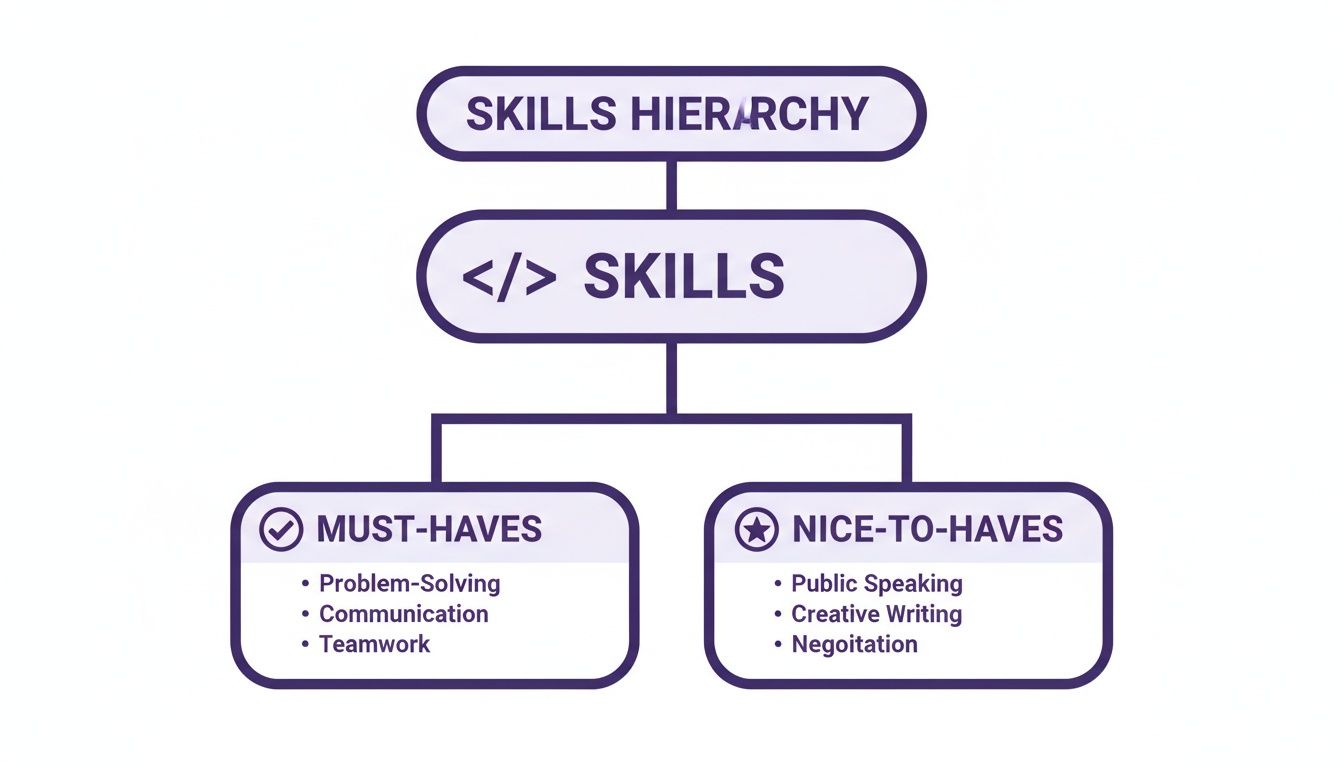
This kind of clarity helps you build a realistic skills list that won't scare off great candidates who might not tick every single box. If you want to go deeper on building your talent pipeline, check out our guide on recruiting software developers.
For a senior developer, the job isn't just about code anymore. It's about strategy, architecture, and mentorship. These are your technical leaders. They don't just build features; they shape the technical direction of the entire product and make everyone around them better.
The job description must speak directly to this high-level impact.
Let's be blunt: in this market, hiding the salary range is a surefire way to have top-tier developers scroll right past your job post. Candidates are done with the "salary-on-request" dance. They want transparency from the get-go.
Putting a clear salary range in your frontend job description isn't just a nice-to-have anymore; it's a non-negotiable for attracting serious applicants. It immediately tells a candidate you respect their time and are serious about fair compensation. This single act of transparency says more about your company culture than a paragraph full of buzzwords ever could.
While the salary is the first thing people look for, savvy developers are weighing the entire package. Your job description needs to paint a complete picture of the financial opportunity you're offering. This is what separates a decent offer from an irresistible one.
Think about the bigger picture. Are there other financial perks?
When you frame the role this way, the conversation shifts from a simple paycheck to a genuine opportunity for long-term financial growth.
The days of luring talent with a ping-pong table are over. Developers today are looking for benefits that genuinely improve their lives and careers.
The benefits that resonate most are the ones that show you're investing in your team as human beings, not just as lines of code. Think less about office snacks and more about real, meaningful support.
Here are the kinds of perks that will make your job description stand out:
You have to know the market. Frontend developer salaries have been climbing steadily, with a global increase of 10-20% over the last five years. Compensation can swing wildly based on location and experience.
For example, in the United States, a mid-level remote JavaScript developer can command anywhere from $116,000 to $144,000. For senior roles in a major tech hub like San Francisco, that number can easily push $200,000. To get a better feel for the current landscape, you can learn more about compensation benchmarks on Coursera.org.
Do your homework, set a competitive range, and put it right in the job description. You'll attract the right candidates and start the conversation on a foundation of trust and respect.

You can write the world's most compelling frontend job description, but it won't matter if nobody sees it. Getting your post discovered is the final, crucial step. It’s all about a smart strategy that blends the right keywords with formatting that works for both people and the software they use.
Think of it this way: your first audience isn't even a person. It's the algorithms on job boards and search engines. If you don't play by their rules, your perfect job post gets buried, and all your hard work goes to waste. Let's make sure that doesn't happen.
To show up in search results, you have to think like a developer who's looking for a new role. What words are they typing into that search bar?
The job title is ground zero. "Frontend Rockstar" might sound fun in a team meeting, but it’s terrible for search. Something direct like "Senior Frontend Engineer (React)" will attract the right people instantly.
From there, weave specific, high-value keywords throughout the description naturally.
This isn't about keyword-stuffing; it's about being precise and using the vocabulary your ideal hire uses every day. And to really boost your reach, consider posting on platforms designed for technical talent. You can explore some of the best engineering job boards to find where these developers are actively looking.
Long before a recruiter or hiring manager reads your JD, an Applicant Tracking System (ATS) will probably parse it. These systems are powerful but notoriously finicky. They scan for keywords and structure, and they can get tripped up by anything out of the ordinary.
An ATS is like a very literal-minded librarian. If you don't use standard section headings and formatting, it will misfile your book, and no one will ever find it. Simple, clean formatting is non-negotiable for visibility.
To make sure your job description sails through the ATS, stick to these simple rules:
These small technical adjustments make a massive difference. They ensure your frontend job description gets past the automated gatekeepers and into the hands of the talented developers you've been looking for.
Even with the best template in hand, you're bound to run into a few tricky questions when you sit down to write. Let's tackle some of the most common ones we hear from hiring managers trying to craft a standout frontend job description.
You're looking for the Goldilocks zone here: somewhere between 400 and 800 words.
This range gives you enough runway to paint a clear picture of the role, the team, and your company's culture without burying a busy developer in a wall of text. Go too short, and it comes off as vague and low-effort. Go too long, and you’ll lose their attention before they even get to the good stuff.
The real secret is scannability. Think short paragraphs, bold headings, and lots of bullet points. You want someone to be able to glance at it on their phone and get the gist in 30 seconds.
Yes, but with a crucial twist: you have to give them context. Just listing "team player" or "good communicator" is a waste of space. It's a generic platitude that tells a candidate nothing about what the job is actually like.
The trick is to tie the soft skill directly to a core function of the role. See the difference?
This approach does two things. It shows the candidate how they'll apply that skill, and it makes the requirement feel authentic and grounded in the reality of the work.
The fastest way to turn off great candidates is by creating a laundry list of every 'required' technology under the sun, being fuzzy about the day-to-day work, and—the big one—hiding the salary range. These are red flags that will attract the wrong applicants and scare away the right ones.
You can't win by playing their game, so don't even try. You're not going to out-perk or out-salary a company like Google. But you have advantages they can only dream of.
Lean into what makes you different. Big Tech offers a role; you're offering a mission.
Focus your pitch on the things a massive corporation struggles to provide:
Many developers are tired of being a small cog in a giant machine. You're offering them a chance to be a key player. That's a powerful story to tell.
Careers in cryptography are high-stakes, high-reward. These are the people who build and break the digital codes that secure our world, protecting everything from your bank account to global decentralized networks. It's a field with massive growth and serious six-figure salary potential. Why Cryptography Careers Are Exploding Welcome to the new frontier of digital trust. […]

The demand for remote machine learning jobs isn't just a trend anymore; it's a fundamental shift in how AI talent is hired and deployed. For ML professionals, this opens up a world of possibilities, not just in terms of flexibility, but also significant financial upside. Companies are in a fierce competition for top talent, and […]

The software engineering field is constantly shifting, with certain specializations commanding unprecedented salaries. But which roles truly offer the highest earning potential, and what does it take to secure one? This data-driven guide breaks down the best paying software engineering jobs, moving beyond vague titles to offer a detailed roadmap for career advancement and strategic […]


