

A great front end programmer job description is your single most important tool for catching the eye of top-tier talent. It’s more than a checklist of duties; it’s a bridge that translates your company's real-world needs and culture into a story that gets skilled developers excited. Think of it as a marketing document for the […]

A great front end programmer job description is your single most important tool for catching the eye of top-tier talent. It’s more than a checklist of duties; it’s a bridge that translates your company's real-world needs and culture into a story that gets skilled developers excited. Think of it as a marketing document for the role itself.

Before you even think about writing the job description, you need to have a solid grasp of what a front end programmer truly does. The best analogy? A house.
While back end developers are busy laying the foundation and hooking up the plumbing and electrical—the critical infrastructure nobody sees—the front end programmer is the architect, builder, and interior designer for every single room a visitor walks into. They construct the entire visible, interactive world your customers touch and feel.
They take the static blueprints handed over by UI/UX designers and bring them to life as functional, intuitive, and welcoming spaces. Every button a user clicks, every form they fill out, and every slick animation that makes them smile is a direct result of a front end programmer's craft.
Let's break down the role into a quick summary.
| Area of Focus | Description |
|---|---|
| Core Function | Building the user-facing part of a website or application. They write the code that determines how content is presented and how users interact with it. |
| Primary Tools | HTML, CSS, and JavaScript are the foundational trio. Modern roles almost always require expertise in a framework like React, Vue, or Angular. |
| Key Collaborators | They work hand-in-hand with UI/UX designers, back end developers, product managers, and QA engineers. |
| Business Impact | A great front end directly influences user engagement, conversion rates, and customer satisfaction. It's the face of the business. |
This table shows how central the role is—it's the critical link between your product's internal logic and the people you want to reach.
A front end programmer doesn't just sling code. They are translators, turning human-centered design concepts into tangible, digital experiences. It’s a delicate dance between art and science, demanding a good eye for aesthetics and a rock-solid understanding of logic and performance.
Here’s what that looks like day-to-day:
This role has a straight line to your bottom line. A fantastic user experience, built by a skilled front end programmer, leads to better engagement, higher conversions, and stronger customer loyalty. On the flip side, a clunky or confusing interface will send potential customers running to your competitors in seconds.
A front end programmer is the ultimate user advocate in the development process. Their success is measured not just by clean code, but by how effortlessly a user can achieve their goals on the platform.
Let’s be clear: the demand for talented front end programmers is through the roof. As every business leans on web and mobile apps to connect with their audience, the need for flawless user interfaces has just exploded.
The U.S. Bureau of Labor Statistics projects about 14,500 new openings for web developers each year through 2034—a growth rate that’s leaving most other jobs in the dust. If you want to dive deeper, you can explore the future of frontend development and see where the industry is headed.
Knowing this is your key to hiring well. To attract the best people in a crowded market, your job description has to go beyond a generic list of tech skills. It needs to tell a compelling story about the impact they'll have, the interesting problems they'll get to solve, and the real value they’ll bring to your team and your customers.
To write a job description that attracts real talent, you need to go beyond buzzwords and show you understand what the role really involves. A front end programmer's job isn't just about making things look good; they are the architects of the user experience, building the interactive and functional part of your application that people see and touch. Think of them as the bridge between a static design and a living, breathing product.
Their primary job is to take a UI/UX design—often a flat image from a tool like Figma or Sketch—and translate it into tangible, functional code. They use HTML, CSS, and JavaScript to bring every pixel, animation, and interaction to life, making sure the final product is a perfect match for the design vision.
But that's just the starting point. The real work lies in ensuring the application is fast, reliable, and works for everyone, on any device.
A front end programmer doesn't just write code for a single feature; they build a sustainable system for the entire user interface. A huge part of this is creating and managing reusable component libraries.
Imagine building with custom LEGO bricks. Instead of making a new button or form field from scratch every time, they create a standardized set of components—buttons, navigation bars, modals—that can be used over and over again. This approach is a game-changer. It dramatically speeds up development, keeps the design consistent across the entire platform, and makes future updates a breeze.
A great front end programmer doesn't just ship a feature. They build a system that helps the whole team build better and faster down the road.
In a world where attention spans are short, performance is everything. A couple of seconds of loading time is often all it takes for a user to leave and never come back. Front end programmers are on the front lines, fighting for every millisecond to make the application feel fast and responsive.
This involves a few key tasks:
These responsibilities mean the final product is not only fast but also inclusive.
A front end programmer's world is a messy one. A feature that looks perfect on your Chrome browser might be completely broken on an iPhone's Safari. This is why a huge part of their job is testing.
They are constantly:
More importantly, front end programmers are rarely lone wolves. They are the collaborative glue that holds a product team together. They work closely with UI/UX designers to nail down interaction details, with back end engineers to connect to data and APIs, and with product managers to ensure every feature aligns with the business goals. This constant communication is what makes it possible to ship a polished, high-quality product.
When you're writing a front end programmer job description, getting the skills section right is everything. It's about more than just listing a bunch of technologies. You need to distinguish between the hard skills that get the code written and the soft skills that make someone a great teammate. The best programmers have both in spades—they can ship brilliant code and make the people around them better.
Think of a programmer's daily work as a cycle of three core activities.
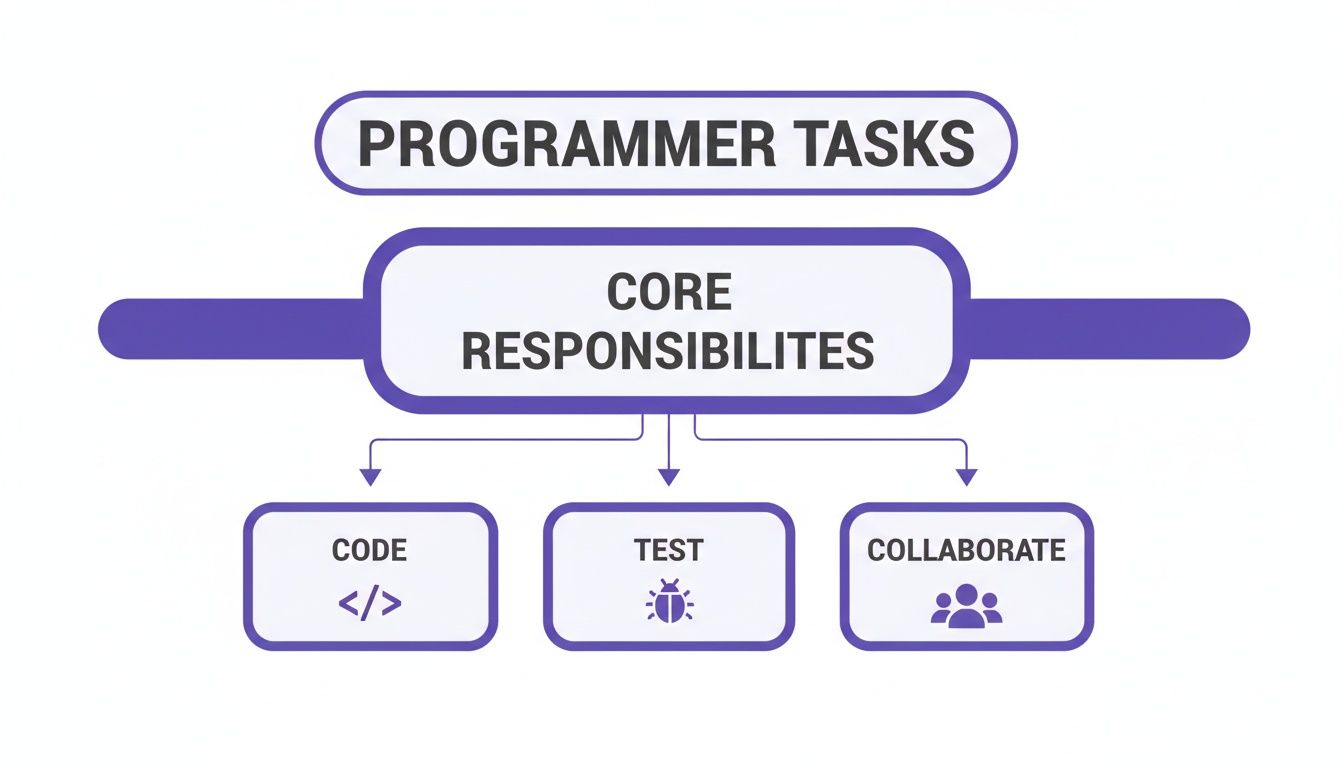
It’s a constant loop of writing code, testing it relentlessly to make sure it works, and talking with the team to keep the entire project moving forward.
Every front-end role is built on a foundation of a few non-negotiable technologies. These are the absolute fundamentals for anyone building for the web.
Of course, the modern front end is all about frameworks that help developers build complex apps more efficiently. Being specific about the framework your team uses is crucial. To get a better handle on why this is so important, it helps to understand the role of JavaScript development in today's tech stacks.
Be specific about your framework. If your team lives and breathes React, say you're looking for a React developer. A vague request for "experience with modern JavaScript frameworks" just invites a flood of mismatched applications and wastes everyone’s time.
Here are a few other key tools and concepts you’ll likely want to see:
Technical chops will get a candidate in the door, but soft skills are what make them a truly valuable part of the team. A programmer who can't communicate their ideas or solve problems creatively will become a bottleneck, no matter how elegant their code is.
A great front-end programmer is a product builder, not just a ticket-taker. They’re involved from the initial brainstorm all the way through to polishing the final pixel.
Here are the soft skills that separate the good programmers from the truly great ones:
By clearly spelling out both the technical and soft skills you need, you’re sending a strong signal that you know what it takes to build great software. This not only attracts better talent but also lays the groundwork for a more effective and collaborative team from day one.
Writing a great front end programmer job description is half the battle. Get it right, and you attract the right people; get it wrong, and you'll be sifting through resumes that don't fit. To get you started, we’ve put together a few copy-and-paste templates for Junior, Mid-Level, and Senior roles.
Think of these as a starting point. The best job descriptions are tailored to your company's specific tech stack, culture, and the actual problems a new hire will be solving.
It's also a good idea to see what others are doing. Checking out examples of current remote front-end job postings can give you a feel for market expectations and help you position your role competitively.
This template is all about potential. You're looking for someone with a solid foundation who is hungry to learn and contribute. The focus is on their passion for coding and their ability to work well with a team, not a long list of past jobs.
Job Summary
We're looking for a bright and motivated Junior Front End Programmer to join our development team. You'll be on the front lines, helping us turn design concepts into clean, responsive, and functional user interfaces. This is the perfect spot for someone with a good handle on HTML, CSS, and JavaScript who’s ready to grow their skills by working alongside experienced mentors on meaningful projects.
Key Responsibilities
Qualifications
Here, you're targeting someone who can hit the ground running. This developer is past the learning-the-ropes stage and is ready to take ownership of features. The job description should reflect that step up in responsibility and skill.
Job Summary
We are seeking a seasoned Mid-Level Front End Programmer to help build the next generation of our products. You'll take the lead on developing key user interface components using modern JavaScript frameworks and industry best practices. We need someone with a strong track record of building scalable, high-performance web apps who is just as comfortable working independently as they are collaborating with the team.
Key Responsibilities
Qualifications
For a senior role, the conversation shifts from doing to leading. You're hiring for strategic vision, mentorship, and architectural ownership. This person won't just write code; they'll shape how your entire team writes code.
For a deeper dive, check out our complete guide to crafting a standout front end web developer job description.
Job Summary
We are looking for a Senior Front End Programmer to be the technical cornerstone of our client-side applications. This isn't just about writing code; it's about making high-level architectural decisions, mentoring the team, and driving the vision for a robust and scalable front-end ecosystem. If you're a strategic thinker who is passionate about code quality, performance, and building world-class user experiences, we want to talk to you.
Key Responsibilities
Qualifications

A well-crafted front end programmer job description is your first step—it gets talented people in the door. But a thoughtful interview process is what truly separates a good hire from a great one. The goal isn't to trip candidates up with abstract brain teasers; it's to see how they'd actually handle the day-to-day challenges on your team.
This means you need an evaluation that tests their technical chops, problem-solving skills, and collaborative spirit all at once.
And remember, the process starts before anyone even walks into a room. To make sure you’re spending your time wisely, it helps to understand what employers look for in resumes so you can spot the most promising applicants right from the start.
It’s time to move beyond the classic Q&A. Sure, asking about their past projects is fine, but the real insights come from seeing a candidate code. Forget the high-pressure whiteboard challenges—they rarely reflect how people actually work.
Instead, try one of these more practical approaches:
An effective interview feels less like an interrogation and more like a collaborative problem-solving session. You’re not just evaluating their skills; you’re giving them a preview of what it’s like to work with you.
Your questions should be designed to reveal how a candidate thinks, not just what they know. A good mix of technical and behavioral questions will give you a much more complete picture. If you're looking for inspiration, you can find a solid list of interview questions for web developers to get started.
Here’s a balanced way to structure your questions:
1. Probing Technical Depth
let, const, and var. When would you reach for each one?"2. Evaluating Problem-Solving Skills
3. Assessing Cultural Fit and Collaboration
By combining practical coding exercises with thoughtful, open-ended questions, you get a real sense of a candidate's potential. This approach ensures your front end programmer job description ultimately leads to a hire who doesn't just have the right skills, but actually makes your whole team better.
Let's talk money. In today's market, you can't afford to be vague or lowball your offer if you want to attract top-tier talent. Simply putting a "competitive salary" line in your front end programmer job description just doesn't work anymore. Good developers know what they're worth, and they expect an offer that lines up with their skill set, location, and the value they'll bring to your team.
So, how do you structure the right offer? It all starts with knowing the market. We've seen front-end programmer salaries jump 10-20% in the last five years alone, thanks to a huge demand for their skills.
Compensation varies wildly, of course. An entry-level developer might start around $70,000, but the average base salary in the US is closer to $98,000. Seasoned pros can easily command over $110,000. You can find more detailed salary data to get a clearer picture for your specific needs.
Several things will push that final number up or down. Understanding these variables is key to crafting a fair and attractive package.
The base salary is just the beginning. A truly compelling offer is a full package that shows you care about a developer's well-being and career path.
A strong compensation package tells a candidate you’re invested in them as a person, not just as a programmer. It’s a powerful tool for retention and a key differentiator in the hiring process.
Think beyond the paycheck and consider adding these elements:
Hiring for any technical role is full of tricky questions and subtle distinctions. Let’s clear up a few of the most common ones that managers run into when trying to hire a front-end programmer.
It’s easy to get these two mixed up, and you’ll often see the titles used interchangeably. But there's a real difference in focus.
Think of a UI Developer as a specialist who lives and breathes the visual layer. They're obsessed with turning a static design into a living, breathing experience in the browser. Their world is dominated by expert-level CSS, slick animations, and nailing every single user interaction to be pixel-perfect.
A Front End Programmer, while also skilled in UI, has a much broader engineering mindset. They’re responsible for the entire client-side application—not just how it looks, but how it works. This means they're wrangling application logic, managing state, and connecting to APIs to pull in and display data. The UI Developer is the visual craftsman; the Front End Programmer is the engineer building the machine.
In a word: no. Making a CS degree a hard requirement is one of the fastest ways to kneecap your hiring process. The front-end world is packed with incredible, self-taught talent and bootcamp grads who can run circles around many formally-educated developers. Sticking to that requirement can shrink your qualified talent pool by over 50%.
Your focus should be on proven ability, not a piece of paper. A strong portfolio showcasing real, functional projects is a far better predictor of success than a diploma.
Instead of demanding a degree, use language like "or equivalent practical experience." Let a candidate’s portfolio, their code samples, and their project history do the talking.
Be specific. Whatever your team is actually using, put that in the job description.
Don't hedge with vague phrases like "experience with modern JavaScript frameworks." If your entire codebase is built on React, you need a React developer, so say "React." If you're maintaining a legacy app in AngularJS, be upfront about it.
Being precise saves everyone time. Candidates who don't have the right skills will self-select out, and you'll spend your time interviewing people who can actually do the job from day one. As it stands, listing React will cast the widest net simply because of its massive market share.
Careers in cryptography are high-stakes, high-reward. These are the people who build and break the digital codes that secure our world, protecting everything from your bank account to global decentralized networks. It's a field with massive growth and serious six-figure salary potential. Why Cryptography Careers Are Exploding Welcome to the new frontier of digital trust. […]

The demand for remote machine learning jobs isn't just a trend anymore; it's a fundamental shift in how AI talent is hired and deployed. For ML professionals, this opens up a world of possibilities, not just in terms of flexibility, but also significant financial upside. Companies are in a fierce competition for top talent, and […]

The software engineering field is constantly shifting, with certain specializations commanding unprecedented salaries. But which roles truly offer the highest earning potential, and what does it take to secure one? This data-driven guide breaks down the best paying software engineering jobs, moving beyond vague titles to offer a detailed roadmap for career advancement and strategic […]


