

A DevOps engineer is the person who builds the bridge between writing code and actually running it for customers. Their main job is to create and manage the CI/CD pipeline—think of it as a fully automated assembly line for software. This pipeline takes code from a developer's computer and gets it into the hands of […]

A DevOps engineer is the person who builds the bridge between writing code and actually running it for customers. Their main job is to create and manage the CI/CD pipeline—think of it as a fully automated assembly line for software. This pipeline takes code from a developer's computer and gets it into the hands of users, fast.

Imagine a high-performance racing team. The developers are the ones designing and building the car, but the DevOps engineer is the pit crew chief. They're the ones who create the automated systems that refuel the car, swap its tires, and run diagnostics in a flash, getting it back on the track faster and safer than anyone else.
At its core, the role is about bringing development (Dev) and operations (Ops) together. Historically, these two teams worked in separate silos, which created a lot of friction and slowdowns. A DevOps engineer helps break down those walls, creating a culture where everyone is collectively responsible for the product from start to finish.
A huge part of a DevOps engineer's job is automation. They live and breathe the principles of workflow automation to get rid of slow, manual tasks that are prone to human error. This relentless focus on automation is what allows a company to ship better software, faster.
The results of their work have a direct impact on the business:
In essence, the DevOps engineer doesn't just manage tools; they engineer a process. They build the underlying platform that allows development teams to operate with speed, autonomy, and confidence, directly impacting an organization's ability to innovate and compete.
This role is a critical piece of the modern software development puzzle. To understand how they work with others, it helps to learn about the different roles in agile software development (https://hiredevelopers.com/roles-in-agile-software-development/) and see how they all fit together. A great DevOps engineer is central to achieving the speed and reliability that today's market demands.
So, what does a DevOps engineer actually do all day? It's not just one thing. Think of them as the architects and mechanics of the entire software delivery process. They’re the ones building the automated systems that let a company ship new features fast without breaking things.
Their work directly impacts how quickly customers see new features and how stable the product feels. Let's dig into the four main pillars of their job.
The heart and soul of a DevOps engineer's world is the CI/CD pipeline. This is basically an automated assembly line for software. It takes the raw code a developer writes and, through a series of automated steps, turns it into a working product for users.
Building and maintaining this pipeline is arguably their most critical task. A good pipeline makes releasing software a non-event—a routine, predictable process instead of a chaotic, all-hands-on-deck emergency. For a deeper dive into the mechanics, you can learn more about what a CI/CD pipeline is and how it works.
A well-oiled pipeline typically handles:
The days of logging into servers and configuring them by hand are long gone. Today, we treat infrastructure—servers, databases, networks—just like software. This is called Infrastructure as Code (IaC). Using tools like Terraform or Ansible, a DevOps engineer writes code that defines exactly how the infrastructure should look.
The benefits are huge. IaC makes everything repeatable and consistent. Need a new environment for testing? Just run a script, and in minutes you have a perfect replica of production. This kills the classic "it worked on my machine" problem and prevents small, undocumented changes from causing big outages later.
IaC turns infrastructure management from a manual, error-prone art into a precise, automated science. It provides a single source of truth for all environment configurations, which can be version-controlled, reviewed, and audited just like application code.
Another huge piece of the puzzle is working with containers, mainly Docker, and orchestration tools like Kubernetes. Docker lets developers package their application and all its dependencies into a neat little box called a container. This container runs the same way everywhere, from a laptop to a cloud server.
But what happens when you have thousands of these containers? That's where Kubernetes comes in. A DevOps engineer uses Kubernetes to manage all those containers at scale. They're responsible for automating tasks like:
Finally, you can't fix what you can't see. A DevOps engineer sets up the systems that watch over everything—what we call observability. They implement robust monitoring and logging tools to track the health and performance of the application and infrastructure in real-time.
When something inevitably goes wrong, these systems provide the data needed to figure out the "why" and fix it fast. This proactive stance is what keeps a platform reliable. The success of this work is often tied to business outcomes, so understanding the right KPI for software development is crucial. By improving metrics like Mean Time to Recovery (MTTR), they ensure the platform stays up and running for users.
To connect these responsibilities to tangible business value, let's look at how each one contributes to the bottom line.
This table breaks down how the day-to-day work of a DevOps engineer directly supports key business goals, from faster innovation to improved customer satisfaction.
| Responsibility | Key Activities | Primary Tools | Business Impact |
|---|---|---|---|
| CI/CD Pipeline | Designing, building, and maintaining automated build, test, and deployment workflows. | Jenkins, GitLab CI, CircleCI, GitHub Actions | Faster Time-to-Market: Automates releases, allowing new features to reach customers quicker. |
| Infrastructure as Code | Writing code to provision and manage servers, networks, and databases. | Terraform, Ansible, Pulumi, AWS CloudFormation | Reduced Costs & Risk: Eliminates manual errors, ensures consistency, and lowers operational overhead. |
| Containerization | Packaging applications into containers and managing them with an orchestrator. | Docker, Kubernetes, Amazon EKS, Google GKE | Improved Scalability & Reliability: Enables applications to scale on demand and run consistently anywhere. |
| Observability | Implementing monitoring, logging, and alerting systems; managing incidents. | Prometheus, Grafana, Datadog, Splunk | Enhanced Customer Experience: Minimizes downtime and performance issues by enabling rapid problem detection and resolution. |
Ultimately, each of these technical functions is designed to make the business more agile, stable, and competitive.
The path from a junior to a senior DevOps role is more than just learning new tools—it’s a total shift in scope, responsibility, and impact. Think of it as moving from executing specific tasks to shaping an organization’s entire technology strategy. This progression is all about mastering both technical and soft skills, which change dramatically with real-world experience.
For both aspiring engineers and the managers looking to hire them, understanding this journey is key. It helps set clear expectations for the devops engineer roles and responsibilities at each level and ensures companies find the right person for the job.
This flowchart breaks down the core technical pillars a DevOps professional masters throughout their career.
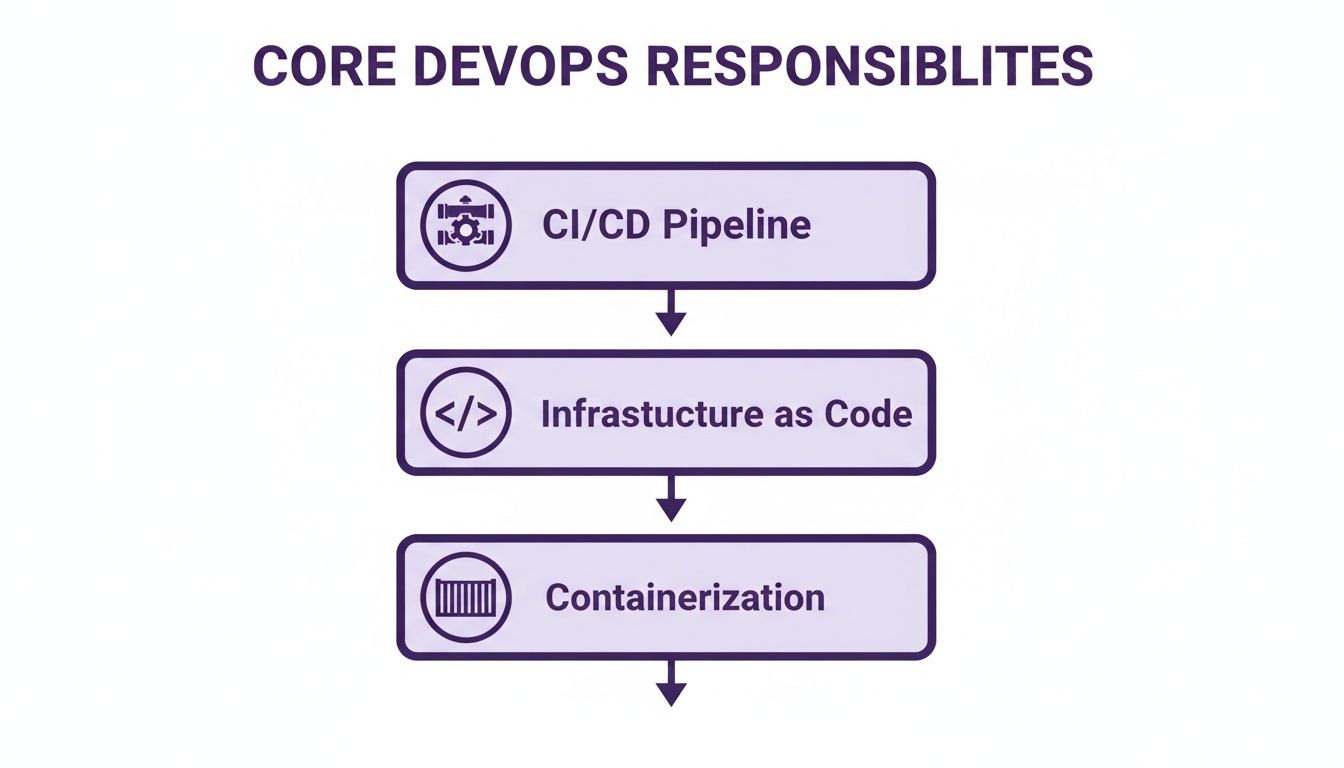
As you can see, the foundation is built on automating the CI/CD pipeline, managing infrastructure with code, and using containerization. The skills just get more sophisticated from there.
The table below gives a side-by-side look at how the technical and soft skills of a DevOps engineer evolve as they gain experience and seniority.
| Skill Category | Junior Engineer (1-3 Years) | Mid-Level Engineer (3-6 Years) | Senior Engineer (7+ Years) |
|---|---|---|---|
| Technical Skills | Proficient with 1-2 scripting languages (e.g., Python, Bash). Manages existing CI/CD pipelines and IaC configurations. Basic container management with Docker. | Strong in multiple scripting languages. Designs and improves CI/CD pipelines and IaC modules. Deploys and manages container orchestration with Kubernetes. | Expert-level proficiency in multiple languages. Architects entire CI/CD and IaC strategies. Designs complex, scalable, and secure cloud-native architectures. |
| Cloud Platforms | Experience with one major cloud provider (AWS, Azure, or GCP), focusing on core services like compute and storage. | Deep knowledge of one cloud provider and familiarity with another. Can implement advanced services and optimize for cost and performance. | Multi-cloud expertise. Architects solutions across different providers and advises on cloud strategy and governance. |
| Problem Solving | Follows established playbooks to troubleshoot common issues and alerts. Escalates complex problems to senior team members. | Independently diagnoses and resolves complex system issues. Proactively identifies and fixes potential problems before they escalate. | Anticipates future problems and designs resilient systems to prevent them. Solves business-level challenges through technology. |
| Communication | Clearly communicates technical issues within the immediate team. Documents work and updates tickets. | Effectively communicates with cross-functional teams (e.g., developers, QA). Can explain technical concepts to non-technical stakeholders. | Leads technical discussions across the entire engineering organization. Mentors other engineers and presents strategic plans to leadership. |
| Leadership | Focuses on individual tasks and learning from others. | Takes ownership of small to medium-sized projects. Begins to mentor junior engineers on specific tasks. | Mentors the entire team, defines best practices, and influences the technical direction of the company. |
This progression shows a clear shift from hands-on execution to strategic oversight. It’s a journey from learning the "how" to defining the "why."
A Junior DevOps Engineer is all about learning the ropes and keeping existing systems running smoothly. Think of them as an apprentice learning a craft. Their main job is to handle well-defined tasks under the watchful eye of more senior engineers.
Their day-to-day usually involves:
At this stage, it’s all about building a solid technical foundation. They're getting priceless hands-on experience by learning how the company’s infrastructure and automation work in a controlled setting.
A Mid-Level DevOps Engineer makes the jump from just maintaining systems to actively building and improving them. They start taking ownership of projects and working with more independence. Their goal is to make things more efficient and reliable.
This is where an engineer stops just following instructions and starts asking "why?" They begin to spot opportunities for improvement on their own, like finding ways to speed up a slow deployment or automating a manual setup process.
Key responsibilities for a mid-level pro include:
They have a much deeper understanding of the systems they manage and can solve more complex problems on their own, bridging the gap between junior-level tasks and senior-level strategy.
A Senior DevOps Engineer works at a strategic level. They're no longer just building parts of a system; they're designing the entire architecture. Their influence goes far beyond their team, affecting the entire engineering organization.
The demand for this level of expertise is off the charts. Market analysis shows that roughly 8 out of 10 DevOps job listings are for senior-level talent, with companies desperate for skills in automation, CI/CD, container orchestration, and cloud platforms. This has made senior DevOps engineers both hard to find and expensive, which is why you can discover more about these hiring trends on devops.com.
A senior engineer’s work is big-picture and strategic:
At this level, soft skills like communication, leadership, and strategic thinking are just as crucial as technical know-how. A senior engineer doesn't just solve problems—they anticipate them and build systems designed to prevent them from ever happening in the first place.
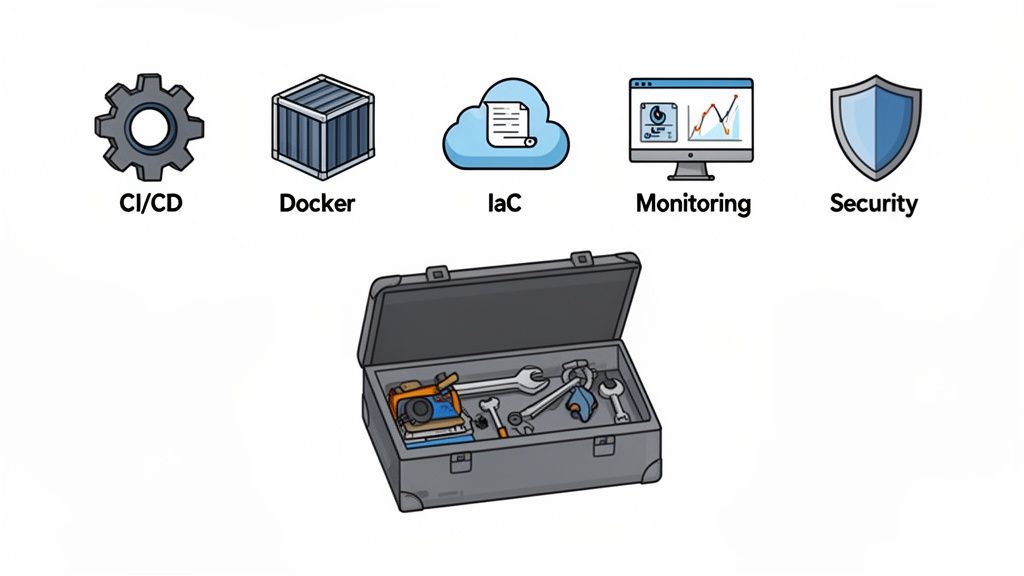
A great DevOps engineer is a lot like a master mechanic. They don't just know how things work; they have a deep understanding of their tools and know exactly which one to grab to solve a specific problem. Their toolbox is packed with powerful technologies for automation, infrastructure management, and system monitoring.
These tools are far more than just personal preferences—they are the very machinery that brings the DevOps philosophy to life. Each one addresses a critical step in the software lifecycle, from the moment a developer commits their first line of code to ensuring the application runs smoothly for millions of users. Let’s pop the hood and look at the core components of this toolkit.
At the heart of any modern DevOps practice, you'll find the Continuous Integration/Continuous Delivery (CI/CD) pipeline. The tools in this category are the engine that drives everything forward, automating the entire process of building, testing, and deploying code. Think of it as a sophisticated, high-speed assembly line for software.
The main goal here is to ship better code, faster. By creating automated workflows, DevOps engineers build a system that automatically catches bugs, validates changes, and pushes updates to users with minimal human intervention. This is how teams go from deploying once a month to multiple times a day.
Gone are the days of manually configuring servers one by one. Infrastructure as Code (IaC) is a game-changing practice where you manage and provision your entire IT infrastructure through code. A DevOps engineer writes configuration files that define exactly how servers, databases, and networks should be set up.
This approach applies the same principles of version control and collaboration from software development to the world of IT operations. It's the ultimate solution to the classic "it worked on my machine" problem by ensuring every environment—from a developer's laptop to the production cluster—is perfectly identical.
IaC is what makes modern cloud operations truly scalable. It empowers a single engineer to manage hundreds or even thousands of servers with the same consistency and control as if they were managing just one.
Containers are designed to solve one of the oldest problems in software: making sure an application runs the same way everywhere. By packaging an application and all its dependencies (libraries, configuration files, etc.) into a single, isolated "container," you create a portable unit of software that just works.
Of course, running one container is easy, but managing thousands is a different beast entirely. That's where orchestration platforms come in. They are the brains of the operation, handling everything from deploying containers to scaling them up or down and monitoring their health.
Once an application is running in production, how do you know if it's healthy? How do you find the root cause of a problem when something goes wrong? This is where observability tools come in. They give engineers the deep visibility they need to understand system health, track performance, and diagnose issues in real time.
This is more than just basic monitoring. True observability means being able to ask new, complex questions about your system's behavior without having to deploy new code. It’s typically built on three pillars of data:
Key players in this space include Prometheus for collecting metrics, Grafana for building beautiful dashboards, and comprehensive platforms like Datadog and Splunk that pull everything together into one place. These tools are the eyes and ears of a DevOps engineer.
Finding the right DevOps engineer is one of the most important hires you’ll make. It’s tough because the role is such a unique blend of deep technical know-how, big-picture thinking, and a knack for collaboration. A great DevOps hire doesn't just keep the lights on; they build the engine that lets your entire development team ship faster and more reliably.
The secret is to match your hiring strategy to where your company is right now. The ideal candidate for a scrappy startup looks very different from the specialist a large enterprise needs to bring on board.
Let's break down how to approach this at different company sizes.
In an early-stage company, you’re looking for a generalist. This is your "jack-of-all-trades" who can build your core systems from scratch. They won't just be maintaining a pipeline—they'll be the one architecting and building your very first CI/CD pipeline, choosing your cloud services, and writing your initial Infrastructure as Code.
You need someone who is:
As your company hits a growth spurt, your needs change. You move from building the foundation to optimizing and scaling it. This is when you start looking for specialists who can bring deep expertise to handle the growing complexity. You might hire your first DevSecOps expert or a Kubernetes guru to wrangle your expanding universe of microservices.
Here, you should focus on candidates who can:
Good DevOps engineers are incredibly hard to find—demand is high and supply is tight. It’s a fierce market out there. In fact, some analyses show that DevOps roles account for a massive 36.7% of all infrastructure jobs posted, which tells you just how much companies are prioritizing automation and cloud skills. That same research found that about one in three DevOps positions were remote, proving that businesses are looking globally to find the right talent. For a deeper dive into these numbers, you can check out the latest market trends on devopsprojectshq.com.
To find the best people, you can't just rely on old-school job boards. Using vetted talent platforms gives you a direct line to a global pool of pre-screened, top-tier candidates, which can slash your hiring time. These platforms do the heavy lifting on initial vetting, so you only spend time talking to people who already meet a high standard. You can find more ideas in our complete guide to recruiting software developers.
Key Interview Tip: Focus on problem-solving, not just tool trivia. Instead of asking, "Do you know Ansible?", try this: "Describe a time you had to automate a complex, manual deployment process. What was your approach, what roadblocks did you hit, and what was the final outcome?" This question uncovers their real-world experience and how they actually think.
We've covered a lot of ground, from the core responsibilities of a DevOps engineer to the specific skills they need to excel. You should now have a clear picture of how these experts are the ones building and running the automated systems that bring modern software to life. They’re the architects of your CI/CD pipelines and the masters of Infrastructure as Code, and their work is the bedrock of both speed and stability.
A great DevOps engineer is so much more than a system administrator with a new title; they are a genuine force multiplier for your entire engineering team.
Think about it this way: your developers build the car, but the DevOps engineer designs and builds the entire highway system—the smooth pavement, the efficient on-ramps, and the traffic control systems—that gets the car to its destination quickly and safely. Investing in top-tier DevOps talent isn't just an IT expense; it's a direct investment in your company's ability to innovate, scale, and leave competitors in the dust.
So, what's next? It's time to turn this understanding into a smart hiring plan. Take a hard look at where your company is right now. Are you an early-stage startup that needs a jack-of-all-trades to lay the foundational plumbing? Or are you a scaling business that needs a specialist to come in and fine-tune your systems for cost and performance?
A great DevOps engineer isn't just a cost center; they are a strategic asset who unlocks developer productivity and drives business value. Their impact is measured in faster release cycles, fewer production incidents, and a more agile engineering culture.
For many teams, the traditional hiring process can feel like a major roadblock—it's slow, competitive, and often frustrating. This is where partnering with a specialized talent platform can make all the difference. Imagine getting immediate access to a global network of senior, pre-vetted DevOps engineers.
This approach lets you sidestep the sourcing headache and connect directly with the expertise you need, often in a fraction of the time. It’s about getting the right person on board so you can start hitting your most ambitious technical goals, faster.
It’s easy to get lost in the weeds with modern tech roles. Let’s clear up a few of the most common questions that come up about DevOps engineers, so you can have a much clearer picture of what the role is all about.
This is a classic point of confusion because there's a ton of overlap. The real difference comes down to their primary focus.
A DevOps engineer is obsessed with the software delivery pipeline. Their world revolves around building a smooth, automated path for code to get from a developer’s laptop into production. Think CI/CD, build scripts, and deployment automation—their main job is to help developers ship better code, faster.
A Site Reliability Engineer (SRE), on the other hand, comes at the problem from an operations angle but with a software engineering mindset. This role, famously born at Google, is all about data. SREs live and breathe reliability targets, or Service Level Objectives (SLOs), and their goal is to keep the production environment stable, performant, and resilient.
Here's a simple way to think about it: The DevOps engineer builds the super-fast highway for code. The SRE is like the civil engineer who makes sure the city (production) can handle all that traffic, has no potholes, and can bounce back instantly if something goes wrong.
In the very early days, yes. A single, talented DevOps engineer can lay the groundwork, setting up the initial cloud infrastructure and getting a basic CI/CD pipeline running.
But this is a short-term solution, and it comes with a ticking clock. As your product gets more complex and your engineering team grows, the workload will absolutely overwhelm one person. That single engineer becomes a massive bottleneck and, even worse, a single point of failure. If they go on vacation or quit, you’re in trouble.
The smart move is to hire your first DevOps engineer to establish the foundation. But you need to have a plan to build a team or bring in skilled contractors as you scale. Pinning all your infrastructure, deployment, and monitoring hopes on one individual is a risk you don't want to take.
You don't measure a DevOps engineer's success with gut feelings; you measure it with cold, hard numbers that reflect real business impact.
The gold standard for this is a set of four KPIs known as the DORA metrics. These are widely accepted as the key indicators of a high-performing engineering organization.
Here’s what they are:
Beyond DORA, you can look at other tangible wins, like reduced cloud infrastructure costs, higher system uptime, or even just happier, more productive developers. Great DevOps work moves all of these numbers in the right direction.
The agile-waterfall hybrid model isn't just a buzzword; it’s a pragmatic solution that blends the disciplined, up-front planning of Waterfall with the iterative, feedback-driven approach of Agile. Think of it as getting the best of both worlds: you get the solid, predictable foundation of a traditional plan but with the flexibility to adapt and refine […]

When it comes to choosing a content management system, the "WordPress vs. Joomla" debate often feels more complex than it needs to be. For CTOs, agency heads, and business leaders making this call in 2026, the strategic reality is refreshingly simple: WordPress is the definitive choice for nearly every business application. While Joomla has a […]

The fundamental difference between Kibana and Grafana boils down to this: Kibana is purpose-built for log analysis and deep-diving within the Elastic Stack, while Grafana shines at visualizing time-series metrics from an incredibly diverse set of data sources. The right choice for you depends entirely on whether your primary need is sifting through text-based data […]


