

The real difference between a contractor and a full-time employee comes down to one simple question: are you looking for specialized skills and flexibility for a specific project, or are you building a stable, deeply integrated team for the long haul? The first points to a contractor, the second to a full-time employee. Your answer […]

The real difference between a contractor and a full-time employee comes down to one simple question: are you looking for specialized skills and flexibility for a specific project, or are you building a stable, deeply integrated team for the long haul? The first points to a contractor, the second to a full-time employee. Your answer will shape not just your project but your company's future.
As a tech leader, deciding who to bring on board is one of the most critical calls you’ll make. It’s a decision that echoes through your project outcomes, your budget, and how quickly your team can adapt to change. Forget generic pro-con lists; the right choice is always situational. It depends entirely on your project scope, timeline, and where you want the business to be in a few years.
To make the best call, you need to understand the different business structures contractors might use, as this can affect your engagement. It's useful to compare Limited Company vs Sole Trader to see what’s most suitable for your situation.
This guide will break down the contractor vs. full-time employee decision across the criteria that actually matter:
This isn’t just a niche decision anymore. The move toward flexible work is a major shift. In July 2023, the Bureau of Labor Statistics reported that 11.9 million Americans—or 7.4% of the entire workforce—were independent contractors in their main job. That's a noticeable jump from 6.9% back in May 2017, proving that more companies are building adaptable teams.
For a quick reference, here’s a table breaking down the core differences. Think of this as the starting point; we’ll dive much deeper into each of these areas. And if you’re looking to get even more specific, our comparison of staff augmentation vs managed services can help you further dial in your strategy.
| Feature | Independent Contractor | Full-Time Employee |
|---|---|---|
| Commitment | Project-based, short-term, or for a defined scope. | Long-term, ongoing role integrated into the company. |
| Cost Structure | Usually an all-inclusive hourly or project rate. | Base salary plus mandatory benefits and overhead. |
| Control & Oversight | High autonomy; controls how the work is done. | Employer directs tasks, schedule, and methods. |
| Integration | Focused on project tasks with limited cultural fit. | Deeply integrated into team and company culture. |
| Benefits | Responsible for their own insurance and taxes. | Receives company-provided benefits (health, PTO). |
When you're deciding between a contractor and a full-time employee, just looking at the hourly rate is a classic rookie mistake. It’s like judging an iceberg by its tip—what you see isn't the whole story. To make a smart financial call, you need to understand the total employment burden, which uncovers the real costs lurking beneath the surface.
A full-time employee's compensation isn't just their salary. It's a whole package of direct and indirect costs that can easily bloat your initial budget. These aren't just nice-to-have perks; they're often mandatory expenses or competitive necessities to attract and keep good people.
The base salary is just the starting point. For every full-time hire, you have to tack on a whole range of other expenses, which typically add 25-40% right on top of their salary.
Here’s a look at what that "benefit load" includes:
Key Insight: The real cost of a full-time employee isn't their salary; it's the salary plus the "benefit load." For a developer making $100,000, your actual cost could be closer to $130,000 or even more each year.
And it doesn't stop there. You also have to factor in the more subtle expenses: laptops, software licenses, professional development budgets, and even the cost of the desk they sit at. When you add it all up, the financial commitment is way bigger than that initial salary figure.
Now, let's look at contractors. Their rate is usually all-inclusive, which is a breath of fresh air. When you agree on an hourly or project fee, that's pretty much the final number. Contractors are independent businesses, so they handle their own financial baggage.
This means you are not paying for:
This straightforward model gives you incredible financial predictability. You know exactly what you're paying for the work, which makes project budgeting much simpler and more transparent. No nasty surprises at the end of the month—a huge win for companies managing tight cash flow.
The growing preference for this kind of flexible staffing is a clear trend in the workforce.
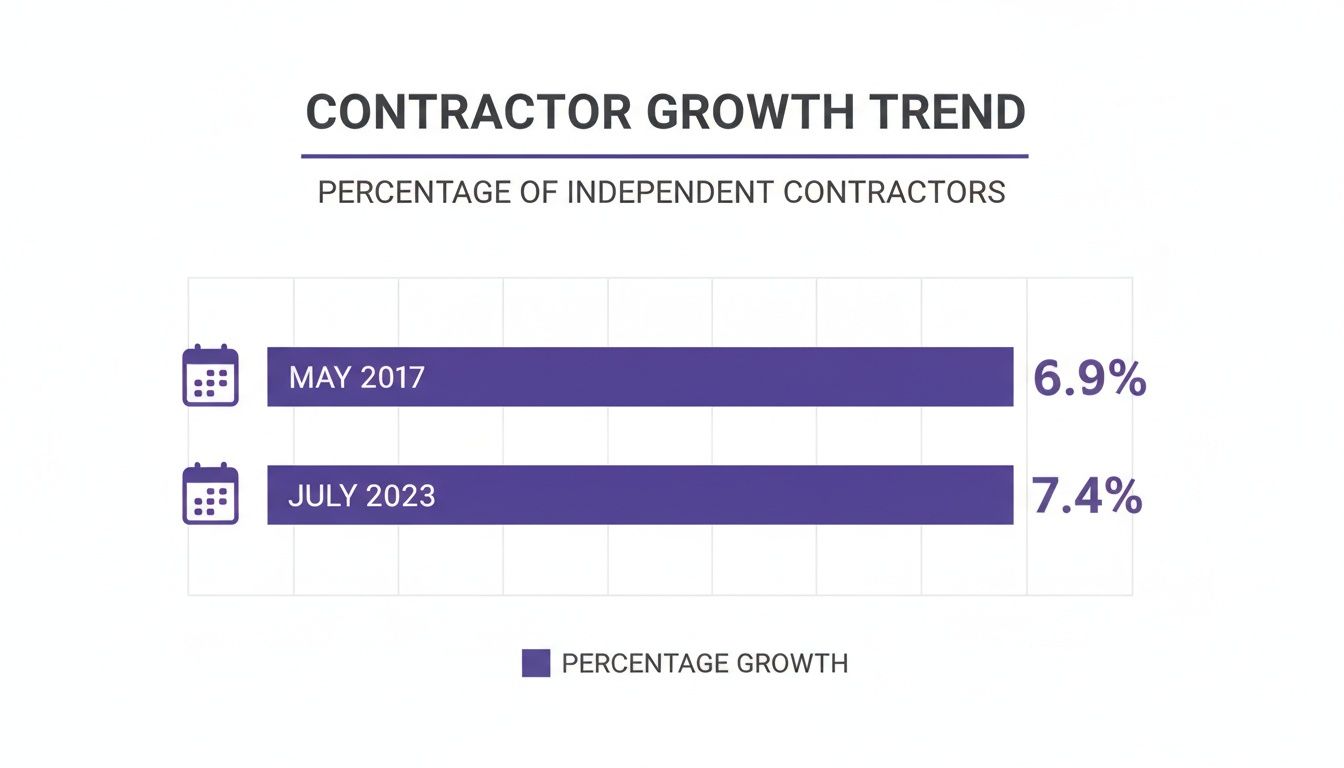
The data speaks for itself. Between May 2017 and July 2023, the share of independent contractors in the U.S. workforce grew from 6.9% to 7.4%. This isn't a fluke; it shows a real shift toward more agile and financially efficient ways of getting work done.
To really see the difference, let’s run the numbers on hiring a mid-level software developer for two years. While the employee's base salary might look lower on paper, the contractor often ends up being the more cost-effective choice once you factor in all those extra expenses.
This table breaks down the total financial burden for a typical US-based software developer.
| Cost Category | Full-Time Employee (FTE) | Independent Contractor |
|---|---|---|
| Base Compensation | $166,400 ($83,200/yr) | $201,600 ($100,800/yr) |
| Payroll Taxes (FICA, FUTA) | $12,730 | $0 |
| Health & Benefits | $25,600 ($1,067/mo) | $0 |
| Recruitment & Onboarding | $16,640 (20% of salary) | $1,000 (platform fee) |
| Equipment & Software | $5,000 | $0 (typically provided) |
| Total 2-Year Cost | $226,370 | $202,600 |
As you can see, even though the contractor's direct compensation is higher, the full-time employee comes with a hefty price tag from benefits, taxes, and recruitment.
In this scenario, hiring a contractor for two years could save you $23,770. That’s a direct saving of nearly $6 per hour. This shows that even when a contractor's hourly rate seems higher at first glance, the lack of benefit loads and overhead often makes it the smarter financial move, especially for project-based work. By looking at the complete picture, you can make a strategic choice that actually fits your budget and business goals.
Let’s be clear: choosing between a contractor and a full-time employee isn’t just about finances or flexibility. It's a critical legal decision, and getting it wrong can land you in some very hot water. When you start hiring across borders, the stakes get even higher. The single biggest landmine here is worker misclassification—a mistake that can trigger audits, staggering fines, and messy legal battles.
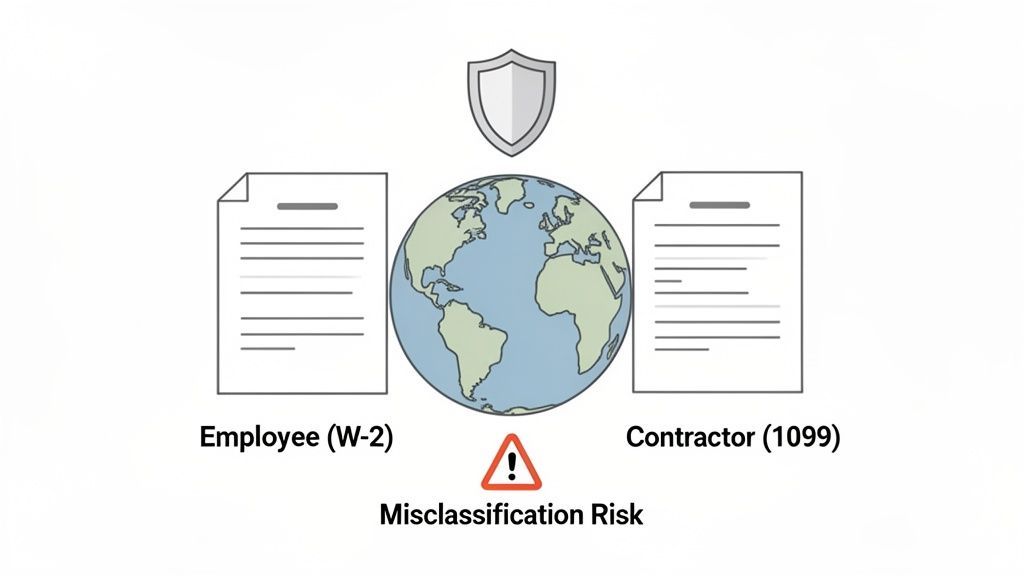
Don't dismiss this as a minor paperwork error. Governments are cracking down on misclassification because it costs them big in lost payroll taxes. If a worker you’ve paid as a contractor is later deemed to be an employee, your company could be on the hook for everything: back taxes, unpaid benefits, overtime, and some truly painful penalties.
While every country has its own specific tests, they all circle back to one core concept: control. The more you control how, when, and where the work gets done, the more likely that person is legally an employee.
Are you setting their hours? Dictating the specific steps they take? Providing the laptop they work on? Integrating them into your team with a company email and title? That all points to an employer-employee relationship.
On the flip side, a genuine contractor runs their own show. They're an independent business hired for their expertise to deliver a specific result. They control their own schedule, use their own tools, and operate as a service provider, not as a subordinate member of your staff.
Crucial Takeaway: The contract you sign doesn't define the relationship; the reality of how you work together does. If you sign a contractor agreement but treat them like an employee, the law will almost certainly see them as an employee.
Getting this right is fundamental. In the U.S., for example, it’s the difference between issuing a Form 1099 for a contractor and a W-2 for an employee. Each path comes with a completely different universe of tax and legal responsibilities for your business.
The legal lines drawn between contractors and full-time employees go far beyond a tax form. Each model carries a distinct set of rights and obligations you need to understand.
What You Owe Full-Time Employees:
The Independent Contractor Reality:
Even the process for ending the relationship is worlds apart. Letting an employee go often involves a documented performance process and carries the risk of a wrongful termination suit. Ending a contract? That’s usually as straightforward as following the termination clause you both agreed to.
Hiring talent internationally cranks the complexity up to eleven. Labor laws aren't just different from country to country—they can be wildly different. What easily passes for a contractor relationship in the United States could be classified as full-time employment in Germany or Brazil, with all the associated obligations.
Trying to DIY this intricate patchwork of global regulations is a massive gamble. One mistake could accidentally create a "permanent establishment" for your company in another country, suddenly subjecting you to local corporate taxes and a whole set of rules you never knew existed.
This is precisely why many businesses opt for an Employer of Record (EOR) or a specialized global payroll platform. These services act as your legal employer on the ground, ensuring your international team members are classified correctly under local laws. They manage the entire administrative headache, so you can build a world-class team without needing a law degree in every country you hire from. It all starts with defining the relationship correctly from day one, and you can learn more about the critical clauses in a strong software engineering contract in our detailed guide.
When you're weighing a contractor vs. a full-time employee, it's about more than just the bottom line. This choice fundamentally shapes how your team operates—how quickly you can move, how you adapt to market shifts, and what your managers spend their time on every day. These operational factors are often the hidden drivers of success or failure.
Think about the hiring process. Bringing on a full-time employee is a marathon, not a sprint. You’re crafting the perfect job description, sifting through résumés, and coordinating multiple rounds of interviews, background checks, and offer negotiations. It’s a process that can easily eat up 2-3 months, a timeline that can feel like an eternity when a market opportunity is closing fast.
Contractors, by design, operate on a completely different timeline. Their world is built for speed. Using platforms with pre-vetted talent pools, like HireDevelopers.com, you can often find, interview, and onboard a skilled specialist in a matter of days. That’s a massive strategic advantage when time is your most critical resource.
Once you’ve made a hire, the real work begins, and this is where the paths diverge dramatically. A full-time employee needs to be woven into the fabric of your company. This isn't just about setting up their email and Slack; it's a deep dive into company culture, internal workflows, long-term strategic goals, and their own career trajectory within the organization.
It’s a significant upfront investment from HR, managers, and teammates, all aimed at fostering loyalty and ensuring they’re aligned with the company’s vision for the long haul.
Contractors, on the other hand, have a much lighter touchpoint. Their onboarding is tactical and project-focused. Give them access to the right tools, a crystal-clear scope of work, and introduce them to key contacts, and they’re off to the races.
Key Differentiator: Full-time onboarding is an investment in building a long-term cultural asset. Contractor onboarding is a transaction designed for immediate, task-oriented productivity.
This lean approach means a contractor can start adding value almost from day one. For companies that need to shore up a team for a specific project right now, this efficiency is a game-changer.
Here's where contractors really shine: flexibility. A contract is, by its nature, a temporary and purpose-driven agreement. This gives you an "on-demand" talent model that’s perfectly suited for the realities of modern business.
Just think about these common scenarios:
This ability to scale your team up or down in lockstep with business demands provides a level of agility that a permanent, full-time team just can't offer. A full-time commitment is rigid; the contract model is fluid.
Finally, let’s talk about management overhead, because it's not the same for both. Managing a full-time employee is a continuous loop of performance reviews, career pathing, professional development, and team-building. It's a deep, ongoing investment in a person’s growth and success at your company.
Managing a contractor is a different beast entirely. Your focus shifts from personal development to project outcomes. It's about clear communication, well-defined deliverables, and making sure they’re sticking to the agreed-upon scope. While they certainly need direction, they are hired as self-starting experts, which typically means less day-to-day hand-holding. This frees up your managers to focus on high-level strategy instead of getting bogged down in personnel management.
The contractor vs. full-time employee debate isn't a simple one. There's no magic formula; the right answer always comes down to the specific challenge you're trying to solve right now. If you align your hiring with your immediate needs and long-term vision, you can build a team that's both effective and strategically smart.
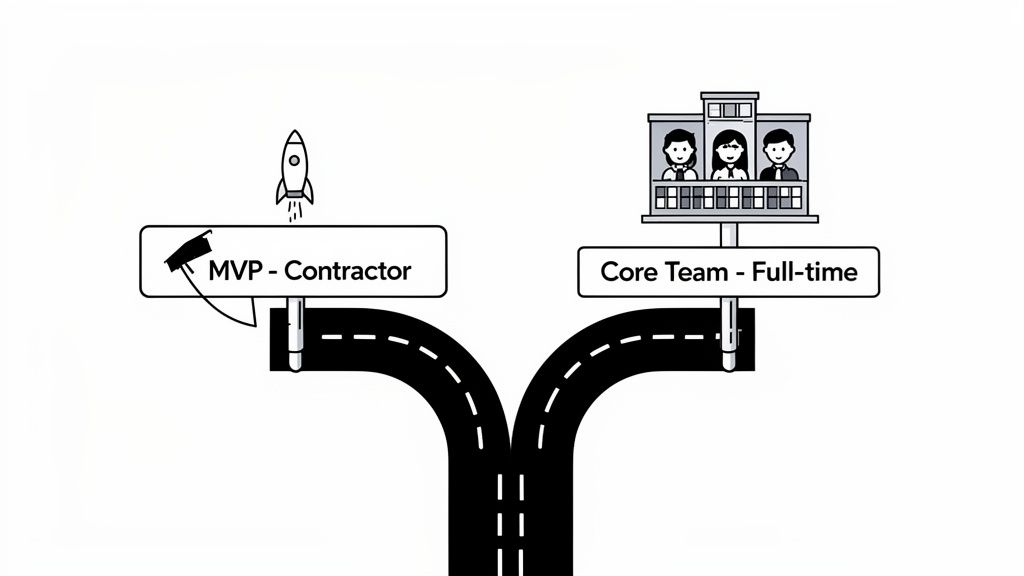
So, let's get practical. We'll walk through the exact business situations where each model shines, giving you a clear framework for making a confident decision when the pressure's on.
Hiring a contractor is your best bet when you need speed, specialized skills, or flexibility for a specific period. This model is all about targeted impact without the long-term overhead.
You'll want to lean on a contractor in situations like these:
Building Your MVP: For a startup, time and money are everything. Contractors are perfect for getting your Minimum Viable Product (MVP) built and shipped fast. You can validate your core idea without taking on the heavy financial load of a permanent engineering team.
Accessing Niche Expertise: Your team is solid, but suddenly you need an AI specialist for a single, complex feature. A contractor gives you instant access to that high-level skill set for one project, saving you the headache and expense of trying to fill a permanent role for a temporary need.
Handling a Sudden Spike in Work: A new client project just landed, or user sign-ups are exploding. You need to scale your development capacity, and you need to do it yesterday. Contractors can be found and onboarded in days, giving you the extra muscle to meet demand without a drawn-out recruitment process.
Covering a Temporary Gap: Your lead developer is about to go on parental leave. Instead of letting projects stall, a contractor can step in to keep the momentum going. It’s the perfect way to maintain continuity without messing with your team's long-term structure.
The Bottom Line: Think of contractors as your special forces. You deploy them for specific missions where their unique skills and rapid availability can solve a clear, short-term problem. They are a tactical solution for an immediate need.
A full-time employee isn't just a resource; they're an investment in your company's soul. This is the right move when your goal is to build a solid foundation, grow a cohesive culture, and protect your most valuable assets.
A full-time hire makes the most sense for these foundational goals:
Building Your Core Engineering Team: The product that defines your business needs a dedicated team. The engineers responsible for its architecture, development, and long-term health should be fully committed employees who have a real stake in its success.
Nurturing Your Company Culture: A strong, unified culture doesn't happen by accident. It's built by people who are deeply invested in the company's mission and who live its values every day. Full-time employees are the ones who carry that culture forward and mentor the next wave of talent.
Developing Proprietary Technology: When you're creating the intellectual property that sets you apart from the competition, you need the loyalty and focus of a full-time team. This approach minimizes IP risks and ensures that critical knowledge doesn't walk out the door when a project ends.
Filling Roles That Require Deep Institutional Knowledge: Certain roles, like a lead architect or head of product, demand a profound understanding of your business, customers, and internal workings. These are best filled by permanent team members who can grow alongside the company.
While contractors give you unmatched flexibility, employees deliver a different kind of value through deep integration and long-term commitment. In fact, many companies find that great contractors become great employees. Staffing industry data shows that 73% of temporary workers successfully move into permanent roles, a rate that’s nearly identical to the 75% full-time hiring rate in the general workforce. This shows a natural pipeline where successful contract gigs often evolve into deeper, more permanent partnerships. You can explore the full research on workforce trends for more industry stats.
At the end of the day, the contractor vs full time employee decision is entirely strategic. By honestly assessing your situation, you can pick the model that fuels your business objectives and get the right people in the right seats at the right time.
Choosing between a contractor and a full-time employee is a big decision. It’s not just about filling a role; it’s a strategic move that affects your budget, team culture, and how quickly you can adapt. This checklist will help you cut through the noise and figure out what makes sense for your business right now.
Forget gut feelings. Walk through these questions to make a clear, informed choice that lines up with where your company is headed.
First things first, what’s the job? Is this a one-and-done project, or is this a permanent part of your business?
Now, let's talk money. You need to be realistic about your cash flow and how much financial commitment you can handle.
The real question isn’t just "What can I afford to pay?" but "What is the total financial burden I am prepared to take on?" A contractor's all-inclusive rate offers predictability, while an employee represents a much deeper, ongoing financial investment.
Finally, consider the actual skills you need and how much this person needs to be part of your team. Are you hiring for a specific task, or are you hiring a new team member?
By honestly assessing these three areas—scope, budget, and skills—you can move forward with confidence, knowing you're making the right strategic choice for your team.
When you're weighing whether to bring on a contractor or a full-time employee, a few key questions always seem to pop up. Let's tackle the most common ones so you can move forward with your hiring plan.
Absolutely. In fact, it's a fantastic way to "try before you buy." When a contractor proves to be a great fit and a high-performer, bringing them on as a full-time employee is a smart move to keep that talent in-house.
The key is managing the switch properly. You'll need to draft a new employment agreement spelling out salary, benefits, and their new role. Just be sure you handle the legal and tax transition by the book to avoid any lingering misclassification issues. Think of it as graduating a valuable contributor to a permanent spot on your team.
Getting this wrong is one of the biggest compliance headaches you can create for your business. Misclassifying an employee as a contractor can lead to a world of hurt, including hefty fines, back taxes, and demands for retroactive benefits like overtime pay and health insurance.
It's not just a paperwork error; it's a fundamental legal mistake. Beyond the financial penalties, you could face expensive lawsuits and serious damage to your company's reputation.
Hiring talent across borders starts with a rock-solid independent contractor agreement. This is your core legal document, and it needs to be crystal clear on the scope of work, how and when they'll be paid, and who owns the intellectual property they create.
You also have to be aware of local labor laws in their country to avoid accidentally creating a permanent business entity there or misclassifying them by their standards. This is where an Employer of Record (EOR) service can be a lifesaver, as they handle the compliance, payments, and global payroll complexities for you.
Great integration comes down to clear communication and a solid onboarding plan right from the start. Give your contractors access to all the tools, documents, and communication channels they need to hit the ground running.
Loop them into relevant team meetings so they're part of the collaborative flow, but be mindful not to treat them exactly like an employee. This helps maintain the legal distinction of their contractor status. A smooth onboarding process ensures they can start contributing quickly and feel like a valued part of the project without blurring those important legal lines.
If your job posts are getting the silent treatment or attracting all the wrong candidates, the problem isn't the talent pool—it's your sales pitch. A vague or uninspired frontend web developer job description is one of the biggest reasons top-tier talent scrolls right past your opening. In a market this competitive, clarity and a compelling […]

Before you even think about posting a job ad for an ecommerce developer, you need a solid game plan. This isn't just about having a vague idea; it's about translating your business goals into a detailed technical roadmap. Get this right, and you'll attract candidates who have the exact skills you need to win. Defining […]

Let's be clear: "offshore development" isn't a piece of software you buy. It's a strategic way of thinking about building your team. Simply put, it means hiring software developers from another country—often one far away—to build your products. Think of it as global talent acquisition. Instead of being stuck with the engineers available in your […]


