

Forget the traditional 9-to-5 grind where everyone is chained to their desk (or Slack status) at the same time. Asynchronous remote jobs are all about focusing on what gets done, not when it gets done. In an async setup, team members collaborate across different hours and time zones without the pressure of being online simultaneously. […]

Forget the traditional 9-to-5 grind where everyone is chained to their desk (or Slack status) at the same time. Asynchronous remote jobs are all about focusing on what gets done, not when it gets done.
In an async setup, team members collaborate across different hours and time zones without the pressure of being online simultaneously. It’s a culture built on trust, clear communication, and giving people the freedom to work when they’re at their best.
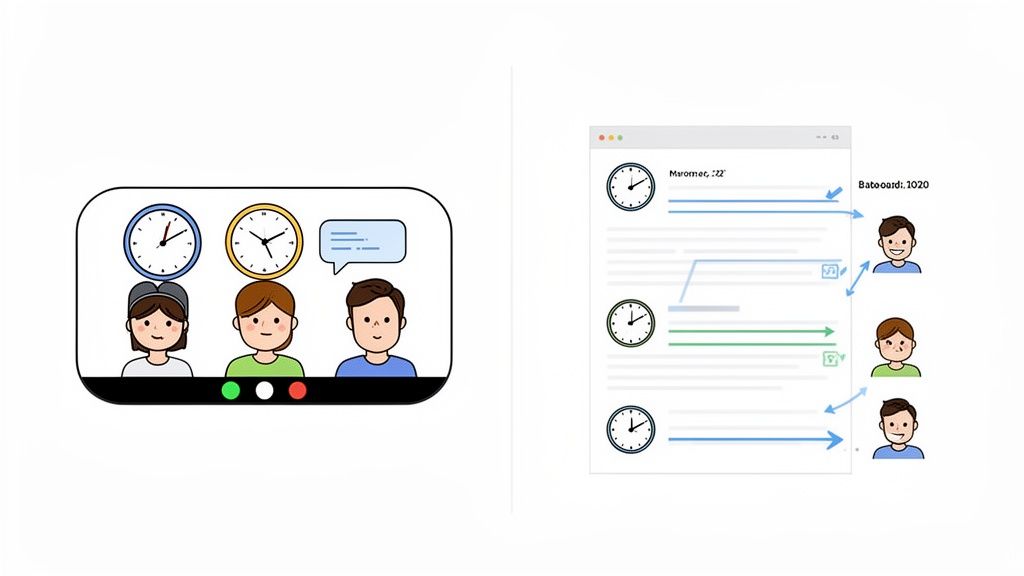
To really get it, picture the difference between a live team meeting on Zoom and a shared Google Doc for a project proposal.
The Zoom call is synchronous. Everyone has to show up at the exact same time. If you’re 8 hours ahead or have a conflicting appointment, you’re out of luck. The conversation happens, and then it's over.
Now, think about that Google Doc. It’s asynchronous. A developer in Poland can add their technical specs in their morning, a designer in Brazil can drop in mockups in their afternoon, and a project manager in California can leave feedback at the end of their day. The project keeps moving forward 24/7, not just in the few hours everyone’s schedules overlap.
This isn’t about radio silence; it's about making communication more intentional and less disruptive.
To put it in perspective, let's look at a quick side-by-side comparison.
This table breaks down the fundamental differences between the way most companies operate and the async model.
| Characteristic | Synchronous Work (The Default) | Asynchronous Work (The Future) |
|---|---|---|
| Communication | Real-time, immediate (meetings, calls, instant chat) | Time-decoupled, thoughtful (docs, comments, recorded videos) |
| Pace of Work | Driven by meeting schedules and instant responses | Driven by individual focus and project milestones |
| Productivity Metric | "Presence" and speed of response | Quality of output and accomplished goals |
| Team Structure | Often limited by time zone overlap | Truly global, hiring the best talent anywhere |
| Documentation | An afterthought, often scattered | A core part of the workflow; the single source of truth |
The shift from one to the other is more than just a logistical change; it's a complete cultural overhaul that redefines what it means to be productive.
At its heart, the asynchronous model is built on a deep respect for an individual's time and focus. The constant pings and "quick syncs" of a typical office are productivity killers. They break concentration and make it nearly impossible to tackle complex problems.
Async work flips the script. Instead of expecting immediate answers, teams create systems that allow for detailed, thoughtful responses. Communication becomes something you schedule, not something that constantly interrupts you.
This is a game-changer for roles that demand deep thinking, like software development. Writing elegant code or debugging a tricky issue requires long, uninterrupted stretches of concentration—something an async environment provides by default.
An asynchronous culture empowers employees with the autonomy to manage their schedules, trusting them to deliver high-quality work. This fosters a sense of ownership and accountability that is crucial for effective remote collaboration.
So, what does a truly async company look like in practice? It’s not just about letting people work flexible hours. It's about having the right systems and mindset in place.
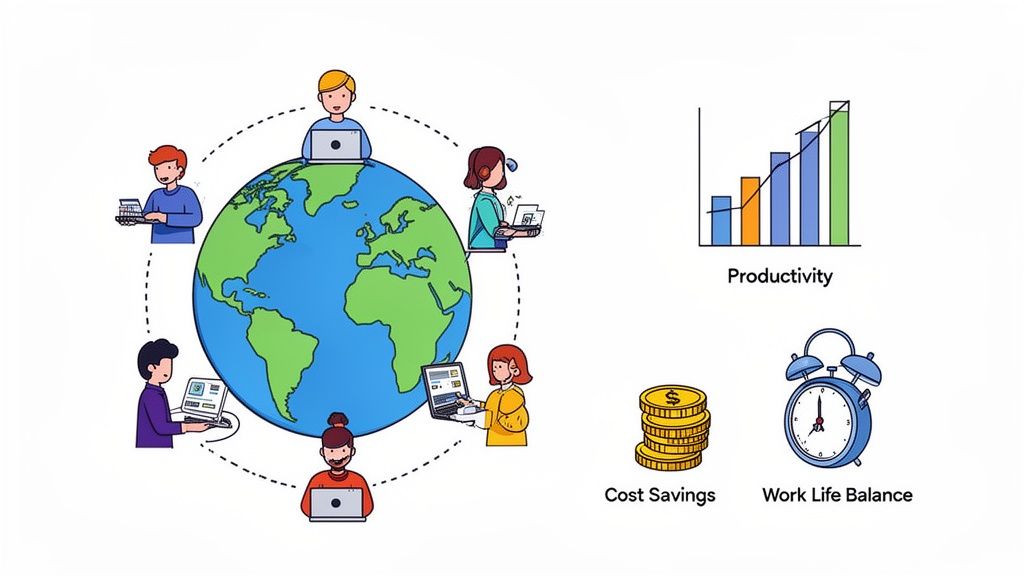
The move to asynchronous work isn't just another fad. It's a calculated decision that smart companies are making to get a serious leg up on the competition. When you untether work from a specific time or place, you unlock some powerful advantages that hit everything from your bottom line to how quickly you can innovate.
One of the biggest wins? The ability to hire from a truly global talent pool. Suddenly, you're not limited to who lives within driving distance or a few time zones away. You can find the perfect person for the job, period, whether they’re in Seattle or São Paulo.
This global approach almost always leads to significant cost savings. Building world-class teams becomes more efficient when you can tap into different talent markets, letting you optimize your budget without ever skimping on quality.
Hiring is just the start. The real magic of an async model is the incredible boost in productivity it creates. It cultivates an environment perfect for deep work—those long, uninterrupted stretches of pure focus. For complex jobs like software development, this is a total game-changer.
Instead of a day chopped up by back-to-back meetings and a constant barrage of Slack pings, your team can organize their schedules around when they're most productive. This autonomy doesn't just feel good; it empowers them to deliver higher-quality work, often in less time.
Asynchronous work isn't just about flexibility—it's measurably boosting output and attracting elite talent. Remote employees often work 10% longer hours than their office-based peers, adding about four extra hours each week.
This productivity spike comes from a fundamental shift in how time is spent. In one study that analyzed over 481,000 hours of work, deep work sessions made up 51% of the time, while meetings shrank to just 15%. That's a massive move from coordinating work to actually doing the work.
For employees, the benefits are just as powerful and can be genuinely life-changing. Async work offers a kind of flexibility that goes way beyond just "working from home." It’s about having real control over your schedule, allowing you to blend your work and personal life in a way that feels healthy and sustainable.
This improved work-life integration is a huge driver of happiness and retention. When people feel trusted and empowered to manage their own time, their loyalty and engagement go through the roof. Of course, leading this new way of working takes skill, and applying the right remote team management tips is crucial for success.
In the end, companies that fully embrace asynchronous remote jobs create a true win-win. They get to build more productive, innovative, and cost-effective teams while offering an incredible employee experience that attracts the best talent from every corner of the globe.
Let's be clear: not every job is a great fit for a fully asynchronous model. While many roles can adapt, certain functions and personality types don't just survive in this environment—they flourish.
The common thread? A focus on deep, analytical work and individual contribution, rather than a need for constant, real-time collaboration.
It should come as no surprise that software development sits at the very top of this list. The real work of a developer—writing clean code, hunting down tricky bugs, and architecting complex systems—demands long, uninterrupted stretches of focus. For a developer in a state of flow, constant meetings and shoulder taps are the enemy.
Many technical and creative roles are a natural match for async work because their output is clear, measurable, and requires intense concentration. Think about jobs where the main deliverable is a tangible piece of work, not just participation in a meeting.
Here are a few roles that are practically built for an async-first culture:
| Role/Department | Why It Works Asynchronously | Essential Async Skills |
|---|---|---|
| Software Development | Writing and reviewing code are deep work tasks. Pull requests and detailed documentation are inherently async. | Clear technical writing, independent problem-solving, mastery of Git workflows. |
| Design (UX/UI) | Creative ideation, mockups, and prototyping benefit from uninterrupted focus. Feedback can be given and received on its own time in tools like Figma. | Visual communication, ability to explain design rationale in writing, receiving written feedback constructively. |
| Content & Copywriting | Writing, editing, and strategy are solitary activities. Collaboration happens seamlessly through shared documents and editorial calendars. | Exceptional written clarity, self-editing, meticulous attention to detail. |
| Data Science & Analysis | Digging into datasets, building models, and generating reports are tasks that demand intense, sustained concentration. | Data storytelling, documenting methodologies clearly, proactive communication on progress. |
Ultimately, any role where the primary output is a well-defined deliverable—be it code, a design, a report, or a piece of writing—is a strong candidate for thriving in an async setup.
Beyond the job title, certain personal traits are powerful predictors of success in an async setting. These are the soft skills that allow someone to perform at a high level without the guardrails of a traditional office.
The most successful async professionals are managers of one. They take complete ownership of their tasks, proactively seek out information, and don’t need someone looking over their shoulder to stay productive.
This level of autonomy isn't magic; it’s built on a foundation of a few core characteristics:
Exceptional Written Communication: Since almost everything happens in writing, the ability to explain complex ideas with clarity and precision is non-negotiable. This is the single most important skill.
High Degree of Self-Motivation: Without a manager down the hall, individuals have to be driven. They must have the internal engine to start tasks, push through challenges, and hit deadlines on their own.
Superb Organizational Skills: Juggling multiple projects and priorities across different time zones is a recipe for chaos without a rock-solid system for organization and time management.
Identifying these traits early in the hiring process is absolutely critical. You can get a much clearer picture of a candidate's async readiness by using a detailed work style assessment designed specifically for remote teams.
Putting together a world-class asynchronous team isn't about tweaking your old hiring plan. It demands a complete rethink. You're not just screening for technical chops; you're hunting for a very specific kind of professional—one who thrives on autonomy and communicates with precision.
The typical interview, with its reliance on live conversation and first impressions, is surprisingly bad at identifying these people. To find them, you have to build a process that mirrors the job itself. Think of it less as an audition and more as a series of practical, hands-on challenges that test for the core async pillars: exceptional written communication, deep-seated autonomy, and proactive problem-solving.
Your main goal is to see how a candidate actually works when no one is looking over their shoulder. This means swapping out some of those back-to-back video calls for carefully designed asynchronous tasks.
It starts from the very first touchpoint. Is their initial application clear and well-structured? Are their follow-up emails thoughtful and easy to understand? These aren't minor details; they're the first clues about their async communication skills.
The most powerful tool in your arsenal is a small, paid test project. This is where the rubber meets the road. For a developer, you might ask them to build a small feature or conduct a code review. The code itself is important, of course. But what’s even more telling is how they handle the process. Do they document their work clearly? Do they ask smart, clarifying questions in writing?
When you do get on a call, make it count. Don't waste time on generic questions about "teamwork." Instead, dig into specific scenarios that reveal how they handle the unique challenges of async collaboration.
Here are a few questions that get to the heart of the async mindset:
These kinds of questions push candidates beyond theory and into the practical, day-to-day realities of async work. For more strategies, check out our complete guide on how to hire remote developers.
Getting this right is more important than ever. The rise of asynchronous remote jobs isn't a temporary blip; it's a fundamental shift. Remote opportunities have tripled since 2020, now making up over 15% of all U.S. job postings. With nearly 80% of workers in major markets doing some form of async work, a hiring process built for the old way of working just won't cut it anymore. You can dive deeper into this trend by reading the full remote work statistics report.
An asynchronous team doesn't just magically appear. It’s carefully built on a foundation of intentional processes and, just as importantly, the right technology. When you don't have a shared office, your digital toolkit becomes the very architecture supporting every project, conversation, and decision.
Think of these tools less as a random list of software and more as the central nervous system of your entire operation. The goal isn’t to just copy the physical office online; it's to create a fundamentally better, more efficient way of working. This requires a shift in thinking, where every tool is chosen to maximize clarity, stamp out ambiguity, and empower people to work on their own terms. When you get the stack right, the need for constant "just checking in" meetings simply melts away.
In an async world, platforms like Slack or Microsoft Teams are no longer real-time chatter rooms. They become organized, searchable libraries of conversation. Making this work means setting them up for async-first communication—moving away from the pressure of instant replies and embracing threaded discussions, crystal-clear channel names, and status updates that protect everyone's deep work time.
Every discussion becomes a permanent record, preventing crucial knowledge from getting siloed in private DMs. This approach transforms your communication tool into a living archive of team collaboration, which is invaluable for getting new hires up to speed and keeping projects on track across multiple time zones.
The golden rule of async communication is to make information public and searchable by default. This simple shift moves teams from a reactive "Who do I ask?" mindset to a proactive "Where can I find it?" culture.
Project management tools aren't optional. Platforms like Jira, Asana, or Trello are the single source of truth for everything that's happening. In an async setup, a well-managed project board gives anyone, at any time, complete visibility into who is doing what, what the priorities are, and where the blockers are. All without a single meeting.
Excellent internal communication is the fuel for any async engine. This is often powered by a disciplined approach to creating better documentation, which cuts down on misunderstandings and repetitive questions. Every task or ticket should be a self-contained package, holding all the context someone needs to grab it and get to work—from detailed descriptions to relevant files and links to key decisions.
Finally, a centralized knowledge base like Notion, Confluence, or Slab acts as your team's shared brain. This is the permanent home for your processes, project plans, and important decisions. Cultivating strong documentation habits is the ultimate async superpower, allowing team members to find their own answers and get unblocked without waiting for a colleague on the other side of the world to wake up.
A recent study that broke down how remote workers spend their time found that a huge chunk is dedicated to coordination and async communication.
The data shows that nearly 34% of a remote employee's day is spent on asynchronous communication. This stat really drives home why having robust documentation and project management tools is so critical—they make sure that time is spent effectively, not wasted.
One of the biggest wins that comes from going asynchronous isn't just flexible hours—it's creating an environment that practically begs for deep work. This is a massive shift away from the typical workday, which is often chopped into tiny, unproductive pieces by endless pings, shoulder taps, and last-minute meetings.
Instead, async work gives your team long, uninterrupted stretches of pure focus.
This is a game-changer for anyone in a role that requires serious brainpower, like software development, data science, or design. When your developers can actually get into a state of flow without constantly being pulled out to answer a question, they solve complex problems faster and produce much higher-quality work. If you want to dive deeper into this idea, check out Cal Newport's concept of Deep Work.
An async-first culture fundamentally changes what a "productive day" looks like. It moves the focus from coordinating work to actually doing the work. And this isn't just a hunch; the data backs it up.
One fascinating study that tracked over 481,000 hours of remote work activity found an almost perfect 50/50 split. Remote employees spent 51% of their time on deep, focused work. The other 49% went to coordination, with the bulk of that—34%—happening through asynchronous communication and only 15% in meetings. This really drives home how async practices are the key to protecting that precious focus time.
By minimizing synchronous demands, companies give their most valuable talent the one resource they need most: uninterrupted time. This advantage directly translates into a significant competitive edge in the market.
This data also shows just how crucial it is to have the right tooling in place. Good project management systems, clear documentation, and smart communication channels are what make this balance possible.
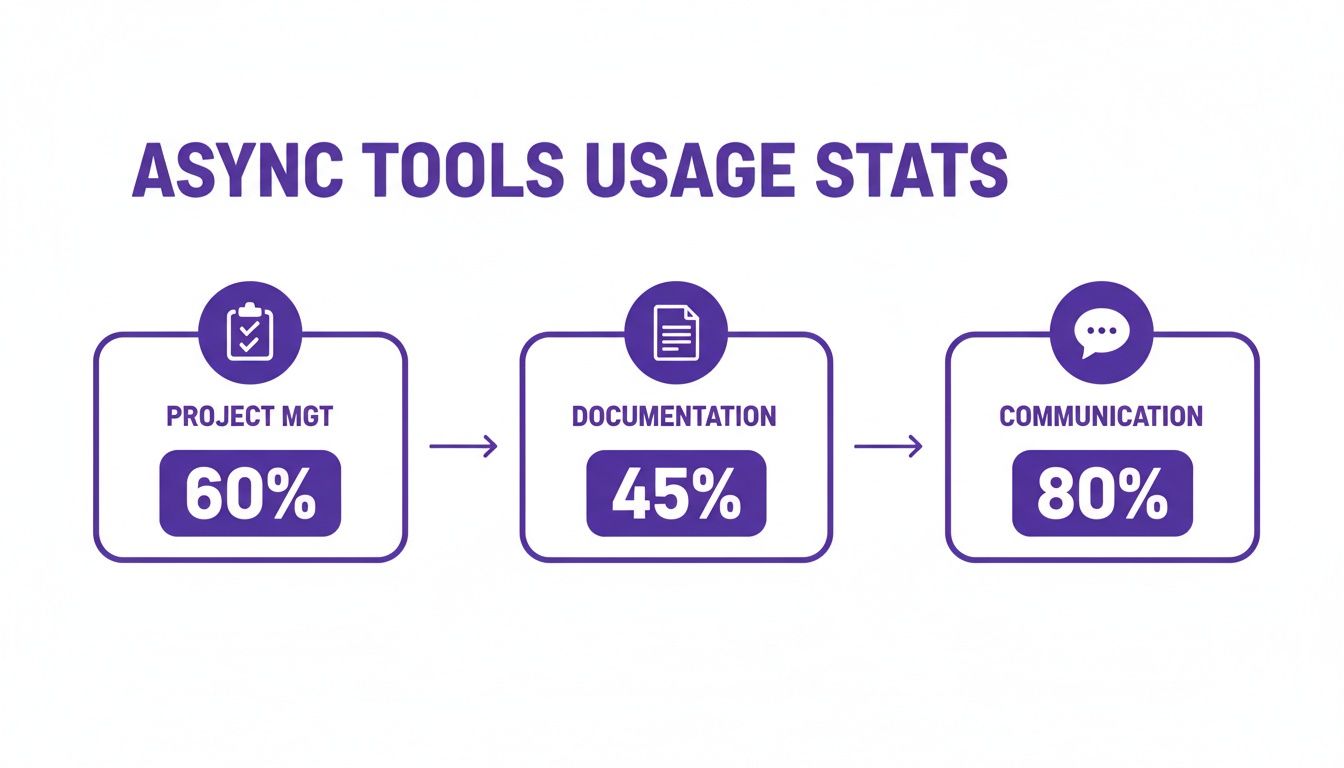
What this chart really tells us is that while communication tools are used most often, it's the solid foundation of project management and documentation that truly enables a team to work together without needing to be online at the same time. That's what guards their deep work time.
Making the leap to an asynchronous model understandably raises a few eyebrows. How do you keep the team connected? Won't everything just slow down? What happens when something actually breaks? These are fair questions that any leader will ask when moving away from a real-time, in-office default.
Let's tackle these common concerns head-on.
You don't build an async culture by accident; you build it with intention. It's less about the spontaneous chats by the coffee machine and more about creating deliberate spaces for connection. Think dedicated Slack channels for hobbies, very public shout-outs for big wins, and planned virtual (or even in-person) get-togethers.
At its core, a strong async culture is built on a foundation of psychological safety and trust. This doesn't come from sitting in the same room, but from clear, respectful communication and people doing what they say they'll do.
It's true, a single back-and-forth exchange might take longer than tapping someone on the shoulder. But when you look at the bigger picture, the overall process is incredibly efficient. You completely eliminate the time wasted trying to sync up schedules for a simple question, and you slash the hours spent in meetings that could have been a memo.
The async model forces everyone to communicate more clearly and thoughtfully from the outset. This actually cuts down on the misunderstandings and follow-up questions, letting people stay in a state of deep focus and get projects done faster.
Every solid async team has a well-defined "break glass in case of emergency" plan. This usually looks like a designated on-call person or a special, high-alert channel reserved only for true crises. The secret sauce here is having a crystal-clear definition of what actually counts as "urgent."
By setting that boundary, you stop people from abusing the emergency line for things that can wait. This protects everyone's focus time for deep work while ensuring that if something critical does happen, it gets the immediate attention it needs.
Your product roadmap is full. Your hiring pipeline is not. A release slipped because you still have no senior backend engineer. Your frontend lead is covering architecture reviews. Product wants an MVP in market before a competitor closes the window. Finance wants headcount discipline. Legal wants cleaner contracts. Engineering wants help yesterday. That is usually […]

When you start looking into the cost of outsourcing software development, you'll see a massive range—from a few thousand dollars for a simple app to millions for a complex enterprise system. Here's the good news: smart outsourcing can often slice your total costs by 50-80% compared to hiring an in-house team. The final price really […]

So, what does it actually take to bring a great app or piece of software to life and keep it thriving in the market? That entire journey, from the first spark of an idea to its ongoing evolution, is the world of digital product management. It's the craft of building digital solutions that people love […]


