

Let's cut right to the chase: are software engineers still in demand? The answer is a resounding yes. Don't let the headlines about tech layoffs fool you. The fundamental need for talented developers isn't just surviving; it's deeply woven into our global economy and growing faster than ever. Why the Need for Engineers Is Stronger […]

Let's cut right to the chase: are software engineers still in demand? The answer is a resounding yes. Don't let the headlines about tech layoffs fool you. The fundamental need for talented developers isn't just surviving; it's deeply woven into our global economy and growing faster than ever.
To really get why software engineering is such a solid career path, you have to look past the short-term market jitters. This demand isn't built on hype; it's fueled by massive, long-term economic shifts.
Think of it like building a skyscraper. You might have new tools like robotic cranes or prefabricated walls, but as the buildings get taller and smarter, you need more expert architects and specialized engineers, not fewer. The complexity drives the demand.
It's the exact same story in the business world. Companies in every industry—healthcare, finance, retail, you name it—are going digital. They need a growing army of software engineers to build the digital foundation that runs everything from their sales and marketing to their internal operations. These aren't just coders; they're the architects of modern business.
A few powerful global trends are colliding to create a permanent talent shortage, making it almost certain that the demand for good engineers will outrun the supply for years to come.
To put these forces into context, here’s a quick breakdown of what’s really driving the market.
| Demand Driver | Market Impact | Why It Matters for Hiring |
|---|---|---|
| Pervasive Digital Transformation | Businesses across all sectors are moving operations to the cloud and building digital-first products. | Every company is competing for the same pool of talent, not just "tech" companies. |
| The AI and Data Revolution | AI, machine learning, and big data analytics are becoming core to business strategy and operations. | Creates intense demand for specialized roles like ML Engineers and Data Scientists. |
| Cybersecurity Imperatives | As digital footprints expand, the need to protect data and infrastructure from threats is critical. | Security-focused developers (DevSecOps) are among the most sought-after professionals. |
| Legacy System Modernization | Trillions of dollars are tied up in old, outdated systems that must be updated or replaced. | Fuels long-term projects requiring engineers skilled in both old and new technologies. |
These aren't just temporary blips on the radar; they are foundational shifts in how the world works, guaranteeing a high-stakes, competitive hiring market for the foreseeable future.
The numbers back this up loud and clear. The U.S. Bureau of Labor Statistics projects a 15% growth for software developer jobs this decade—a rate they call "much faster than average." On a global scale, some studies warn of a staggering 85 million unfilled tech roles by 2030, which could cost companies trillions. You can dive deeper into the 2026 tech trends and talent forecasts. This massive gap between what companies need and the talent available is precisely why skilled software engineers are still one of the most valuable assets in the world.
When people ask, "Are software engineers in demand?" the real answer is, "It depends on where you look." The demand isn't a flat line across the globe; it's a dynamic map full of hotspots, and knowing where they are gives any hiring manager a serious edge.
Sure, traditional tech hubs like Silicon Valley still have a massive gravitational pull. But the competition there is off the charts, and the costs are sky-high. That's why smart companies have started looking beyond their own zip codes, tapping into incredible, cost-effective talent pools all over the world. Remote work blew the old map to pieces, making it possible to build a dream team without everyone being in the same city.
The United States and Canada are, without a doubt, still titans of the tech world. North America has the highest number of software development jobs on the planet and, not surprisingly, the highest salaries. But that also makes it the toughest and most expensive market to hire in.
For companies here, the local talent pool is often stretched to its breaking point. This leads to painfully long hiring cycles and fierce bidding wars, especially for senior-level engineers. It's exactly this pressure that has made North American companies the biggest champions of global hiring, looking abroad to build their teams faster and more efficiently.
In recent years, Latin America has exploded onto the scene as a go-to for nearshore engineering talent. Countries like Brazil, Argentina, and Colombia are churning out waves of highly skilled, creative developers who are eager to make their mark.
The biggest win? The time zones line up beautifully with North America, which makes real-time collaboration a breeze. On top of that, companies can often land top-tier talent for a fraction of what they'd pay in the U.S., without compromising on quality. This region is a core part of the global tech ecosystem now, especially known for its strength in mobile development and fintech.
If you want to dig into which countries excel at what, check out our guide on the best countries to hire remote developers in 2025.
For decades, Eastern Europe has been something of a poorly kept secret in tech, known for its strong technical education and a culture of serious engineering. Countries like Poland, Romania, and Ukraine are famous for producing developers with incredible problem-solving skills and deep expertise in complex areas like backend systems, AI, and machine learning.
While English proficiency might have been a hurdle in the past, today’s generation of engineers is fluent, making them easy to integrate into any international team. It’s a region that offers the perfect mix of high-end technical chops and smart economics.
This infographic really drives home the key factors fueling this demand worldwide. It shows why digital transformation, new tech, and a persistent talent gap make a global perspective not just a good idea, but a necessity.
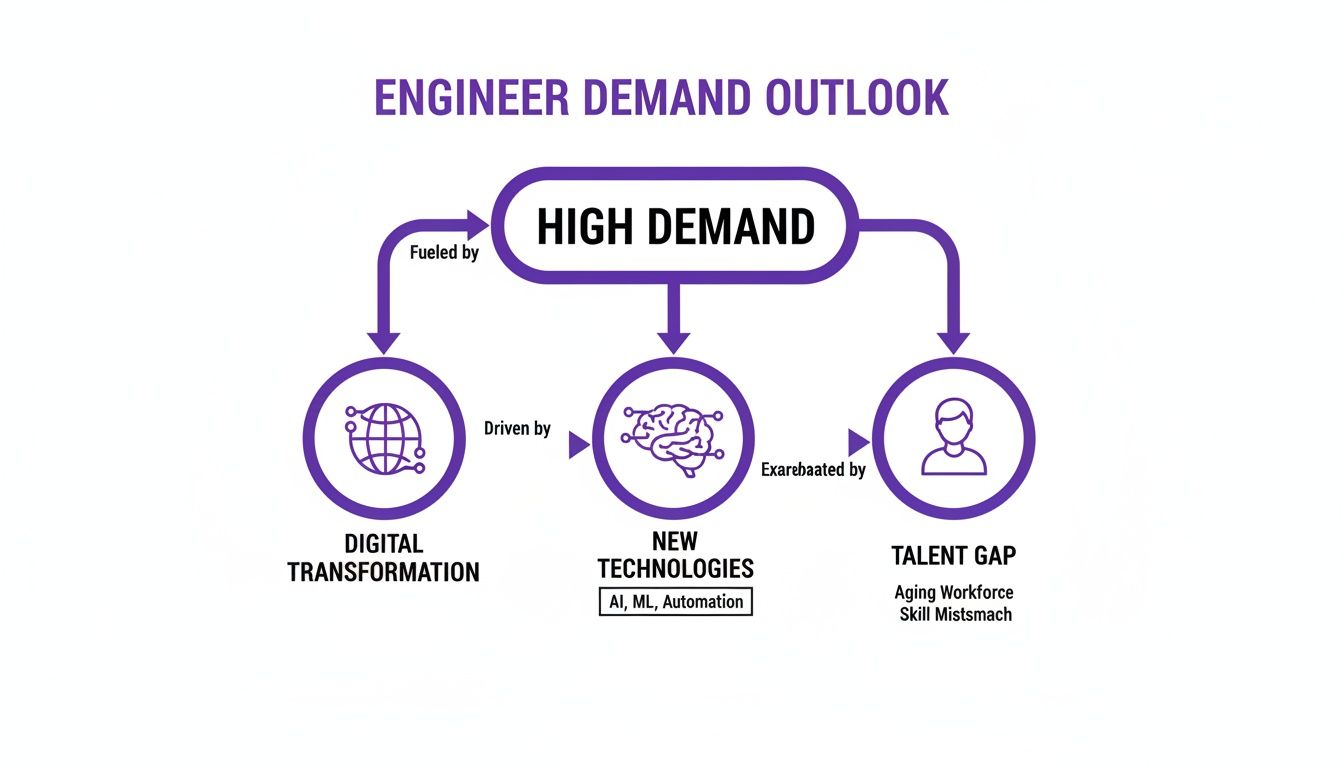
This isn’t a temporary hiring trend. It’s a fundamental shift driven by global forces, which makes having a global hiring strategy more critical than ever before.
Asia is an absolutely massive and incredibly diverse market for talent. India, of course, is a global IT giant with an enormous pool of software engineers. The tech scene there is on fire, backed by strong government support and a real focus on innovation. You can explore STEM opportunities in India to get a better sense of the landscape.
But it doesn't stop there. Other countries like Vietnam and the Philippines are quickly becoming major players, gaining a reputation for their fantastic work ethic and growing expertise in specific technologies. For companies that need to build large teams or find developers with very specific, niche skills, Asia offers unmatched depth. The trick is knowing how to navigate the cultural and logistical differences—which is where having a global talent partner really pays off.
While it's true that software engineers are generally in demand, the real story is in the details. The most intense competition—and the biggest paychecks—are found in a handful of key specializations.
It's no longer enough to just be a "software engineer." The market is hungry for specialists who can tackle its most complex and valuable problems.
Think of it like medicine. A general practitioner is vital for routine care, but for a complex heart problem, you need a cardiac surgeon. In tech, companies are facing challenges that demand that same level of specialized expertise. This shift means the answer to "are software engineers in demand?" has become more nuanced. Generalists face a crowded field, while experts in high-growth areas are playing in a different league entirely.
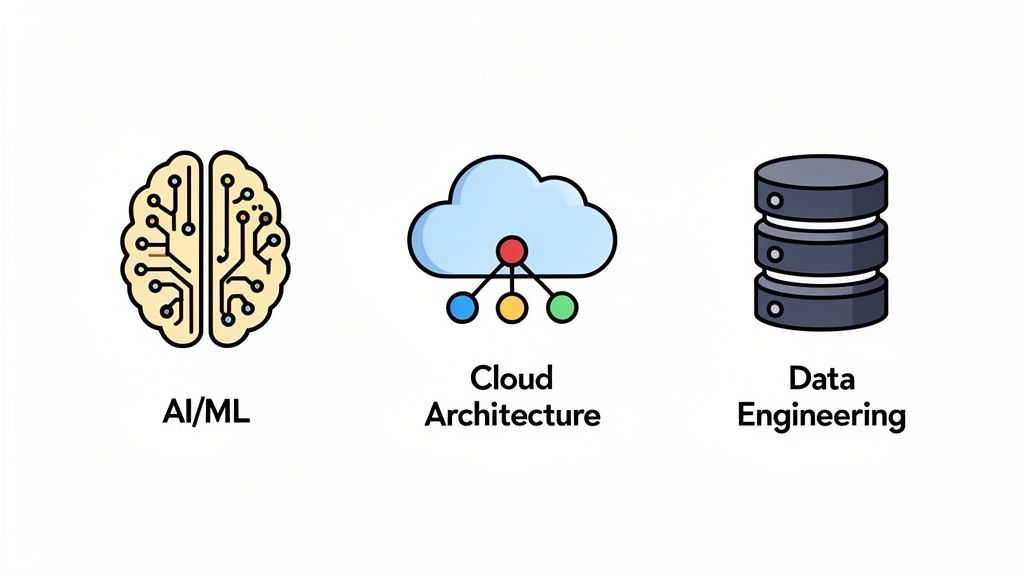
Three areas consistently pop up at the top of every hiring manager's wishlist: Artificial Intelligence/Machine Learning (AI/ML), Cloud Architecture, and Data Engineering. These aren't just buzzwords; they're the pillars supporting modern business intelligence and digital infrastructure.
Engineers with these skills aren't just building apps. They're creating the intelligent, scalable, and data-driven systems that give companies their competitive edge. Their work translates directly into smarter products, leaner operations, and entirely new ways to make money.
This has created a massive talent bottleneck. The issue isn't a lack of jobs, but a scarcity of qualified people to fill them, especially at the mid-to-senior level. One outlook predicts the developer shortage will jump by 40% between 2025 and 2026. This is fueled by AI-driven demand for ML experts reaching 3x the current supply, a wave of senior developers retiring, and tighter immigration policies shrinking the talent pool.
For both developers mapping out their careers and companies trying to hire them, it's crucial to understand what these specialists actually do.
The table below breaks down the roles companies are scrambling to fill and the specific skills they're looking for.
| Specialization | Core Responsibilities | Essential Skills & Technologies |
|---|---|---|
| AI/ML Engineer | Building, training, and deploying machine learning models to power features like recommendation engines, predictive analytics, and fraud detection. | Python, TensorFlow, PyTorch, Scikit-learn, statistical modeling, and deep learning algorithms. |
| Cloud Architect | Designing, building, and managing scalable, secure, and resilient cloud infrastructure to run modern applications and services. | AWS, Azure, Google Cloud, Docker, Kubernetes, Terraform, and infrastructure-as-code principles. |
| Data Engineer | Constructing and maintaining the data pipelines and databases that collect, process, and store vast amounts of information for analysis. | SQL, NoSQL (e.g., MongoDB), data warehousing (Snowflake, BigQuery), Apache Spark, and ETL processes. |
Each of these roles requires a unique blend of programming knowledge, systems thinking, and business sense. They are distinct but also deeply interconnected.
An ML model, for instance, is worthless if it isn't fed by clean data pipelines and can't be deployed on scalable cloud infrastructure. Following tried-and-true software engineering best practices is what ensures these complex systems all work together smoothly.
Key Takeaway: The real magic—and the highest value—happens where these fields intersect. An engineer who gets both cloud infrastructure and machine learning is a rare find and can command a top-tier salary.
For developers looking to get ahead, the path is clear: specialize. For a deeper look at the proficiencies companies want most, this list of the Top 10 In-Demand Skills for Remote Work in 2025 offers some great insights. Mastering one of these high-impact areas is the best way to build a future-proof career in a field that's always on the move.
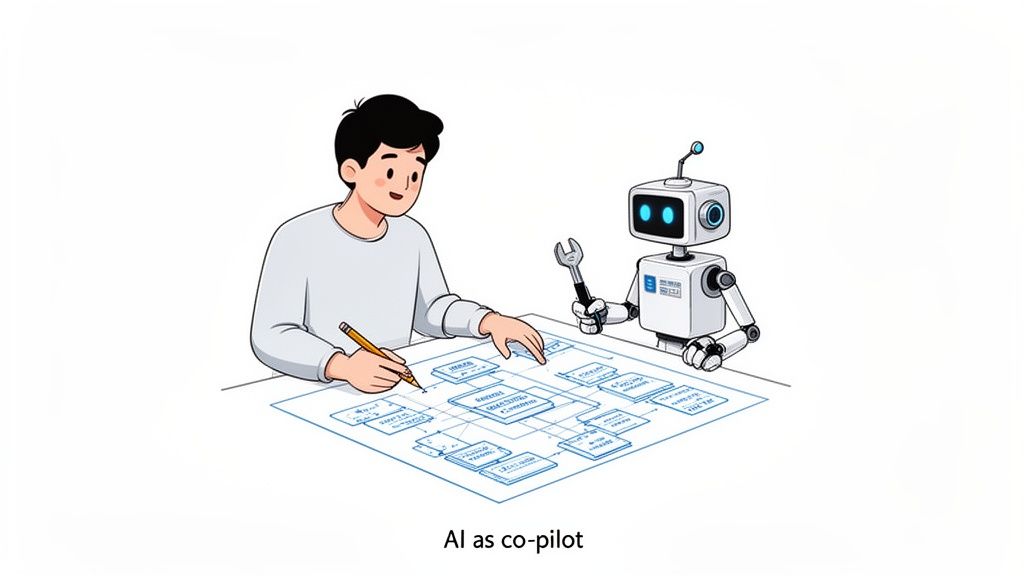
The rise of powerful AI has kicked off one of the biggest debates in tech: will it make software engineers obsolete? The short answer is a hard no. The reality is that AI is fundamentally reshaping the engineering role, becoming an incredibly powerful co-pilot rather than a replacement pilot.
Think of it like this: giving a master carpenter a set of advanced power tools doesn't make them redundant. It makes them faster, more precise, and able to build things they couldn't before. That’s exactly what AI is doing for software development. It handles the tedious, repetitive parts of coding, which frees up human engineers to focus on what they do best.
This shift allows developers to spend their time and energy on high-value work that AI just can't touch. We're talking about architecting complex systems, creative problem-solving, and making sure the final product is secure, scalable, and actually solves a real human need.
AI excels at routine, pattern-based work. It can spit out boilerplate code, offer bug fixes, and write unit tests in a flash. While this massively boosts an engineer's productivity, it doesn't come close to eliminating their role.
Instead, the job itself evolves. An engineer's value is no longer measured just by lines of code written. It's now about guiding the AI, validating its output, and weaving its suggestions into a larger, coherent system. They become the strategic thinkers, the quality gatekeepers, and the ultimate decision-makers.
The core of engineering has always been about solving problems. AI is just a new, incredibly powerful tool for doing that. It allows a single developer to accomplish what might have taken a small team to do in the past, amplifying their impact rather than erasing it.
We’re already seeing this evolution play out. AI and automation are changing the job market, and top analysts expect the need for skilled engineers to grow as AI becomes a standard part of the toolkit. In fact, Gartner predicts that by 2027, roughly 80% of software engineers will need to be skilled at using AI-assisted development tools. Far from cutting jobs, this trend suggests that as AI takes over basic coding, companies will need more engineers to build unique products, manage complex integrations, and govern AI systems responsibly. You can read more about the future of the AI-assisted job market for a deeper dive.
Even the most sophisticated AI models have major blind spots. They don't truly understand context, business goals, or the subtle needs of the people who will actually use the software. This is where human engineers are simply irreplaceable.
Here are just a few key areas where human oversight is absolutely essential:
At the end of the day, the demand for software engineers isn't going away; it's just moving up the value chain. Companies will always need brilliant people to build the next generation of software, and those who learn to masterfully wield AI as a tool will be the most sought-after talent on the market.
In a market this hot, clinging to old hiring methods is like showing up to a Grand Prix in a horse-drawn carriage. You’re not just slow—you’re going to lose the race for top talent every single time. The old playbook of posting a job, waiting weeks for resumes to trickle in, and then kicking off a multi-month interview marathon is completely broken.
We all know how that story ends: drawn-out hiring cycles, blown product deadlines, and top candidates accepting offers from faster, more decisive companies. Too often, teams misjudge technical skills in the interview process or, even worse, hire the wrong person out of desperation. This isn't just frustrating; it's a direct threat to your ability to innovate and scale.
The biggest problem with old-school hiring is friction. Every delay, every extra interview, and every moment of indecision is an open invitation for a great engineer to walk away. The only way to win is to remove that friction with a smarter, more agile approach.
This isn't about small tweaks; it's a complete rethink of the entire process:
This is a mental shift—from passively posting jobs to actively acquiring the talent you need to win.
The fastest way to make this shift is by using a curated global talent platform. Think of it as an exclusive, pre-vetted marketplace where the world’s best engineers are already waiting. Instead of you spending months sifting through thousands of resumes, the platform has already done all the hard work.
The real power here is simple: these platforms give you direct access to the top 1% of global engineering talent, all of whom have already passed intense technical and soft-skill assessments.
This model flips hiring on its head. It turns a high-risk gamble into a predictable, efficient system. You get the confidence that comes from elite-level vetting without having to build a massive in-house recruiting team. For a deeper dive, our guide on how to hire software engineers breaks down these strategies step-by-step.
When you switch to a platform-based model, the results aren't just theoretical—they're immediate and measurable. You’re not just filling a seat; you’re building a powerful competitive advantage.
This is the modern playbook. It’s a practical roadmap for building an exceptional team without the friction, guesswork, and sky-high costs of the past.
After digging through all the data, one thing is crystal clear: the answer to "are software engineers still in demand?" is a resounding yes. The need for people who can build the digital world hasn't gone anywhere, but the kind of demand is definitely shifting. We're not looking at a future where engineers become obsolete; we're seeing a future that belongs to specialists.
The path forward is for engineers who don't just accept change but actively embrace it. Mastering new tools, especially AI, and making them a core part of their workflow is the new standard. On the flip side, the most successful companies will be those who get really good at building high-performing, global teams. In an economy that runs on software, your engineers are what give you an edge.
We’ve seen firsthand how skills in AI, cloud, and data engineering are blowing the doors open to new opportunities. We also put to rest the old fear that AI will replace developers. It's not about replacement; it's about elevation. AI is shifting the job from just writing lines of code to architecting complex solutions and solving bigger, more strategic problems. For businesses, this means the fight for top talent is more intense than ever.
In this new landscape, hiring elite engineers isn't just another operational expense. It's the most critical investment you can make in your company's future. Your ability to build, innovate, and grow hinges completely on the quality of your engineering team.
For companies ready to build that A-team, tapping into the global talent pool is the smartest move you can make. Platforms like HireDevelopers.com cut through the noise of traditional hiring, giving you a faster, pre-vetted pipeline to world-class talent.
And for developers mapping out their careers? Never stop learning. Specializing in high-growth areas is your ticket to a future-proof and fulfilling career. The demand is there—the opportunities are massive for those who are ready to grab them.
Even with a clearer picture of the market, you probably still have a few questions buzzing around. Let's tackle some of the most common ones I hear, whether you're building a team or building a career.
Yes, absolutely. It's easy to get spooked by the headlines about layoffs at big tech firms, but those stories don't capture the full picture. The reality is that there's still a fundamental shortage of skilled engineers across the board.
What we're seeing isn't a collapse in demand, but a shift. Companies are laser-focused on hiring specialists in high-growth fields like AI, cloud infrastructure, and data engineering. For seasoned engineers with the right skills, there are more opportunities than ever. The long-term outlook remains incredibly strong—the need for great developers isn't going away.
This is a classic startup dilemma. If you don't have a technical background, hiring your first engineer feels like a huge gamble. Make the wrong choice, and it can set you back months, or even sink the company. The smartest move is to partner with a platform that handles the deep technical vetting for you.
This takes all the guesswork out of the process.
When a service uses multi-stage technical interviews, real-world code challenges, and system design evaluations, you know you're only talking to top-tier candidates. Seasoned engineers have already validated their skills, so you can focus on finding the right fit for your vision.
By leaning on an expert-led vetting system, you avoid a potentially disastrous mis-hire and give your startup the technical foundation it needs to win.
Not in the slightest, provided you have a rock-solid vetting process. The old idea that remote or offshore talent is somehow "less than" is completely outdated. In a global talent market, excellence isn't defined by a zip code.
The best talent platforms screen for a few key things:
This approach opens the door to the top 1% of engineers globally. It allows you to build a world-class team with proven experts who can deliver, period. The quality comes from the vetting, not the location.
Beyond rock-solid coding fundamentals, the most critical skill to master is using AI-assisted development tools effectively. AI is quickly taking over the routine, boilerplate parts of the job, which means an engineer's real value is shifting to more strategic work.
Getting good with AI copilots—knowing how to write the right prompts, when to trust the output, and how to integrate AI-generated code seamlessly—is fast becoming a core competency. The engineers who embrace AI as a powerful sidekick to amplify their productivity will be the ones who thrive. It's the key to staying ahead of the curve.
Careers in cryptography are high-stakes, high-reward. These are the people who build and break the digital codes that secure our world, protecting everything from your bank account to global decentralized networks. It's a field with massive growth and serious six-figure salary potential. Why Cryptography Careers Are Exploding Welcome to the new frontier of digital trust. […]

The demand for remote machine learning jobs isn't just a trend anymore; it's a fundamental shift in how AI talent is hired and deployed. For ML professionals, this opens up a world of possibilities, not just in terms of flexibility, but also significant financial upside. Companies are in a fierce competition for top talent, and […]

The software engineering field is constantly shifting, with certain specializations commanding unprecedented salaries. But which roles truly offer the highest earning potential, and what does it take to secure one? This data-driven guide breaks down the best paying software engineering jobs, moving beyond vague titles to offer a detailed roadmap for career advancement and strategic […]


