

Let's be clear: "offshore development" isn't a piece of software you buy. It's a strategic way of thinking about building your team. Simply put, it means hiring software developers from another country—often one far away—to build your products. Think of it as global talent acquisition. Instead of being stuck with the engineers available in your […]

Let's be clear: "offshore development" isn't a piece of software you buy. It's a strategic way of thinking about building your team. Simply put, it means hiring software developers from another country—often one far away—to build your products. Think of it as global talent acquisition. Instead of being stuck with the engineers available in your city, you get to tap into a worldwide pool of expertise.
The big motivators? Accessing hard-to-find skills, scaling your team on demand, and, of course, doing it all in a way that makes financial sense.
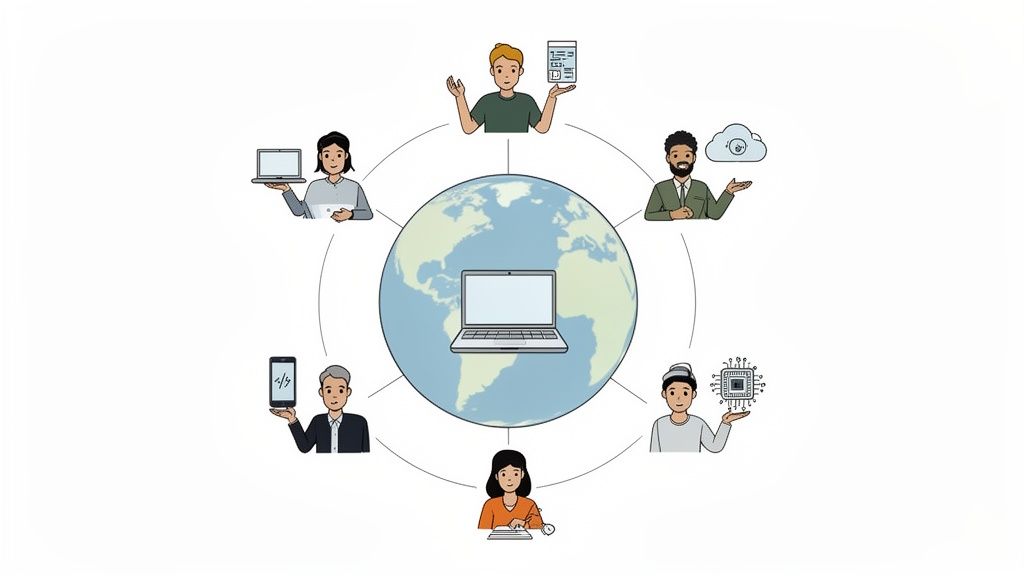
Imagine you're putting together a championship sports team. Would you only scout players from your hometown? Of course not. You'd search the globe for the absolute best talent to get a competitive edge. Offshore software development applies that exact same logic to building a world-class engineering team. It’s a powerful strategy that breaks you free from local hiring bubbles, giving you access to elite developers and fresh perspectives from anywhere on the planet.
This is about more than just saving a few bucks on salaries; it's about using global resources to hit your business goals. Smart companies see it as a key driver for growth, not just a line item on a budget. And they're not alone—the global offshore software development market is already worth over $160 billion.
Before you dive in, you need to know the lingo. People often throw around "offshore," "nearshore," and "onshore" like they're the same thing, but they represent very different approaches to building a remote team. Each one strikes a unique balance between cost, collaboration, and cultural familiarity.
Let's break them down:
The decision to go offshore isn’t just about the bottom line anymore. Today, it’s about strategic acceleration. It’s about finding the specific skills you need to build a better product faster than your competitors can. It's about building an engineering organization that's more resilient, skilled, and dynamic.
At the end of the day, a smart offshore strategy turns a potential talent shortage into a global opportunity. It’s how a startup can afford to build its MVP, how a growing company can quickly add senior engineers for a new feature, and how a big enterprise can find that one niche expert for a mission-critical project.
Deciding to take your software development offshore is a serious strategic move, kind of like deciding whether to build a new factory in your hometown or halfway around the world. It’s a path loaded with incredible opportunities, but it also has its share of potential pitfalls you’ll need to navigate carefully. Getting a clear picture of both sides is the only way to make a call that truly fits your business.
The upsides go way beyond just saving money. While cost reduction is often what gets companies interested, the real game-changer is tapping into a global ecosystem of talent.
The biggest, most immediate win with offshoring is gaining access to a massive international pool of developers. Let's face it, local hiring markets can be brutal—fiercely competitive and incredibly expensive, especially when you need someone with a very specific, niche skillset. Offshoring blows those doors wide open.
Access to Specialized Skills: It's no surprise that 70% of companies say their main reason for offshoring is to find specialized talent. You're no longer stuck with the experts in your zip code when you need a top-tier machine learning engineer or a battle-tested cybersecurity pro.
Scaling at Speed: Need to spin up a new project team, like, yesterday? Hiring locally can drag on for months. Offshore platforms, on the other hand, can connect you with developers who are already vetted and ready to go, sometimes in a matter of days. You can ramp your development power up or down as needed.
Around-the-Clock Productivity: This is a big one. By assembling a team that spans different time zones, you can create a “follow-the-sun” workflow. As one team clocks out, another clocks in and picks up right where they left off. This can slash your project timelines by keeping development moving 24/7.
The real magic of modern offshore development isn't just about finding cheaper developers; it's about finding the right developers, faster. It turns hiring from a local headache into a global strategic advantage.
Of course, you can't just dive in without being realistic about the challenges. These hurdles aren't deal-breakers, but they do require smart management and the right kind of partner. If you ignore them, you risk blown deadlines, shoddy code, and a frustrated team.
Most of the common problems boil down to communication and getting everyone on the same page. Time zone gaps can cause frustrating delays, and subtle cultural differences in how people communicate can easily lead to crossed wires if you’re not prepared.
Communication Barriers: In fact, some studies show that roughly 54% of offshore projects run into cultural or communication snags. When you don't have that real-time overlap for quick chats and problem-solving, things can slow to a crawl.
Quality Control Concerns: If you don't have a rock-solid vetting process, you can easily end up with developers who don't have the skills they claimed. This leads to bad code that has to be fixed or completely rewritten, which wipes out any money you thought you were saving.
Security and IP Risks: You're handing over your company’s secret sauce—your intellectual property and sensitive data—to a team in another country. That requires a bulletproof legal and security setup. Things like data privacy laws and IP protection have to be spelled out in no uncertain terms in your contracts.
These are all legitimate concerns, but they are absolutely solvable. The trick is to stop thinking about it as just "outsourcing tasks" and start thinking about it as building a single, integrated team. That means setting up clear communication rules, using the right collaboration tools, and building a team culture that makes everyone feel included, no matter where they are.
Most importantly, working with a platform that does the heavy lifting with rigorous, multi-stage vetting is non-negotiable. This step alone filters out the noise and ensures you're only talking to top-tier, pre-qualified engineers, dramatically reducing the risk of poor quality right from the start. For a deeper dive into the financial aspects, you can learn more about how offshore software development costs break down and what factors influence them.
Picking the right spot on the map for your offshore team is one of the most important calls you'll make. Think of it like setting up a critical supply chain—your choice of location impacts everything from cost and efficiency to how smoothly your daily operations run. The world's a big place, but the real hotspots for top-tier software talent are clustered in a few key regions, each with its own flavor.
To make the right choice, you have to look past the sticker price. You're balancing the local tech scene, whether you can get your teams on a call without someone being up at 3 a.m., and how easily you can communicate.
Over the last decade, Eastern Europe—think Poland and Ukraine—has cemented its reputation as a true powerhouse for high-quality engineering. This isn't by accident. The region has a deep-rooted focus on STEM education, which consistently produces developers with serious technical chops, especially in complex fields like enterprise architecture, cybersecurity, and data science.
Sure, their rates are a bit higher than what you'll find in Asia, but they're still a fraction of what you'd pay in the US or Western Europe. The real win here is the time zone. You get a solid overlap with European markets and a workable window with the US East Coast, which makes real-time collaboration a whole lot easier. Plus, English proficiency is typically excellent, cutting down on the misunderstandings that can sink a project.
For any company in the Americas, Latin America is an incredibly compelling option. Countries like Brazil and Argentina are booming tech hubs, churning out skilled developers who are well-versed in popular technologies like JavaScript, Python, and mobile development.
The killer feature here is time zone alignment. It’s a game-changer. Your team in Latin America is working pretty much the same hours you are, which is a massive plus for agile teams that live and die by their daily stand-ups and quick feedback loops. While the hourly rates might be a touch higher than in Asia, the sheer ease of logistics and cultural familiarity often makes it well worth the investment.
It's impossible to talk about offshore development without talking about Asia. Powerhouses like India and the Philippines have long dominated the market, and for good reason. They offer a staggering talent pool and the most competitive pricing on the planet, making them the default choice for startups and enterprises trying to stretch every dollar.
The global offshore software development market is booming, expected to jump from $160.9 billion to $179.05 billion. India is at the heart of this, snapping up 54% of US outsourcing contracts thanks to its massive 5.8 million strong developer community. You can find more insights on this global market trend and how different regions stack up.
This infographic lays out the pros and cons pretty clearly:
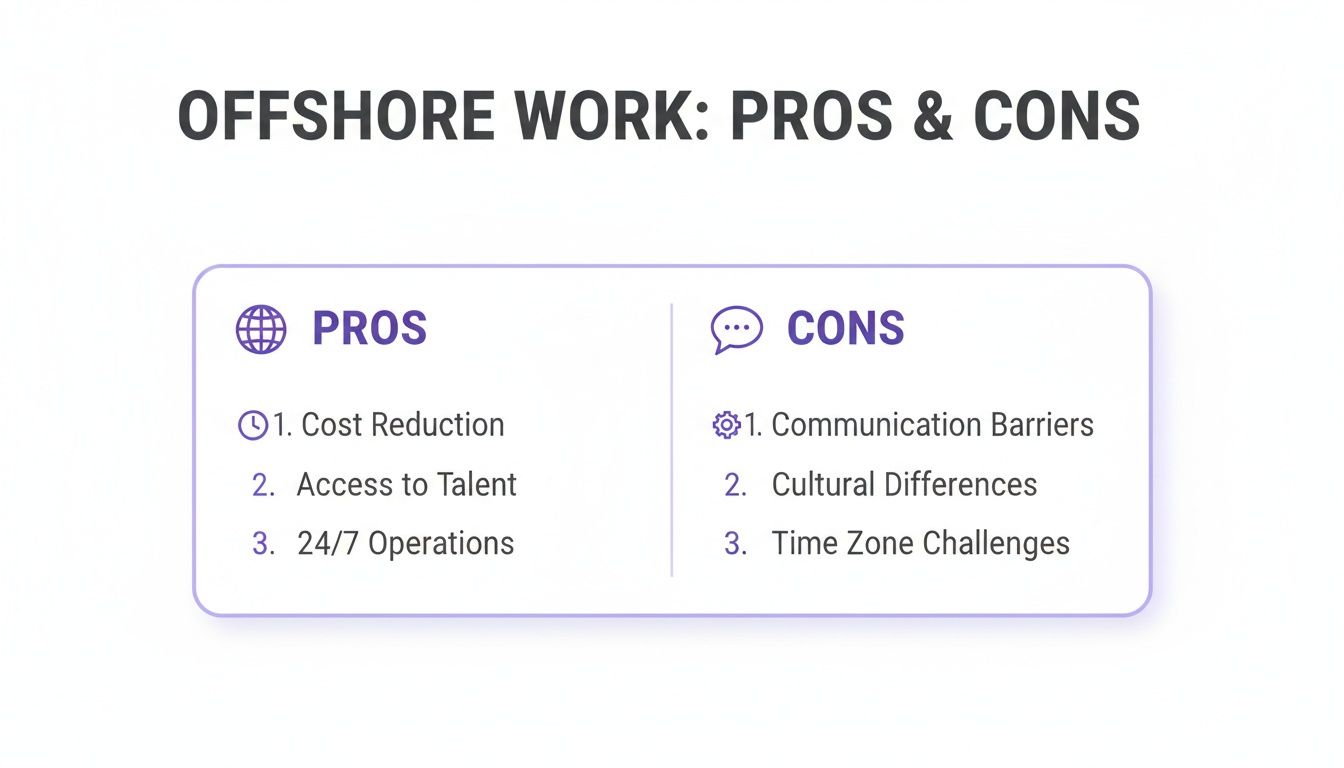
The big catch, of course, is the time difference. Working with teams in Asia often means embracing asynchronous communication or setting up a "follow-the-sun" workflow. But if your project is well-defined and doesn't need constant, real-time hand-holding, the value you get is tough to beat.
To help you visualize the differences, here’s a quick comparison of the top offshore regions. This table breaks down their strengths, typical costs, and other key details to help you find the best fit for your team.
| Region | Average Hourly Rate | Key Tech Stacks | Time Zone Overlap (US/EU) | Primary Strengths |
|---|---|---|---|---|
| Eastern Europe | $30 – $65 | .NET, Java, Python, C++ | Good with EU, Partial with US East Coast | Deep technical expertise, strong problem-solvers, high-quality code. |
| Latin America | $35 – $70 | JavaScript (React, Node), Python, Ruby | Excellent with North America | Time zone alignment, strong cultural affinity, agile-friendly. |
| Asia | $20 – $50 | PHP, JavaScript, Mobile (iOS/Android) | Minimal with US/EU | Unmatched cost-effectiveness, massive talent pool, great for scale. |
Ultimately, there's no single "best" region—only the one that's the best fit for your project's specific needs, budget, and collaborative style.
Choosing the right region isn't about finding the "best" one, but the "best fit" for your specific project. Your decision should be a strategic balance of budget, the need for real-time collaboration, and the specific technical skills your project demands.
This is where modern platforms like HireDevelopers.com can really help. Instead of you becoming an overnight expert in global labor laws and tech markets, they give you a single gateway to developers who have already been rigorously vetted, no matter where they are. This lets you focus on what really matters—the developer's skills and experience—confident that the platform has already done the heavy lifting on screening and qualification.
Expanding your team globally with offshore software developers opens up a world of talent. It’s an exciting prospect, but it also means wading into the complex waters of international law. This tangled web of legal, tax, and intellectual property (IP) regulations can quickly become a minefield if you’re not prepared.
Frankly, without a solid plan, you could easily spend more time untangling administrative knots than actually building your product. Managing a global team isn't just about paying someone in a different currency; it’s about understanding the specific labor laws, tax duties, and data privacy rules that can change dramatically from one border to the next.
When you decide to hire talent abroad directly, you essentially take on the full responsibility of that country's entire legal framework. This brings a few major challenges to the forefront that can carry significant risk if you get them wrong.
Trying to navigate this legal maze on your own is like being your own international lawyer, accountant, and HR department all at once. It’s a massive distraction that pulls focus and resources away from what you should be doing: running your business.
Beyond these major legal hurdles are the practical, day-to-day headaches. You have to set up international payroll, figure out the correct tax withholding, and administer benefits that are compliant with local standards. This administrative load just gets heavier with every new country you hire in. A good starting point is to learn more about the different types of software engineering contracts and what they mean for your business.
Thankfully, there’s a much simpler way forward. Instead of trying to build a global legal and HR team from scratch, you can partner with a platform that acts as an Employer of Record (EOR).
Think of an EOR as your expert HR partner on the ground in another country. They legally employ the developer on your behalf, taking care of all the messy, high-stakes administrative work so you don't have to.
This model effectively outsources the entire legal and compliance burden. The EOR takes charge of:
Working with an EOR service gives you all the advantages of accessing top global talent without the enormous operational and legal headaches of direct international hiring. It frees you up to focus on what really matters: integrating your new team members and building incredible software.
A great offshore team doesn't just happen. It’s intentionally built with solid processes, the right tech, and a genuine focus on building a cohesive culture. Nailing the hire is just step one. To truly get the most out of that talent, you have to create a workflow that makes them feel like a core part of the team, not just a contractor on the other side of the world.
This means having a clear blueprint for managing a distributed team, one that erases time zones and encourages real collaboration. It’s all about creating a system where transparency isn't an afterthought—it's the default.
Frameworks like Scrum are the lifeblood of effective software teams, and their importance is magnified when you’re working offshore. Agile provides the rhythm and structure needed to keep everyone marching in the same direction, no matter where they’re located.
The trick is adapting these familiar ceremonies for a remote-first world. Daily stand-ups, for example, are non-negotiable, but you have to schedule them thoughtfully to work for everyone's time zone. The goal is quick, clear updates that keep projects moving and unblock anyone who's stuck.
Sprint planning and retrospectives need to be highly organized virtual meetings. Using digital whiteboards and shared documents is key to making sure every voice is heard and everyone can contribute to making the next sprint better. This kind of discipline is what prevents the "out of sight, out of mind" trap that can easily derail an offshore team.
Think of a well-run Agile process as the central nervous system for your offshore team. It creates a shared language and rhythm, ensuring every developer knows exactly what the priorities are and how their work fits into the bigger picture.
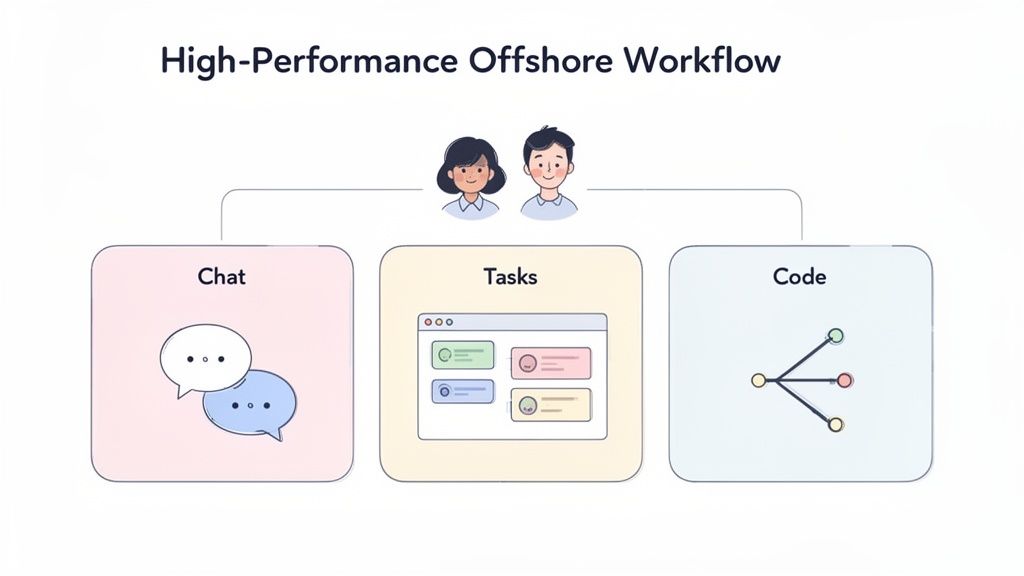
The right tools are the glue holding your distributed team together. A thoughtfully chosen tech stack can make an ocean feel no bigger than a desk, allowing ideas and information to flow freely. Your setup should really nail three key areas: communication, project management, and code collaboration.
Real-Time Communication: A tool like Slack is absolutely essential. It’s your virtual office where developers can ask a quick question, share a code snippet, or just have a casual chat. Set up dedicated channels for projects, teams, or even social interests to help build that team bond.
Project Management and Task Tracking: A platform like Jira becomes your single source of truth. It's where you create user stories, assign work, and track sprint progress with total transparency. Anyone from the CTO down to a junior developer can see the status of any task, at any time.
Version Control and Code Collaboration: GitHub (or GitLab) is the undisputed standard here. It's the foundation for collaborative coding, handling everything from code reviews and pull requests to maintaining a clean, well-documented codebase.
As you build out your workflow, look for practical ways to improve developer productivity and keep your team operating at a high level.
Processes and technology get you most of the way there, but the human element is what truly makes or breaks an offshore engagement. Building a strong, unified culture takes active effort.
Start by making your virtual stand-ups more than just a list of status updates. Encourage the team to share small wins or talk through challenges. Beyond that, schedule regular, informal video calls with no agenda—just a chance to connect as people. These small interactions build the trust and rapport that are so critical for great teamwork.
Ultimately, your goal is to make your offshore developers feel like true members of the team, not just hired guns. Involve them in roadmap discussions, give them public shout-outs for great work, and create opportunities for them to mentor others. When your offshore team feels seen and valued, their engagement—and the quality of their work—will skyrocket.
Turning global talent acquisition into a competitive advantage means swapping the old, painful hiring process for a clear, modern playbook. When you're building an offshore team, you can't afford slow, uncertain methods. You need a streamlined approach.
It all kicks off with the job description. Think of it less like a wish list and more like a magnet for the exact person you need. Don't just ask for a "senior backend developer." Get specific. What frameworks will they use? What architectural puzzles will they solve? What performance goals will they own? This level of detail acts as a natural filter, saving everyone time.
Once you have candidates, your remote interview process needs to be sharp. A multi-stage gauntlet is usually best. Start with a screening to check the basics, then move to a live coding session that mimics a real day on the job. The final step should be a conversation with the team to see if the personalities and work styles click. It's as much about culture as it is about code.
A well-thought-out onboarding plan is probably the single biggest predictor of an offshore hire's long-term success. The first 90 days are everything. This is where you build loyalty, establish productivity, and make them feel like part of the team. A messy, unstructured welcome leads to confusion; a clear plan builds momentum from day one.
Here’s a simple framework that just works:
As you build out your team, it's also worth looking into different engagement structures, like the dedicated software development team model, which can be a game-changer for long-term projects.
The real difference between the old way and the new way of hiring offshore is speed and certainty. A traditional search drags on for months with no quality guarantee. A modern talent platform, on the other hand, can give you a shortlist of vetted engineers in a few hours and help you onboard them in less than a week.
This kind of speed is only possible because the heavy lifting—the vetting—is already done. Platforms that pre-screen for technical chops, communication skills, and professional reliability take most of the risk off your plate. It lets you skip the noise and focus on what truly matters: finding the perfect person for your team.
For a deeper dive into this process, check out our complete guide on how to hire an offshore development team and get it right the first time.
Stepping into the world of offshore development always brings up a few big questions. It's smart to have them. Getting straight answers is the only way to feel confident about your decision, so let's tackle the most common ones we hear from founders and tech leaders.
We'll skip the jargon and get right to the practical stuff—from making sure your code is top-notch to understanding what you'll actually save.
This is probably the most important question, and the answer isn't about hope—it's about process. You don't leave quality to chance. The best way to lock in quality is by working with a partner who has an almost painfully rigorous vetting process. I'm talking about a multi-stage system that goes way beyond a quick résumé scan.
A truly solid vetting system should include automated coding challenges, live technical interviews with senior engineers, and a real look at their communication and problem-solving skills. When a platform does this right, any candidate you meet has already been proven to be in the top percentile of global talent. This heavy lifting upfront is what takes most of the risk off your plate.
Everyone knows offshoring saves money, but the real number is often surprising. It's not uncommon for companies to see a 50-70% reduction in total employment costs when compared to hiring in a major tech hub like San Francisco or New York. And that's not just salary.
The "true" savings come from all the other costs you don't have to pay:
When you use a platform that acts as an Employer of Record (EOR), they handle all of that complex local admin stuff, so the savings are clean and predictable.
The modern approach to offshoring isn't just about reducing costs—it's about reallocating that capital to accelerate product development, expand market reach, and out-innovate the competition.
If you've ever hired locally, you know it can be a slow, painful grind that takes months. That old timeline is a major project killer. Thankfully, this is one area where things have completely changed for the better.
With a modern talent platform, you can have a shortlist of perfectly matched, pre-vetted candidates ready for you to talk to within 24 to 48 hours of your initial call. From there, it moves fast. You can realistically go from your first interview to making an offer and getting your new developer onboarded in about a week. Speed like that turns hiring from a bottleneck into a genuine competitive edge.
You're probably in one of two situations right now. You need to hire a Scrum Master fast because delivery feels messy, or you've already interviewed a few and every candidate sounds polished, certified, and strangely interchangeable. They know the terms. They can define artifacts and ceremonies. But you still can't tell who can steady a […]

Most advice on API vs REST API starts with definitions and stops there. That's too shallow for a real project. The decision affects delivery speed, integration risk, documentation load, support burden, and even who you need to hire to keep the system stable after launch. The common mistake is treating “API” and “REST API” like […]

You're probably in one of two situations right now. You need to hire a Java developer because a core system is growing faster than your team can support, or you inherited a Java codebase and need someone who can stop the bleeding without making the architecture worse. Both situations punish vague hiring. A generic “Java […]


