

If you're trying to pin down a typical back end developer salary in the United States, you'll find it lands somewhere between $101,000 and $175,000 per year. The national average usually hovers around $120,000. But let's be honest, that's just a starting point. Your actual paycheck is a mix of where you live, how many […]

If you're trying to pin down a typical back end developer salary in the United States, you'll find it lands somewhere between $101,000 and $175,000 per year. The national average usually hovers around $120,000. But let's be honest, that's just a starting point. Your actual paycheck is a mix of where you live, how many years you've been coding, and the specific tech you know inside and out.
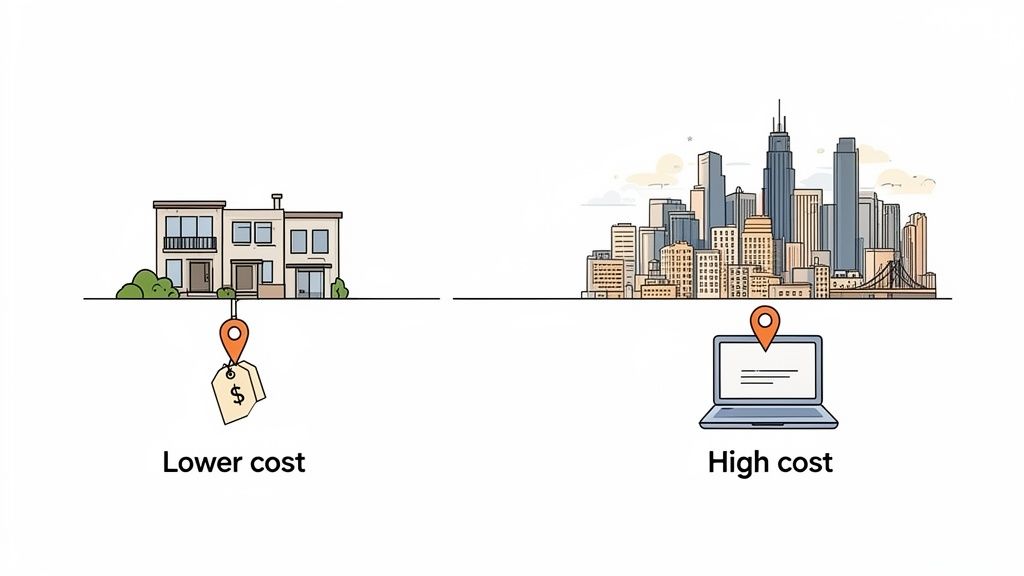
A back end developer's salary isn't one set number; it's a wide and dynamic range. Think of it like buying a house. A small apartment in San Francisco will always cost more than a huge house in a smaller town. The same principle applies directly to tech salaries.
This guide is here to break down all the moving parts that decide where a developer’s pay falls on that spectrum. We'll look at everything from their experience level to how much demand there is for their programming skills. The big idea here is simple: talent is everywhere, but the cost of that talent is local.
A few core ingredients really determine what a developer can earn. If you're a hiring manager, getting these right is the key to making competitive offers that attract great people without blowing your budget. For developers, this is your roadmap for getting that next promotion and raise.
Here are the biggest variables in play:
The real secret for companies today is realizing you don't have to pay Silicon Valley prices to get Silicon Valley-caliber talent. When you open up to a global hiring model, you can find that perfect sweet spot between skill, experience, and what your budget can handle.
This is how you build a world-class engineering team without breaking the bank. As we dig into the numbers, you'll see how hiring strategically gives you access to the top 1% of developers on the planet, letting you scale your team and build amazing products without being tied to the sky-high costs of one city.
Think of a developer's career like any other skilled craft—the more time you put in, the more valuable your work becomes. In the world of software, "experience" isn't just a number on a resume. It’s the hard-won wisdom that comes from wrestling with tough problems, putting out fires in production, and making design choices that don't come back to haunt you years later.
This natural progression from a rookie coder to a seasoned architect is mirrored perfectly in a back end developer's paycheck. Every step up the career ladder comes with a significant jump in both responsibility and compensation, laying out a clear financial path for anyone in the field.
The first year is all about soaking up information like a sponge. As an entry-level developer, your days are filled with well-defined tasks, squashing bugs, and writing code under the watchful eye of a senior teammate. The main goal is simple: learn the codebase and start contributing to small-scale features.
Companies see an entry-level developer as an investment—someone with a ton of potential who just needs the right mentorship to really shine. The salary at this stage reflects that, offering a solid starting point for what can become a very lucrative career.
After that first year, things really start to click. With the fundamentals down, early-career developers begin to take on real ownership. They can build out features with far less hand-holding, understand how their code fits into the bigger picture, and become a more active voice in team meetings.
This is where you see the first big salary bump. A developer with a few years under their belt is no longer just a learner; they're a reliable, productive member of the team who consistently delivers value.
Data clearly shows that experience pays off. While the average back end developer salary sits at $101,631, that number is an average across all skill levels. A developer with less than one year of experience earns around $84,544, but someone with just a bit more time in the trenches (1-4 years) already commands $96,271. This upward trend continues, proving the direct link between expertise and earnings. You can explore more salary data with these insights from PayScale.
The table below breaks down how salary typically progresses with experience in the US market, giving you a clearer picture of the financial journey.
| Experience Level | Years of Experience | Average Annual Salary (USD) |
|---|---|---|
| Entry-Level | 0-1 years | $84,544 |
| Early-Career | 1-4 years | $96,271 |
| Mid-Level | 4-6 years | $115,000+ |
| Senior-Level | 7+ years | $135,000+ |
As the data shows, each career milestone unlocks a new tier of earning potential, rewarding developers for the skills and wisdom they accumulate over time.
For many companies, especially startups, mid-level developers hit the perfect sweet spot. They have the ideal blend of skill, experience, and cost. These engineers are self-sufficient, can lead small projects, and are capable of mentoring the junior members of the team. Their code isn't just about making things work; it’s about building things that last.
This stage comes with another hefty pay increase. Businesses are more than willing to pay a premium for this level of competence because mid-level engineers can build complex systems without needing the constant guidance of a junior or carrying the higher salary of a principal architect.
If you're looking for a serious salary boost, pursuing specialized credentials can make a huge difference. Check out some of the options in this list of the Top 10 High Paying IT Certifications.
After seven or more years in the game, a back end developer's role often shifts from writing code to shaping technology. Senior developers are the ones thinking about the big picture. They design intricate systems, make the tough architectural calls, and set the technical direction for entire teams or departments. Their success is measured not by lines of code, but by the stability, performance, and long-term health of the company's entire software ecosystem.
This level of responsibility, as you'd expect, commands the highest salaries. Senior engineers are invaluable because they can spot trouble before it happens, prevent costly mistakes, and make everyone around them better. Their deep experience is a strategic asset, and their compensation reflects that.
When it comes to a back end developer's salary, one factor trumps all others: location. It’s the single biggest variable. You can have two developers with the exact same skills and years of experience, but their paychecks can look wildly different just because of where they call home. This isn't about one being "better" than the other; it's a simple function of local economies, the cost of living, and how hot the job market is in that specific region.
For anyone in a hiring position, getting a handle on these global differences is the secret to a powerful strategy called "geographic arbitrage." Think of it like building a car. You could source every single part from an expensive, local factory, or you could find the exact same high-quality parts from different suppliers around the world for a fraction of the cost. The final product is just as good, but your budget goes a whole lot further.
That’s precisely what you can do with top-tier engineering talent. By looking beyond your city limits, you can assemble a world-class team without getting caught in the bidding wars of hyper-competitive local markets.
The salary gap between established tech hubs and emerging ones is massive. A developer in San Francisco or New York rightly commands a premium salary that reflects an astronomical cost of living and fierce competition for their skills. Meanwhile, you have incredible tech ecosystems booming in places across Europe, Latin America, and Asia, packed with brilliant engineers whose salary expectations are perfectly aligned with their local economies.
This opens up a huge opportunity for companies smart enough to hire globally. You’re not cutting corners on skill; you're just being strategic about where you find it.
This global difference isn't a small tweak to your budget—it's a complete game-changer for how you build your company. The ability to hire a seasoned senior developer in one country for what a junior costs in another can give a startup a much longer runway or allow an enterprise to double its output without doubling its payroll.
As developers gain experience, their salary expectations naturally grow. The chart below shows that typical career progression, illustrating the significant pay bumps that come with seniority.
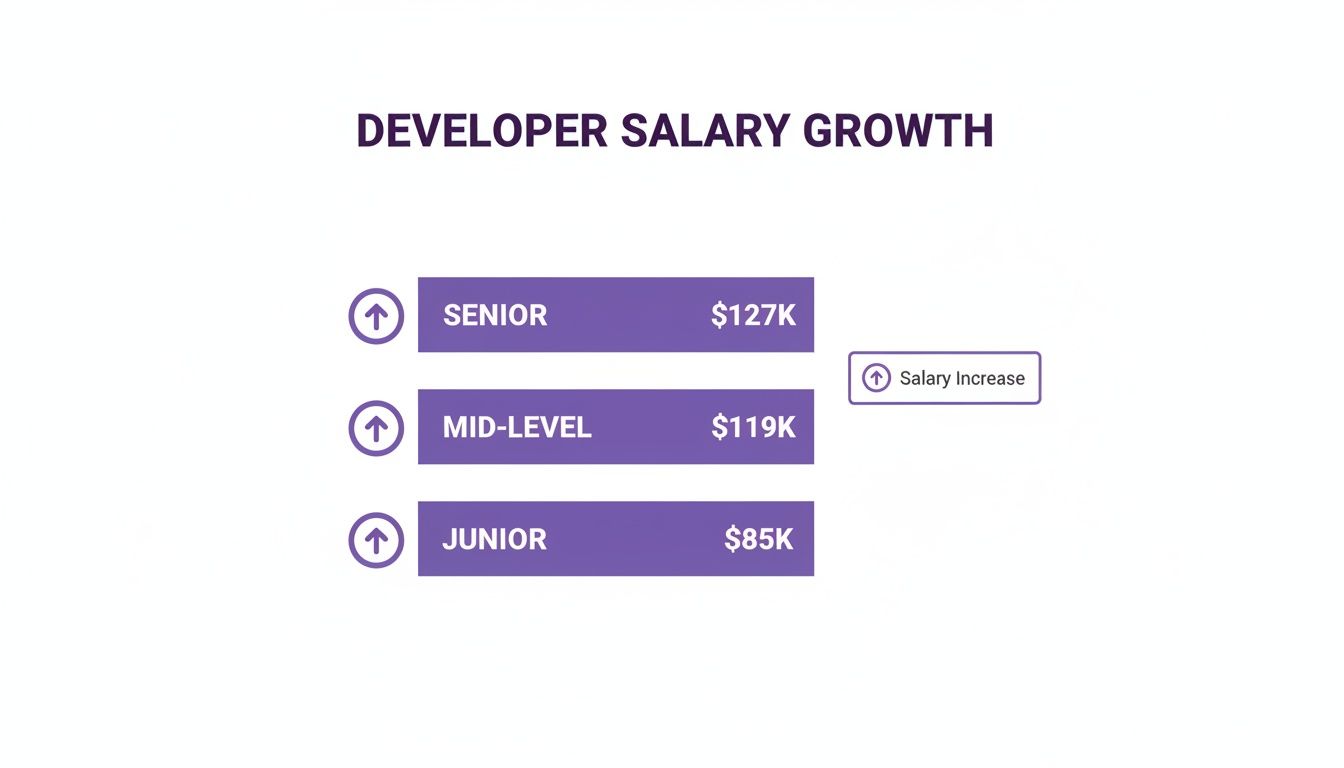
While the specific dollar amounts vary from country to country, this pattern of growth is a global constant.
Let's ground this in real numbers. Looking at salaries around the world makes it clear just how much location matters.
To give you a clearer picture, here’s a breakdown of average back end developer salaries in a few key markets, all converted to USD for an easy comparison.
| Country | Junior Developer Salary (USD) | Mid-Level Developer Salary (USD) | Senior Developer Salary (USD) |
|---|---|---|---|
| United States | ~$71,000 | ~$101,500 | ~$126,000+ |
| United Kingdom | ~$50,000 | ~$75,000 | ~$125,000+ (£100k) |
| Germany | ~$55,000 | ~$70,000 | ~$82,000+ |
| Bulgaria | ~$45,000 | ~$66,000 | ~$85,000+ |
The data paints a very clear picture. The United States leads the pack, with junior roles starting around $71,000 and the average salary hitting $101,500. A senior engineer in the US can easily pull in $126,000 or more.
But contrast that with a thriving European tech hub like Bulgaria. There, the average salary falls between $66,000 and $85,000 USD. Germany and the UK sit somewhere in the middle, with a senior developer in the UK earning up to £100,000 (roughly $125,000 USD). This means you can often hire a highly experienced senior developer in a market like Bulgaria for less than what you’d pay a junior in the US.
This kind of strategic team-building is something we explore in much more detail in our guide on offshore software development costs.
These global salary differences are exactly why remote work and global hiring have exploded. Companies are no longer stuck fishing in their local pond.
Here’s what this really means for your business:
At the end of the day, understanding geography's role in the back end developer salary equation is the first step toward building a smarter, more resilient, and more effective engineering team. It’s not about spending more; it’s about hiring smarter.
Let’s be honest: not all back end developers are paid the same, and the biggest reason often comes down to their tech stack. The specific languages, frameworks, and tools you’ve mastered are what can really multiply your paycheck.
Think of it like this: any decent mechanic can change your oil, but the one who’s a certified expert in servicing high-performance electric vehicle batteries is going to charge a whole lot more. Their specialized knowledge is in high demand and short supply.
It's the exact same story in software. A company building a lightning-fast trading platform will pay top dollar for developers who are experts in languages like Go or Rust. Meanwhile, a small business just needs a simple e-commerce site, so a developer using a more common stack will do just fine. That demand for specialized, high-performance skills is what inflates the salary.
Some programming languages just plain pay more. Why? Because they're essential for building the high-performance, scalable systems that modern companies rely on, especially in the cloud.
If you’re skilled in a language built for speed and handling lots of tasks at once, you’re already ahead of the game. Stack Overflow's annual survey consistently shows that languages like Go and Rust are at the top of the pay scale, pulling in salaries well above the industry average.
Here are a few languages that almost always mean a bigger paycheck:
Knowing a language is one thing. Knowing how to use it in the real world with the right frameworks and cloud tools is what really separates the high-earners. A developer who can just write Python is valuable, but one who can build, deploy, and scale a full application using Django on an AWS server is in a completely different league.
This is where deep knowledge pays dividends. Sure, frameworks like Django (for Python) or Node.js (for JavaScript) are industry standards, but true expertise is what commands a premium. For example, being able to clearly explain the differences between Express.js and the wider Node.js ecosystem is something that comes up in technical interviews and salary talks. We dig into this in our Express.js vs Node.js comparison.
The bottom line is this: specialization is what gets you paid. A generalist can get an application up and running. But a specialist who understands cloud architecture or DevOps is the one who makes sure it doesn't crash when a million users show up. That kind of reliability is worth a lot of money to a business.
Cloud and DevOps skills are especially hot right now. Adding these to your resume can easily tack on tens of thousands of dollars to your salary:
At the end of the day, your tech stack is your calling card. By choosing to learn in-demand languages, master key frameworks, and add valuable cloud skills, you’re not just getting better at your job—you're actively boosting your earning power for the rest of your career.
The massive shift to remote work didn't just change where we work; it completely blew up the old rules for back end developer salaries. Pay used to be tied directly to the cost of living in a specific city. A developer in San Francisco made "San Francisco money," and that was that.
Now, those geographical chains are breaking. We're seeing a more global, fluid talent market emerge, which is great news for both companies and engineers. Companies are no longer stuck fishing in the small pond of local talent, and developers aren't limited by the opportunities in their hometown.
This has been a huge equalizer. For developers in regions with a lower cost of living, it’s a golden opportunity to earn a competitive global wage that might be several times what local companies can offer.
For businesses, especially startups, it means you can find world-class engineers without the sticker shock of Silicon Valley prices. It’s a win-win that smart companies are jumping on.
The numbers tell the story. The global average salary for a remote back end developer now sits around $72,484 a year, typically falling somewhere between $59,845 and $86,454. This makes remote back end roles some of the best-paid software jobs on the planet. For hiring managers, this global rate hits a strategic sweet spot—it’s far more budget-friendly than a senior US salary but gets you significantly more experience than an entry-level hire. You can dig into more of this data on how remote work is changing developer compensation.
This new reality means founders can finally afford the senior talent they need to build a great product, without being locked out by geography.
Let's be clear: this isn't just a passing trend. Building remote teams is now a core business strategy. It allows companies to take the money they would have burned on sky-high local salaries and expensive office leases and pour it back into what really matters—product development, marketing, or simply extending their runway.
Think about the practical advantages here:
The big takeaway is that top-tier talent isn't just clustered in a few expensive zip codes anymore. It’s everywhere, ready to build incredible things for companies smart enough to look for it.
This is about more than just saving a few bucks. It’s a strategic move to build a stronger, more skilled, and more resilient engineering team. You can learn more about the benefits of hiring a global remote team and see how it works in the real world.
Understanding what shapes a back end developer salary is a great start. But the real goal is to turn that knowledge into a hiring strategy that gives you a genuine competitive edge. It’s time to think beyond the expensive, traditional approach of hiring only in your local market.
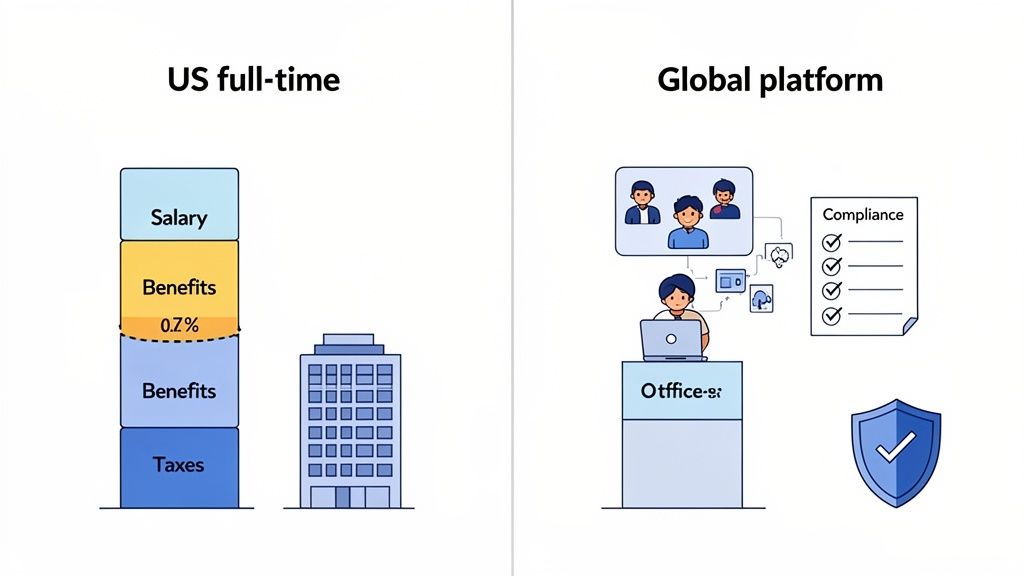
Let's break down the numbers. When you hire a full-time developer in the US, the salary you see on the offer letter is just the tip of the iceberg. The true cost to your company is significantly higher once you add up all the overhead.
This is where the figures can get a little eye-watering.
Hiring locally means dealing with a whole ecosystem of expensive, often hidden, costs. It’s not just about the paycheck; it’s about the entire employment infrastructure you’re suddenly responsible for.
These extra expenses typically include:
Suddenly, that developer with a $120,000 base salary is actually costing your company well over $160,000 per year.
Now, let's compare that to the much simpler model of hiring through a global talent platform. This isn't just about finding a developer at a lower rate; it's about a fundamentally more efficient and flexible way to build your team. You’re getting access to the top 1% of engineers worldwide without all the financial and administrative baggage.
The core idea is simple: you pay a clear, all-inclusive monthly rate for a senior-level developer. The platform handles all the messy details—international payroll, benefits, and legal compliance—so you can stay focused on building your product.
This approach flips the script on hiring. It transforms a slow, expensive ordeal into a quick, strategic move. Instead of spending months and thousands on recruiters, you can get a shortlist of pre-vetted, top-tier candidates in as little as 24 hours. For more on innovative hiring and global talent trends, you can find some great insights from the Parakeet AI blog.
This is about more than just saving money. It's a real shift in how modern companies build and scale. By tapping into a global talent network, you can build a world-class team, speed up your development cycles, and gain a massive strategic advantage—all while keeping your budget firmly in check.
When you're trying to figure out back end developer salaries, a lot of questions pop up, whether you're the one getting hired or the one doing the hiring. Let's tackle some of the most common ones to give you a clearer picture of the compensation landscape.
Think of this as the practical advice you need for negotiating your next role or planning your team's budget.
In a normal year, you can usually expect a 3-5% raise. This mostly keeps you in line with the cost of living and rewards solid, consistent work. But let's be real—the big jumps don't happen there.
Significant raises usually come from a few key moves:
Your base salary is just the starting point. A truly competitive offer for a back end developer is about the whole package, and the other parts can add up to a lot of value.
A strong total compensation package shows that a company invests in its employees beyond just a paycheck. It's a key indicator of company culture and long-term employee value.
Here's what a comprehensive package usually looks like:
For most businesses, the answer is a clear yes. Using a talent platform like HireDevelopers helps you sidestep the many hidden costs of traditional recruiting.
Think about it this way: a $120,000 salary in the US doesn't actually cost the company $120,000. Once you add recruiter fees (which can be 20-30% of the salary), benefits (25-40%), and payroll taxes, the total cost balloons to over $160,000.
A global talent platform wraps all of this into a single, predictable monthly rate. Not only does this give you access to incredible developers from around the world at a better price point, but it also handles all the headaches of international compliance and payroll. You save money, and you save a ton of administrative time.
You're probably in one of two situations right now. You need to hire a Scrum Master fast because delivery feels messy, or you've already interviewed a few and every candidate sounds polished, certified, and strangely interchangeable. They know the terms. They can define artifacts and ceremonies. But you still can't tell who can steady a […]

Most advice on API vs REST API starts with definitions and stops there. That's too shallow for a real project. The decision affects delivery speed, integration risk, documentation load, support burden, and even who you need to hire to keep the system stable after launch. The common mistake is treating “API” and “REST API” like […]

You're probably in one of two situations right now. You need to hire a Java developer because a core system is growing faster than your team can support, or you inherited a Java codebase and need someone who can stop the bleeding without making the architecture worse. Both situations punish vague hiring. A generic “Java […]


