

A freelance software engineer isn't just a temporary coder; they're a strategic specialist you bring in for specific, mission-critical tasks. Think of them as a highly skilled operative for getting a product launched faster, plugging a critical knowledge gap, or just giving your team the extra firepower it needs without the long-term commitment of a […]

A freelance software engineer isn't just a temporary coder; they're a strategic specialist you bring in for specific, mission-critical tasks. Think of them as a highly skilled operative for getting a product launched faster, plugging a critical knowledge gap, or just giving your team the extra firepower it needs without the long-term commitment of a full-time hire.
Knowing when to hire a freelance software engineer versus a full-time employee is a crucial strategic call. This isn't just about filling a seat. It's about injecting the right talent at the exact moment it can make the biggest impact. This flexible model is built for speed, precision, and efficiency, making it perfect for specific situations where agility is everything.
The global freelance economy has ballooned into a $1.5 trillion powerhouse, and tech-related services are at the forefront. Skilled freelancers in programming and IT now make up 47% of all freelancers, a talent pool of roughly 30 million professionals. This gives businesses an incredible opportunity to access specialized skills on demand.
One of the best times to hire a freelance developer is when you need to get your Minimum Viable Product (MVP) to market—fast. Startups and new product teams are always racing against the clock to validate an idea before the funding runs out. A freelance software engineer gives you the focused development power to build, test, and launch quickly, skipping the drawn-out recruitment process for a permanent hire.
By bringing in a specialist, you can bypass months of hiring and immediately focus on execution. That speed can be the difference between carving out a market foothold and watching a competitor get there first.
Your in-house team might be brilliant, but nobody can be an expert in everything. When a project suddenly calls for deep knowledge in something like machine learning, blockchain integration, or a specific cloud architecture, a freelance expert is the ideal solution.
They bring up-to-the-minute knowledge that your team might not have, which helps you sidestep costly learning curves and rookie mistakes. It's a win-win: your team gets to learn from a master while still delivering a top-notch product.
Business demands are never a flat line. You might land a huge project or face a sudden, immovable deadline that your current team just can't handle alone. Hiring a freelance software engineer gives you that temporary horsepower to manage these peaks.
You get an experienced developer for the exact duration of the project without the long-term overhead of a salary, benefits, and equipment. For anyone new to this model, it helps to understand the different platforms out there. You can start with our guide on freelancing platforms for beginners.
Finding a truly great freelance software engineer isn't just about scanning a resume for keywords. The best ones are a potent mix of deep technical skill, focused expertise in a specific niche, and the professional savvy to integrate seamlessly with your team.
Think of their skillset as a three-layered pyramid. The base is their core technical foundation, the middle layer is their high-value specialization, and the very top is the set of soft skills that ensures a project runs smoothly from start to finish. You need all three for a successful hire.
This is the bedrock—the absolute non-negotiables. Any freelance software engineer worth their salt must have a genuine, hands-on mastery of the fundamental programming languages and frameworks your project relies on. I'm not just talking about textbook knowledge of syntax; I mean the ability to write clean, efficient, and maintainable code that won't crumble under pressure.
You'll typically see foundational skills like these:
This is where you decide if a freelancer can even play the game. The chart below gives you a good idea of the strategic moments when bringing in someone with these strong core skills makes the most sense.
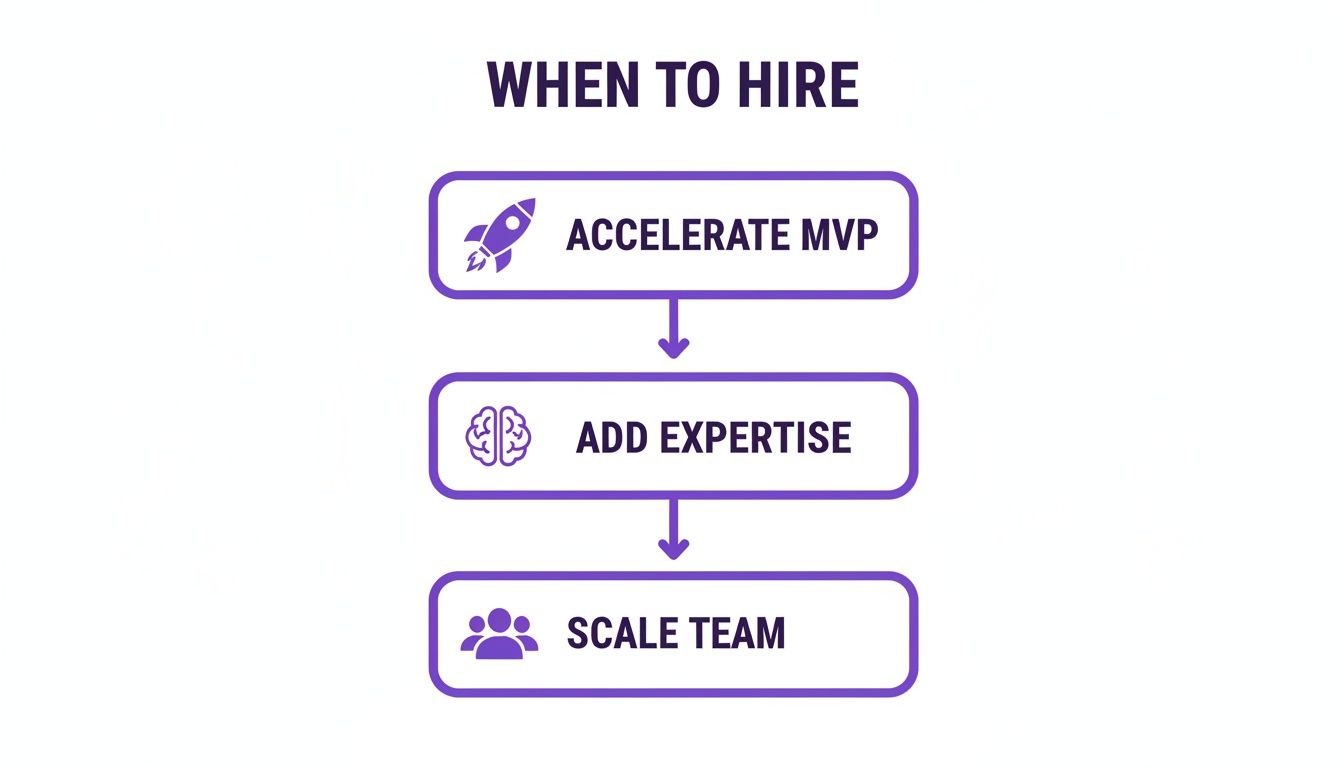
As you can see, freelancers aren't just a stop-gap for overflow tasks. They are strategic partners who can help you launch products faster, inject specialized knowledge you don't have in-house, and scale your team up or down as needed.
While the core skills get them in the door, it's the specialized expertise that truly sets an elite freelancer apart. This is what allows them to deliver massive value and solve the kind of complex, high-stakes problems that justify premium rates. Understanding the nuances of a full stack developer role, for example, can help you pinpoint exactly what kind of specialist you need.
A specialist doesn't just check off tasks on a list. They bring strategic insight from their deep experience, often spotting opportunities or preventing disasters you didn't even see coming.
Think about in-demand areas like DevOps and cloud infrastructure, native mobile development for iOS or Android, or the explosive field of AI and Machine Learning. An expert in one of these domains can deliver a solution in weeks that might take your internal team months of trial and error to figure out.
Let's be clear: technical prowess alone isn't enough. A freelance software engineer is essentially a remote partner, and their ability to work with your team is just as critical as their ability to write code. This "collaboration toolkit" is all about those essential soft skills that prevent headaches and keep projects on track.
Here’s what you should be looking for:
Figuring out how much to budget for a freelance software engineer can feel tricky. It’s tempting to just hunt for the lowest hourly rate, but that's a common mistake. The real key is to understand what drives the cost and to see the right freelancer as an investment, not just an expense. Once you make that mental shift, you're on the right track.
You’ll see rates for freelance software engineers all over the map, typically anywhere from $75 to over $200 per hour. That huge range isn't arbitrary—it’s a direct reflection of the expertise and value you're getting for your money.
A few core factors determine where a developer lands on that pricing spectrum. Knowing what they are will help you set a realistic budget and find the perfect fit for your project.
Here’s the most important mindset shift: stop thinking about cost-per-hour and start thinking about value-per-project. A top-tier, higher-rate engineer might finish the job in half the time—and with fewer bugs—than a cheaper developer, ultimately saving you a ton of money and headaches down the road.
Before we get into specific numbers, it’s helpful to see how rates break down by experience and technology. This table gives you a solid baseline for what to expect.
A breakdown of average hourly rates based on experience, region, and technical specialization to help with project budgeting.
| Specialization / Role | Junior Rate (USD/hr) | Mid-Level Rate (USD/hr) | Senior Rate (USD/hr) |
|---|---|---|---|
| Front-End (React, Vue, Angular) | $50 – $80 | $80 – $120 | $120 – $180 |
| Back-End (Node.js, Python, Java) | $55 – $85 | $85 – $130 | $130 – $190 |
| Full-Stack (MERN, MEAN, etc.) | $60 – $90 | $90 – $140 | $140 – $200 |
| Mobile (iOS/Swift, Android/Kotlin) | $65 – $95 | $95 – $150 | $150 – $210 |
| DevOps / Cloud Infrastructure | $70 – $100 | $100 – $160 | $160 – $220 |
| AI / Machine Learning | $80 – $120 | $120 – $180 | $180 – $250+ |
These ranges are a great starting point, but remember they can shift based on project complexity and the other factors we've discussed.
It’s easy to get sticker shock when you see a freelancer's hourly rate next to a full-time employee's salary. But that’s not an apples-to-apples comparison. A full-time salary is just the tip of the iceberg.
The fully-loaded cost of a salaried employee goes way beyond their paycheck. You also have to account for benefits (health insurance, retirement plans), payroll taxes, paid time off, equipment, and training. All told, these overhead expenses can easily add another 25-40% on top of their base salary.
A freelancer, on the other hand, is running their own business. Their rate is all-inclusive because they cover all those costs themselves. You pay strictly for the productive hours they put into your project—nothing more. If you want to dive deeper into the numbers, our guide on software development cost estimation breaks it all down.
This model gives you incredible flexibility. You can bring in world-class talent for critical projects without taking on the heavy financial and long-term commitment of another full-time hire.
Finding a freelance software engineer is one thing, but finding a great one? That's a different game entirely. Your standard interview process just isn’t going to cut it. You need a vetting playbook that peels back the layers and shows you how a candidate really thinks, solves problems, and conducts themselves professionally.
This isn't just a "nice-to-have" anymore. The freelance market is packed with talent, and to find the best, you need to know how to source candidates effectively. A sharp, well-designed vetting process is how you filter through the noise and zero in on that top 1%.
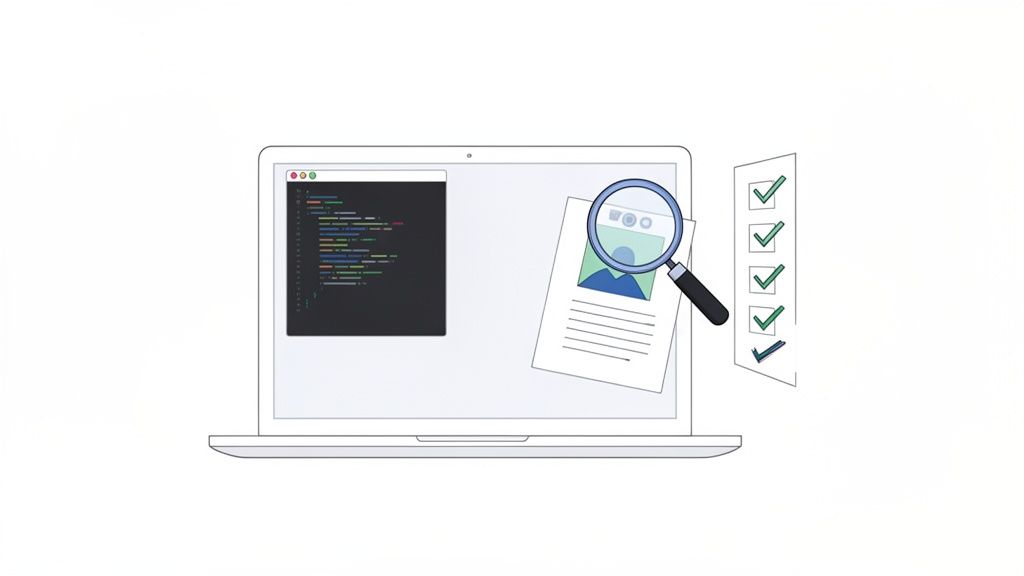
Think of a candidate's portfolio less like an art gallery and more like a collection of business case studies. Look right past the shiny user interfaces and start asking "why." You’re searching for signs of deliberate, thoughtful engineering, not just pretty pictures.
Here’s what to look for:
This initial scan is your first filter. It quickly separates the people who just assemble code from the ones who truly engineer solutions.
Forget about those abstract whiteboard interviews asking about obscure algorithms. They're relics of a bygone era that test memorization, not the real-world skills that will actually move your project forward.
Instead, give them a small, practical challenge that’s a bite-sized version of the work you need done.
The point isn't to stump them with a brain teaser. It's to see their brain work. A great candidate will ask smart questions, talk you through their logic, and deliver code that is clean and functional.
Keep the task respectful of their time—a few hours at most. It's hands-down the best way to see how an engineer approaches a problem, writes code, and communicates their decisions, all of which are mission-critical for remote work.
The final interview is where you move beyond the code and assess the person. The soft skills and professional mindset are what separate a good coder from a great partner you can rely on.
This is more important than ever. By 2028, the freelance workforce in the U.S. is projected to hit a staggering 90.1 million people. While AI might nibble at the edges of junior roles, experienced senior engineers are in high demand. Platforms like HireDevelopers.com are built around this reality, focusing on vetting that top 1% of global talent through rigorous multi-stage screenings.
Here are a few questions that get right to the heart of the matter:
You’ve vetted the portfolio, nailed the interview, and the contract is signed. The heavy lifting is done, right? Not so fast. The success of your entire project often comes down to what happens next: a thoughtful, structured onboarding that gets your new freelance software engineer up to speed and shipping code.
A clumsy start is a recipe for friction, confusion, and expensive delays. A great onboarding experience, on the other hand, sets the stage for a collaborative and productive partnership. This is more than just a welcome email—it’s about strategically integrating a specialist into your team and workflow.
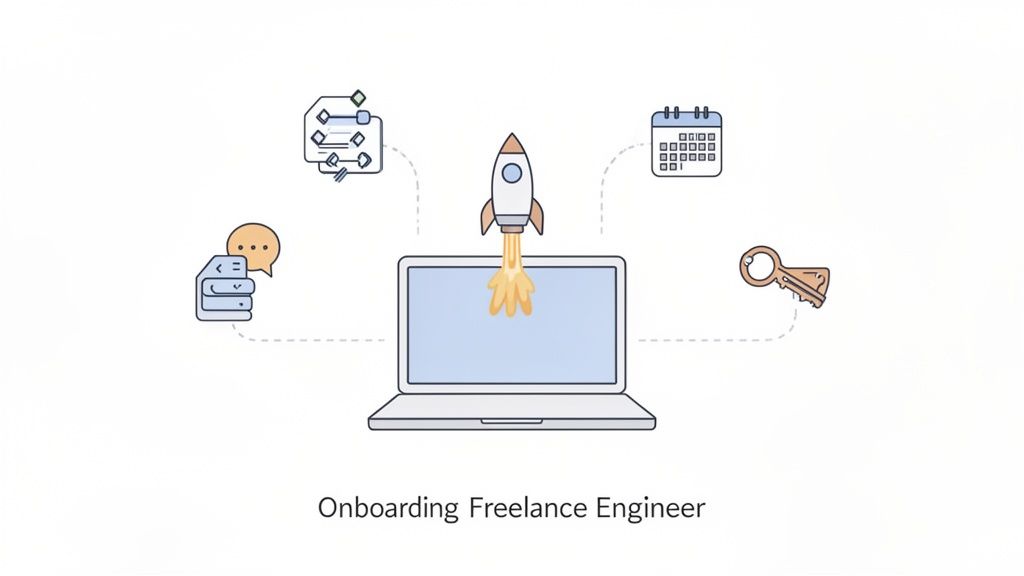
Those first few days are all about building momentum. Before a single line of code is written, your freelancer needs the right access and context. Your main job here is to clear any and all roadblocks that could slow them down.
Here’s a practical checklist to get everything in order:
Onboarding isn't just an administrative chore—it's the first real step in executing the project. A freelancer who spends their first two days chasing logins is a freelancer who isn't building your product.
Once access is handled, it’s time to define the rules of engagement. This is all about proactive communication to head off the small misunderstandings that can snowball into scope creep and missed deadlines.
Set a clear cadence for how and when you'll connect. This might look like:
Freelance software engineers are in high demand. In fact, projections show that over 52% of the U.S. workforce may be freelancing by the end of the year. This boom means the best talent has come to expect professional, well-organized clients. You can learn more about the trends reshaping the modern workforce. For a deeper dive, check out our guide on how to onboard remote employees for more detailed strategies.
Bringing a freelance developer onto your team can feel like a big step, especially if you've never done it before. You're probably wondering about the day-to-day logistics, who owns the code, and whether this can be more than just a one-off project.
Let's clear up some of the most common questions we hear from founders and hiring managers.
This is probably the number one concern, and it's a valid one. But the reality is, modern development teams have already cracked this code with asynchronous communication. You don’t need everyone online at the same time to get things done.
The trick is to build a system that works around the clock. By using tools like Slack for quick chats and Jira for tracking tasks, you create a central hub for your project. Good documentation becomes your best friend, ensuring anyone can pick up a task and understand the requirements without needing a live meeting.
To make it work, just find a small window of 2-3 overlapping hours each day for any urgent sync-ups or brainstorming sessions. Combine that with daily written stand-ups, and you'll find the project keeps moving forward smoothly, no matter where your developer is based.
Another big question is about ownership. Who gets the rights to the code the freelancer writes? The answer here is simple and non-negotiable: you do.
Your company must own 100% of the intellectual property. This is handled through a clear Independent Contractor Agreement that includes a "Work for Hire" clause. This legal language ensures that all IP created during the project is automatically transferred to and owned by your company.
Don't even think about starting a project without this in place. It’s a standard, straightforward step that protects your most valuable assets and prevents any messy disputes down the road.
Absolutely. It’s a common misconception that freelancers are only for short-term gigs. In reality, many of the best freelance relationships evolve into long-term partnerships.
Think of it as having an expert on call. Many companies rely on the same freelance developers for years to handle ongoing maintenance, new feature development, and even strategic tech decisions.
This model gives you the best of both worlds: the stability of working with someone who knows your systems inside and out, combined with the flexibility to scale their hours up or down as your needs change. It’s a smart, sustainable way to get dedicated talent without the overhead of another full-time hire.
You're probably in one of two situations right now. You need to hire a Scrum Master fast because delivery feels messy, or you've already interviewed a few and every candidate sounds polished, certified, and strangely interchangeable. They know the terms. They can define artifacts and ceremonies. But you still can't tell who can steady a […]

Most advice on API vs REST API starts with definitions and stops there. That's too shallow for a real project. The decision affects delivery speed, integration risk, documentation load, support burden, and even who you need to hire to keep the system stable after launch. The common mistake is treating “API” and “REST API” like […]

You're probably in one of two situations right now. You need to hire a Java developer because a core system is growing faster than your team can support, or you inherited a Java codebase and need someone who can stop the bleeding without making the architecture worse. Both situations punish vague hiring. A generic “Java […]


