

Let's be blunt: the fastest way to get a world-class remote developer on your team is to use a specialized talent platform. This isn't just about speed; it's about sidestepping the entire traditional recruiting circus. Instead of spending months sifting through résumés and endless interviews, you get direct access to a curated, global pool of […]

Let's be blunt: the fastest way to get a world-class remote developer on your team is to use a specialized talent platform. This isn't just about speed; it's about sidestepping the entire traditional recruiting circus. Instead of spending months sifting through résumés and endless interviews, you get direct access to a curated, global pool of pre-vetted engineers who are ready to hit the ground running, often in as little as a week. The best platforms wrap screening, compliance, and payroll into one neat package, making it an incredibly efficient move.

If you see hiring remote developers as just another HR trend, you’re missing the point entirely. For savvy CTOs, founders, and engineering managers, going global is a core business strategy. It’s a powerful lever that gives you a genuine competitive edge by breaking free from the constraints of your local talent market.
The most obvious win is tapping into a worldwide reservoir of skill. Think about it: instead of fighting tooth and nail for the same few local experts everyone else is after, you can find developers with deep, niche expertise in exactly the tech stack or industry you need, no matter where they live. This freedom to hire the best person, not just the closest one, directly fuels faster scaling and a more innovative team.
Of course, cost is a massive driver. By hiring in global markets, it's not uncommon for companies to slash salary-related expenses by 50-80% without sacrificing a single ounce of quality or experience. For a startup, that’s a longer runway. For an enterprise, it’s a healthier bottom line. Those savings go right back into the business—funding product development, marketing, or other critical growth engines.
But I get it. Many leaders pump the brakes when they think about the potential headaches:
The secret is realizing these aren't deal-breakers; they're just logistical puzzles to be solved. With the right systems and partners in place, the strategic advantages completely dwarf these operational hurdles.
This is precisely where a dedicated talent marketplace like HireDevelopers.com becomes a game-changer. These platforms are engineered from the ground up to solve these exact problems, turning a potential minefield into a well-paved road. For example, a good platform takes the exhaustive vetting process off your plate, so every candidate you see has already cleared high bars for both technical prowess and soft skills.
Here’s a quick look at how the benefits stack up against the challenges, and where a platform fits in.
| Strategic Benefit | Common Hurdle | The HireDevelopers.com Solution |
|---|---|---|
| Global Talent Access | Sourcing and vetting quality candidates globally is difficult and time-consuming. | Access to a curated, pre-vetted pool of top-tier developers, matched to your specific needs. |
| Significant Cost Savings | Navigating international payroll, taxes, and compliance is a complex legal minefield. | Integrated payroll and compliance management handles all the backend complexities for you. |
| Faster Scaling | Traditional recruiting cycles take months, delaying critical product development. | Accelerated hiring timeline, connecting you with qualified candidates in days, not months. |
| Increased Diversity | Managing different time zones and cultural nuances can disrupt team collaboration. | Tools and support for asynchronous communication, plus a global talent pool that inherently fosters diversity. |
This platform-driven model transforms what was once a complex, high-risk endeavor into a streamlined, reliable process. It gives you the infrastructure for handling all the tricky bits—compliance, payments, and smooth onboarding. As you continue to explore the benefits of hiring a global remote team, you'll quickly see that the right partner makes all the difference. By offloading the administrative weight, you're free to focus on what you do best: building incredible products with exceptional people.
Before you even think about posting a job, you need a crystal-clear picture of who you're looking for. A vague "Senior Backend Engineer" job description is a recipe for disaster. It attracts a flood of mismatched candidates and wastes everyone's time, including yours. Top talent is drawn to clarity, not ambiguity.
The foundation of any successful hire is a well-defined role. This really boils down to two things: the technical skills you can't live without and the kind of person who will thrive on your team. Get this right, and you'll not only attract better candidates but also keep your entire hiring process focused and fair.
Let's start with the technical skills. The biggest mistake I see, especially with startups, is creating a "unicorn" job description that lists every technology under the sun. This doesn't just intimidate great candidates; it signals that you don't actually know what you need.
It’s far more effective to create two distinct lists: must-haves and nice-to-haves.
Must-Haves: These are the absolute non-negotiables. The skills someone needs to walk in and contribute from day one. For a mobile developer, this might be "3+ years of professional experience with Swift and UIKit" or "demonstrated experience shipping multiple apps to the App Store."
Nice-to-Haves: These are the bonus skills—things that would be great but aren't deal-breakers. Think "experience with SwiftUI," "familiarity with CI/CD pipelines," or "contributions to open-source projects."
This simple separation is your most powerful filtering tool. It stops you from passing on a brilliant engineer who ticks 80% of the boxes just because they lack a secondary skill they could pick up in a few weeks. It also helps you write a much more honest and appealing job description.
When you clearly distinguish between essential and desirable skills, you widen your talent pool. You’re inviting candidates who are strong in the core requirements to apply, rather than scaring them away with an endless wish list.
With your skills defined, you can now write a job description that works. Don't think of it as a formal HR document. It’s a marketing asset, designed to sell the role to the best engineers in the world.
A remote job description that stands out from the noise includes:
To keep your process consistent and fair, create a simple evaluation scorecard before you interview anyone. This is your best defense against hiring bias, ensuring every candidate is measured against the same yardstick. It doesn't have to be complicated.
Here's a sample to get you started:
| Criteria | Weight | Score (1-5) | Notes |
|---|---|---|---|
| Technical Skills (Must-Have) | 40% | ||
| GoLang Proficiency | Code examples were clean, but struggled with concurrency question. | ||
| API Design Experience | Explained RESTful principles clearly. | ||
| Soft Skills | 30% | ||
| Communication Clarity | Articulate and concise answers. | ||
| Problem-Solving Approach | Broke down the problem logically. | ||
| Cultural & Team Fit | 30% | ||
| Asynchronous Work Style | Experience working with distributed teams. | ||
| Ownership Mentality | Asked great questions about project impact. |
This simple tool transforms gut feelings into objective data, making your final decision much easier and more defensible.
This whole process—defining the role, separating skills, and creating a scorecard—is exactly where a platform like HireDevelopers.com comes in. They work with you to refine these requirements from the get-go, so the pre-vetted candidates you see are a perfect match from the start. They handle the heavy lifting of translating your business needs into a precise technical and cultural profile, saving you from the immense cost of a bad hire.
So, you’ve perfectly defined the role. Now comes the real adventure: diving into the global talent pool to find and, more importantly, verify the right engineer. Finding a developer with a great-looking resume is just the start; you have to be absolutely sure they have the skills to back it up. That means moving beyond a simple chat and into a process that validates their real-world abilities.
The world of work has changed for good. Remote job postings have tripled since 2020, a clear signal that hiring elite talent from anywhere on the planet is the new normal. Before the pandemic, a remote role was a rarity, making up just 4% of U.S. job listings. Today, that number has jumped to over 15%. This is a massive opportunity, but only if you know where to look.
The channels you use to find candidates will make or break your hiring success. Different platforms attract different kinds of talent, so it pays to understand the trade-offs.
This whole process starts with a solid foundation: defining exactly who you need.
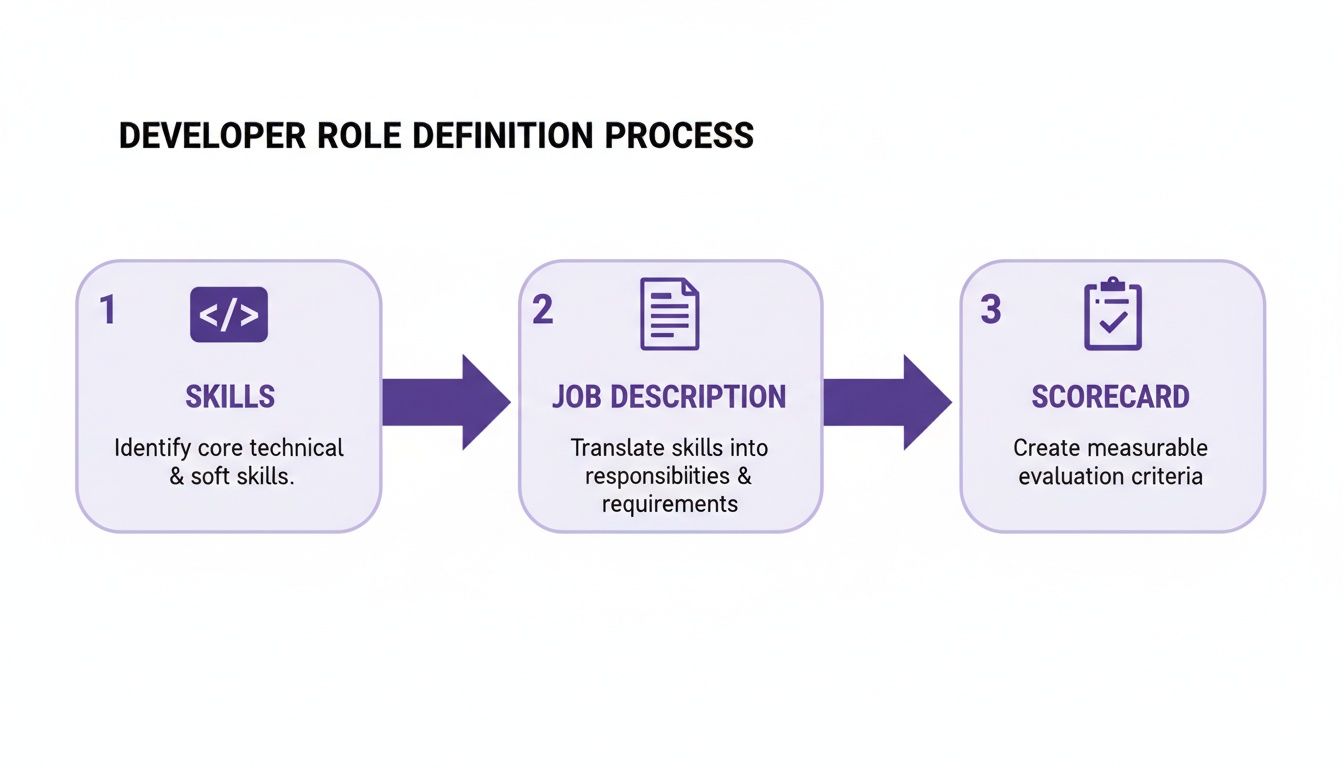
Nailing down the skills, the job description, and a clear scorecard first brings focus and clarity to every step that follows.
A thorough vetting process is your single best defense against a bad hire. It needs to test for skills in a way that reflects how your team actually works. Forget about abstract brain teasers—focus on practical problem-solving. And in today's global market, you also need to be sure you're onboarding legitimate talent; incorporating robust identity verification is a non-negotiable step.
A battle-tested vetting funnel usually looks something like this:
The goal isn't just to see if they get the right answer. It's to understand how they think. A great engineer can talk through trade-offs, explain why they chose a certain architecture, and work with you to find a solution.
The final interviews are where you confirm everything—technical depth and cultural fit. Pairing a live coding challenge with smart behavioral questions gives you a 360-degree view of the candidate.
A live coding session is the best way to see how someone thinks on their feet. But please, don't ask them to invert a binary tree on a whiteboard. Give them a small, practical problem that mirrors a task they’d actually do on your team.
For a Backend Engineer, you could try this:
These questions are your window into how a candidate operates in a real-world work environment. Use the STAR method (Situation, Task, Action, Result) as a framework to get detailed answers.
Try adapting some of these:
At HireDevelopers.com, this entire multi-stage vetting process is already baked in. Our AI screening, live skills assessments, and in-depth technical interviews are all designed to find the world's top 1% of engineers. By the time a candidate lands in your inbox, they’ve been thoroughly vetted, so you can skip straight to the high-value conversations that matter most. For even more strategies, check out our guide on how to find developers.

When you decide to hire remote developers, you aren't just widening your search radius—you're making a strategic financial move. Looking beyond the sky-high salaries of tech hubs like Silicon Valley opens up a world of opportunity where exceptional skill meets incredible cost-efficiency.
For startups and scale-ups, this isn't just a minor budget tweak. It's a game-changer. The ability to bring on two or three world-class engineers for the price of one in a major US city can literally change your company's trajectory, accelerating your product roadmap and stretching your runway.
The numbers speak for themselves. By tapping into regions like Latin America, Southeast Asia, and Eastern Europe, companies can often slash salary expenses by 50-80% without a single compromise on talent quality. This isn't about finding "cheap" labor; it's about smart global economics.
A senior full-stack developer in a hot US market might demand a salary north of $150,000. An engineer with the exact same skills and experience in a rising tech hub like Brazil or Poland might have a salary expectation closer to $60,000-$80,000. That difference goes straight back into your business, fueling growth.
These emerging markets are talent goldmines, home to millions of specialists with salaries that can be up to 75% lower than US equivalents. Recent analysis shows Latin America's depth, with Mexico and Brazil each having over 250,000 tech professionals. Meanwhile, hubs like Santiago, Buenos Aires, and Bogotá each have more than 100,000 specialists.
The opportunity is massive. You can build a powerful, globally distributed team that hands you a serious competitive advantage.
While the cost savings are compelling, the strategic benefits of hiring from global talent hubs run much deeper. These regions offer unique advantages that can directly boost your team's productivity and innovation.
For North American companies, hiring in Latin America offers a massive logistical win: time zone alignment. A developer in Colombia or Brazil works hours that almost perfectly overlap with your teams in New York or Chicago.
This "nearshore" model means:
Tapping into nearshore talent hubs removes one of the biggest headaches of remote work. You get the global talent you want with the daily collaboration you need.
Another common myth is that language barriers will trip you up. The reality? Many of the top global tech hubs boast incredibly high levels of English proficiency.
Countries like Poland, the Philippines, and South Africa consistently rank high on global English proficiency indexes. Their education systems often emphasize English from a young age, and their engineers are used to working in international environments. This ensures communication flows smoothly, from a detailed technical spec to a casual chat on Slack. For a deeper analysis, our guide on the best countries to hire remote developers offers detailed regional comparisons.
This is where HireDevelopers.com comes in. We give you direct, compliant access to these high-value talent pools. We’ve already vetted the candidates for their technical skills and communication chops and handle all the messy international payroll and legal stuff. You can focus on what matters: integrating your new high-impact team member and building a great product.
You’ve found your perfect developer. Now comes the part that can feel like a minefield: getting them from "candidate" to a fully integrated team member. This final stretch—handling contracts, navigating compliance, and nailing the onboarding—is where great remote working relationships are made or broken.
This isn't just paperwork. How you handle these final steps sets the tone for everything that follows. It's about building a foundation of trust, security, and productivity right from day one.
Your first big decision is how to legally engage your new developer. This choice impacts everything from taxes and benefits to your company's liability. You’ve really only got two paths, and they're quite different.
Most companies, especially startups, start by hiring global talent as independent contractors. It’s the faster, more direct route. You create a straightforward contract that defines the work, the deliverables, and how you'll pay them. This gives you incredible flexibility and keeps the administrative burden low, which is a huge win for project-based work or when you're just starting to build your team.
The other option is using an Employer of Record (EOR). Think of an EOR as your legal partner in the developer's home country. They take care of all the tricky stuff—local payroll, taxes, benefits, and compliance—on your behalf. If you're looking for a long-term, committed team member and want to offer competitive benefits without the headache of setting up a foreign legal entity, an EOR is the way to go. It’s also critical to stay on top of the rules for remote worker compliance for multi-state employers as well as international regulations.
Choosing between a contractor and an EOR isn't just a legal formality—it defines the relationship. The contractor model prioritizes flexibility and speed, while the EOR model provides stability and deeper integration for long-term team members.
A fantastic onboarding experience is your best shot at making a new remote hire feel like they truly belong. If you rush it or seem disorganized, you risk them feeling disconnected and unproductive from the get-go. But a well-thought-out plan can have them making an impact almost immediately.
A solid remote onboarding process always hits three key areas:
Systems & Access: This is the non-negotiable first step. Before day one, make sure they have logins and permissions for everything. We're talking code repos, project management tools (like Jira or Trello), communication channels (like Slack), and any cloud accounts. Nothing kills first-day excitement like spending hours just waiting for access.
People & Culture: Remote work is all about intentional connection. Set up a few short, casual video calls with the people they'll work with most closely. And here's a pro tip: assign them an "onboarding buddy." This is another engineer who can answer all the small, practical questions about the codebase, team workflows, or just how things really get done around here.
Project & Goals: Get them a win, fast. Give them a small, clearly defined starter task that lets them get their hands dirty with the codebase and make a real contribution in their first week. It’s a huge confidence booster and a great way to show them how efficiently your team operates.
The global talent pool has also created huge opportunities for cost savings. Based on data from over 450,000 developers, the worldwide average salary for a remote software engineer is $70,877. But a closer look shows just how much that varies: the average is $82,757 in North America, $60,363 in Latin America, and $56,483 in Asia. You can find more data on global developer salary trends on Arc.dev.
This is where HireDevelopers.com completely changes the game. We take this entire administrative burden off your shoulders. All the complexities of contracts, global payroll, and compliance are handled for you, with flexible engagement models designed to protect your business. You get access to world-class talent without the legal headaches, so you can focus on what you do best: building your product and welcoming your new team member.
Deciding to hire remote developers is a big move, and it's natural to have a few questions swirling around. What's the real cost? How can you really know you’re getting top talent? And what about the cross-border legal stuff? Getting straight answers is the first step to building a global team you can count on.
I've been in this game a long time, and I've heard just about every question there is. Below, I’ve broken down the most common ones I get from founders, CTOs, and hiring managers to cut through the noise and give you some real clarity.
The cost of a remote developer can swing wildly, and it really comes down to three things: where they live, how many years they've been in the trenches, and their specific tech stack. Honestly, that variation is where your strategic advantage lies.
Think about it this way: a senior developer in North America can easily pull in a salary north of $82,000. But an engineer with the exact same skills in a bustling Latin American tech hub might have a salary expectation closer to $60,000. That’s not a gap in quality; it's just a reflection of different local economies.
This reality lets smart companies save a significant amount of cash, extending their runway and scaling their teams faster than they thought possible. It’s not about finding the cheapest person, but about finding world-class talent at a fair, sustainable market rate. Platforms like HireDevelopers.com give you a transparent look at this global talent pool, so you can build a killer team that actually fits your budget.
If you want to reliably vet remote engineers, you have to look past the resume. A simple interview just won't cut it. The best approach is a structured, multi-stage process that tests both their technical chops and the soft skills that actually matter.
A solid vetting funnel almost always includes these steps:
This layered approach is designed to see how a candidate thinks, communicates, and executes—not just what’s on their CV. It's the single best predictor of on-the-job performance and how we consistently find developers in the top 1%.
This is the exact rigorous process we built into the HireDevelopers.com platform. We run this gauntlet for you, meaning every candidate you meet has already cleared the hurdles for technical excellence and strong communication. It saves you an incredible amount of time.
Okay, let's talk about the part that usually scares people the most: international payroll and legal compliance. It feels complicated, but the good news is, this is a solved problem.
You really have two main paths you can go down:
For a lot of companies, the admin work for either option is just one more thing they don't have time for. This is where a platform can be a lifesaver. At HireDevelopers.com, we bake full payroll and compliance support right into our service. We take that entire headache off your plate so you can just focus on building great software with your team.
We all know traditional hiring can be a painful, months-long slog. But when you tap into a dedicated remote talent platform, you can crush that timeline down to just a few days.
With a service like HireDevelopers.com, the entire system is built for speed. We have a pre-vetted pool of engineers ready to go, so you can get a hand-picked shortlist of qualified candidates within 24 hours of telling us what you need.
Because all the time-consuming screening and technical tests are already done, you jump straight to the final, meaningful interviews. This means we often see clients go from their first call with us to their new developer's first day in under a week. That kind of speed is a massive competitive advantage, letting you scale your team and hit your product goals without the usual friction.
You're probably in one of two situations right now. You need to hire a Scrum Master fast because delivery feels messy, or you've already interviewed a few and every candidate sounds polished, certified, and strangely interchangeable. They know the terms. They can define artifacts and ceremonies. But you still can't tell who can steady a […]

Most advice on API vs REST API starts with definitions and stops there. That's too shallow for a real project. The decision affects delivery speed, integration risk, documentation load, support burden, and even who you need to hire to keep the system stable after launch. The common mistake is treating “API” and “REST API” like […]

You're probably in one of two situations right now. You need to hire a Java developer because a core system is growing faster than your team can support, or you inherited a Java codebase and need someone who can stop the bleeding without making the architecture worse. Both situations punish vague hiring. A generic “Java […]


