

The very nature of software engineering is changing. It's moving away from a world of pure, manual coding and toward one of strategic system design. Fueled by AI automation, the rise of cloud-native architecture, and a truly global talent market, the engineer's role is evolving. We're seeing a shift from hands-on builder to high-level architect—someone […]

The very nature of software engineering is changing. It's moving away from a world of pure, manual coding and toward one of strategic system design. Fueled by AI automation, the rise of cloud-native architecture, and a truly global talent market, the engineer's role is evolving. We're seeing a shift from hands-on builder to high-level architect—someone who orchestrates intelligent systems to solve core business problems.
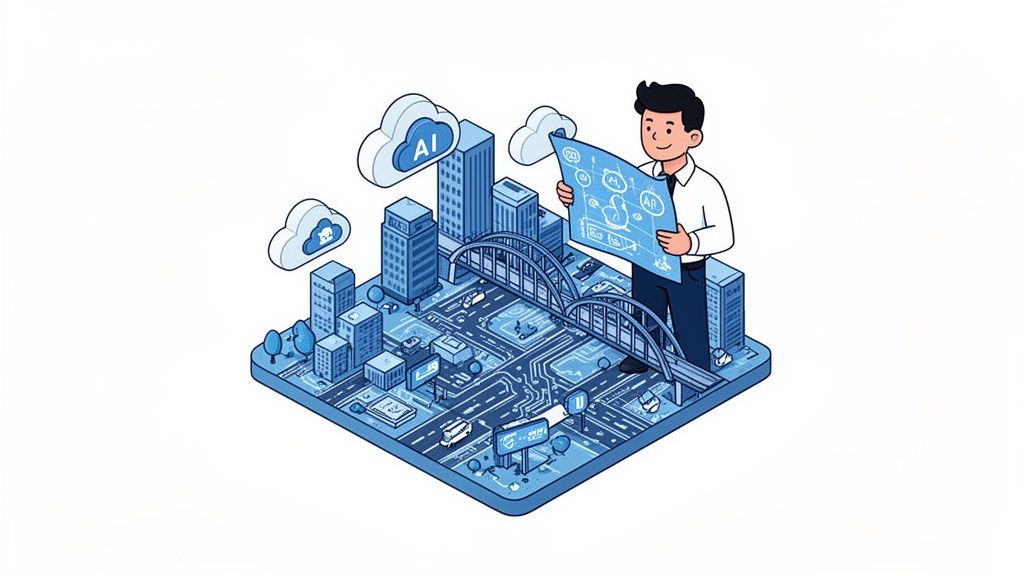
The ground is definitely shifting under our feet. What used to be a discipline defined by painstakingly writing code line-by-line is now becoming a field centered on high-level architecture, smart automation, and seamless integration. This isn't just a minor patch; it's a fundamental rewrite of the entire engineering playbook.
I like to think of the traditional software engineer as a master stonemason, meticulously carving and placing each stone to build a cathedral. The future, however, positions the engineer more like a modern city planner. Instead of laying individual bricks, they're designing the entire grid—the infrastructure, the automated public services, the interconnected systems—that allows a metropolis to function, adapt, and grow.
Several powerful trends are converging to reshape the industry. For any CTO, founder, or engineering leader trying to build a team that lasts, getting a handle on these forces is the critical first step.
The core shift is from writing code to architecting outcomes. An engineer’s value is increasingly measured not just by their fluency in a specific language, but by their ability to leverage powerful tools, design robust systems, and deliver real business impact.
For leaders, this new reality is both a challenge and a massive opportunity. It means rethinking how you hire, how you structure your teams, and what skills you prioritize. The most successful engineering organizations of tomorrow will be the ones that fully embrace this "city-planner" mindset, focusing on the big picture while using incredible new tools to handle the details.
To make this more concrete, let's break down the key trends and what they mean for your team on a practical level.
Here's a quick summary of the most impactful trends and their immediate implications for engineering teams and business leaders.
| Trend | Core Concept | Impact on Engineering Teams |
|---|---|---|
| AI as a Co-Pilot | AI tools automate routine coding, debugging, and testing. | Increases productivity; shifts focus to system design and problem-solving. |
| Low-Code/No-Code | Platforms enable non-engineers to build applications. | Frees senior developers for complex tasks; requires governance. |
| Cloud-Native First | Building scalable apps with microservices and serverless. | Enhances scalability and resilience; demands new architectural skills. |
| Global Talent Access | Hiring vetted engineers from anywhere in the world. | Solves local talent shortages and reduces costs; requires remote-first culture. |
Understanding these shifts is the first step. The next is figuring out how to adapt your strategy to not just survive, but thrive in this new environment.
Artificial intelligence is changing the game in software development, but probably not in the way you think. The common fear is that AI will replace engineers. The reality? It’s becoming an indispensable co-pilot, handling the grunt work so developers can focus on what they do best—solving complex problems and designing elegant systems.
This partnership between human creativity and machine efficiency is what's really driving the future of engineering.
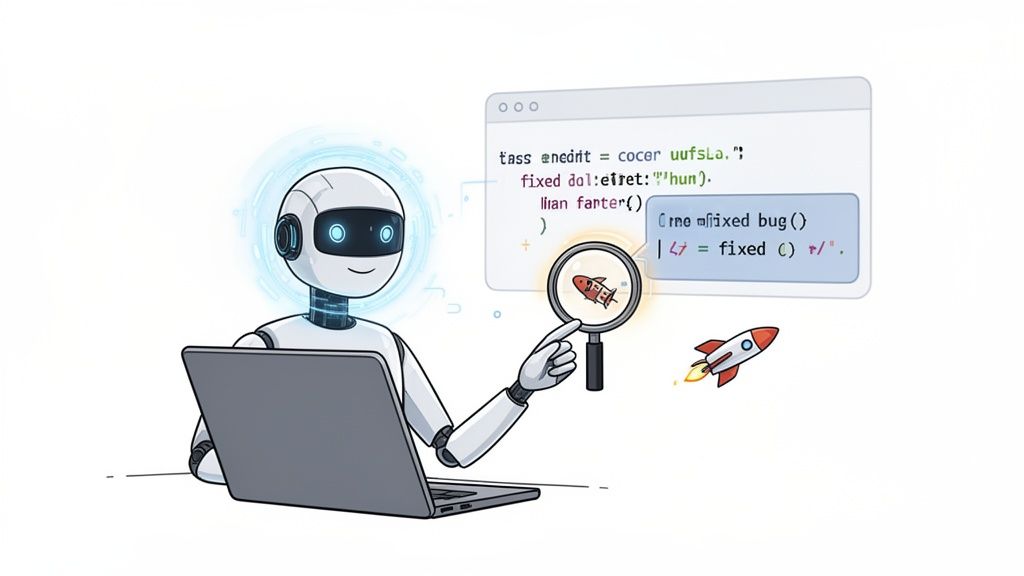
Take a tool like GitHub Copilot. It doesn’t just build an entire app on its own. Instead, it acts like a hyper-competent junior developer, suggesting lines of code, finishing functions, and spitting out boilerplate in seconds. This isn't just a minor time-saver; it fundamentally changes the workflow, freeing up mental energy and letting engineers ship code faster.
Essentially, the job is shifting. It's less about hammering out every single line of code and more about strategically guiding AI tools to generate the right code.
Right now, the most obvious impact of AI is in automating code generation. Today's tools are getting remarkably good at tasks that used to eat up hours of a developer's day. This isn't just about making things faster; it's about giving engineers more time to innovate.
Think about debugging. AI can sift through massive codebases to find the root cause of a bug, suggest a fix, and even draft the patch. What used to be a multi-hour detective mission is becoming a quick review-and-approve task.
But AI’s influence doesn’t stop at writing and fixing code. It’s being woven into the entire development pipeline to boost quality and speed.
The big idea here is the shift from writing code to orchestrating it. Engineers are becoming the architects and supervisors of a highly automated process, making sure the final product is well-built, secure, and actually solves the business problem.
To succeed in this new world, engineers need a different set of skills—skills centered on working with AI. The demand for great engineers isn't going anywhere, but the definition of a great engineer is changing. To get a better handle on this, it helps to understand why use AI in app development to unlock faster results.
One of the most important new skills is prompt engineering. This is the craft of giving clear, precise instructions to an AI to get the exact output you need. A great prompt can mean the difference between getting elegant, production-ready code and a useless block of text.
On top of that, critical thinking and code review are more important than ever. AI-generated code isn't flawless. An engineer’s job is to be the final gatekeeper, quickly judging its quality, security, and performance. The best engineers will be the ones who can ask the right questions—of the business, of their team, and of the AI. You can dig deeper into this in our guide on whether software engineers are in demand.
While AI is busy automating the routine parts of coding, another massive shift is happening that changes who gets to build software in the first place. Low-code and no-code (LCNC) platforms are popping up everywhere, handing the power to create applications to people far beyond the engineering department.
Think of them as a sophisticated box of digital LEGOs. These platforms offer a whole library of pre-built, standardized blocks—things like user logins, data forms, or payment gateways. Team members with zero coding experience can just snap these pieces together using a visual, drag-and-drop interface to build a surprisingly functional app.
This completely changes the game. A marketing manager can spin up a custom landing page for a new campaign, or an HR specialist can automate a new hire's onboarding process, all without writing a single line of Python or JavaScript.
The business impact here is huge. The most obvious win is the ability to finally get ahead of the development backlog that seems to haunt every engineering team. When people across the business can build their own simple tools, the whole company can move faster.
This isn't about getting rid of developers. It's about empowering the whole organization. LCNC platforms take the simpler builds off the engineering team's plate, freeing up senior engineers to wrestle with the tough architectural problems that really move the needle.
Instead of waiting months for engineering to build a simple internal dashboard, the operations team can whip one up themselves in a few days using a tool like Retool or Airtable. That ticket disappears from the engineering queue, and the business gets what it needs almost instantly. It makes the entire organization more nimble.
The rise of LCNC doesn't make developers obsolete; it actually elevates their role. They shift from being the builders of everything to becoming the architects and guardians of a much larger tech ecosystem. The job becomes less about fielding every small request and more about enabling others to build things safely and effectively.
In this new world, senior engineers have a few crucial jobs:
This evolution is a core part of the future of software engineering. Professional developers transition from being tactical executors to strategic enablers. They're the ones who design the playground, set the rules of the game, and make sure it connects safely to the rest of the world.
Beyond AI and low-code, the very foundation of how we build and run software is being completely rebuilt. The future of software engineering isn't just about cranking out code faster; it's about architecting systems that are scalable, tough, and secure by design. This means a full-on commitment to cloud-native principles and thinking about security from the very first line of code.
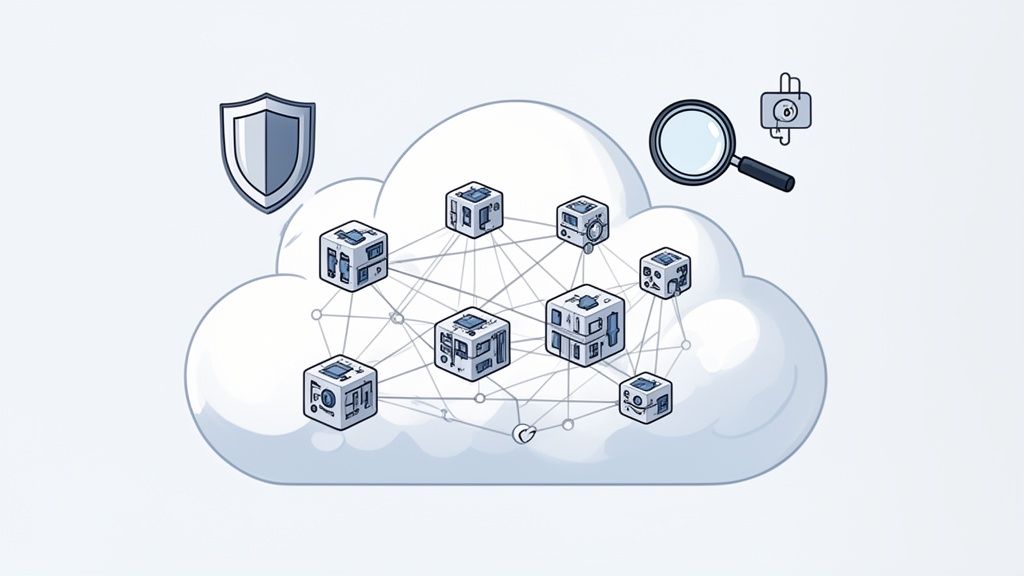
This shift means performance and reliability are no longer checklist items you handle right before launch. They are fundamental responsibilities baked into the engineering process itself.
These days, just running your application "on the cloud" doesn't cut it. Cloud-native is a whole philosophy that designs applications to take full advantage of what the cloud offers. Forget building one giant, monolithic application; the new way is to break it down into smaller, independent parts.
Think of it like this. The old method was like building a house with solid concrete walls. Need to fix the plumbing? You’d have to demolish a huge chunk of the structure.
A cloud-native approach is more like building with Lego bricks. If the "kitchen" brick has a problem, you can just swap it out or fix it without touching the rest of the house. This is the big idea behind microservices, where every feature runs as its own self-contained service.
This way of building comes with some incredible perks:
In a world where cyber threats are a constant reality, trying to bolt on security at the end of the development cycle is just asking for trouble. The modern approach is DevSecOps, which weaves security practices into every single stage of building software.
This is what we call the "shift-left" mindset. Instead of waiting for a security team to find vulnerabilities in a finished product (on the right side of a project timeline), you shift security all the way to the left—to the very beginning.
Security becomes a shared responsibility for the entire team, not just a siloed department. Developers get tools that scan for vulnerabilities while they’re coding, and automated security checks become a standard part of the deployment pipeline.
If you want to dig deeper into how automation makes this possible, our guide explaining what a CI/CD pipeline is is a great place to start. By catching security issues early, teams build much safer software and avoid those painful, last-minute fixes.
As systems get more complex and distributed (thanks, microservices!), simply monitoring them isn't enough. Monitoring tells you that something is wrong—for instance, a server's CPU is pegged at 95%.
Observability, on the other hand, gives you the tools to ask why it's wrong. It’s the difference between a "check engine" light coming on and having a full diagnostic report that points directly to the faulty sensor.
We achieve observability by collecting three key types of data:
By piecing these data points together, engineers can quickly get to the root cause of even the most confusing problems in a distributed system. This ability to truly understand what’s happening under the hood is non-negotiable for the modern software engineer.
All the incredible advancements we're seeing—from AI assistants that write code to infinitely scalable cloud architectures—all come down to one thing: skilled people. But for most CTOs and founders I talk to, finding and keeping great engineers has become the single biggest roadblock to getting anything done. This isn't just a tough hiring market; it's a deep, structural, and global problem with very real economic teeth.
The numbers are frankly staggering. By 2030, the world could be short more than 85 million software engineers. The potential economic hit? A mind-boggling $8.4 trillion in lost revenue every single year. This isn't some far-off future problem, either. Right now in the U.S., the demand for developers is growing at double the rate of the overall workforce, and we’re on track for a deficit of over 1.2 million IT professionals by 2026.
The pain is sharpest for senior roles in hot areas like AI, cloud, and security. It's not uncommon to see critical positions sit open for months, driving salaries through the roof and burning through a startup's precious runway. You can get a much deeper look at the data in this in-depth analysis of the software talent shortage.
This reality forces every tech leader to ask a tough question: If the talent I need isn't down the street, where do I find it? The answer is to stop thinking locally and start building globally.
For the longest time, hiring was a geographic lottery. If your company was in San Francisco, you hired from the Bay Area. A London startup hired from the UK. That model is broken. The only way to build a world-class team today is to tap into the massive, distributed pools of talent all over the world.
Going remote-first instantly expands your hiring pool from a small local pond to a global ocean. Suddenly, you have access to a much richer diversity of skills, experiences, and perspectives—a proven recipe for innovation. Instead of fighting over the same handful of senior engineers in your city, you can find specialists with deep expertise who happen to live in a different time zone. This creates a more flexible team and often a much more sustainable budget.
This shift brings some immediate, powerful advantages:
Of course, hiring across borders brings its own set of headaches. How do you vet technical skills? How do you handle international payroll and legal compliance? This is where modern talent platforms have become absolutely essential for any company looking to grow.
Think of these platforms not as simple job boards, but as a strategic partner that de-risks the entire process of global hiring. They do the heavy lifting of sourcing, screening, and deep technical vetting, so you only see top-tier candidates ready to hit the ground running.
These platforms are built to solve the exact pain points that make global hiring feel so daunting. They use a rigorous, multi-stage vetting process that often blends AI-powered screening with live technical challenges and in-depth soft-skill interviews. They sift through thousands of applicants to find the top 1-3% of talent. This means every single candidate you speak with has already been confirmed to have the technical chops, communication skills, and professional experience you need.
This completely changes the hiring game. Instead of spending months buried in résumés and conducting endless first-round interviews, you can get a hand-picked shortlist of senior engineers in as little as 24 hours. For a startup racing to launch or a larger company trying to accelerate a critical project, that speed is everything. You can onboard world-class talent in a fraction of the time—and often at a fraction of the cost—of trying to do it all yourself.
Let's be honest: clinging to the old, slow way of hiring is a recipe for disaster. The talent crisis isn't just a headline; it's a reality that's hitting engineering teams hard. The future of software development requires a total rethink of how you find, assess, and bring people on board. The market has completely flipped. We've moved from a world of generalist, entry-level roles to a fierce hunt for senior, multi-talented pros who can handle the complexity of today's AI-driven systems.
This means you have to start thinking skills-first. Forget sifting through stacks of resumes. The smart move is to prioritize deep, objective technical vetting. Winning leaders are already using platforms that screen candidates effectively and run tough, multi-stage assessments to see how people really solve problems in the wild.
The old "post and pray" method of job board recruiting is dead. If you're waiting weeks for applications to trickle in, you've already lost. Projections show that the average time-to-fill for developer roles is set to double by 2026. This is fueled by insane demand for AI skills and a market that’s heavily skewed toward senior talent.
This problem is only getting worse. We're staring down a global shortage expected to hit 85 million tech professionals by 2030, putting incredible pressure on companies to hire faster without lowering the bar.
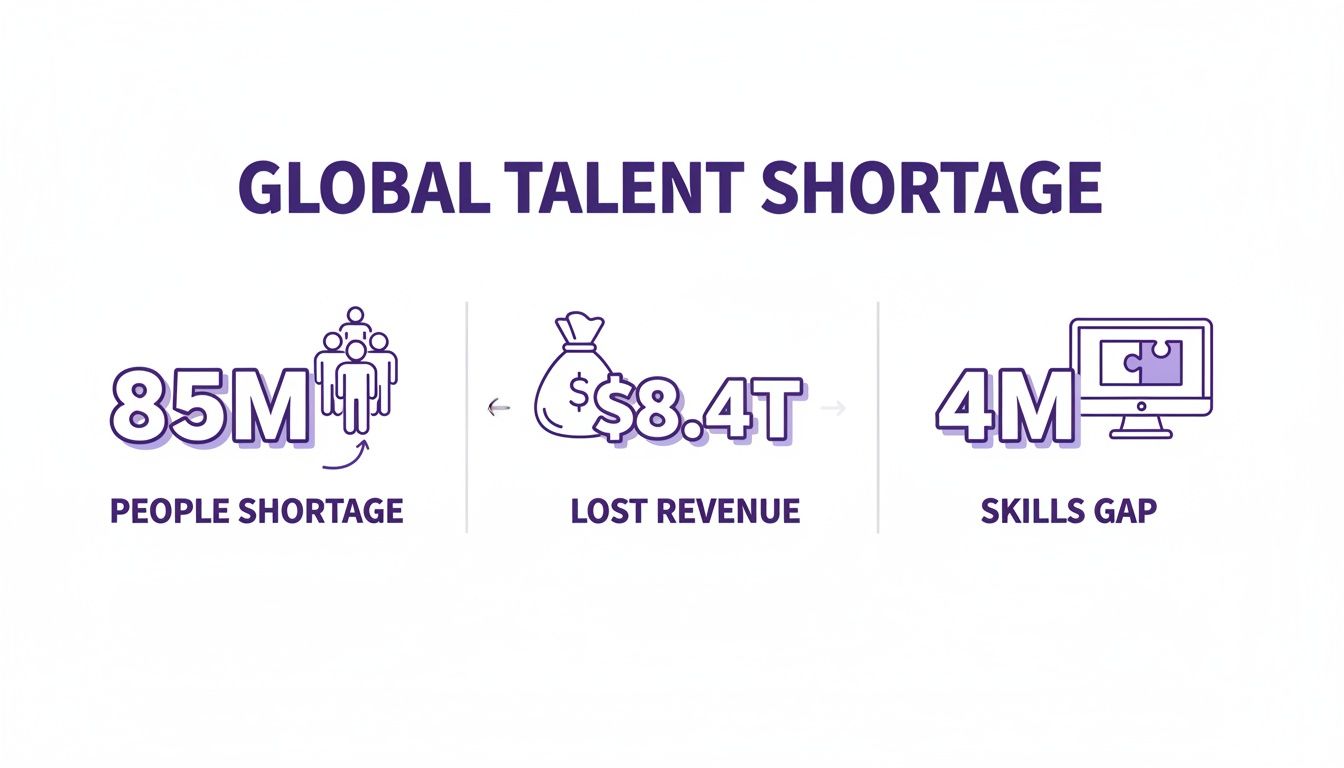
The data here is stark. Waiting around isn't an option anymore. The cost of delayed projects and empty seats is simply too high to ignore. For a closer look at these trends, it's worth exploring the most in-demand tech jobs and skills.
The most competitive companies aren't just hiring faster; they're hiring smarter. They've replaced outdated processes with agile talent acquisition models that provide access to a global, pre-vetted pool of experts on demand.
To compete, you also need to understand how top talent thinks and presents themselves. For example, knowing the ins and outs of writing a software engineer resume that lands interviews gives you a huge advantage in spotting great candidates and understanding what they're looking for.
The modern solution flips the whole hiring model on its head. Instead of a long, drawn-out search, what if you could tap into a curated network of elite global talent? This approach isn't just a small tweak; it offers some massive advantages for staying competitive.
This isn't a short-term fix. It’s a solid strategy for building resilient, high-performing teams for the long haul. By embracing vetted global talent, you can sidestep local hiring bottlenecks, cut costs, and get your hands on the rare skills you need to innovate. For a deeper dive, check out our guide on how to hire software engineers.
The future of software engineering isn’t just about writing cleaner code. It’s about being a master architect of complex systems, a creative problem-solver, and a strategic partner to the business. Success used to be measured in lines of code or features shipped; now, it’s about the ability to work alongside AI, engineer genuinely secure systems, and deliver tangible business value.
This shift puts a whole new level of expectation on developers. It’s no longer enough to be good at one thing. Continuous learning and a willingness to adapt are now table stakes.
For any CTO or engineering leader, the mandate is clear: you need to build a team that can thrive in this new reality. That means creating a culture of innovation, investing in the right tools, and assembling a group of high-performers who can turn future challenges into your biggest competitive edge.
The single most important asset you have is your team's mindset. You have to build a culture where trying new things is encouraged, not punished, and where learning is a daily activity. Give your engineers access to training on what’s next—whether that's generative AI, cloud-native security, or advanced observability practices.
More importantly, create channels for them to share what they've learned and collaborate on new ideas. This isn't just about preparing for today's tools; it's about building a team that sees inevitable change as an opportunity, not a threat.
The most impactful engineers of the next decade will be masters of adaptation. They will blend deep technical skills with strategic thinking, using AI as a partner to solve problems that were once considered impossible. This is the new benchmark for excellence.
As expectations from the business keep climbing, you need a smarter approach to team building. The pressure to deliver projects faster is relentless, but you can’t just ask your current team to work harder. The real solution is to strategically augment your crew with world-class global talent to fill critical gaps in areas like AI, cloud, and security. For more data on this trend, check out these software development market statistics.
This is where finding the right talent partner becomes a game-changer. Instead of getting stuck in long, expensive, and often frustrating hiring cycles, you can tap into the top 1% of vetted global experts who are ready to hit the ground running. It’s a powerful way to accelerate your roadmap without the traditional friction.
Here are a few practical ways to do this:
By blending your in-house talent with a global network of specialists, you build a much more resilient and agile organization—one that can out-innovate competitors, sidestep talent shortages, and confidently tackle whatever comes next.
You're probably in one of two situations right now. You need to hire a Scrum Master fast because delivery feels messy, or you've already interviewed a few and every candidate sounds polished, certified, and strangely interchangeable. They know the terms. They can define artifacts and ceremonies. But you still can't tell who can steady a […]

Most advice on API vs REST API starts with definitions and stops there. That's too shallow for a real project. The decision affects delivery speed, integration risk, documentation load, support burden, and even who you need to hire to keep the system stable after launch. The common mistake is treating “API” and “REST API” like […]

You're probably in one of two situations right now. You need to hire a Java developer because a core system is growing faster than your team can support, or you inherited a Java codebase and need someone who can stop the bleeding without making the architecture worse. Both situations punish vague hiring. A generic “Java […]


