

Hiring remote developers isn't just a pandemic-era trend anymore; it's a core strategy for any company serious about growth and innovation. The real trick isn't just throwing a job post online and hoping for the best. It’s about building a repeatable, disciplined process that nails sourcing, vetting, and onboarding talent from anywhere in the world. […]

Hiring remote developers isn't just a pandemic-era trend anymore; it's a core strategy for any company serious about growth and innovation. The real trick isn't just throwing a job post online and hoping for the best. It’s about building a repeatable, disciplined process that nails sourcing, vetting, and onboarding talent from anywhere in the world. This is how you find more than just a coder—you find a genuine, long-term contributor to your team.
The tech industry has fundamentally changed. We're no longer stuck hiring within a 30-mile radius of the office, which means we can tap into a global talent pool that was previously untouchable. This isn't just about filling roles faster. It's about finding the absolute best person for the job, period, no matter where they live. We're seeing this play out in the numbers, too, with a 49% year-over-year increase in fully remote job postings.

Think of this guide as a playbook, not just a list of tips. It’s designed to help you build a high-performing, deeply integrated remote team from the ground up.
Going remote-first with hiring brings some serious, tangible benefits that go way beyond convenience. It lets you build an engineering team that's more resilient, diverse, and surprisingly cost-effective.
Here's what you stand to gain:
The goal isn't just to fill a headcount; it's to hire an engineer who can ship production-ready features that create business value. This requires a deliberate and structured process.
Of course, it’s not all sunshine and rainbows. Hiring globally comes with its own set of puzzles to solve, like navigating cultural nuances, figuring out international payroll, and staying compliant with local laws. This guide will walk you through practical solutions for each of these hurdles, so you can build your world-class team with confidence.
If you just post a generic job description and hope for the best, you’re already behind. That’s a losing strategy in the hyper-competitive market for remote developers. The best engineers are problem-solvers at heart; they’re hunting for compelling challenges, not just a laundry list of programming languages.
Before you even think about writing a job post, you need to define the role with surgical precision. This means going way beyond a vague title like "Software Engineer."
What you need is a detailed ‘role scorecard.’ Think of it as your internal source of truth—a document that outlines not just the hard skills but the real business impact this person will have. It forces you and your team to get brutally honest about what success actually looks like six months down the road.
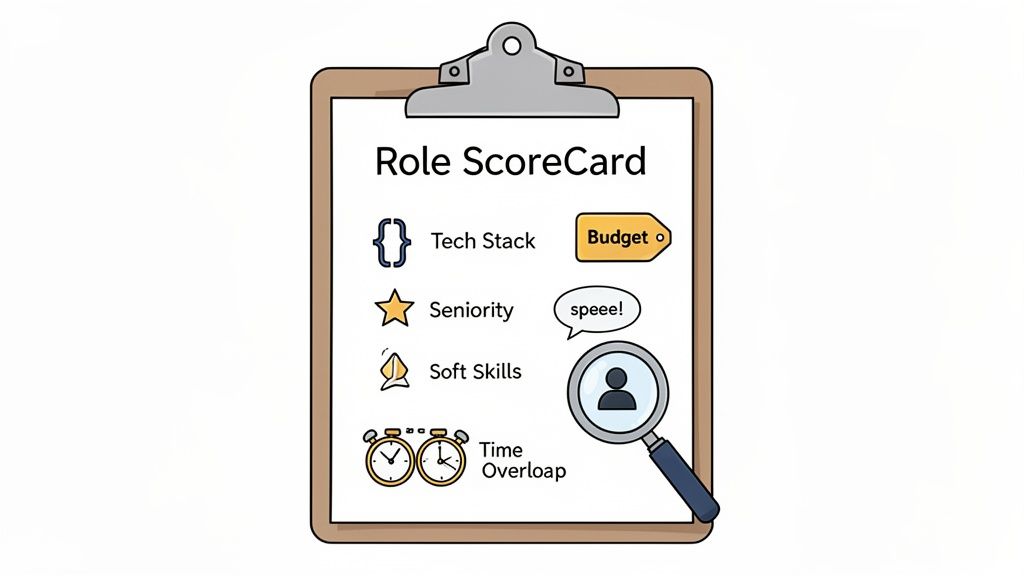
First, shift your thinking from tasks to outcomes. What specific business problem will this developer solve? Answering this question frames the entire role and makes it instantly more appealing.
For example, don't just say, "Write code for our new feature." That’s boring.
Instead, frame it as a mission: "Own the development of our new real-time analytics dashboard, from database schema design to frontend implementation, to help customers cut their reporting time by 50%." See the difference? The second version is a challenge, not just a to-do list.
This clarity is also your best tool for nailing down the right seniority level. Do you need a senior architect who can build a solution from the ground up? Or a solid mid-level engineer who can execute brilliantly on a well-defined plan? Getting this wrong is one of the most common—and expensive—mistakes companies make.
In a remote setup, pure technical brilliance isn't enough. I’ve seen incredibly talented coders fail because they lacked the soft skills to thrive without someone looking over their shoulder. Your scorecard must call these traits out explicitly.
Here’s what really matters:
A developer who can't write clearly or articulate their progress asynchronously will create friction, no matter how talented they are at coding. These skills are as important as their technical expertise.
Figuring out compensation is a huge hurdle when you start hiring globally. You’re balancing the need to attract top-tier talent with your own budget realities. Here's a pro-tip: using a single salary benchmark from your home country simply won't work.
You have to research regional salary bands. The market rate for a senior developer in Latin America is completely different from one in Eastern Europe or Southeast Asia. Platforms that specialize in global talent are your friend here; they often provide the data you need to set a realistic starting point. This approach ensures your offers are competitive for the local market and sustainable for your business.
Remember, the demand for skilled developers is exploding. The U.S. Bureau of Labor Statistics projects that software developer jobs will grow by 25% by 2031. More and more of this growth is remote, which makes a well-defined, competitive role more critical than ever. It's worth learning more about the global rise of remote jobs to understand what you're up against.
To help you get this right from the start, use the checklist below. It walks you through all the key questions you need to answer before you start your search.
| Category | Key Questions to Answer | Example (Senior Backend Python Developer) |
|---|---|---|
| Business Impact | What mission will this person own? What key metric will they move? | "Reduce API response time by 30% for our core product." |
| Seniority Level | Do they need to architect solutions or execute on a plan? | Senior: Requires someone who can lead system design. |
| Tech Stack | What are the must-have vs. nice-to-have technologies? | Must-have: Python, Django, PostgreSQL. Nice-to-have: AWS, Docker. |
| Soft Skills | What non-technical traits are non-negotiable for remote success? | Proactive communication, high accountability, autonomy. |
| Budget | What is the salary range, based on regional data? | $70k – $95k USD, based on Latin American market rates. |
| Time Zone | How many hours of overlap are required with the core team? | Minimum 4 hours of overlap with the US Eastern Time Zone. |
| Team Structure | Who will they report to? Who will they collaborate with most? | Reports to the Head of Engineering; works closely with 2 other devs. |
By building out a comprehensive role scorecard like this, you create a powerful filter for your entire hiring process. You’re no longer just looking for anyone who can code; you're looking for the right person who will truly succeed in your remote environment. This foundational work pays dividends, making every step that follows more efficient and far more effective.
Now that you have a crystal-clear picture of who you’re looking for, it’s time for the hunt. But where do the best remote developers actually hang out? Just posting a job on a massive board and hoping for the best—what I call the "post and pray" method—is a surefire way to drown your inbox in irrelevant resumes.
The truth is, the most talented engineers aren't usually scrolling through job listings. They’re passive candidates. To catch their attention, you need a smart, multi-channel sourcing strategy. This isn't about casting the widest net possible; it's about fishing in the right ponds with the right bait.
Let's break down the main channels: job boards, specialized talent platforms, and recruitment agencies. Each has its place, and knowing the trade-offs will save you a world of hurt.
General job boards like LinkedIn are the obvious first stop for many. They offer incredible reach and can fill your pipeline with applicants almost overnight. But that volume comes with a hefty price: a terrible signal-to-noise ratio. You’ll find yourself wading through hundreds of applications just to find a handful of genuinely promising candidates.
The market for remote work is white-hot. One report recently clocked a 49% year-over-year increase in fully remote job postings. To stand out, a bland job description just won’t do. You can get a sense of this trend and see which companies are leading the charge in remote hiring.
For a more targeted approach, I always recommend niche engineering job boards. These sites attract a much more qualified audience of developers. If you need some ideas, our guide to the best engineering job boards is a great starting point. Also, don't overlook platforms built specifically for remote work, like remotefirstjobs.com.
Real-World Scenario: A startup needs a mid-level frontend developer but is watching its budget closely. They have an internal TA team with the bandwidth to screen a lot of profiles. For them, a mix of LinkedIn and a few niche boards is a practical, cost-effective way to build a big initial candidate pool without a huge upfront investment.
This is where things get interesting. Specialized talent platforms are essentially curated marketplaces of pre-vetted developers. These services do the grueling upfront work for you—sourcing, technical screening, English proficiency tests, and soft skills evaluations.
What you get is a shortlist of high-quality candidates who are ready for a real conversation. The whole model is built for speed. Instead of waiting weeks for applications to roll in, you can often be reviewing qualified profiles within 24-48 hours.
Here’s why I’m a big fan of this approach:
Of course, this premium service costs more than a simple job posting. But when you calculate the hours your engineering team saves by not screening unqualified applicants, the ROI becomes incredibly compelling.
For your most critical or hard-to-fill roles, partnering with a specialized recruitment agency is the ultimate high-touch solution. Agencies are your secret weapon for finding senior leaders or developers with rare, niche skills—the kind of people who will never be actively looking for a job.
Think of a great agency as an extension of your own team. They take the time to deeply understand your company culture, the team's dynamics, and the unique challenges of the role. This allows them to pitch the opportunity to top-tier talent in a way that a cold email never could.
So, when does an agency make sense?
The main consideration here is cost. Agency fees are typically a hefty percentage of the candidate's first-year salary. This makes them impractical for most junior or mid-level roles, but for those make-or-break senior positions where a bad hire would be a disaster, it's an investment that can absolutely pay for itself.
Alright, let's get those applications sorted. Once your job post is live and the resumes start pouring in, the real work begins. Sifting through hundreds of applicants to find that top 1% requires a well-oiled, multi-stage vetting machine. A generic interview process just won't do; you need a framework that specifically tests for the qualities that make a remote developer truly great.
It’s about so much more than just coding ability. You’re hunting for engineers who have the complete package for remote success: deep technical skill, crystal-clear asynchronous communication, and the drive to solve problems on their own. Forget the tired, old interview questions. Let's build a process that shows you who a candidate really is.
The sourcing channels you use—job boards, specialized platforms, or agencies—will all send candidates of different calibers your way, which makes having a solid filtering system absolutely critical.
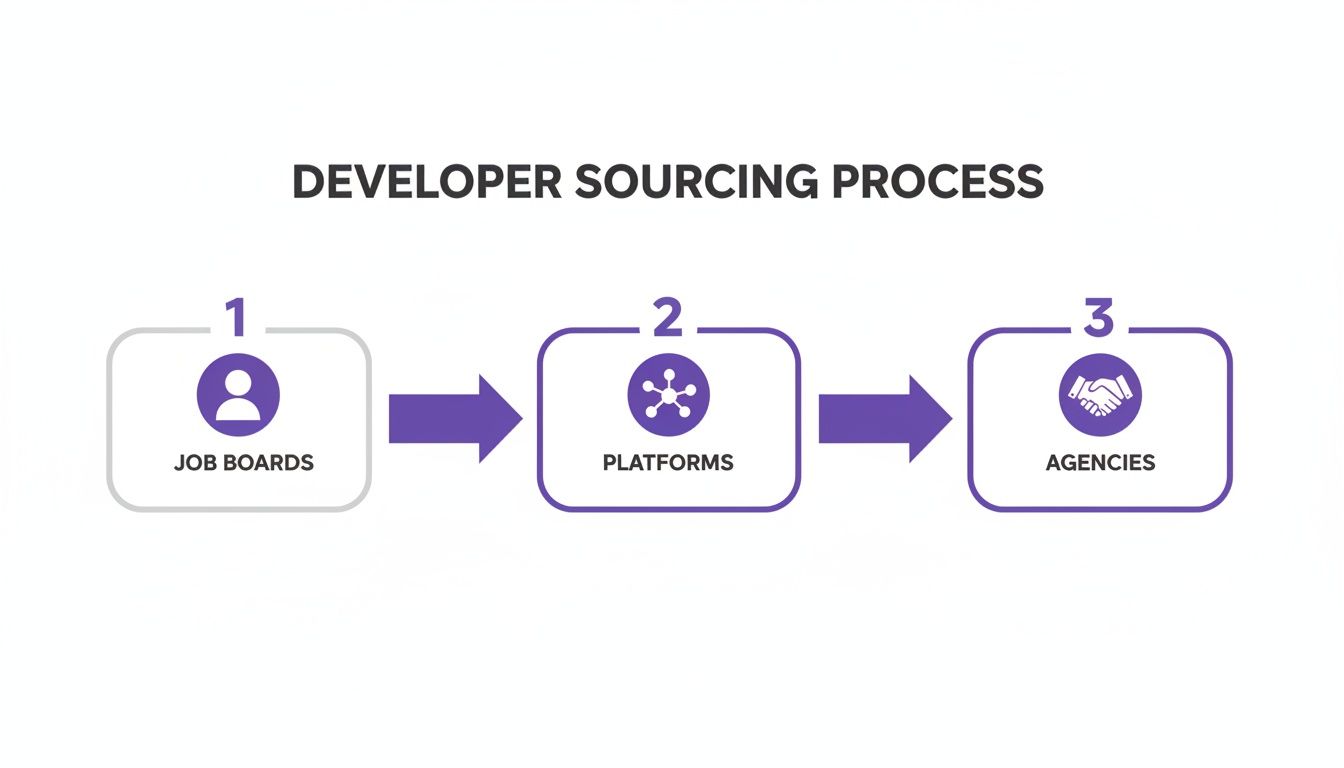
Here's how to structure your vetting process to consistently find the best remote talent.
Your first pass is all about speed and efficiency. The goal here is to quickly weed out anyone who is obviously not a fit, so you can pour your energy into the people who show real promise. Think of it as a quick scan for red flags and green lights.
What I'm looking for at this stage:
This initial screen should be fast—no more than a few minutes per resume. It's a simple filter that saves everyone a ton of time.
Forget brain teasers and abstract whiteboard problems. The best way to see if someone can actually do the job is to give them a small, practical coding challenge that reflects a real-world task. This is where you separate the talkers from the doers.
The key is to respect their time. The challenge shouldn't take more than 3-4 hours to complete. Asking someone to give up their entire weekend is a big ask, especially if they’re interviewing with other companies.
Example Take-Home Assignment: Senior Backend Engineer
Objective: Build a simple REST API using FastAPI that pulls data from a public API, performs a basic transformation on it, and sends back the result.
Requirements:
- Package the application using Docker.
- Write a simple
README.mdwith setup instructions.- Include a few basic unit tests.
You're not just looking for code that works. You're assessing their code quality, their habits (like using Docker), and whether they can write clear documentation. It’s a tiny slice of what their daily work will actually look like. Our more in-depth guide on recruiting software developers has even more tips on creating these kinds of effective tests.
After a candidate submits a solid take-home test, it’s time for a live conversation with one of your senior engineers. This isn't another coding quiz. The real goal is to have them walk you through their submission and talk through their technical decisions.
Using their own project as the basis for the discussion makes the whole thing feel more collaborative and less like an interrogation.
Here are some questions I like to ask:
Questions like these reveal how they think, how they communicate complex ideas, and how they respond to feedback—all things you can't see in a coding test alone.
For any senior role, a system design interview is a must. This is your chance to see if they can think at a higher level and design systems that are scalable and reliable. Give them a big, open-ended problem related to what your company does.
A classic example is: "Let's design a URL shortener like Bitly." There's no single right answer. You're watching to see how they ask clarifying questions, identify potential bottlenecks, and discuss the trade-offs of different architectural patterns.
A robust interview process needs to cover all the bases—from hands-on coding to high-level architecture. Here’s a breakdown of how the stages fit together to give you a complete picture of a candidate.
| Stage | Primary Focus | Format | Key Goal |
|---|---|---|---|
| Resume Screen | Experience & Communication | Async Review | Filter for basic qualifications and red flags. |
| Coding Challenge | Practical Coding Skills | Take-Home Assignment | Assess code quality, problem-solving, and good habits. |
| Technical Deep Dive | Technical Reasoning | Live 1:1 Video Call | Review their code and understand their thought process. |
| System Design | Architecture & High-Level Thinking | Live Whiteboarding | Evaluate ability to design scalable, resilient systems. |
| Behavioral & Culture | Soft Skills & Team Fit | Live 1:1 or Panel Call | Confirm alignment with remote work culture and values. |
This multi-stage approach ensures you're not just evaluating a candidate's ability to solve a puzzle, but their potential to become a valuable, long-term member of your team.
This final stage is also where you should dig into behavioral questions specifically designed for remote work. The best remote developers are excellent communicators and self-starters.
A few powerful questions to ask:
These questions get right to the heart of the proactive communication and self-management skills that are non-negotiable for a thriving remote team.
You've made it through the sourcing jungle and the interview gauntlet. The finish line is in sight—you’ve found a fantastic remote developer who crushed every single stage. Now for the tricky part: making an offer they can't refuse while navigating the minefield of global hiring.
This is where a lot of companies trip up. It's a delicate dance between putting together a compelling compensation package, figuring out international labor laws, and getting an ironclad contract in place. Get it right, and you’ve locked in top talent. Get it wrong, and you're looking at legal headaches and, even worse, losing your perfect candidate.
Crafting an offer that actually lands starts with understanding the local market. A salary that feels right in San Francisco might be completely unrealistic or, on the flip side, insultingly low somewhere else. Your budget scorecard from the planning phase was a good starting point, but now it’s time to get specific.
The real goal is to find that sweet spot: an offer that's fair for the developer where they live and sustainable for your business. This usually means thinking beyond a simple base salary.
Think about the whole package. A great offer often includes:
When you present a well-rounded package, you’re not just hiring a contractor; you're showing them you see them as a long-term partner.
One of the most critical choices you'll make is how you classify the developer. You really have two main paths, and each has massive implications for compliance, payroll, and your company's risk.
1. The Independent Contractor Route
This is often the simplest and fastest way to get started. You sign a direct contract, they send you an invoice, and you pay it. This model gives you a ton of flexibility, but it puts the entire burden of taxes and benefits on the developer. Be careful here—the working relationship must genuinely look and feel like a contractor arrangement to avoid misclassification issues down the road.
2. The Employer of Record (EOR) Model
Think of an Employer of Record (EOR) as your local legal expert on the ground. They act as the official employer in the developer's country on your behalf. An EOR handles everything—payroll, taxes, benefits, and making sure you're compliant with all local labor laws. This is a much more solid, long-term solution that dramatically cuts your legal risk and administrative overhead. It effectively makes the developer a full-fledged employee in their home country.
Choosing between a contractor and an EOR is a strategic call. For a one-off project or your first couple of global hires, the contractor route can work just fine. But as you start to scale your remote team, an EOR provides the solid legal and compliance foundation you need to grow without worry.
No matter which model you choose, a clear, comprehensive, and legally enforceable contract is absolutely non-negotiable. This document is your first line of defense and sets crystal-clear expectations from the get-go. Don't just grab a generic template off the internet; it's worth investing in a contract specifically designed for international remote work.
Your agreement needs to spell out several key things in no uncertain terms:
| Contract Clause | Why It's Absolutely Critical |
|---|---|
| Intellectual Property (IP) | This ensures that every line of code, design, and piece of work created for you belongs to you, period. This is the single most important clause. |
| Confidentiality (NDA) | You need to protect your company’s sensitive information, trade secrets, and client data. This is how you do it. |
| Scope of Work | Clearly define the role, responsibilities, and what you expect them to deliver. This prevents so many future headaches and misunderstandings. |
| Payment Terms | Get specific on the payment amount, currency, how often they'll be paid (e.g., bi-weekly, monthly), and the invoicing process. |
| Termination Conditions | Outline the notice period required and the specific conditions under which either one of you can end the contract. |
Handling these legal and financial details with care and professionalism gives your new hire incredible confidence in you and your company. It's the final, crucial step in landing that amazing remote developer and kicking off what you hope will be a long and productive relationship.
The contract is signed and the offer is accepted. You might think the hard part is over, but in reality, the most crucial phase of hiring a remote developer has just begun. I've seen it happen time and time again: a clumsy, disorganized onboarding process turns a rockstar new hire into an isolated, disengaged team member who's gone in six months.
Getting this right isn't just about hiring talent; it's about keeping it. A great onboarding plan is the bridge that connects a new person to your team. It's so much more than shipping a laptop and setting up a Slack account. It’s a deliberate, structured experience designed to immerse your new developer in your team's culture, workflows, and mission right from the get-go. This initial period truly sets the tone for their entire future with your company.
The first week is all about two things: removing friction and building human connection. You want your new developer to feel welcomed and ready to go, not completely overwhelmed.
Before their first day, make sure all their access is set up and ready. Think code repos, project management tools like Jira, cloud services, and all communication channels. Nothing kills first-day momentum faster than spending hours waiting for permissions.
Next, focus on people. Schedule a few short, informal 1:1 video calls with the key folks they’ll be working with. This isn't for a project deep-dive; it’s just to put faces to names and start building rapport.
The single most important thing you can do? Assign them an onboarding buddy. This shouldn't be their manager, but a friendly peer who can answer all the "stupid questions" everyone is afraid to ask. Think things like, "Which Slack channel is for random gifs?" or "Can someone walk me through getting the dev environment running?" It's a game-changer.
A clear plan for the first three months gives a new developer clarity and a sense of purpose. It turns a vague job description into a series of achievable milestones, which is especially critical for remote developers who can't just absorb information by being in the office.
Here's a simple framework that works:
An effective onboarding isn't a checklist; it's an experience. It’s about making a new hire feel seen, supported, and connected to the mission, ensuring they feel like a core part of the team, not just a contractor on the other side of the world.
To help your new hire hit the ground running, it’s also wise to support their physical workspace. Consider sharing resources on how to achieve the best home office setup for productivity and focus.
Finally, remember that building team culture with a remote team requires real, intentional effort. You can't just rely on spontaneous chats in the hallway.
Schedule some non-work virtual events, like casual coffee chats or team game sessions, just to foster personal connections. It also helps to create dedicated Slack channels for shared interests—things like #music, #gaming, or #cooking—which help people build community outside of project work.
This structured approach is everything. For a more detailed playbook on setting up your own system, check out our guide on how to onboard remote employees. When you invest heavily in a thoughtful onboarding experience, you aren't just setting someone up for success. You're laying the groundwork for long-term retention—and that's the ultimate win.
You're probably in one of two situations right now. You need to hire a Scrum Master fast because delivery feels messy, or you've already interviewed a few and every candidate sounds polished, certified, and strangely interchangeable. They know the terms. They can define artifacts and ceremonies. But you still can't tell who can steady a […]

Most advice on API vs REST API starts with definitions and stops there. That's too shallow for a real project. The decision affects delivery speed, integration risk, documentation load, support burden, and even who you need to hire to keep the system stable after launch. The common mistake is treating “API” and “REST API” like […]

You're probably in one of two situations right now. You need to hire a Java developer because a core system is growing faster than your team can support, or you inherited a Java codebase and need someone who can stop the bleeding without making the architecture worse. Both situations punish vague hiring. A generic “Java […]


