

To hire remote developers effectively, you can't just post a job and hope for the best. It requires a repeatable system for finding talent anywhere in the world, vetting them properly, and integrating them smoothly into your team. This isn't just about filling seats; it's a strategic move to access specialized skills and get a […]

To hire remote developers effectively, you can't just post a job and hope for the best. It requires a repeatable system for finding talent anywhere in the world, vetting them properly, and integrating them smoothly into your team. This isn't just about filling seats; it's a strategic move to access specialized skills and get a real handle on development costs.
The way we build tech teams has completely changed. The question isn't if you should hire remotely, but how you can do it to get ahead. When you open up your search to the entire globe, you suddenly have access to experts in niche technologies that are either impossible to find or wildly expensive in your local area.
Of course, it’s not without its own hurdles—you’ll be juggling time zones, cultural differences, and some tricky international compliance rules.
This guide lays out a proven, end-to-end framework. It’s a playbook built for CTOs, founders, and hiring managers who need to do more than just fill a role. The aim here is to build a distributed engineering team that actually drives your business forward.
Hiring great remote developers hinges on a disciplined process. You're not just looking for someone who can write clean code; you need a person who thrives with autonomy and can communicate effectively in a remote setting. This means rethinking how you find, interview, and bring new people on board. For a really deep dive into the entire journey, this technical guide to hiring elite remote DevOps engineers is an excellent resource.
A solid framework breaks down into three core phases, as you can see below.
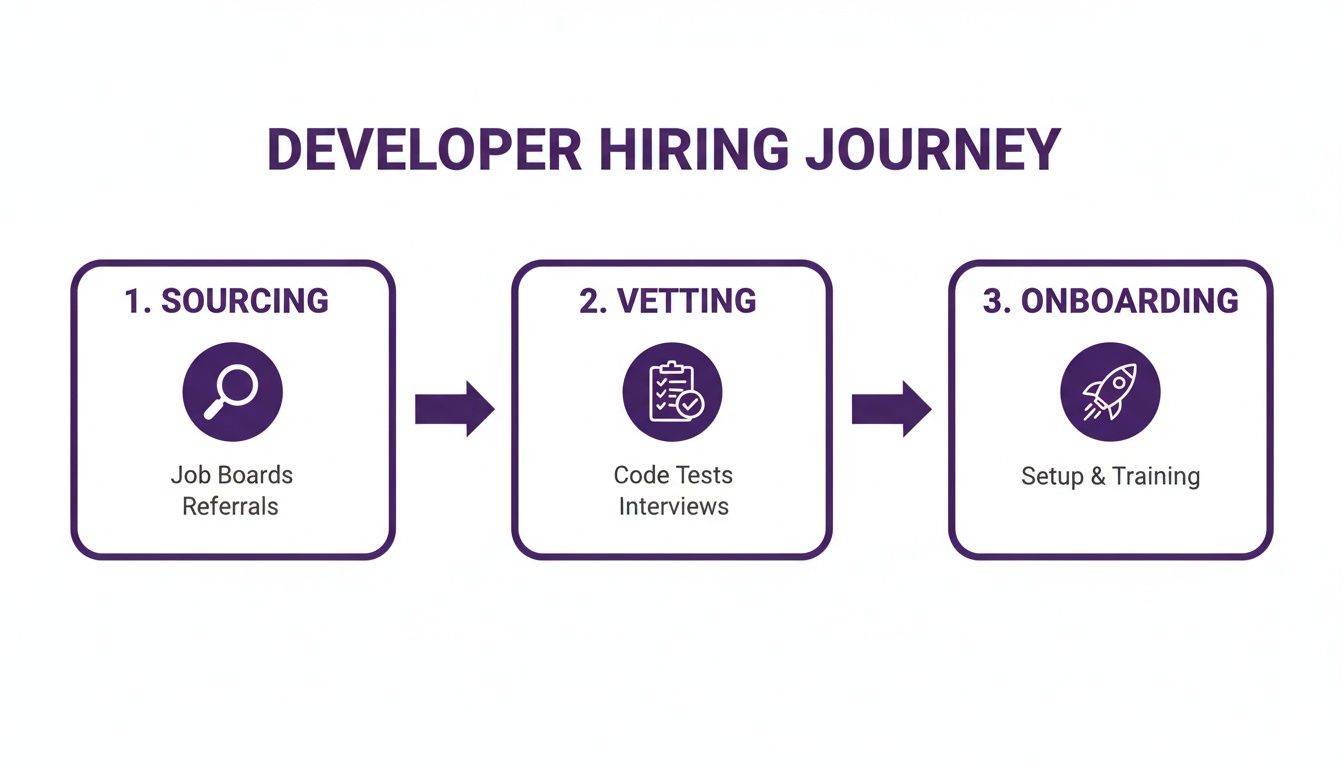
Every single stage, from finding candidates to that first week of onboarding, is crucial. It’s how you make sure a developer has the right technical chops and fits into your company’s culture and workflow.
Building a global team is about so much more than just saving money. It’s about creating a more resilient, innovative, and productive organization. When you hire developers from different corners of the world, you’re bringing in a diversity of thought that leads to better problem-solving and stronger products. We explore this further in our article on the benefits of hiring a global remote team.
By thinking globally, companies can build more dynamic and capable teams. The key is to transform the hiring process from a localized search into a worldwide talent strategy, focusing on skills and potential above all else.
This approach definitely takes some careful planning, but the payoff is huge. It sets you up to scale faster, operate more efficiently, and attract the best talent on the planet, no matter where they live.
If you want to hire top-tier remote developers, you need to go where they are—and that’s rarely on a generic job board. The best engineers aren't just passively waiting for recruiters. They're solving problems in niche communities, building things on GitHub, and talking shop on platforms that actually value their skills. The real key is to stop the old "post and pray" method and start actively sourcing.
Think about it: where do the developers you admire spend their time? Are they debating the merits of a new JavaScript framework on a Discord server? Are they a top contributor to an open-source library your team relies on? These are the modern-day hunting grounds.

This shift isn't just a trend; it's a necessity. Today, 78% of companies are already sourcing developers internationally to find the right skills. With 90% of firms expecting IT shortages by 2026, looking globally is no longer optional. In fact, 51% of companies specifically hire from around the world to find niche expertise in fields like AI and machine learning.
Your strategy for finding talent should be tailored to your specific needs. How fast do you need to hire? What’s your budget? What exact skills are you looking for? Different channels serve different purposes.
I've seen so many companies make the mistake of treating all sourcing channels the same. A startup that needs a senior Go developer in two weeks has completely different needs than an enterprise building a data science team for the long haul. You have to match the channel to the urgency and complexity of the role.
To help you decide where to focus your efforts, here's a quick breakdown of the most common channels and what they're best for.
| Sourcing Channel | Vetting Level | Speed to Hire | Typical Cost | Best For |
|---|---|---|---|---|
| Pre-Vetted Platforms | High (Technical & Soft Skills) | Fast (1-3 weeks) | Higher (Platform Fees) | Startups and companies needing to hire quickly and reliably. |
| Niche Communities | Varies (Self-Vetted) | Slow (Weeks to Months) | Low (Time Investment) | Finding highly specialized experts or building a long-term talent pipeline. |
| Open-Source | High (Code-Based) | Slow | Low (Time Investment) | Sourcing developers with proven, public-facing technical skills. |
| Specialized Job Boards | Low (Self-Reported) | Medium (3-6 weeks) | Moderate (Posting Fees) | Attracting a focused pool of active job seekers for common roles. |
| Recruitment Agencies | High | Medium | Very High (% of Salary) | Enterprises with large budgets or for executive-level technical hires. |
Each channel has its place. The trick is to build a strategy that blends the speed of vetted platforms with the targeted precision of community and open-source sourcing.
When you hire remotely, geography becomes a powerful lever, not a limitation. Different regions offer distinct advantages in cost, time zone alignment, and technical expertise. Understanding these differences helps you build a smarter, more effective team.
Two of the most common approaches I see are nearshoring and offshoring.
Knowing this helps you make strategic choices. If your team lives and breathes agile ceremonies and pair programming, a nearshore developer is probably the right call. If you need a backend wizard to tackle complex problems while your US team sleeps, an offshore engineer might be a better fit.
Ultimately, finding the right remote developer is about building a multi-channel sourcing engine. When you combine the speed of vetted platforms with the deep insights from community engagement and the strategic advantage of regional targeting, you create a repeatable system for hiring the best engineers on the planet.
When you hire a remote developer, you're not just buying lines of code. You're bringing someone into your team who needs to be autonomous, a crystal-clear communicator, and proactive. These aren't just nice-to-haves; they're essential for anyone working on a distributed team.
I’ve seen it happen too many times: a candidate with a stellar resume gets hired and immediately becomes a bottleneck. Why? Because they can't manage their own time or articulate a problem clearly. That’s why the best vetting processes I've seen are built around three core pillars: technical chops, communication clarity, and genuine autonomy. This isn't about throwing complex algorithms at people; it's about systematically uncovering the traits that predict real-world success.

A résumé tells you what a developer claims they’ve done. A practical test shows you how they actually do it. The goal here is to see their problem-solving process in action, judge their code quality, and check their comfort with modern tools—not just their memory of syntax.
A well-designed take-home coding challenge is my go-to for this. The key is to keep it short and respectful of their time—no more than 3-4 hours of work. Make the task a small, real-world problem your team would actually tackle.
This simple challenge tells you so much. You immediately see their grasp of modern frameworks, their comfort with containerization (a must-have production skill), and the clarity of their documentation.
The take-home test shows you how they work alone. The live coding session shows you how they collaborate under pressure. Forget asking them to write a binary search algorithm on a whiteboard. That’s an academic exercise.
Instead, frame it as a pair-programming session. Give them a small, well-defined bug in an existing codebase or a tiny feature to build. Then, work on it with them.
A great candidate will start treating you like a teammate, talking through their logic and bouncing ideas around. It's a powerful signal that they’ll integrate smoothly into an agile, remote environment where that kind of communication is everything.
The best live coding sessions feel less like an exam and more like the first day on the job. The goal is to see how a candidate thinks, communicates, and collaborates, not just whether they get the 'right' answer.
For a remote developer, soft skills are hard requirements. You need to know if they can manage their own work, communicate effectively in Slack, and take ownership without a manager breathing down their neck. This is where you need to get good at asking targeted behavioral questions.
These questions are designed to push past canned answers and get candidates to talk about their actual experiences.
Questions to Uncover Self-Motivation and Ownership
Questions to Assess Asynchronous Communication
Their answers will tell you whether they default to proactive problem-solving or just passively wait for instructions. You’re listening for specific examples that show a deep sense of ownership and a real understanding of what it takes to work well in a distributed team.
Just as you're looking for green flags, you have to be vigilant for the red ones. Certain behaviors can signal a poor fit for a remote role, even if the candidate is technically brilliant.
By combining practical coding assessments with deep, behavioral questioning, you can build a truly comprehensive picture of a candidate. This rigorous vetting is your best defense against a bad hire and the surest way to build a high-performing, self-sufficient remote engineering team.
You’ve found the perfect developer. They nailed the technical interview, their communication is spot on, and they’re a great cultural fit. Awesome.
Now for the part that trips up even seasoned managers: the paperwork. How do you actually hire someone from another country, legally and without a ton of hassle? This is where you shift from vetting a candidate to building a professional relationship, and getting the structure right from day one is critical.
The legal and financial side of hiring globally can feel like a labyrinth of regulations. But honestly, it usually boils down to two main paths. The one you choose will dictate how you handle payments, taxes, and your company's legal exposure when you hire remote developers.
The first big decision is figuring out the nature of the working relationship. This isn't just about labels; it has massive implications for compliance, payroll, and who owns the intellectual property they create.
The two most common models are bringing them on as an independent contractor or hiring them as a full-time employee through a specialized service.
The biggest mistake I see is companies treating a long-term, full-time developer like a freelancer just to dodge the paperwork. This opens you up to huge misclassification risks. An EOR solves this headache, letting you focus on building your product, not becoming an expert in Brazilian labor law.
For many companies, starting with a contractor model makes a lot of sense. If the relationship works out and their role becomes more central to your team, you can always transition them to an EOR arrangement for better long-term stability and legal cover.
So, which path is right for you? It really comes down to your company's risk tolerance, your long-term plans for the role, and how much administrative work you're willing to take on.
Let's break down the differences.
| Feature | Direct Contractor Agreement | Employer of Record (EOR) Service |
|---|---|---|
| Speed to Hire | Very Fast (Days) | Fast (1-2 Weeks) |
| Compliance Risk | Higher (Borne by you) | Minimal (Handled by EOR) |
| Payroll & Taxes | You pay invoices; they file their own taxes | Fully managed by the EOR |
| Benefits | Typically not included | Can include local health, pension, etc. |
| Best For | Short-term projects, initial trials, high-flexibility needs | Long-term roles, core team members, risk-averse companies |
Going the direct contractor route puts the legal burden on you. You have to make sure the contract is solid and that you aren't accidentally creating a permanent employment relationship in the eyes of the law. This is where a well-drafted agreement becomes your best friend. For a clear breakdown of what that entails, it’s worth reviewing the key elements of a robust software engineering contract to protect your business.
An EOR service, on the other hand, costs a bit more but essentially outsources this entire compliance nightmare.
No matter which model you choose, protecting your intellectual property is non-negotiable. Your remote developer will be creating valuable code and accessing sensitive company information from day one. Your contract needs to be absolutely airtight on this front.
Make sure your agreement includes crystal-clear clauses covering:
These aren't just suggestions; they're your business's armor. They ensure that even if the working relationship ends, your company retains complete ownership of the valuable assets the developer helped build. You're taking on significant, unnecessary risk without them.
The moment you hire a remote developer, the clock starts ticking. A fantastic hire can quickly sour if their first few weeks are a confusing mess of unanswered questions and unclear expectations. Believe me, the first 90 days are where a successful remote relationship is made, and a poor onboarding experience is the fastest way to lose the great talent you just worked so hard to find.
This isn't just about sending a welcome email. It's about creating a deliberate, structured experience that plugs a new person into your technical environment and—just as importantly—your company culture.
The best onboarding actually starts before your new developer's first day. This proactive approach shows you’re organized and you value their time, completely eliminating that dreaded first-day scramble where they're stuck waiting for account access. The goal is to get them set up to do meaningful work right away.
Here’s what your pre-start checklist should cover:
The first week needs to be a carefully orchestrated blend of technical deep dives, process walkthroughs, and personal introductions. The objective here is context and connection, not overwhelming them with a massive project on day one.
A balanced first-week plan looks something like this:
The goal of the first week isn't massive productivity; it's successful integration. A developer who feels connected to the team and understands the bigger picture will deliver far more value in the long run.
Technical onboarding gets a new hire coding, but cultural onboarding makes them a true part of the team. This is especially vital when you hire a remote developer who won't absorb your company's vibe by osmosis in an office. You have to be intentional about creating opportunities for connection.
Even as some companies pull back from fully remote work, the strategic advantage of global talent remains. The remote developer hiring landscape has shifted, with fully remote tech job postings now accounting for just 18% of new positions. This reflects a careful balance companies are striking between collaboration and accessing a worldwide talent pool, particularly as U.S. tech jobs are projected to surge from 6 million to 7.1 million by 2034. You can find out more about current remote developer hiring trends.
To foster a strong remote culture, build these habits:
For a comprehensive approach to integrating new remote hires and ensuring their long-term success, delve into this practical guide to employee onboarding. A well-executed plan turns a new hire into a high-performing, long-term asset.
Even with the best playbook in hand, you’re bound to have some questions when you decide to hire remote developers. That’s perfectly normal. Getting these common concerns sorted out upfront is the key to moving forward with confidence and building the global team you envision.
Let's dig into the questions I hear most often from other leaders.
This is usually the first thing on everyone's mind, and the honest answer is: it depends. A senior engineer based in a major North American city can easily run you over $150,000 a year. The good news? Looking globally opens up a whole different world of possibilities.
You can find a developer with the exact same skills and experience in a hotbed of talent like Latin America or Eastern Europe for a fraction of that cost—think somewhere in the $60,000 to $90,000 range. This isn't about finding "cheap" labor; it's about accessing world-class talent in markets with different costs of living. Partnering with a platform that specializes in these regions just makes it easier to tap into these savings while they handle all the tricky payroll and compliance details.
Let's get one thing straight: remote productivity isn't about watching the clock. It’s all about focusing on results. From my experience, it boils down to three things: hiring for autonomy, creating dead-simple processes, and using the right tools.
You have to screen for self-starters and great communicators from day one. Once they’re part of the team, your job is to track progress toward goals, not micromanage their calendar.
The foundation of remote productivity is trust, backed by clear communication. When you hire autonomous individuals and give them the right tools and context, they don't just meet expectations—they exceed them.
Here’s what works in practice:
Traditional recruiting is a slog. Trying to fill a technical role in-house can easily take months, which is a lifetime in the tech world. If you need to move fast, that old model is a massive bottleneck.
The quickest path is, without a doubt, working with a vetted talent platform. These services have already done the hard work of sourcing and screening candidates. They test for technical chops and the soft skills needed to thrive in a remote setup. Instead of drowning in hundreds of resumes, you get a handful of pre-qualified developers, sometimes in just a few days. It completely short-circuits the most painful parts of the hiring process.
Hiring internationally brings a new set of rules to the game—contracts, local labor laws, taxes. It’s a lot to handle on your own, and mistakes can be costly. You really have two main options to stay out of trouble: a direct contractor agreement or an Employer of Record (EOR).
With a direct contract, all the compliance headaches fall on you. An Employer of Record, however, acts as the legal employer in the developer’s country. They handle everything—local payroll, benefits, and legal compliance—so you can focus on building your team, not becoming an expert in international law.
You're probably in one of two situations right now. You need to hire a Scrum Master fast because delivery feels messy, or you've already interviewed a few and every candidate sounds polished, certified, and strangely interchangeable. They know the terms. They can define artifacts and ceremonies. But you still can't tell who can steady a […]

Most advice on API vs REST API starts with definitions and stops there. That's too shallow for a real project. The decision affects delivery speed, integration risk, documentation load, support burden, and even who you need to hire to keep the system stable after launch. The common mistake is treating “API” and “REST API” like […]

You're probably in one of two situations right now. You need to hire a Java developer because a core system is growing faster than your team can support, or you inherited a Java codebase and need someone who can stop the bleeding without making the architecture worse. Both situations punish vague hiring. A generic “Java […]


