

So, you're ready to hire offshore developers. The process boils down to a few key stages: figuring out exactly what you need, picking the right way to hire, vetting candidates like a pro, and then sorting out the paperwork and onboarding. Get this right, and you'll turn a potential headache into a serious competitive edge. […]

So, you're ready to hire offshore developers. The process boils down to a few key stages: figuring out exactly what you need, picking the right way to hire, vetting candidates like a pro, and then sorting out the paperwork and onboarding. Get this right, and you'll turn a potential headache into a serious competitive edge.
Let's get one thing straight: hiring offshore isn't just about saving a few bucks anymore. It’s a strategic move that smart companies are making to grow faster. Whether you're a startup trying to get an MVP off the ground or a big company hunting for niche AI talent, the mission is the same—find incredible engineers you can't find or afford at home.
The global shift to remote work has completely changed the game, making it easier than ever to build a world-class team with talent from anywhere. This isn't just a fleeting trend; it’s how modern engineering teams get built.
The numbers back this up. The global offshore software development market is exploding, on track to hit a staggering $806.55 billion by 2030. This boom is driven by a simple reality: there's a massive talent shortage in places like the US and Western Europe, but the demand for specialized skills keeps climbing.

Picture this: a fintech startup is desperately searching for senior Go developers in San Francisco. Every local candidate is either demanding an astronomical salary or just doesn't have the specific fintech background they need. Their product roadmap is stalled.
Frustrated, they decide to look abroad. Within three weeks, they’ve onboarded two battle-tested senior engineers from Eastern Europe. Suddenly, that recruitment roadblock is gone. They’re back on track, accelerating their launch by months. This guide is your blueprint to pull off the same kind of win.
Think of this as your playbook. We're going to walk through every critical step, so you can make smart, confident decisions. Here’s what we'll dig into:
A quick word of advice: hiring is just the first step. True success with an offshore team comes down to how you manage them. To make sure your new developers stick around and do amazing work, you need to master the best practices for managing remote teams.
By following this roadmap, you'll be well on your way to building a high-performing global team that can truly push your business forward.
Before you even think about where to find your next offshore developer, you need to get brutally honest about what you actually need. A vague job description is the fastest way to get buried in mismatched resumes and burn through weeks of valuable time.
Getting this right from the start is everything. It’s not just about listing programming languages. You have to paint a clear picture of the role, the project, and how this person will plug into your team's day-to-day. This level of detail helps great candidates find you and ensures you're all on the same page from the first conversation.
Let's be real. Posting a job for a "Python Developer" will invite a flood of applications you have no time to sort through. You need to be far more specific.
Look at the difference between these two descriptions:
The second version tells a story, doesn't it? It goes beyond the "what" (tech stack) and explains the "how" (team dynamic) and the "why" (the project's goal). When you’re hiring globally, this clarity is non-negotiable—it closes communication gaps before they even form.
Budgeting for an offshore developer is more than just picking an hourly rate and multiplying. If you want a realistic financial plan, you have to look at the total cost of engagement.
Think of your budget as a strategic tool, not just a number. It's what keeps your project on track by aligning your technical goals with financial reality, preventing nasty surprises down the road.
A classic mistake is getting blindsided by the "hidden" costs. Things like platform fees, currency conversion charges, and software licenses can quickly add up. For a full picture of what to expect, our guide on offshore software development costs breaks it all down. Understanding these numbers helps everyone, from the CTO to the finance team, build a budget that actually works.
The good news? The global talent pool offers incredible value if you know where to look. Rates vary significantly from one region to another.
This table illustrates the significant cost variations for senior software developer talent across different global regions, helping businesses make informed budgeting decisions.
| Region | Average Hourly Rate (USD) | Key Strengths |
|---|---|---|
| Asia (e.g., India) | $25 – $50 | Massive talent pool, strong technical education, cost-effective |
| Eastern Europe | $50 – $95 | High technical proficiency, strong STEM focus, good time zone overlap |
| Latin America | $50 – $100 | Cultural affinity with North America, strong communication, time zone alignment |
| North America | $150 – $300 | Proximity, deep expertise in niche technologies, large market |
As you can see, tapping into markets like India, where average rates are between $25-50 per hour, can result in strategic cost savings of 50-80% compared to a US-based developer commanding $150-300 per hour. The key is to access this talent without compromising on quality.
Finally, you have to define what a successful hire actually looks like in measurable terms. Don't wait three months to figure out you and your new developer have different ideas of "done."
Get these metrics ironed out from the very beginning.
When hiring offshore developers, setting these benchmarks creates an objective framework for performance. It turns a vague feeling of "is this working?" into a data-driven conversation, which is the foundation of any strong, long-term partnership.
Alright, so you know what you need and what you can spend. Now comes the big question: how are you actually going to bring this talent on board? The way you structure the relationship with your offshore developers is just as important as who you pick. This decision will ripple through everything, from your daily management style to your legal and financial obligations.
The choice really comes down to a single, critical question: how much control and administrative headache are you prepared to handle?
A massive enterprise with a dedicated global HR department might not bat an eye at hiring developers directly. They’ve got the machinery to handle international payroll, contracts, and compliance. For them, it’s just another Tuesday.
But for a scrappy startup with maybe one person handling HR (if that), the direct-hire route is a nightmare waiting to happen. In that scenario, partnering with a firm that manages all the backend chaos is a huge win. It lets the team focus on what actually matters: building their product.
This flowchart can help you visualize the decision-making process, balancing your project's technical needs against your budget.
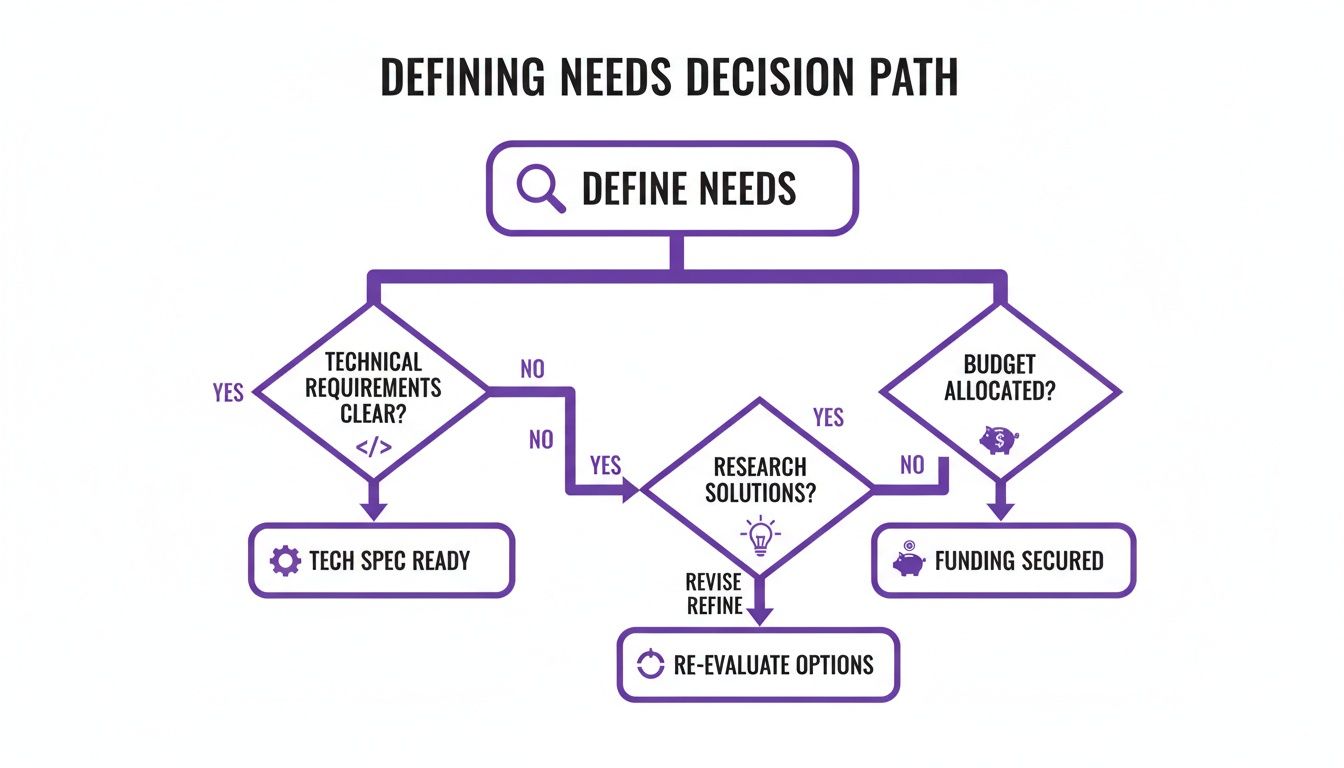
The key takeaway is that your tech requirements and your budget aren't separate issues; they're completely intertwined. Together, they point you toward the smartest way to build your team.
First, let's get the lingo straight. People often use "offshore" as a catch-all term, but the distinction between nearshore and offshore has very real consequences for how your team works day-to-day.
Nearshore: This means hiring developers in countries that are geographically and culturally close, often in similar time zones. For a company in the US, this is Latin America. The biggest advantage here is real-time collaboration without forcing anyone to work at 3 a.m.
Offshore: This is what most people think of—hiring talent in more distant countries, like those in Eastern Europe or Asia. The main draw is usually access to an enormous talent pool and significant cost savings.
There's no single "best" choice here; it all depends on your situation. If your team thrives on spontaneous brainstorming and quick sync-ups, nearshoring is probably the way to go. If your work is more asynchronous and keeping costs down is the top priority, traditional offshoring can deliver incredible results.
This is where the rubber really meets the road. Your decision here dictates how much of the hiring and management grunt work you do yourself versus how much you hand off to a partner who specializes in it.
Managed Platforms (like HireDevelopers.com)
Think of this as the "concierge" approach. You tell the platform what you need, and they handle everything else—sourcing candidates, vetting them, and managing payroll and legal compliance.
Pros:
Cons:
This model is a lifesaver for companies that need to scale fast or simply don't have the internal bandwidth to manage global hiring.
Direct Hiring
This is the old-school, do-it-yourself method. You're in charge of everything: posting on job boards, wading through hundreds of resumes, conducting every single interview, and then figuring out all the international legal and financial paperwork on your own.
Pros:
Cons:
Direct hiring gives you ultimate control, but it requires a massive investment of time and resources. It really only makes sense for larger companies with established global operations.
Ultimately, this choice often reflects a company’s broader strategy around team building. To dig deeper, you can learn more about the differences between staff augmentation vs managed services to see which philosophy aligns with your long-term goals. Getting this decision right from the start is critical for building your offshore strategy on a solid foundation.
Once you've decided on an engagement model, the real work begins: separating the truly great developers from the merely good ones. Anyone who has hired knows that a superficial process is a recipe for a bad hire, wasting a ton of time and money. Finding exceptional talent demands a structured vetting process that probes for real-world skills, not just the ability to regurgitate textbook algorithms.
The secret is a multi-stage framework that looks at candidates holistically. It’s not just about code. It's about communication, problem-solving, and how they think under pressure. This is the exact kind of rigorous process that top-tier platforms like HireDevelopers.com use to make sure you only talk to the top 1% of candidates, saving you from that soul-crushing mountain of unqualified resumes.
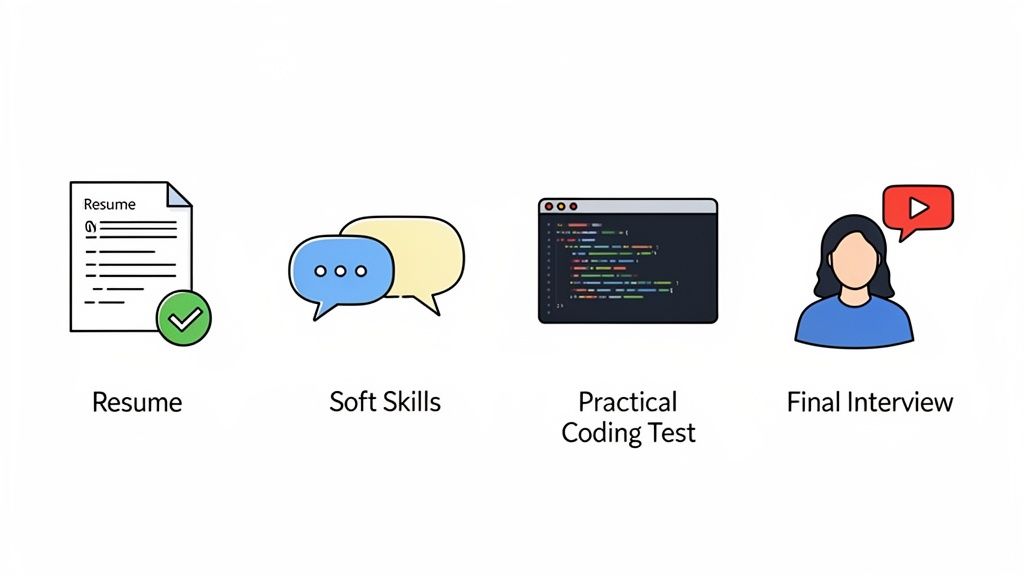
Your first filter has to be more than just a keyword search. Sure, you need to confirm they have the core technical skills, but the real goal here is to find evidence of practical application and impact.
Don't just scan for a list of technologies. You need to search for context.
This initial screen isn't about finding a perfect match on paper. It's about filtering out the noise to build a strong list of candidates who have demonstrated tangible results—a crucial first step when you need to find developers who can hit the ground running.
Technical brilliance means very little if a developer can't communicate, collaborate with a team, or roll with the punches when priorities shift. A dedicated soft skills assessment is non-negotiable, especially in a remote setup.
Forget the generic questions like, "Are you a team player?" Instead, use behavioral questions that force candidates to pull from their own past experiences.
Sample Soft Skills Questions
The goal here is to listen for the "how." A great candidate won't just tell you what happened; they'll explain their thought process, the specific actions they took, and what they learned from the experience.
This stage is your best tool for gauging cultural fit and spotting the developers who will be proactive, communicative partners in your project.
This is where the rubber meets the road. You get to validate their technical claims. The key is to make the test relevant to the actual work they’ll be doing. Abstract puzzles are far less effective than a practical, job-specific task.
A well-designed coding challenge should feel like a mini-version of a real-world task.
Set a reasonable time limit (maybe 2-4 hours) and evaluate them on more than just whether they finished. You should be looking for clean, well-structured code, a logical problem-solving approach, and the ability to follow instructions. This is a direct window into the quality of their work.
The last step is a live conversation that ties everything together. This interview should have two distinct goals: confirming their technical depth and making sure they’re a strong cultural fit.
For the technical part, dive deep into the coding challenge they submitted.
The cultural fit conversation is just as important. Talk about your team's communication style, workflow, and values. This is your final chance to confirm that their working style will mesh with yours.
This thorough, multi-stage process ensures that when you hire offshore software developers, you’re not just filling a role—you’re adding a high-impact, long-term member to your team.
You've found your ideal developer. They aced the technical interview, they fit the team culture, and you’re ready to get started. But hold on—the next steps are just as critical. This is where you move from candidate to teammate, and it involves locking in the legal details and rolling out a welcome mat that sets them up for success.
Getting the paperwork and the first few weeks right isn’t just a formality. It’s about protecting your business, your intellectual property, and making sure your new hire feels like part of the team from day one. Nail this, and you'll have a productive developer in no time. Get it wrong, and you're setting yourself up for headaches.
When you hire an offshore developer, you're almost always bringing them on as an independent contractor, not a direct employee. This distinction is key. You're either engaging them directly or working through a managed platform that acts as the Employer of Record (EOR).
The cornerstone of this relationship is a comprehensive Independent Contractor Agreement. This isn't something to gloss over. A vague contract is just asking for trouble later.
Make sure your agreement is crystal clear on these points:
This is one of the biggest reasons people use managed talent platforms like HireDevelopers.com. They’ve already done the heavy lifting. Their legal frameworks are built for international hiring, which means they absorb the risk and handle the administrative mess for you.
For an extra layer of confidence, you can run contracts through an AI Legal Employment Document Analyzer to double-check for clarity and completeness before signing.
A solid contract is just the beginning. The real magic happens during onboarding. A bumpy start can kill a new hire's enthusiasm and slow down their productivity. Your goal should be to remove every bit of friction so they can start contributing right away.
Think of it as a 30-day mission. Here’s a simple playbook that works.
The first week is all about getting connected. The goal is to get their machine set up and make them feel welcome.
Now it's time to get their hands on the code. Start small to build momentum and confidence.
By the end of the first month, they should feel like a part of the team.
This isn't just a checklist; it's a signal to your new hire that you're organized, professional, and genuinely invested in their success.
Let's be honest—going global with your hiring strategy for the first time can bring up a lot of questions. For most founders and managers, this is uncharted territory, so it's smart to get some clarity before you dive in. We've gathered the most common questions we hear from companies just starting to figure out how to hire offshore software developers.
Think of this as your go-to guide for tackling those nagging doubts. The idea here is to swap apprehension for confidence, helping you make sharp decisions that line up with your company's goals.
This is almost always the first question, but it's more of a logistical puzzle than a real roadblock. In fact, if you play your cards right, different time zones can become a massive advantage.
Clear communication is the engine of any great software team. So, yes, worrying about language skills and cultural mismatches is completely valid. The good news is that you can solve for this by being intentional during your hiring process.
Good hiring platforms make this a non-issue. For example, at a platform like HireDevelopers.com, every single candidate goes through a tough English assessment to ensure they can communicate complex ideas clearly and fluently.
It's about more than just language, though. Cultural fit really comes down to professional alignment. You're looking for developers who speak up, ask smart questions, and are honest about where they are with their work—especially when they're stuck. Those are the signs of a great teammate, no matter where they are in the world.
A great way to test this is with scenario-based questions in the interview. Ask them about a time they disagreed with a project manager or had to explain a technical problem to someone non-technical. How they describe handling those situations will tell you everything you need to know about their communication style.
This one is a big deal and absolutely non-negotiable. Protecting your IP with an offshore team all comes down to getting the right legal agreements signed from day one. Your contract is your first and best line of defense.
Make sure any agreement you sign has two iron-clad clauses:
This is another huge reason why working with a managed talent partner is so valuable. They’ve already got the legal framework sorted out with contracts that have been battle-tested across countless international agreements. It takes the legal risk and guesswork off your plate so you can just focus on building a great product.
You're probably in one of two situations right now. You need to hire a Scrum Master fast because delivery feels messy, or you've already interviewed a few and every candidate sounds polished, certified, and strangely interchangeable. They know the terms. They can define artifacts and ceremonies. But you still can't tell who can steady a […]

Most advice on API vs REST API starts with definitions and stops there. That's too shallow for a real project. The decision affects delivery speed, integration risk, documentation load, support burden, and even who you need to hire to keep the system stable after launch. The common mistake is treating “API” and “REST API” like […]

You're probably in one of two situations right now. You need to hire a Java developer because a core system is growing faster than your team can support, or you inherited a Java codebase and need someone who can stop the bleeding without making the architecture worse. Both situations punish vague hiring. A generic “Java […]


