

Think of software project management as the central nervous system for turning a great idea into a real, working product. It’s the process of planning, directing, and monitoring a project from concept to launch, making sure it hits its goals on time and within budget. Without it, you get chaos. With it, every line of […]

Think of software project management as the central nervous system for turning a great idea into a real, working product. It’s the process of planning, directing, and monitoring a project from concept to launch, making sure it hits its goals on time and within budget.
Without it, you get chaos. With it, every line of code, every design choice, and every team meeting has a clear purpose.
Trying to build a complex piece of software without a project management framework is like trying to build a house without blueprints. You might have talented developers and brilliant designers, but without a plan to coordinate their efforts, you’ll end up with a mess—walls in the wrong places, wires that lead nowhere, and a final product that’s unstable and over budget.
This isn't just a metaphor; it’s a hard reality in the tech industry. The data paints a stark picture of what happens when projects go off the rails.
The risks aren't just about missing a deadline. Unmanaged software projects create a triple-threat of financial, timeline, and value-based failures that can sink a business. The numbers from large-scale IT projects are sobering.
| Risk Area | Average Impact (Large IT Projects) | Implication for Your Business |
|---|---|---|
| Budget Overruns | 45% over budget | Your initial investment can nearly double, draining cash reserves that could be used for marketing, sales, or future growth. |
| Timeline Slippage | 7% over time | Competitors can beat you to market. Delayed launches mean delayed revenue and a loss of first-mover advantage. |
| Value Destruction | 56% less value delivered | The final product misses the mark. It fails to solve the customer's problem, leading to low adoption and wasted effort. |
These statistics show that simply "winging it" is a recipe for disaster. The good news is that strong alignment between the business vision and the engineering team’s execution is the single best way to beat these odds.
When a software project lacks clear direction, a few classic problems almost always pop up. They start small but quickly snowball, creating massive risks for the entire venture.
Scope Creep: This is the silent killer of many projects. Without a firm plan and someone to guard it, new "must-have" features get added on the fly. Your simple, elegant app idea slowly morphs into a bloated, confusing mess that never seems to be finished.
Budget Overruns: Rework, endless back-and-forth, and inefficient processes don't just waste time—they burn cash. What was once a predictable, fixed-cost project can quickly become a financial black hole.
Technical Debt: When teams are pressured to hit moving targets, they take shortcuts. This "debt" in the codebase makes future development slow and buggy. Properly managing technical debt is non-negotiable for long-term success.
Project management in software engineering isn’t just about making schedules and tracking tasks. It’s the art of bringing order to chaos, aligning everyone on a single mission, and ensuring every ounce of effort moves the project forward.
Ultimately, a poorly managed project crushes morale and burns out founders. The initial excitement fades, replaced by the constant stress of trying to control an uncontrollable process.
A solid project management methodology is the rudder your ship needs. It provides the direction and control necessary to navigate from a brilliant concept all the way to a successful launch.
Picking a software development methodology isn't about finding the "best" one on the market. It’s about finding the best fit for your project, your team, and your goals. Think of it like a chef choosing a cooking technique: a quick stir-fry is perfect for a fast weeknight meal, while a slow braise is what you need for a deep, complex flavor. Each has its place.
This decision is one of the most critical you'll make. Trying to run a fast-moving startup MVP with a rigid, documentation-heavy methodology is a recipe for disaster. On the other hand, a loosely structured, "figure it out as we go" approach will likely crash and burn when building a large, compliance-driven enterprise system.
Your choice of methodology directly impacts your project's risk. An unmanaged project is a high-risk gamble, while a well-chosen framework is your best tool for managing uncertainty and steering the project toward success.
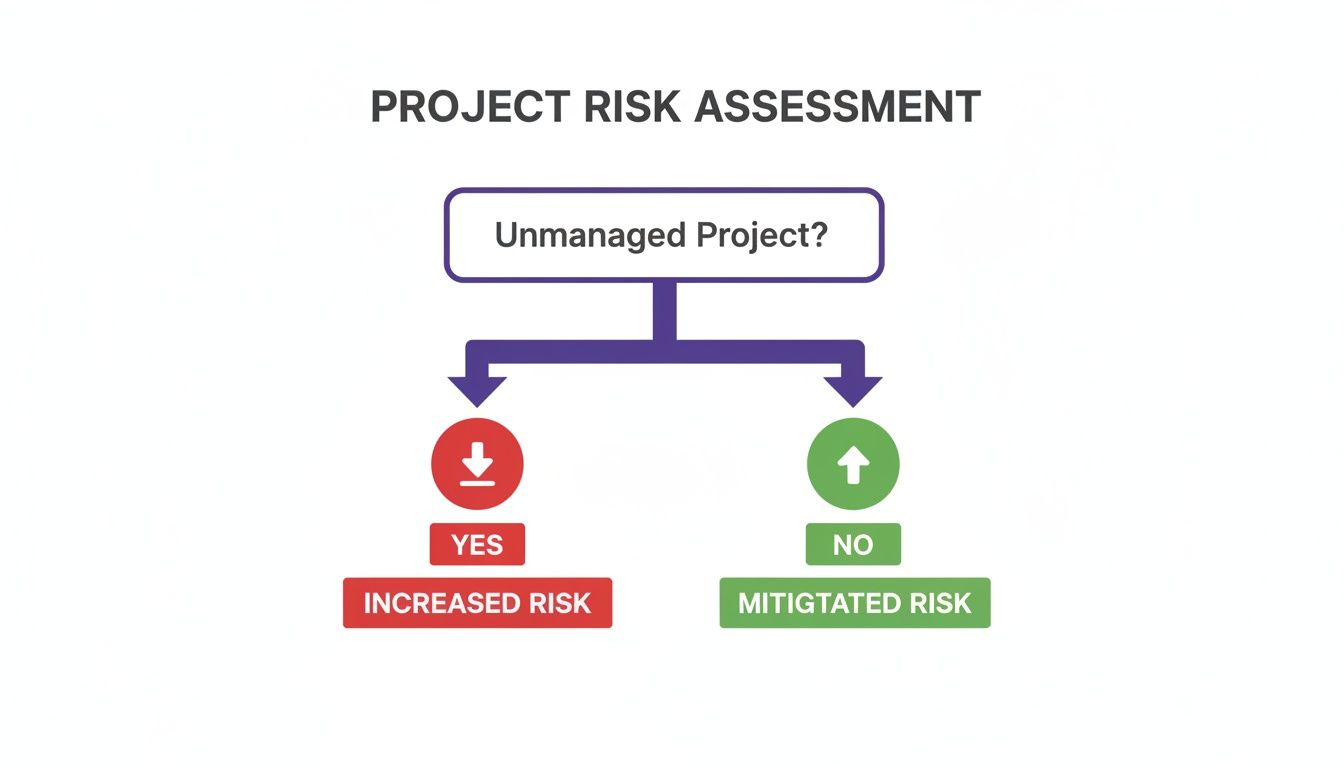
As you can see, this isn't just about process for process's sake. It's a fundamental risk management strategy that often separates the projects that thrive from those that fail.
First things first: Agile isn't a single, prescriptive method. It's a guiding philosophy, a mindset built around embracing change and delivering value in small, consistent chunks.
Imagine a sculptor working on a block of marble. They don't have a pixel-perfect image from day one. Instead, they chip away, step back to assess their work, and adjust their approach based on what they see. This iterative cycle of creating, getting feedback, and course-correcting is the heart of Agile.
This philosophy is tailor-made for projects where you don't know every requirement upfront—which, let's be honest, is most software today. It champions collaboration with customers and a relentless focus on creating working software over getting bogged down in rigid plans.
The core idea is simple: build a little, test it, learn from it, and then decide what to build next. This cycle dramatically reduces the risk of spending months building the wrong thing.
Frameworks like Scrum and Kanban then provide the practical guardrails to put these Agile principles into action.
If Agile is the philosophy, Scrum is one of its most popular playbooks. It organizes all work into fixed-length iterations called sprints, which usually last two to four weeks. The name comes from rugby, and it's a fitting analogy: the entire team huddles up, commits to a set chunk of work from a prioritized list (the product backlog), and focuses intensely on getting it across the finish line during that sprint.
This structure creates a powerful rhythm of flexibility and predictability.
Scrum shines when you're tackling complex products in a fast-changing environment. It provides just enough structure to keep everyone aligned without killing your ability to adapt.
If Scrum is a series of timed sprints, Kanban is more like the ticket board in a busy restaurant kitchen. It’s all about visualizing your team's entire workflow and smoothly managing the flow of tasks moving through it. You do this with a Kanban board, which has columns representing each stage of your process—like "To Do," "In Progress," "Testing," and "Done."
The magic of Kanban is its focus on limiting Work in Progress (WIP). By setting a hard limit on how many tasks can be in any one column at a time, you force the team to confront bottlenecks head-on. If the "Testing" column is full, no new work can be pulled in until something is tested and moved out. This keeps the whole system flowing.
Kanban is brilliant for teams managing a continuous stream of work with shifting priorities, like IT support, maintenance, or content creation teams. Its beauty lies in its simplicity and incredible flexibility.
While Agile focuses on iterative development, Lean and DevOps add crucial layers of speed and efficiency to the whole project management in software engineering process.
Lean development, born from the world of manufacturing, is obsessed with one thing: eliminating waste. In software, "waste" can be anything from building features nobody uses and slow handoffs between team members to the time spent fixing bugs that could have been prevented in the first place. The goal is to deliver maximum value to the customer with minimum effort.
DevOps takes this a step further by demolishing the traditional walls between Development (Dev) and Operations (Ops) teams. It's a cultural and technical movement that uses automation to create a seamless pipeline for building, testing, and deploying software. By automating everything possible, DevOps ensures that high-quality software can be released quickly, safely, and reliably, turning the entire development lifecycle into a well-oiled machine.
Amazing software is never a one-person show. It's the product of a well-oiled team of specialists, each playing a critical part. Just hiring a bunch of "coders" won't get you there. Truly effective project management in software engineering starts with putting together the right team, where everyone knows their role and how it connects to the bigger picture.
Think of it like building a house. You wouldn't just hire carpenters. You need an architect for the blueprint (the vision), a general contractor to keep everything on schedule (the project manager), and electricians and plumbers for their specialized skills. A software project needs that same kind of coordinated talent.
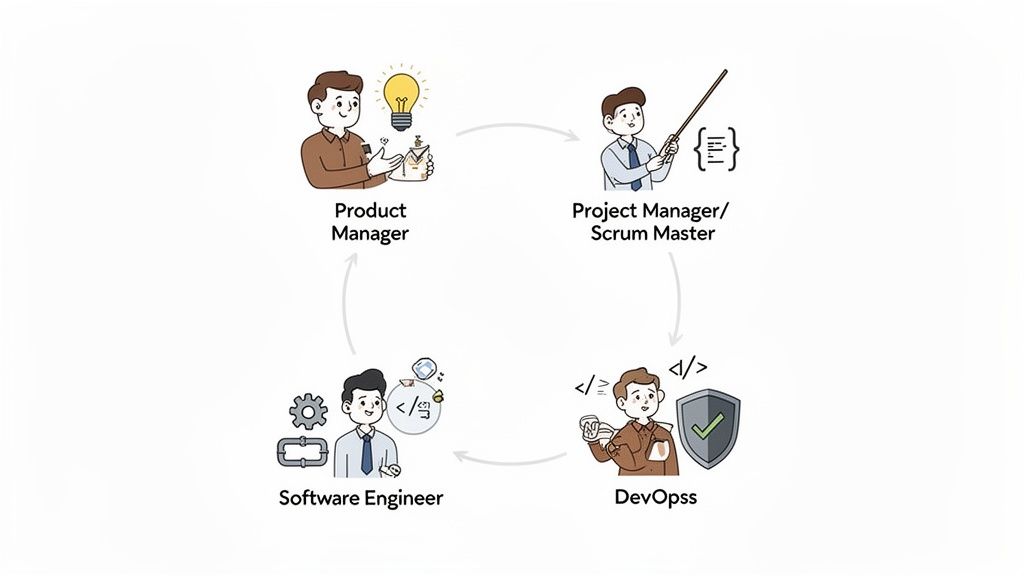
For anyone in a hiring position, understanding these roles is non-negotiable. It's the key to seeing how individual experts, whether in-house or sourced, come together to transform an idea into a functional, high-quality product.
To get a product off the ground, you need to fill a few fundamental seats. Each role brings a unique perspective and skill set to the table, making sure everything from business strategy to the nitty-gritty code is covered. Let's break down who you need on your team.
The Product Manager (The Visionary): This is your "why" person. They are the champion of the user, diving deep into market research and customer needs to define the product vision. They own the product backlog, prioritizing what gets built and when, all to solve real user problems and hit business goals.
The Project Manager or Scrum Master (The Orchestrator): This role is all about the "how" and "when." A great project manager or Scrum Master is a servant leader who keeps the process running smoothly. They clear obstacles, make sure communication is flowing, and protect the team from distractions, creating an environment where developers can just focus on building great software.
Software Engineers (The Builders): Here are the craftspeople who bring the vision to life by writing the code. Working hand-in-glove with product managers to understand requirements, they are the architects and builders of the actual application.
If you want to go deeper on how these roles function in a modern, agile environment, it's worth exploring the different roles in Agile software development and how they collaborate.
Beyond that core trio, two other roles are absolutely essential in today's software world. They make sure the product isn't just built, but that it's built right and delivered to users reliably.
A team without clear roles is like an orchestra without a conductor. Everyone might be talented, but the result is noise, not music. Defining responsibilities is the first step toward creating a high-performing, collaborative environment.
QA Engineers (The Protectors of Quality)
Quality Assurance (QA) engineers are your first line of defense against a bad user experience. They are obsessed with quality, systematically testing the application to hunt down bugs, uncover usability flaws, and confirm that every feature works as intended. Their diligence protects your brand’s reputation and builds user trust by ensuring a polished product reaches the customer.
DevOps Engineers (The Pipeline Automators)
DevOps engineers are the crucial link between writing code and getting it into the hands of users. They build and manage the automated pipelines for continuous integration and continuous delivery (CI/CD), which allows new features and fixes to be shipped quickly and safely. They're the ones who make modern, rapid software delivery possible.
The need for leaders who can manage these complex teams is exploding. According to one report, an estimated 2.3 million new project-management roles will need to be filled each year across the globe. This trend underscores just how critical it is to have professionals who can blend deep software knowledge with sharp project leadership. You can find more project management software statistics and trends in this detailed report from Mosaic.
The right tools are the central nervous system for any software project. Without them, even the most disciplined team can get lost in a sea of missed messages, conflicting priorities, and version control nightmares—especially when everyone’s working remotely. A well-chosen tech stack provides the rails for communication, collaboration, and automation, turning a great plan into tangible progress.
Think of it as the digital workshop for your development team. You need a dedicated area for planning (your project tracker), a reliable way to talk to each other (messaging platforms), a bulletproof system for organizing your code (version control), and an automated assembly line to ship your work (CI/CD). Each piece is crucial for creating a transparent and efficient workspace.
The market for these tools is exploding, with projections showing it will hit $12.02 billion by 2030. And for good reason. Despite this, only 23% of organizations actually use dedicated project management software. That's a huge missed opportunity when you consider that 77% of high-performing projects rely on them. The efficiency gains are massive—teams using modern PM platforms save an estimated 498 hours per year, simply by having better visibility and coordination. You can dig into more project management statistics on monday.com.
Building your stack doesn’t have to be a monumental task. Most successful teams build their workflow around a handful of tools that fall into four key categories. Each serves a specific job, and when they work together, they create a single source of truth for the entire project.
This is your command center. It’s where you visualize the entire workflow, track every single task (often called an "issue" or "ticket"), and see exactly who is working on what at any given moment. This is the digital equivalent of a massive Kanban board or a detailed Scrum sprint plan.
In modern software development, fast, fluid communication is completely non-negotiable. These tools kill off slow, clunky email chains and replace them with instant messaging, organized channels for specific topics, and integrations that pull notifications from all your other tools into one central hub.
A great tech stack doesn’t just manage tasks; it amplifies your team’s ability to collaborate. The goal is to reduce friction and create a seamless flow of information from idea to deployment.
The last two pillars form the technical backbone of your project. These tools make sure the code itself is managed, tested, and delivered with precision and reliability.
Think of a version control system as a meticulous history book for your codebase. It’s what allows multiple developers to work on the same project at the same time without overwriting each other's contributions. It tracks every single change, making it possible to roll back to a previous version if a bug sneaks in.
This is your automation engine. CI/CD pipelines automate the tedious work of building, testing, and deploying code. Every time a developer commits a change, these tools automatically run a suite of tests to check for bugs and then, if everything passes, deploy the code to a staging or production environment.
To really nail down the right combination of tools, check out this comprehensive guide on how to choose a tech stack for your software product. Getting this foundation right is a huge step in effective project management in software engineering, as it creates an environment where your team can truly do its best work.
The best engineers aren't always in your backyard. Tapping into the global talent pool is a game-changer, but it also dials up the difficulty on project management. When your team is scattered across cities, countries, and time zones, you can't just wing it.
Leading a remote team isn't about finding the fanciest video conferencing software. It's about deliberately architecting a system of communication, trust, and accountability that works without a shared office. The real goal is to forge a cohesive, high-performing engineering unit that can out-innovate and outperform traditional, co-located teams.
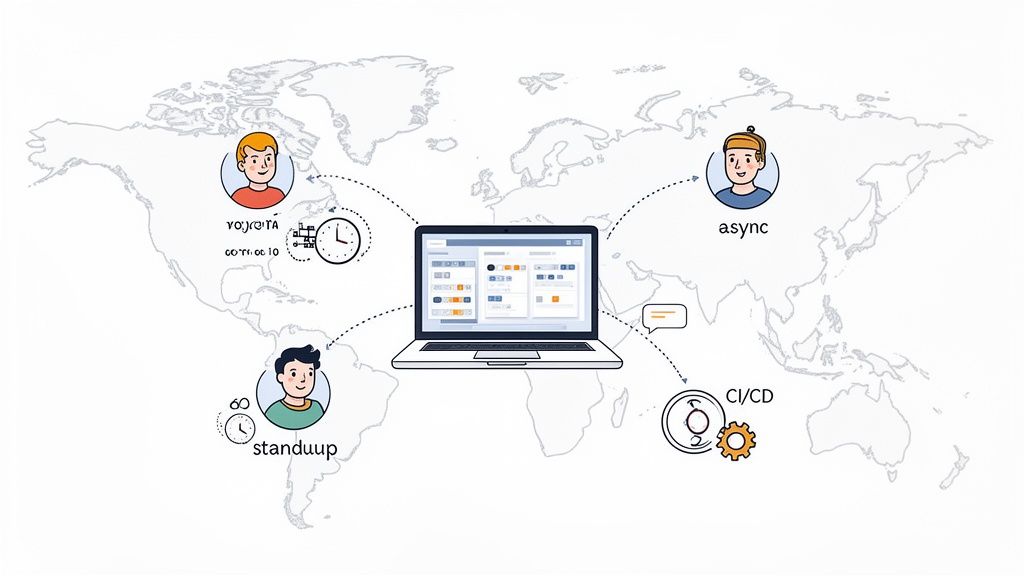
You lose a lot when you go remote. No more overhearing a key conversation or pulling a developer aside for a quick chat. Every single interaction has to be intentional, clear, and—most importantly—documented.
A classic misstep is trying to recreate the office vibe with back-to-back video calls. This isn't just inefficient; it's a fast track to burnout and completely misses the point of remote work's flexibility. The trick is to master the balance between real-time and time-shifted communication.
Remote work thrives on clarity. If a new team member is confused about where to find information or how to ask a question, your communication system is broken. A central, written source of truth is non-negotiable.
One of the greatest advantages of a global team is the potential for a 24-hour development cycle. An engineer in Europe can hand off their work at the end of their day, and a teammate in Latin America can pick it right up to run tests or perform a code review. This "follow-the-sun" model can seriously accelerate your timeline.
But here’s the catch: it only works if your project management is airtight. Every task needs to be documented with meticulous detail, dependencies must be crystal clear, and handoffs have to be seamless. The developer signing off needs to leave a perfect breadcrumb trail for the next person. Your project management tool becomes the central hub where this detailed baton-passing takes place.
When you can’t manage by walking around, you have to manage by trust and output. This puts an enormous amount of pressure on who you hire in the first place. Honestly, the single most important factor for success in remote software development is rigorous upfront vetting.
You're not just looking for raw technical talent. You're screening for a specific set of soft skills that are non-negotiable for remote work:
This is exactly why working with platforms that specialize in vetting global talent is such a powerful move. They do the heavy lifting to ensure every candidate has both the technical chops and the remote-first mindset. This allows you to build a team you can count on from day one. To dig deeper, check out these essential remote team management tips that can help turn your distributed team from an operational headache into a true strategic asset.
We've covered a lot of ground, and by now, you've seen how all the moving parts of software project management come together to turn a great idea into a real-world product.
If you take away just one thing from this guide, let it be this simple blueprint. Getting it right really comes down to mastering four key areas.
First, you have to choose the right methodology. Think of it as the operating system for your team's work. Whether you go with the structured sprints of Scrum or the fluid, visual workflow of Kanban, this choice dictates how you get things done.
Second, you need crystal-clear roles. When everyone knows exactly what they're responsible for—from the Product Manager shaping the vision to the QA Engineer ensuring quality—the team works like a well-oiled machine, without the usual friction and confusion.
Third, get the right tools in place. A solid stack for tracking tasks, communicating, and managing code isn't just nice to have; it's the central nervous system of your project. This is especially true for remote teams, where tools are what keep everyone connected and on the same page.
Finally, you must master remote collaboration. The best engineers are located all over the world. Your ability to build trust and communicate clearly with a distributed team isn't just a skill—it's a massive competitive advantage.
The core lesson is this: exceptional project management is a learnable discipline, not an innate talent. It’s about consistently applying the right principles to bring order to the inherent chaos of software creation.
Of course, you can't improve what you don't measure. For a deeper look at tracking what truly matters, check out this breakdown of essential KPIs for software development.
The fastest way to put this blueprint into action is to work with people who already live and breathe these principles every day. By building your team with pre-vetted, globally-sourced engineers, you can skip the painful learning curve and get straight to what you do best: building great software.
If you're a founder or manager trying to connect business goals with the nuts and bolts of development, you've probably got questions. Let's tackle a few of the most common ones that come up when discussing project management in software engineering.
If I had to pick just one, it would be Cycle Time. This metric tells you the total time it takes for an idea to go from the start of active work to being live and in the hands of your users.
Why is it so powerful? Because a short, consistent cycle time is the hallmark of a healthy, efficient team. It's a much more honest indicator of progress than just counting hours worked. Other vital signs include Velocity (for Scrum teams, measuring how much work gets done per sprint) and Cumulative Flow Diagrams (great for Kanban teams to see if work is piling up somewhere).
Your job is to focus on the "what" and the "why," and leave the "how" to your technical team. You bring the vision to the table—the business goals, the user problems you're solving, and what success looks like for every feature.
To run the day-to-day, you need a project manager or a lead engineer you can trust completely. Your role then becomes using your project management software for a bird's-eye view, demanding regular demos of the actual product, and asking questions until you genuinely understand the progress and any hurdles. Your clarity on the product vision is the single most important thing you can contribute.
A founder's job isn't to write code; it's to provide the context and purpose that guides it. A clear vision empowers a technical team to make the right calls.
For almost any software project built today, the answer is Agile. The old-school Waterfall model, where you have to finish one entire phase (like design) before starting the next (like coding), is just too slow and rigid for a world where customer needs and market conditions change overnight.
Agile is all about building, getting feedback, and adapting in short, repeated cycles. That flexibility is non-negotiable if you want to build something people actually want to use. For a startup trying to find its footing or a company launching a new product, Agile isn't just a good idea—it's essential for survival.
You're probably in one of two situations right now. You need to hire a Scrum Master fast because delivery feels messy, or you've already interviewed a few and every candidate sounds polished, certified, and strangely interchangeable. They know the terms. They can define artifacts and ceremonies. But you still can't tell who can steady a […]

Most advice on API vs REST API starts with definitions and stops there. That's too shallow for a real project. The decision affects delivery speed, integration risk, documentation load, support burden, and even who you need to hire to keep the system stable after launch. The common mistake is treating “API” and “REST API” like […]

You're probably in one of two situations right now. You need to hire a Java developer because a core system is growing faster than your team can support, or you inherited a Java codebase and need someone who can stop the bleeding without making the architecture worse. Both situations punish vague hiring. A generic “Java […]


