

Think of a nearshore software development service as a strategic partnership. You're hiring top-tier tech talent from a neighboring country, usually one that's in the same or a very similar time zone. It's a smart way to get the cost advantages of outsourcing without giving up the real-time collaboration that agile projects absolutely depend on. […]

Think of a nearshore software development service as a strategic partnership. You're hiring top-tier tech talent from a neighboring country, usually one that's in the same or a very similar time zone. It's a smart way to get the cost advantages of outsourcing without giving up the real-time collaboration that agile projects absolutely depend on.
Imagine your development team is just down the hall, ready for a quick brainstorm or the daily stand-up meeting. Now, what if that "hall" stretched across a border into a neighboring country? That’s the essence of a nearshore software development service. It’s a model built to give you the best of both worlds: access to a global talent pool and serious cost savings, all while maintaining the smooth communication you'd expect from an in-house team.
Unlike traditional offshore outsourcing, where you're often battling huge time-zone gaps and cultural misunderstandings, nearshoring is all about geographical and cultural closeness. It sounds like a small distinction, but it makes a world of difference for a project's success.
Let's be honest, the initial pull for any outsourcing is usually about saving money, and nearshore development certainly delivers on that front. But its real magic is how it balances those savings with high-quality, real-time teamwork. Those late-night calls and frustrating feedback delays that can kill an offshore project's momentum? They're replaced by overlapping work hours. This alignment is a game-changer for agile development, which thrives on quick feedback loops and constant communication.
This model is catching on fast for a few key reasons:
A nearshore partnership feels like a natural extension of your own team. It closes the distance, letting your business grow efficiently while keeping the collaborative spirit you need to build great software.
The numbers back this up. The demand for nearshore software development services is expected to grow at a healthy 15% CAGR from 2025 to 2033. This boom is mostly fueled by North American companies, with an estimated 80% now looking into or actively using nearshore solutions in Latin America. The appeal is obvious: nearshore teams can lead to 50-65% cost reductions compared to US-based hires, with rates that are, on average, 46% lower than their onshore peers—all without sacrificing the collaborative benefits of working on the same clock. To get a deeper look at these trends, you can read more about nearshore development projections for 2025.
Picking a software development partner is more than just a line item on a budget; it's a major strategic decision. The choice you make between onshore, nearshore, and offshore models will fundamentally shape your project's communication, speed, and overall vibe. Each path comes with its own unique set of trade-offs around cost, collaboration, and control.
Think of onshore development as hiring in your own backyard. The team is in the same country, so they operate under the same business norms and are always available for a quick face-to-face meeting. This setup offers the absolute best in real-time collaboration, but it also comes with the steepest price tag, reflecting local salaries and operating costs.
On the complete other end of the spectrum is offshore development. By partnering with teams in far-flung countries, you can unlock some serious cost savings. However, this approach often introduces big hurdles, like massive time-zone differences of 8-12 hours, which can throw a real wrench in agile workflows and create frustrating communication delays.
This is exactly where a nearshore software development service comes in and shines. It’s often seen as the perfect middle ground, blending the significant cost reductions of a global talent pool with the collaborative perks of being close by. It's like hiring a team in a neighboring country—just a short flight away.
With nearshore partners, time-zone differences are minimal, usually just 1-3 hours. This overlap is an absolute game-changer for collaboration. Suddenly, daily stand-ups, real-time brainstorming sessions, and quick feedback loops are easy to manage, not a logistical headache. It allows your external team to mesh with your in-house crew almost seamlessly.
This model lets you tap into incredible talent pools in regions like Latin America or Eastern Europe. You get highly skilled developers at a fraction of what you'd pay locally, but without giving up on clear, constant communication.
To really get a feel for the differences, it helps to see them side-by-side. The table below breaks down the key factors that should guide your decision, from cost to cultural alignment.
| Factor | Onshore Development | Nearshore Development | Offshore Development |
|---|---|---|---|
| Cost | Highest cost, reflecting local market rates. | Moderate cost savings (40-65% reduction). | Highest cost savings (often 70% or more). |
| Time Zone | Identical time zone. | Minimal difference (0-3 hours). | Significant difference (8-12+ hours). |
| Collaboration | Seamless, real-time communication. | High level of real-time collaboration. | Primarily asynchronous communication. |
| Cultural Fit | Identical cultural and business norms. | High cultural and linguistic alignment. | Potential for significant cultural gaps. |
| Agility | Ideal for agile and iterative workflows. | Excellent for agile methodologies. | Challenging for agile processes. |
| Talent Access | Limited to the local talent pool. | Access to regional tech hubs. | Access to a vast global talent pool. |
As you can see, the nearshore model strikes a compelling balance. It delivers those crucial financial benefits while keeping the high-bandwidth communication needed to build great software. If you want to dive deeper, check out our complete guide on the benefits of outsourcing custom software development.
This decision tree gives you a visual guide for thinking through which model fits your project best.
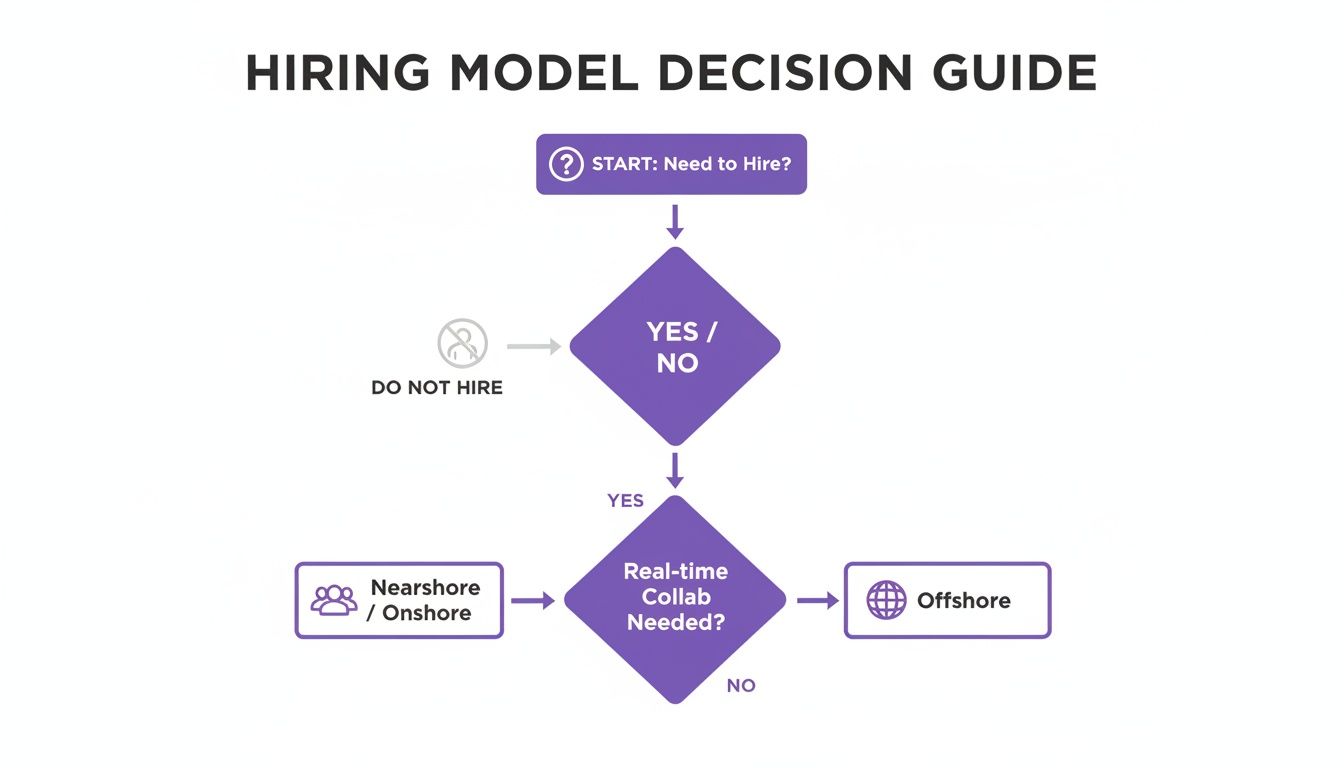
The flowchart makes it clear: if real-time collaboration is a must-have, your best bets are nearshore and onshore. From there, the choice often comes down to balancing your budget against the need for an in-person presence.
So, what does choosing a nearshore software development service actually mean for your business? We can talk about models and definitions all day, but the real magic happens when you see the impact on your budget, your timeline, and your final product.
The first thing most companies notice is the cost savings. This isn't just a small discount; it’s a significant shift in what you can achieve with your budget. You’re not just finding cheaper labor—you’re accessing a global market of highly skilled developers without the staggering salary and overhead costs of major tech hubs. Think of it as getting senior-level talent for a mid-level price, allowing you to build a more powerful team than you could afford locally.
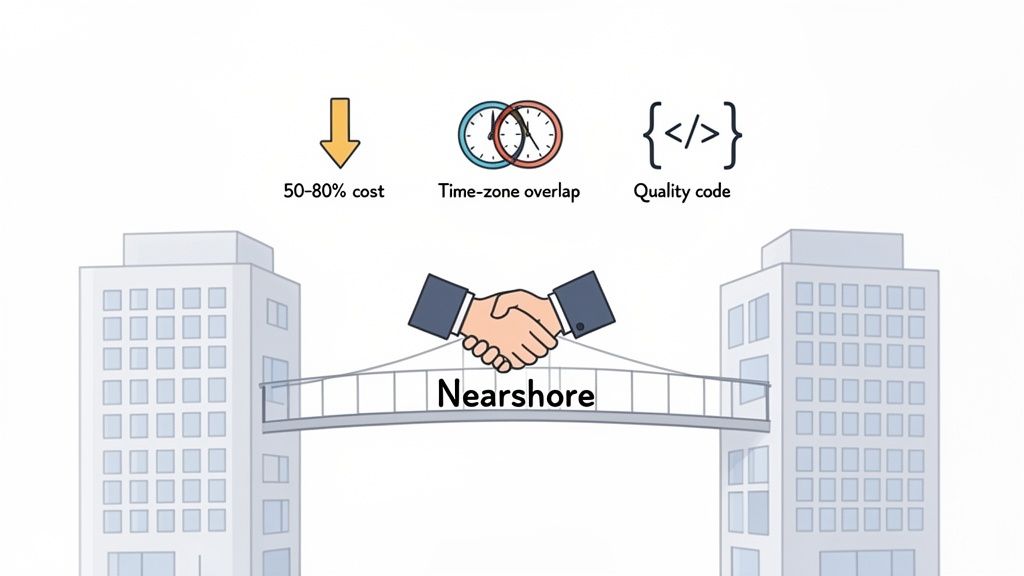
While the cost benefits are what get people interested, the real game-changer is collaboration. Having your team in a similar time zone—often just an hour or two apart—is a massive strategic advantage. It erases the painful delays that often hamstring offshore projects. No more sending a question at the end of your day and waiting 24 hours for a reply.
With a nearshore team, you can have a quick video call to solve a blocker. Daily stand-ups are actually daily. You can even do pair programming sessions in real time. Your nearshore developers quickly stop feeling like distant vendors and start feeling like true colleagues down the hall, all pushing toward the same goal.
The core benefit of nearshore is not just cost, but speed. By aligning work schedules, you remove friction from the development process, allowing your teams to maintain momentum and deliver features faster.
This alignment directly translates to getting things done quicker. We’ve seen shared time zones slash project delays by up to 30%, which is huge when you’re running on an agile schedule. When everyone can talk, iterate, and solve problems together, you simply build better software, faster.
Another huge plus is tapping into a massive, highly skilled talent pool. Regions like Latin America and Eastern Europe have become incredible tech hotspots, pouring resources into STEM education and producing world-class engineers.
Suddenly, you have access to specialists in hot fields like AI, machine learning, or cybersecurity who might be nearly impossible—or incredibly expensive—to find at home. There’s also a cultural element that people often overlook. Stronger cultural alignment and similar communication styles mean fewer misunderstandings and a team that gels much more quickly.
This combination creates a powerful ripple effect across your entire business:
In the end, a smart nearshore partnership gives you a serious competitive edge. The cost savings are often the hook—59% of enterprises see clear reductions with this model, with rates often 46% lower than hiring locally. For companies in the US, that can mean 50-65% in savings, all while maintaining elite quality. If you want to dive deeper into the numbers, you can find more insights on the nearshore outsourcing market size.
Choosing the right outsourcing model can feel like a make-or-break decision. But don't worry, certain tell-tale signs can point you directly toward a nearshore software development service. It's not a silver bullet for every situation, but for projects where cost, collaboration, and top-tier talent have to strike a perfect balance, nearshore really shines.
First, take a hard look at how your team operates. Is your development process built on agile sprints, daily stand-ups, and constant feedback? If that kind of real-time communication is absolutely essential, nearshore should be at the top of your list. The minimal time difference means your teams are online at the same time, sidestepping those frustrating 24-hour delays that often plague offshore projects.
For companies in the early growth stages, the name of the game is making every dollar count. Nearshore development offers a smart way to do just that, especially during two critical phases.
For both scenarios, nearshore offers the agility and cost-effectiveness needed to compete and grow. Think of it as a strategic lever for scaling smarter, not just bigger.
Beyond the budget, nearshore is your go-to solution for tough technical problems. Sometimes, the specific expertise you need—whether it’s a rare programming language or deep industry knowledge—is either impossible to find locally or comes with an eye-watering price tag.
Consider nearshore your strategic talent reserve. When you need a specialist in a niche field like AI, DevOps, or blockchain, a nearshore partner can bring in vetted experts who plug right into your team. This is how you accelerate innovation and solve problems that would otherwise stall your progress.
This is particularly true for projects that require deep domain knowledge. Whether it’s navigating fintech compliance or securing healthcare data, having a developer who understands both the code and the context is a huge advantage. Nearshore hubs in places like Latin America have built up impressive specializations in these areas, making it much easier to find that perfect-fit expert.
The data backs this up: a staggering 80% of North American companies are now looking at nearshore options to deal with talent shortages and the ever-present need for seamless collaboration. As the global IT outsourcing market grows toward a projected $812.71B by 2029, the advantages of nearshore are undeniable. The overlapping work hours and cultural familiarity just make everything smoother, reducing risk and getting you up to speed faster. To see the numbers behind this trend, check out these insightful nearshore software development statistics.
Assembling a world-class nearshore team shouldn't feel like a slow, frustrating crawl through endless interviews and administrative red tape. With the right partner, you can bring elite developers on board with surprising speed. A modern nearshore software development service cuts through the usual hiring chaos, offering a clear, proven playbook that prioritizes both quality and velocity.
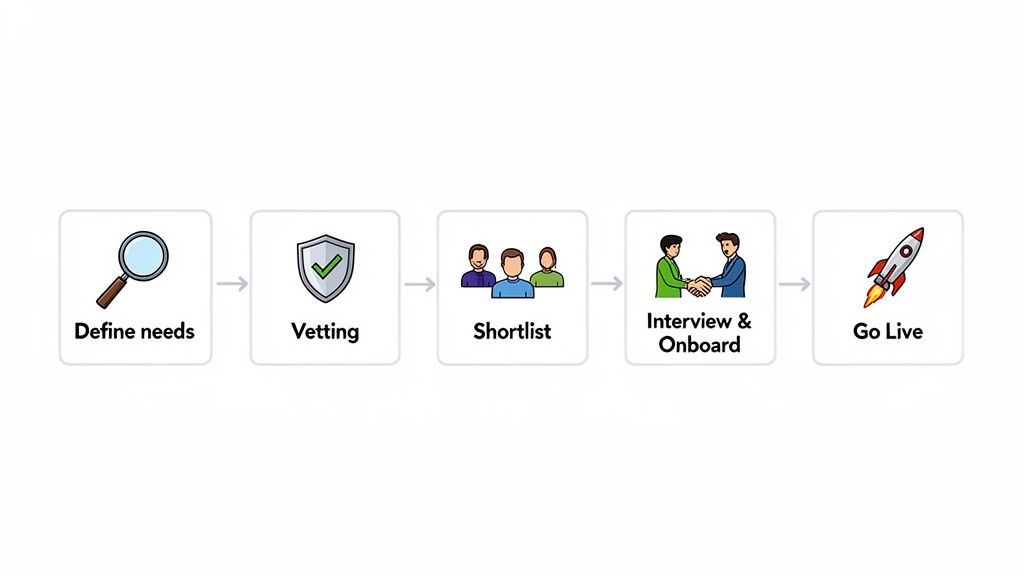
The entire process hinges on one simple, critical first step: getting crystal clear on what you actually need. Before you even look at a single resume, you have to map out the precise skills, project scope, and business goals. This foundational work ensures you’re not just hiring a coder but finding a true partner who understands the "why" behind the work.
Think of this as creating the blueprint for your perfect team member. Vague job descriptions are a magnet for generic, unqualified applicants, so specificity is your best friend here. Don't just say you need a "React developer." Get granular. Detail the exact frameworks, libraries, and level of experience that matter most.
Your definition should lock down three key areas:
Nailing down this profile makes every subsequent step in the hiring process smoother and far more accurate.
Once your needs are clearly defined, the talent search begins. This is where a modern hiring platform completely changes the game. Forget spending weeks sifting through hundreds of résumés yourself—a robust vetting process does all that heavy lifting for you.
At HireDevelopers.com, this means you get access to a pre-vetted pool of the world's top developers. These candidates have already cleared a series of demanding, multi-stage assessments, including AI-powered screenings, live technical interviews, and in-depth soft skills evaluations. This meticulous process filters out everyone but the most qualified professionals, so you only ever see the best of the best.
The result? We can deliver a handpicked shortlist of elite, pre-screened candidates who perfectly match your criteria in as little as 24 hours. What used to be a months-long search becomes a one-day task, giving you a massive head start.
This strategy is a cornerstone of effective talent acquisition. To dive deeper into integrating external talent seamlessly, you can explore these detailed staff augmentation best practices.
With a shortlist of top-tier candidates in hand, you can jump straight to the final interviews. Since all the initial technical and cultural screening is already done, you can focus your conversations on what really matters: project specifics and how they’ll fit with your team. This makes the interview process far more productive and insightful for everyone involved.
After you’ve made your pick, onboarding is just as fast. The best nearshore service providers handle all the complex administrative work for you.
This typically includes:
It’s the smart solution for today’s fast-moving businesses, letting you build a powerful, dedicated nearshore team with unmatched speed and total confidence.
Picking the right nearshore partner is one of the most important calls you’ll make. Get it right, and you’ll accelerate growth. Get it wrong, and you’re looking at costly delays and a whole lot of frustration.
To make sure you end up with a team that's transparent, reliable, and genuinely high-performing, you need a solid vetting plan. This checklist is designed to walk you through the essential areas to dig into, complete with the tough questions you absolutely need to ask.
Think of it like hiring a key executive. You wouldn’t bring them on board without a serious interview process, right? The same level of diligence applies when choosing your nearshore software development service provider.
First things first: you’re here for top-tier technical talent. This is where your evaluation has to start. It’s not enough for a company to simply claim they have skilled developers—they need to prove it. A shallow screening process is a massive red flag.
You need to ask direct questions about how they find and qualify their people:
A partner worth their salt will have a demanding, multi-stage assessment that truly tests problem-solving abilities, code quality, and system design thinking.
What really makes a nearshore partnership click is seamless integration. The best partners have proven processes and tools that make your new team members feel like a natural part of your own crew. Your job is to figure out how they close the gap between two different companies to create one unified, productive team.
A thorough vetting process is a cornerstone of good vendor management best practices. It’s how you find a partner that truly aligns with your goals while keeping risks in check.
Here's what to dig into:
Look for a partner who is proactive about communication, not just reactive. They should have a well-oiled playbook for embedding their talent into client teams. To get a sense of what the best in the business look like, you might want to check out a curated list of the best nearshore software development companies.
Protecting your intellectual property and confidential data is completely non-negotiable. Any professional nearshore firm will have ironclad legal and security protocols ready to go from day one. Any gray area here is an immediate deal-breaker.
Your intellectual property is your company's most valuable asset. Ensure your nearshore partner treats it with the same level of importance, with clear, legally binding agreements that leave no room for interpretation.
You need crystal-clear answers on these points:
A confident, professional partner will hand over documentation and be completely transparent about their security measures. If you get hesitation or fuzzy answers, it’s your cue to walk away.
Here's a quick checklist to bring all these points together, helping you systematically evaluate potential partners.
| Evaluation Category | Key Questions to Ask | What to Look For (Green Flags) |
|---|---|---|
| Technical Screening | How do you vet developers' coding skills and problem-solving abilities? Can we see sample code or participate in the final interview? | A multi-stage process with live coding, system design challenges, and code reviews. Transparency and willingness to involve you. |
| Tech Stack Alignment | Can you provide specific examples of projects you've completed using our required technology stack? | Detailed case studies, client testimonials, and developers with demonstrable, relevant project experience. |
| Communication & Culture | What's your standard process for integrating a developer into a new client team? What tools do you use for daily communication and project management? | A structured onboarding plan. Proactive communication cadence. Familiarity with standard tools like Slack, Jira, and Teams. |
| Agile Proficiency | How do your developers participate in agile ceremonies like stand-ups, sprint planning, and retrospectives? | Concrete examples of past agile project involvement. A clear understanding of agile principles, not just theory. |
| IP and Data Security | Who owns the intellectual property created? What data protection and compliance standards (GDPR, SOC 2) do you meet? | Clear contract language stating you own 100% of the IP. Certifications or documentation proving compliance. |
| Legal Agreements | Do all team members sign NDAs? Can we review your standard Master Service Agreement (MSA)? | Standard practice of NDAs for all personnel. A clear, fair, and transparent MSA that protects both parties. |
By using this checklist, you can move forward with confidence, knowing you’ve chosen a nearshore software development service that is technically sharp, collaboratively aligned, and legally sound.
Even after seeing all the benefits laid out, it's natural to have a few lingering questions before you dive in. Most leaders I talk to have similar concerns, so let's tackle the big ones head-on so you can move forward with total confidence.
This is where the nearshore model really shines. Forget the months-long slog of traditional hiring. With a good nearshore partner, you can have a fully vetted, top-tier developer ready to join your team in as little as one week.
How is that possible? Because they’ve already done all the legwork—the sourcing, the technical grilling, and the initial interviews are all in the rearview mirror. You just get a shortlist of qualified pros, letting you focus on who fits your project best. Your new team member can be contributing value almost right away.
It happens. Sometimes the chemistry just isn't right. That's why any nearshore partner worth their salt offers a risk-free trial period. If a developer isn't the perfect technical or cultural match, the provider will quickly find a replacement at no additional cost.
This flexibility is a massive advantage over direct hiring, where a bad fit can be a costly, long-term problem. The entire point is to build the right team, and a solid partner is committed to making that happen, no strings attached.
Think of your partner as a safety net. They get that team dynamics are critical and will handle any mismatch swiftly, so your project never loses momentum.
This is non-negotiable, and any professional nearshore service treats it that way. Security is handled through rock-solid legal agreements. First, every single developer signs a detailed Non-Disclosure Agreement (NDA) before they even see your project brief.
Second, the Master Service Agreement (MSA) you sign should make one thing crystal clear: 100% of the intellectual property and code developed belongs to you. No ambiguity, no fine print. This two-pronged approach gives you ironclad protection for your work and complete peace of mind.
While the exact numbers depend on the developer's experience and your tech stack, most companies reduce their salary and hiring expenses by 50-65% compared to hiring in major US tech hubs like San Francisco or New York.
But let's be clear: this isn't about chasing the lowest possible price. It’s about getting incredible value. You can bring on a senior-level engineer for what a mid-level developer might cost you locally. This lets you build a more powerful, experienced team without blowing up your budget—a huge strategic win for any growing company.
You're probably in one of two situations right now. You need to hire a Scrum Master fast because delivery feels messy, or you've already interviewed a few and every candidate sounds polished, certified, and strangely interchangeable. They know the terms. They can define artifacts and ceremonies. But you still can't tell who can steady a […]

Most advice on API vs REST API starts with definitions and stops there. That's too shallow for a real project. The decision affects delivery speed, integration risk, documentation load, support burden, and even who you need to hire to keep the system stable after launch. The common mistake is treating “API” and “REST API” like […]

You're probably in one of two situations right now. You need to hire a Java developer because a core system is growing faster than your team can support, or you inherited a Java codebase and need someone who can stop the bleeding without making the architecture worse. Both situations punish vague hiring. A generic “Java […]


