

For a founder with a game-changing idea but not a line of code to your name, the decision to hire a developer for a startup is everything. It's the moment your vision starts its journey from a brilliant concept into a tangible product. This process is far more than just filling a role; it shapes […]

For a founder with a game-changing idea but not a line of code to your name, the decision to hire a developer for a startup is everything. It's the moment your vision starts its journey from a brilliant concept into a tangible product. This process is far more than just filling a role; it shapes your company's entire trajectory.
Get this right, and you've got a partner who can build your dream. Get it wrong, and you could be stuck in limbo, burning through precious time and cash.
If you're a non-technical founder, wading into the world of software development can feel daunting. The jargon is thick, the landscape is unfamiliar, and the stakes couldn't be higher. Your first developer isn't just an employee—they're the architect of your product, the cornerstone of your future engineering culture, and a true partner in your venture.

This guide is your map. We'll skip the generic advice and give you a real-world roadmap designed for founders who need to nail this crucial hire on the first try. Let's be honest, the modern hiring market is a battleground. Remote work has opened up a global talent pool, but it also means you're competing with everyone for the best engineers.
Your challenge isn't just finding someone who can write code. It's about finding someone who can build, think, and grow right alongside you. Startups run on tight timelines and even tighter budgets, so your first developer has to be more than just a programmer.
You're really looking for:
This whole process starts way before you even think about posting a job description. It begins with getting crystal clear on what your product truly needs to get off the ground. For most early-stage companies, that means building a Minimum Viable Product (MVP) to validate the idea and attract investors. To dig deeper into this, check out our guide on how to build an MVP with a lean, focused approach.
A classic founder mistake is hiring for a five-year vision when you only have a six-month runway. The real key is to hire for the immediate challenge of building your core product, while keeping an eye on where you're headed next.
Before diving into the nitty-gritty of the hiring process, it helps to frame your thinking around a few critical decision points. Each choice you make will have a direct impact on your budget, timeline, and product.
This table summarizes the core choices you'll face as a founder. Think of it as your strategic checklist for making a smart, informed hire.
| Decision Point | Key Considerations | Impact on Startup |
|---|---|---|
| Scope Definition | MVP vs. Full-Featured Product? What are the absolute "must-have" features to launch? | Directly affects the type of developer you need and how long the initial build will take. |
| Hiring Model | Freelancer, full-time employee, agency, or offshore/nearshore team? | Impacts budget, level of commitment, scalability, and your day-to-day management responsibilities. |
| Budget Allocation | What can you realistically afford for salary, benefits, and tools? | Sets the boundaries for the experience level and geographic location of the talent you can attract. |
| Technical Stack | What technologies will the product be built on? Do you need a specialist or a generalist? | Determines the pool of available candidates and can influence long-term maintenance and hiring costs. |
Considering these factors upfront will save you a world of headaches later on. It forces you to be pragmatic and align your hiring strategy with your actual business goals.
Throughout this guide, we’ll give you a founder-centric playbook. You'll learn how to translate your big idea into a concrete job spec, how to vet candidates like a pro (even without a technical background), and how to put together an offer that attracts top-tier talent without emptying your bank account.
Making the right choice here is about more than just filling a seat—it's about finding the right partner to build your future with.
I know the temptation. You have an idea, you've secured some funding (or you're bootstrapping like mad), and you just want to get on the job boards and find someone to build the thing.
Hold on.
Hiring a developer for your startup, especially your first one, is one of the most critical decisions you'll make. The real work happens long before you even think about writing a job post. This is where you translate that brilliant vision in your head into a practical, hireable role. Get this wrong, and you'll burn through time and cash chasing the wrong person.
For non-technical founders, this part can feel a bit fuzzy. But it's really just about getting crystal clear on what you need right now versus what you'll need down the road. It's easy to hire for the five-year roadmap when you only have a six-month runway—that's a classic startup mistake.
Your first technical hire should be obsessed with one thing: getting a functional product into the hands of your first users. That’s it. We're talking about the absolute core features needed to prove your concept.
Let's say you're building a meal-planning app.
Your first hire is for the MVP. You're looking for someone who can lay a solid foundation, not build the penthouse suite on day one.
Okay, so you know the what. Now, who do you hire to build it? Do you need a versatile full-stack developer who can juggle a bit of everything, or a deep specialist who's a master of one domain?
For most early-stage startups, the answer is almost always a full-stack generalist.
Think of a generalist as a Swiss Army knife. They can build your front end, wrangle your database, and deploy your server. They're exactly what you need to get from zero to one. A specialist is more like a scalpel—perfect for precise, complex surgery later on, but not very useful for building the operating room itself.
This decision has a huge impact on your budget and the kind of candidates you’ll attract. A seasoned generalist is comfortable with the chaos of a new product and can make smart tech choices that balance getting things done quickly with not building yourself into a corner.
This kind of careful, deliberate hiring is more important than ever. Recent data shows a significant market shift: early-stage startup hiring rates have dropped from 49% in 2022-2023 to just 27%. That's a 35% plunge. Founders are no longer just hiring for growth; they’re hiring with surgical precision to get the exact skills they need. You can dig into more of these startup hiring trends on jobright.ai.
Before you even think about writing a job description, get your thoughts down in a simple internal document. This isn't for public consumption; it’s the blueprint for your job description. It forces you to think beyond a wish list of programming languages and focus on what you actually need this person to accomplish.
Your role definition document should cover:
This simple exercise ensures you're hiring someone to solve business problems, not just to write code. Once this is clear in your mind, writing a job post that attracts the right people becomes infinitely easier. If you need a little inspiration, check out some compelling job advertisement examples to see how to make your listing pop.
Bringing a developer on board isn't a one-size-fits-all decision. The path you take will directly hit your burn rate, product velocity, and even your ability to scale down the road. This is a strategic choice, and it needs to line up perfectly with where your startup is right now—your budget, your timeline, and your immediate goals.
For a lot of founders, the default move is to hire a full-time, in-house developer. It's an appealing option because it promises deep integration and long-term commitment. But it also comes with the highest costs and a lengthy, often frustrating, recruitment cycle. It’s the right play when you're building a core product that demands deep institutional knowledge and a dedicated owner.
But a full-time hire isn't your only option. In fact, for an early-stage venture, it's often not the best one. You've got a whole spectrum of choices, each with its own set of trade-offs.
This decision tree helps visualize the path from your initial idea to picking the right kind of developer role.
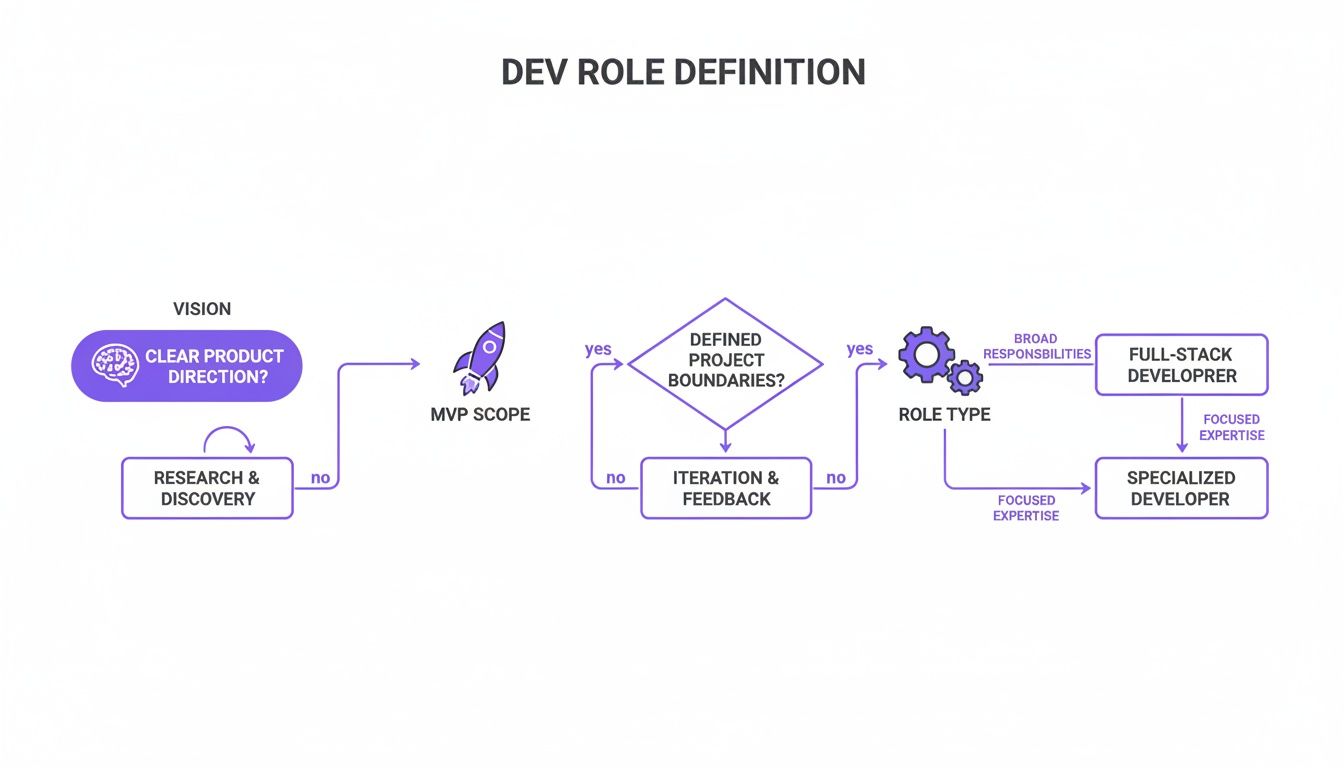
The flowchart drives home a critical point: you can't even begin to define the technical role you need until you have absolute clarity on your product vision and MVP scope.
To help you decide, let's break down the three most common hiring models. Each has its place, and the "best" one really depends on your immediate needs, your budget, and how much hands-on management you're prepared to do.
| Hiring Model | Best For | Average Cost | Pros | Cons |
|---|---|---|---|---|
| Freelancer | Short-term, specific tasks (e.g., MVP, bug fixes, feature sprints). | Varies widely ($50-$200+/hr). | Fast hiring, specialized skills, flexible, no long-term overhead. | Less integrated, requires clear specs, potential availability issues. |
| Full-Time | Building a core product, long-term development, and technical leadership. | High ($100k+ salary plus benefits and equity). | Deep commitment, company culture contribution, long-term ownership. | Expensive, slow to hire, significant long-term financial commitment. |
| Agency | Non-technical founders needing a fully managed, end-to-end product build. | Highest upfront cost (often $50k-$250k+ per project). | Access to a full team (PM, UI/UX, devs), de-risks execution, predictable outcomes. | Very expensive, less control over the team, can be slower than a dedicated hire. |
Ultimately, this isn't just about cost. It's about aligning the talent model with your strategic goals. A freelancer gets you speed for a specific task, a full-time hire builds your foundation, and an agency delivers a turnkey solution.
When you need speed and specific expertise, freelancers are your secret weapon. Need a landing page cranked out in a week? Or a tricky API integration that’s blocking your launch? A skilled freelance developer can parachute in, nail the task, and move on without the long-term overhead.
This model is a lifesaver for:
The trade-off, of course, is a lack of deep integration. Freelancers are project-focused. Don't expect them to get wrapped up in your company culture or obsess over your five-year product strategy. Managing them also requires tight briefs and crystal-clear communication—they aren't mind-readers.
When you’re truly ready to build the heart of your product and company, a full-time employee is the only way to go. This is your founding engineer—the person who will own the codebase, shape the technical culture, and grow with the business. It’s a huge investment in both cash and equity, but the payoff is loyalty and deep, unwavering product ownership.
Hiring a full-time developer is the right call when you have:
The commitment of a full-time hire goes both ways. You're not just buying their time; you're investing in their career. In return, you get a dedicated partner who is fully aligned with your startup's success.
If you’re a non-technical founder who needs a complete product built—and you don't want to manage the day-to-day grind of development—an agency can be a powerful partner. They bring a whole team to the table: developers, project managers, designers, the works. They handle everything.
This is the most expensive option upfront, no question. But it can significantly de-risk the entire process, especially if you're out of your depth on the technical side. It makes sense if you need to launch something complex and want an experienced team to just make it happen. The catch? You're trading control for convenience, and the price tag can be a non-starter for bootstrapped companies.
One of the smartest moves a startup can make today is looking beyond its own backyard. The remote work explosion has opened up a global talent pool, giving you access to incredible engineers at a fraction of the cost.
Global hiring data shows US firms are increasingly hiring in Latin America and Asia. In some of these markets, average software engineer salaries hover around $31,000, a world away from the $132,000 you might pay domestically. With 13% of new positions staying fully remote, this isn't a temporary trend; it's a massive strategic advantage.
There are two main flavors of this approach:
Be warned: managing an international team requires a deliberate effort. You need top-notch communication tools like Slack and Zoom, a culture of clear documentation, and real sensitivity to cultural differences. For a much deeper dive, our guide on how to hire remote developers is packed with practical strategies to make it work.
Now that you know who you’re looking for and how you want to hire them, it’s time for the real hunt. But let me be blunt: just posting a job on LinkedIn and waiting for the magic to happen is a fast track to frustration. The best engineers aren't just scrolling through mainstream job boards; they’re busy building things and talking shop in their own communities.
To find great talent, you have to meet them where they are. That means looking beyond the usual suspects and getting involved in the platforms where developers build their reputations and showcase their work.

Casting a wide net feels productive, but casting a smart net is what actually works. You need to focus your energy where the signal-to-noise ratio is high.
If you want to go even deeper on sourcing channels, we've put together another guide on how to find developers that covers more strategies for unearthing hidden talent.
Getting a list of candidates is just the start. The real challenge, especially if you’re a non-technical founder, is figuring out who can actually build what you need. A bad hire is incredibly costly, so a solid vetting process is non-negotiable.
Think of it as a multi-stage funnel. Each step is designed to test for different things—not just coding ability, but also communication, problem-solving instincts, and culture fit.
You also have to be realistic about the market. It's a tough environment out there, with new grads making up just 7% of recent Big Tech hires and more than half of all developer roles now demanding senior-level experience. This fierce competition for seasoned talent means it takes longer to hire, and you have to be vigilant to filter out unqualified or even fraudulent applicants. You can get a better sense of the competitive landscape for developer jobs on talent500.com.
Your first pass is all about spotting potential and weeding out the obvious mismatches. You don’t need to be a coding expert to do this well.
Just look for these clear signs:
Once you have a shortlist, the first real conversation shouldn’t be about code. It’s about mindset. It's about communication. It’s about figuring out if you can actually work with this person day in and day out.
Try asking questions that reveal how they think:
What you're listening for is curiosity, humility, and a genuine interest in the problem your business is trying to solve. A candidate who asks smart questions about your users and your goals is a keeper.
Please, forget the abstract brain teasers and whiteboard algorithm challenges. They don’t reflect the reality of building a product at a startup. Your goal is to see how a candidate tackles a problem they might actually face on the job.
The best technical assessment is a small, self-contained project that mirrors a real task. For a web developer, maybe it's building a simple feature with a specific API. For a mobile developer, it could be creating a single-screen app with a couple of interactive elements.
Give them a clear brief and a reasonable deadline—a few hours of focused work spread over 2-3 days is more than fair. You’re not just looking at the final code. You're evaluating their communication, the questions they ask along the way, and how they structure their work.
And if you’re non-technical? This is the perfect time to bring in a fractional CTO or a trusted technical advisor to review the project submission. Their expert eye can validate the quality of the code, giving you the confidence you need to make that final, critical decision.
You’ve navigated the sourcing maze, survived the technical deep dives, and finally found the one. This is the developer who gets your vision and has the skills to build it. But now comes the most nerve-wracking part for many founders: making an offer, especially when you know you can't compete with the eye-watering salaries thrown around by Big Tech.
Don't panic. Hiring a developer for a startup isn't just about the paycheck. It’s about selling a stake in the future. Your offer needs to be a compelling story—a narrative about vision, ownership, and genuine impact that a six-figure corporate salary simply can’t buy.
For any early-stage startup, cash is oxygen. You have to preserve it. This is where equity becomes your most powerful negotiating tool. The goal is to craft a package where the potential long-term upside of equity feels more exciting than the immediate gratification of a massive salary.
A common and effective approach is to offer a solid salary—one that’s competitive but sits just below the top of the market—and pair it with a meaningful slice of equity. This move immediately signals that you’re looking for a partner, not just a hired gun. You want someone who’s invested in the company’s success because their own success is directly tied to it.
Whatever you do, don't just email a PDF with a number on it. Get on a call. Walk them through the offer personally. This is your final pitch, and it has to be about much more than money. You’re inviting them to join a mission.
Frame the entire conversation around the unique advantages that only a startup can provide:
Your greatest negotiation tool isn’t your bank account; it’s your vision. Top engineers are driven by the chance to build something that matters. Make it clear that your offer is an invitation to be a builder, not just a coder.
Once you get a "yes," it's time to make it official. A handshake deal feels good, but it's not enough to protect you or your new hire. Getting the paperwork right is a sign of professionalism and sets the relationship up for success.
Your formal offer letter should be quickly followed by a few essential legal documents:
As a startup finds its footing, its ability to attract top talent grows. In hyper-competitive markets like the US and UK, founding engineers can command salaries up to £200K ($270K) plus equity. This is especially true as AI-focused ventures now make up 10-15% of all startup hires globally. For a deeper look at these figures, check out the latest startup hiring trends on jobright.ai. Having your legal ducks in a row shows you’re serious and helps you close your top candidate with confidence.
That signed offer letter feels like the finish line, but it's really just the start of the race. When you hire a developer for a startup, those first 90 days are absolutely crucial. This is where you set the stage for their long-term success and stop them from becoming another casualty of tech's high turnover rate. Trust me, a sloppy onboarding experience is a fast track to them leaving within a year.
The goal here isn't just about handing over a laptop and a list of passwords. You need to pull them into the very core of what you're building. This means getting them excited about the product vision, integrated into your culture, and, most importantly, comfortable with the existing codebase. A solid onboarding process closes the gap between their raw talent and your specific business problems, getting them up to speed and contributing meaningfully in a fraction of the time.

Don't wait until they walk through the door to figure this out. You need an onboarding plan mapped out before day one. And I'm not talking about HR paperwork—I mean a real roadmap for their first month.
If you're looking for a great starting point, the Open Onboarding Cookbook has some fantastic templates and frameworks you can adapt.
Onboarding isn't just about getting someone to write code. It's about making them feel like a valued part of the mission, confident that they can make an impact, and genuinely excited about the problems you're paying them to solve.
Onboarding has a beginning and an end, but retention is something you work on every single day. As an early-stage startup, you probably can't win on salary alone. Your secret weapon is creating an environment they won't want to leave.
It all starts with a culture of deep ownership. Give your developer real autonomy over a specific feature or part of the product. When someone feels true ownership, their mindset shifts from just checking off tasks to delivering real outcomes.
Next, give them a clear path for meaningful growth. This doesn't require a rigid corporate career ladder. It could be the chance to learn a new programming language, lead the next big project, or mentor the junior developer you hire down the line.
Finally, protect their work-life balance like your company's life depends on it—because it does. Burnout is the number one killer of creativity and passion. Showing you value their well-being is how you build the kind of loyalty that keeps your core technical team around for the long haul.
Even the most buttoned-up hiring plan has gray areas. Let's dig into the questions that almost every founder asks when they're about to make that critical first developer hire.
Thinking the salary is the only cost is a classic first-time founder mistake. The real number is always higher. You need to account for the hidden costs that add up quickly.
We're talking about recruitment fees, which can easily eat up 15-25% of the developer's first-year salary. Then there are benefits, payroll taxes, and the gear they'll need—laptops, software licenses, you name it. And while it's not a cash expense, you absolutely have to factor in equity as part of the total compensation package.
For a decent mid-level full-stack developer in a major US tech hub, you should be prepared for an all-in cost somewhere between $120,000 and $180,000+ for the first year. Looking outside the US can bring that number down, but don't forget to budget for the legal and administrative complexity that comes with it.
It's often less about what they say and more about what they don't say. The biggest red flag is a candidate who gets fuzzy on the details of their past projects. If you ask about a tough technical challenge and get a vague, hand-wavy answer, dig deeper. It could mean their contribution wasn't as significant as their resume suggests.
Keep an eye out for these other warning signs:
A great developer is genuinely invested in the why behind the what. If they're more excited about using a specific framework than solving your customer's problem, they're probably not the right fit for an early-stage startup.
This is the ultimate "partner vs. employee" dilemma. A technical co-founder is in the trenches with you, sharing the risk, the vision, and a huge slice of equity. You're looking for a true partner to build a company with. An employee, even an early one, is a skilled professional you're paying to execute a vision you've already largely defined.
There's no single right answer, but the question to ask yourself is this: "Do I need a strategic equal to help me figure out what to build, or do I need a technical expert to help me build it?" If you need a partner to share the entrepreneurial burden, find a co-founder. If your vision is clear and you just need the technical horsepower to bring it to life, hiring your first developer is the way to go.
You're probably in one of two situations right now. You need to hire a Scrum Master fast because delivery feels messy, or you've already interviewed a few and every candidate sounds polished, certified, and strangely interchangeable. They know the terms. They can define artifacts and ceremonies. But you still can't tell who can steady a […]

Most advice on API vs REST API starts with definitions and stops there. That's too shallow for a real project. The decision affects delivery speed, integration risk, documentation load, support burden, and even who you need to hire to keep the system stable after launch. The common mistake is treating “API” and “REST API” like […]

You're probably in one of two situations right now. You need to hire a Java developer because a core system is growing faster than your team can support, or you inherited a Java codebase and need someone who can stop the bleeding without making the architecture worse. Both situations punish vague hiring. A generic “Java […]


