

TypeScript has cemented its place as an industry standard, making it a non-negotiable skill for modern software developers. Acing a technical interview, however, requires more than just familiarity with the syntax. It demands a deep, practical understanding of its core concepts, from basic type safety to advanced architectural patterns. This guide is designed to dissect […]

TypeScript has cemented its place as an industry standard, making it a non-negotiable skill for modern software developers. Acing a technical interview, however, requires more than just familiarity with the syntax. It demands a deep, practical understanding of its core concepts, from basic type safety to advanced architectural patterns. This guide is designed to dissect the most critical TypeScript interview questions you are likely to encounter in 2025.
We will provide a comprehensive breakdown, moving from foundational concepts like the differences between types and interfaces to more complex topics such as Generics, Decorators, and custom Type Guards. For each question, you'll find not just a model answer but also specific evaluation criteria to help hiring managers identify strong candidates. This roundup covers the full spectrum, offering role-specific variations for frontend, backend, and full-stack positions.
This resource is built for both sides of the table. If you're a candidate preparing to demonstrate your expertise, these questions and answers will sharpen your skills. Effective preparation extends beyond just reviewing technical concepts; mastering the interview process itself through dedicated effective interview practice can significantly boost your confidence. For hiring managers and CTOs, this guide serves as a practical toolkit for structuring interviews and accurately assessing a candidate's real-world TypeScript proficiency. We'll explore questions that reveal a developer's ability to write clean, maintainable, and scalable code, ensuring you can confidently identify and hire top-tier talent.
This is a fundamental entry point in most TypeScript interview questions, designed to gauge a candidate's core understanding. TypeScript is a programming language developed and maintained by Microsoft. It's a strict syntactical superset of JavaScript, which means any valid JavaScript code is also valid TypeScript code. The primary addition TypeScript brings is static typing.
Unlike JavaScript's dynamic typing where type errors are found at runtime (often by the end-user), TypeScript's static type checker analyzes your code as you write it. This process, known as transpilation, converts TypeScript code (.ts) into standard JavaScript code (.js) that can be executed by browsers or Node.js environments. This compile-time checking catches entire classes of bugs before they ever reach production.
The core distinction lies in the timing and nature of type checking:
This difference is crucial for building reliable, large-scale applications where preventing runtime errors is a high priority. Frameworks like Angular, NestJS, and increasingly Vue.js have adopted TypeScript to leverage these benefits, making it an essential skill for modern web development.
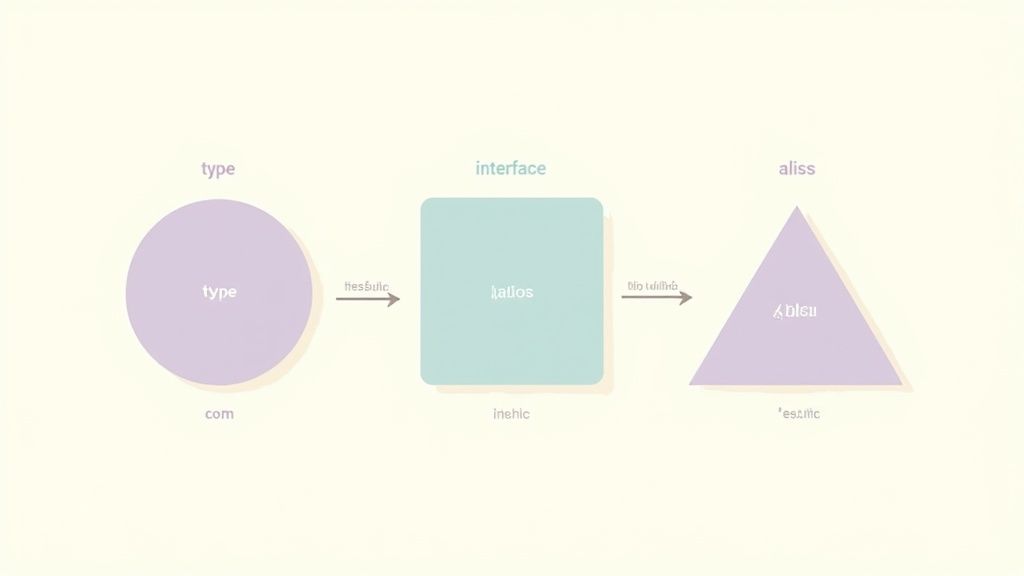
This is another foundational topic in TypeScript interview questions, designed to probe a candidate's understanding of how data structures are defined. While type aliases and interface can often be used interchangeably for describing object shapes, they have distinct capabilities and best-practice use cases. The core purpose of all three is to create custom names for type annotations, improving code readability and reusability.

An interface is a powerful way to define a "contract" for an object's shape. It can be extended by other interfaces and implemented by classes. A type alias, created with the type keyword, is more versatile. It can represent not only object shapes but also primitives, union types, intersection types, and tuples, making it a flexible tool for more complex type definitions.
The choice between interface and type often comes down to their specific features and the intended use case:
interface declarations with the same name are automatically merged into a single definition. This is useful for extending existing interfaces, even from third-party libraries. type aliases do not merge and will raise a duplicate identifier error.implements). Type aliases can achieve similar results using intersections (&), but the syntax and intent are different. Interfaces are generally preferred for object-oriented patterns.interface when defining the shape of an object or a class contract. Use a type alias for defining union types, tuples, or more complex utility types that are not object-focused. To efficiently define types for complex JSON data structures, consider leveraging online JSON to TypeScript converter tools.A common convention is to use interface for public-facing APIs or object structures that might be extended, and type for internal or more complex, non-object types. Understanding this distinction demonstrates a deeper, more practical knowledge of TypeScript.
This is one of the more advanced, yet crucial, TypeScript interview questions that separates junior from mid-level developers. Generics are a powerful feature that allows you to create reusable components, functions, classes, or interfaces that can work over a variety of types rather than a single one. Essentially, they act as placeholders for types, which are specified when the code is used. This provides a flexible way to write code while maintaining strict type safety.
The primary goal of generics is to enable you to write a function or class that works with any data type without sacrificing type checking. Without generics, you would either have to use the any type, which loses type information, or write separate functions for each data type. Generics, defined with angle brackets <T>, solve this by creating a variable for the type itself, which is passed in by the consumer of the component.
Generics are fundamental for creating scalable, type-safe APIs and data structures. Here’s how they are commonly applied:
Generic Functions: A classic example is an identity function that returns whatever is passed into it. Using <T>, you ensure that the return type is the same as the argument type.
function identity(arg: T): T {
return arg;
}
let output = identity("myString"); // type of output is 'string'
Generic Interfaces: For abstracting data structures, like a repository pattern, you can define an interface that works with any model.
interface Repository {
findById(id: number): T;
findAll(): T[];
}
Generic Classes: You can create classes that are type-agnostic, such as a container or collection class that can hold any type of value.
class Container {
private value: T;
constructor(val: T) {
this.value = val;
}
}
Generics are a core concept for anyone serious about building robust applications with TypeScript. To dive deeper into this and other related topics, you can find more interview questions on TypeScript to prepare for your next technical discussion.
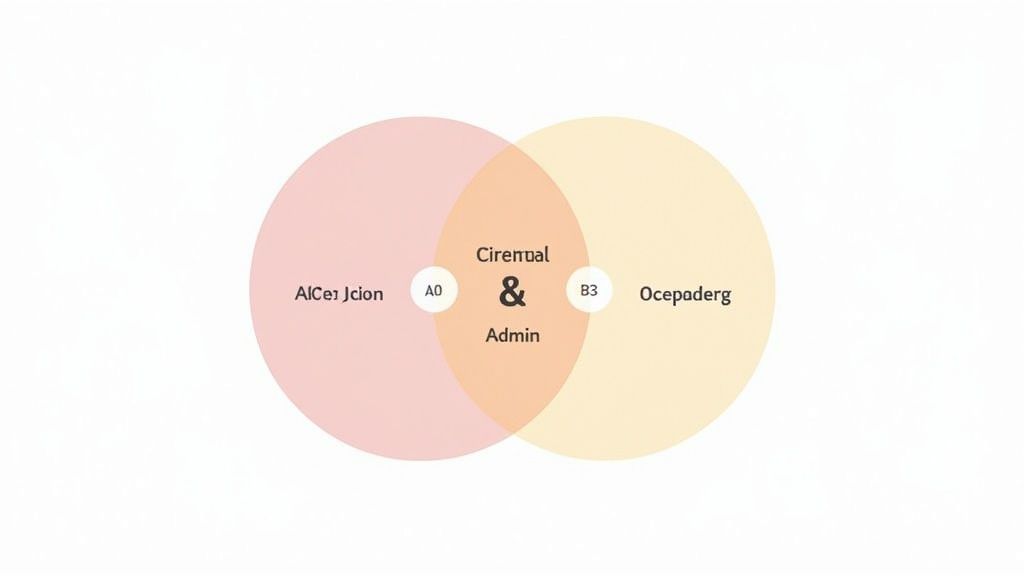
This is a common follow-up to basic typing questions, designed to probe a candidate's understanding of how to compose and combine types. Union and intersection types are fundamental tools for creating flexible yet precise type definitions in TypeScript. A union type describes a value that can be one of several types, using the | (pipe) operator. An intersection type, in contrast, combines multiple types into one, using the & (ampersand) operator.
Union types are perfect for scenarios where a variable or function parameter can accept a range of different, but known, types. Intersection types are used to merge the properties of multiple existing types, creating a new type that has all the features of its components. Mastering both is essential for writing expressive and robust TypeScript code.
The core distinction lies in how they combine types: "OR" versus "AND".
string or a number.This is a classic object-oriented programming question adapted for TypeScript, designed to test a candidate's understanding of encapsulation and class design. Access modifiers in TypeScript control the visibility and accessibility of class members (properties and methods) from different contexts. They are a compile-time feature that helps enforce boundaries and create a clear, intentional public API for a class.
These modifiers are keywords you place before a class member name to define its access level. When TypeScript is transpiled to JavaScript, these modifiers are erased, as they are not a feature of JavaScript's class syntax. Their purpose is to provide developer-time safety and structure within the TypeScript environment.
The core distinction lies in where a class member can be accessed:
public: This is the default modifier. A public member can be accessed from anywhere, both inside and outside the class. If no modifier is specified, the member is implicitly public.private: A private member can only be accessed from within the same class declaration. It cannot be accessed by instances of the class or by any child classes that extend it. This is used to hide internal implementation details.protected: A protected member is accessible from within its own class and also from any subclasses that extend it. It cannot be accessed from outside instances, making it useful for creating extensible base classes.A common shorthand is using parameter properties in the constructor, which both declares and initializes a member property in one step. For instance, constructor(private id: number) {} creates a private id property on the class, making the code more concise and readable. This question is crucial in interviews as it reveals a candidate's grasp of fundamental OOP principles within the TypeScript ecosystem.
This is a critical TypeScript interview question that separates candidates who just use TypeScript from those who truly understand its type-safety principles. The choice between any and unknown directly reflects a developer's commitment to writing safe, maintainable code. While both can hold any value, their enforcement of type-checking rules is fundamentally different.
The any type is an escape hatch. It effectively disables all type checking for a variable, telling the TypeScript compiler to trust that the developer knows what they are doing. You can call any method or access any property on a value of type any without a compile-time error, deferring potential crashes to runtime. In contrast, unknown is a type-safe counterpart. It represents a value whose type is not known, forcing the developer to perform explicit type checks before performing any operations.
The core difference is that unknown enforces type safety, while any bypasses it entirely. This distinction is crucial for modern, robust application development.
unknown is the top type in TypeScript's type system; it can hold any value, but you cannot perform operations on it without first narrowing its type. any also accepts any value but allows any operation, sacrificing compile-time safety.any, the compiler allows potentially unsafe operations. With unknown, the compiler will throw an error if you try to use the value before its type has been confirmed using a type guard (like typeof or instanceof).unknown over any wherever the type of a value is truly unknown at compile time, such as with API responses or user input.Here’s a practical comparison:
// Using 'any' (unsafe)
let valueAny: any = "Hello TypeScript";
console.log(valueAny.toUpperCase()); // Works
console.log(valueAny.nonExistentMethod()); // No compile-time error, will crash at runtime
// Using 'unknown' (safe)
let valueUnknown: unknown = "Hello TypeScript";
// console.log(valueUnknown.toUpperCase()); // Compile-time error!
// We must narrow the type first
if (typeof valueUnknown === 'string') {
console.log(valueUnknown.toUpperCase()); // Works, because TS now knows it's a string
}
Ultimately, using unknown forces you to handle uncertainty in your code gracefully, leading to fewer runtime errors and a more predictable codebase. It encourages explicit, defensive programming, which is a hallmark of an experienced developer.
This question assesses a candidate's knowledge of a common TypeScript feature used for creating more readable and maintainable code. Enums (short for enumerations) allow developers to define a set of named constants. By grouping related values, enums make it easier to work with a fixed set of options, such as application states, user roles, or specific directions.
When TypeScript code is compiled, enums are transformed into plain JavaScript objects. This allows them to be used at runtime, providing a tangible structure that helps prevent "magic strings" or arbitrary numbers in the codebase. Using an enum like UserRole.Admin is far more descriptive and less error-prone than using a string like "ADMIN" or a number like 1.
TypeScript offers several types of enums, each with distinct characteristics and use cases that are important to cover in typescript interview questions.
Numeric Enums: Members are assigned numeric values. If not explicitly initialized, the first member defaults to 0, and subsequent members auto-increment by one.
enum UserRole {
Guest, // 0
Member, // 1
Admin // 2
}
String Enums: Each member must be initialized with a string literal. String enums offer better readability and are easier to debug, as their values are human-readable in logs and console outputs.
enum Direction {
Up = 'UP',
Down = 'DOWN',
Left = 'LEFT',
Right = 'RIGHT'
}
Const Enums: For performance-critical applications, const enums are a powerful choice. They are completely erased during compilation, and their values are inlined wherever they are used. This results in a smaller bundle size and faster execution, as there's no runtime object lookup.
const enum Status {
Active = 1,
Inactive = 0
}
This question probes a candidate's knowledge of more advanced, meta-programming features in TypeScript. Decorators are a special kind of declaration that can be attached to a class, method, accessor, property, or parameter. They are functions prefixed with an @ symbol and are executed at design time, allowing them to observe, modify, or replace the definition of what they are attached to.
Decorators are an experimental feature and require enabling the experimentalDecorators compiler option in your tsconfig.json file. They provide a clean, declarative syntax for adding functionality and metadata to your code, a pattern heavily utilized by modern frameworks like Angular, NestJS, and TypeORM to simplify complex tasks like dependency injection, routing, and database modeling.
Understanding decorators goes beyond syntax; it's about recognizing their powerful application in building scalable and maintainable systems.
reflect-metadata library is often used alongside decorators to read this metadata at runtime, enabling powerful patterns like inversion of control (IoC) containers. For example, NestJS uses @Injectable() to mark a class for its dependency injection system.@Log() decorator to automatically log method calls or an @Auth() decorator to protect API endpoints without cluttering the core business logic.@Deprecated() decorator could wrap a method in a function that logs a warning message to the console whenever the old method is called, guiding developers to use a newer alternative.This is a more intermediate-level entry in a list of TypeScript interview questions, designed to test a candidate's understanding of type safety and control flow analysis. A type guard is a TypeScript expression that performs a runtime check to guarantee the type of a variable within a specific scope, most often a conditional block. This process is called type narrowing.
TypeScript provides several built-in type guards. For example, typeof is used for primitive types, instanceof for class instances, and the in operator for checking object properties. These guards allow the TypeScript compiler to intelligently narrow a broad type, like a union (string | number) or unknown, to a more specific type within the conditional block, enabling type-safe operations.
The real power comes from creating custom type guards. These are user-defined functions that return a special type predicate: argument is Type. This predicate signals to the compiler that if the function returns true, the argument passed to it should be treated as the specified type. This is crucial for working with complex domain-specific objects or validating external data.
Built-in Guards: These are your first line of defense.
typeof value === 'string': Narrows the type of value to string.error instanceof Error: Narrows error to the Error class instance.'swim' in animal: Checks if the animal object has a swim property.Custom Type Guards: For reusable, complex validation, a custom guard is ideal. This makes your code cleaner and more expressive.
interface Fish {
swim: () => void;
}
// Custom type guard using a type predicate
function isFish(pet: unknown): pet is Fish {
return (pet as Fish).swim !== undefined;
}
let pet: unknown;
if (isFish(pet)) {
pet.swim(); // Safe to call, as 'pet' is now known to be a 'Fish'
}
This technique is essential for writing robust, type-safe code that handles dynamic data structures, API responses, or any scenario where a variable's type isn't known with certainty at compile time. It demonstrates a developer's ability to leverage TypeScript's advanced features to prevent runtime errors.
This is a common TypeScript interview question that probes a candidate's understanding of immutability and compile-time guarantees. The readonly modifier is a TypeScript feature that prevents a property from being reassigned after its initial declaration. It serves as a powerful tool for enforcing immutability at the type-checking level, making code more predictable and less prone to bugs caused by accidental mutations.
When applied, the TypeScript compiler will throw an error if you attempt to modify a readonly property. This is particularly useful for configuration objects, state management patterns (like in Redux or MobX), and functional programming paradigms where data immutability is a core principle. It ensures that once an object is created, its fundamental properties remain stable throughout its lifecycle.
The readonly modifier can be applied in several contexts to enhance type safety and communicate intent clearly within the codebase:
Class Properties: Ensures that a property set in the constructor cannot be changed later.
class AppConfig {
readonly apiUrl: string = 'https://api.example.com';
constructor(env: string) {
if (env === 'development') {
this.apiUrl = 'https://api.dev.example.com';
}
}
}
Object Type Properties: Creates immutable object shapes using interfaces or type aliases.
type ReadonlyUser = {
readonly id: number;
name: string;
};
Arrays: The ReadonlyArray<T> type creates an array where methods that mutate the array (like push, pop, splice) are removed, preventing modifications.
const numbers: ReadonlyArray = [1, 2, 3, 4, 5];
// numbers.push(6); // Error: Property 'push' does not exist on type 'readonly number[]'.
It is important to remember that readonly is a compile-time check only; it is completely erased during transpilation and provides no runtime protection. Adopting readonly is a best practice that improves code clarity and maintainability, which are key focus areas during a technical review; you can learn more about code review best practices to understand why this matters.
| Item | Implementation complexity | Resource requirements | Expected outcomes | Ideal use cases | Key advantages |
|---|---|---|---|---|---|
| What is TypeScript and How Does it Differ from JavaScript? | Moderate — setup and transpilation step | TypeScript compiler, build tooling, tsconfig, developer training | Compile-time type checks, improved maintainability | Large apps, team projects, long-lived codebases | Early error detection, strong IDE support |
| Explain Types, Interfaces, and Type Aliases in TypeScript | Low–Moderate — conceptual choices | Knowledge of type system, minimal tooling | Clear data contracts and reusable type definitions | API shapes, public interfaces, domain models | Explicit schemas, better autocompletion |
| What are Generics in TypeScript and How Do You Use Them? | High — type parameter design can be complex | Advanced type design skills, tests, tooling | Reusable, type-safe abstractions across types | Libraries, collections, generic APIs | Reusability with preserved type safety |
| What are Union and Intersection Types? | Moderate — requires careful narrowing | Understanding of narrowing and discriminants | Flexible, expressive type models; safer polymorphism | Functions with multiple input shapes, modeling variants | Expressiveness, exhaustiveness checks |
| Explain Access Modifiers (public, private, protected) in TypeScript | Low — simple to apply conceptually | Knowledge of OOP patterns; compile-time checks only | Better encapsulation and clearer class contracts | Class-based designs, encapsulation needs | Enforces intent and prevents accidental use |
| What is the Difference Between 'any' and 'unknown' Types? | Low — conceptual policy decision | Code audits, type-guard helper utilities | Safer boundaries when using unknown; fewer unchecked ops | API boundaries, gradual typing/migrations | unknown enforces checks; any allows unrestricted use |
| What are Enums in TypeScript and How Do You Use Them? | Low–Moderate — simple but with bundle implications | Awareness of runtime output; consider const enums or unions | Named constant sets, improved readability | Finite option sets, domain constants | IDE completion, semantic constants |
| Explain Decorators in TypeScript and Their Use Cases | High — experimental feature with metadata needs | experimentalDecorators, reflect-metadata, framework support | Declarative augmentation, reduced boilerplate | DI, routing, validation in frameworks (Angular/Nest) | Declarative meta-programming, concise annotations |
| What are Type Guards and How Do You Create Custom Type Guards? | Moderate — requires explicit guard logic | Utility functions, unit tests, careful implementations | Precise narrowing and fewer runtime errors | Handling unions and unknowns, complex type checks | Reliable type narrowing and improved safety |
| What is the Purpose of 'readonly' and How Does It Enhance Type Safety? | Low — simple modifier usage | Developer discipline; code reviews | Compile-time immutability (shallow), fewer accidental mutations | Immutable state, configs, public APIs | Prevents reassignment, clarifies intent and usage |
Navigating the landscape of typescript interview questions is more than a simple Q&A exercise; it's a strategic process for identifying developers who can build robust, scalable, and maintainable applications. Throughout this guide, we've moved beyond basic syntax to explore the deeper concepts that separate proficient developers from true TypeScript architects. From foundational differences with JavaScript to the nuanced power of generics, decorators, and custom type guards, each question serves as a diagnostic tool.
For candidates, mastering these areas is your pathway to demonstrating a commitment to code quality and a deep understanding of modern software engineering principles. For hiring managers, this curated list of questions and evaluation frameworks provides a blueprint for accurately assessing a candidate's ability to leverage TypeScript’s full potential, ensuring your next hire can contribute to a resilient and error-free codebase from day one.
The journey from knowing TypeScript to mastering it is marked by a few critical shifts in perspective. Understanding these shifts is key to both acing an interview and building a high-performing team.
string or number. It’s about leveraging advanced features like unknown for safer type assertions, using readonly to enforce immutability, and creating custom type guards to build intelligent, self-documenting code.|) and intersections (&) is fundamental. It shows a developer can model complex, real-world data structures accurately, reducing runtime errors and improving collaboration between frontend and backend teams.public, private, protected) and decorators are not just features; they are tools for building well-architected, object-oriented systems. A strong grasp here indicates a developer who thinks about long-term maintainability and API design.Having explored this comprehensive set of typescript interview questions, the path forward is clear. It’s time to integrate these insights into your hiring process and personal development roadmap.
For Hiring Managers and CTOs:
interface over a type alias in a specific scenario? Why is unknown a safer alternative to any? The rationale reveals their depth of knowledge.For Developers:
Ultimately, mastering the art of the TypeScript interview is a powerful lever for career and company growth. It connects exceptional talent with forward-thinking teams, fostering an environment where quality, scalability, and developer experience are paramount. By focusing on these deeper principles, you ensure that you are not just hiring a coder, but a craftsman who will elevate your entire engineering organization.
You're probably in one of two situations right now. You need to hire a Scrum Master fast because delivery feels messy, or you've already interviewed a few and every candidate sounds polished, certified, and strangely interchangeable. They know the terms. They can define artifacts and ceremonies. But you still can't tell who can steady a […]

Most advice on API vs REST API starts with definitions and stops there. That's too shallow for a real project. The decision affects delivery speed, integration risk, documentation load, support burden, and even who you need to hire to keep the system stable after launch. The common mistake is treating “API” and “REST API” like […]

You're probably in one of two situations right now. You need to hire a Java developer because a core system is growing faster than your team can support, or you inherited a Java codebase and need someone who can stop the bleeding without making the architecture worse. Both situations punish vague hiring. A generic “Java […]


