Scikit Learn vs Pytorch

Victor
Posted on 11 October 2026
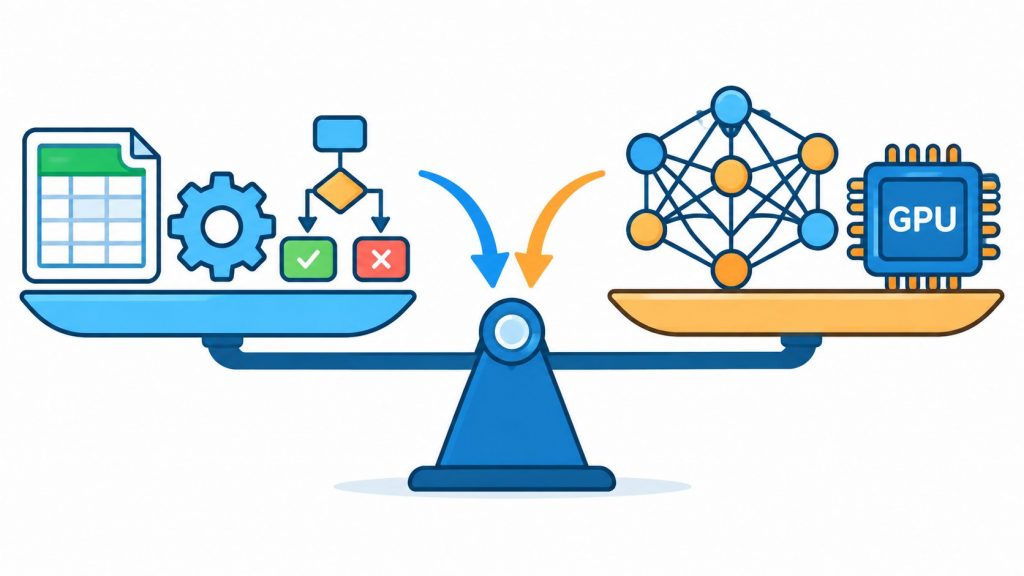



Scikit-learn is the default for structured operational and tabular clinical data, while PyTorch is required for unstructured data such as medical imaging and clinical natural-language processing. In practice, most mature healthcare AI teams eventually need engineers skilled in both.
The popular advice to “pick one framework” is wrong for medical practices. A no-show prediction model built from appointment history, billing codes, referral volume, and staffing records has little in common with a system that interprets radiology images or extracts meaning from physician notes. Treating those projects as the same engineering problem leads to inflated infrastructure, poorly written job descriptions, and avoidable deployment risk.
The practical question is which data your practice can use responsibly, what decision the model will support, and where the model must run. Scikit-learn usually gives teams the fastest route to a reproducible baseline for structured data. PyTorch becomes the right choice when the project depends on neural networks, tensor computation, automatic differentiation, GPUs, or custom architectures.
The comparison below gives practice owners and technology managers a working starting point. The sections that follow connect the choice to healthcare workflows, deployment constraints, privacy boundaries, and the talent needed to maintain the system after the first prototype.
| Decision area | Scikit-learn | PyTorch |
|---|---|---|
| Best initial fit | Structured clinical and operational data | Images, text, audio, signals, and custom neural models |
| Typical practice examples | No-show prediction, staffing demand, billing anomaly detection | Medical imaging, clinical NLP, waveform analysis |
| Development style | Standardized estimators, pipelines, and model selection | Tensor operations, autograd, custom modules, and training loops |
| Usual infrastructure | CPU-oriented services and batch workflows | GPU or accelerator-oriented training when justified |
| Main hiring signal | Reproducible tabular pipelines and validation discipline | Deep-learning architecture, profiling, and deployment expertise |
| Recommended strategy | Establish the baseline here first | Add when the data or model genuinely requires it |
Table of Contents
Framework comparisons often ask which library is better as though a medical practice were choosing a single permanent technology stack. That framing ignores how healthcare data is produced. Scheduling systems, billing platforms, referral logs, staffing calendars, and many EHR exports create rows and columns. Radiology files, pathology slides, voice recordings, ECG traces, and free-text notes do not.
For a structured practice-management problem, scikit-learn is the sensible default. Its algorithms cover regression, classification, clustering, preprocessing, and model selection, and its workflow is designed around prepared feature matrices. A practice could use it to estimate appointment cancellations from prior scheduling behavior, predict staffing demand, or flag unusual billing patterns. Those projects still require careful validation and clinical review, but they don't require a custom neural architecture merely because the word “AI” appears in the business case.
PyTorch belongs to a different layer of the stack. It provides tensor computation and automatic differentiation, which allow engineers to define and train neural networks for inputs that aren't naturally represented as a small table. A model processing medical images may need convolutional or transformer-based components. A clinical NLP system may need to represent long, variable text and fine-tune a neural language model. A time-series project may require a custom architecture for waveform data.
Practical rule: Start with the simplest model that can answer the operational question safely. Move to deep learning only when the data representation or performance requirement justifies the added engineering burden.
The distinction matters for practice leaders because framework choice changes project scope. A scikit-learn pilot can often stay close to the data warehouse and an existing Python service. A PyTorch program may require GPU access, dataset versioning, specialized evaluation, experiment tracking, model optimization, and a stronger MLOps function. Neither approach removes the need for privacy controls, access management, auditability, and human oversight.
The 2024 Python Developers Survey reported that 38% of respondents trained or generated predictions using machine-learning models, an increase of six percentage points from the previous year. Among those machine-learning users, more than two-thirds used scikit-learn and PyTorch, and a separate summary reported approximate usage of 67% for scikit-learn and 60% for PyTorch. The percentages shouldn't be added because respondents could select multiple technologies. The survey results support a useful conclusion for healthcare hiring: these tools frequently coexist.
Scikit-learn's history helps explain its role. The project began in 2007 as a Google Summer of Code project led by David Cournapeau, continued later that year by Matthieu Brucher, and was led from 2010 by researchers at France's INRIA. Its first public release came on February 1, 2010, and its academic reference appeared in the Journal of Machine Learning Research in 2011. That mature, general-purpose foundation makes it well suited to everyday structured-data work.
PyTorch emerged from the later deep-learning generation. Its value is greatest when the practice's data contains information that conventional features can't adequately preserve, such as image texture, language context, spatial relationships, or complex signal patterns. For a broader view of how computational workflows can scale in scientific and biomedical settings, leaders may also find scaling bioinformatics with Beam useful when discussing infrastructure beyond the model library itself.
Scikit-learn is organized around an estimator API. Classifiers, regressors, preprocessors, and related components expose a standard fit(X, y) method, while fitted models generally provide predict or related methods. Meta-estimators wrap other components, with Pipeline and GridSearchCV serving as central examples in the official documentation.
That uniformity has practical value in a medical practice. A team can combine missing-value handling, feature selection, normalization, and a final classifier or regressor into one fitted object. The same object can be validated, searched, serialized, and used for prediction without creating a different training interface for every algorithm. A manager assessing candidates should understand that this isn't just a convenient syntax preference. It supports reproducibility and reduces opportunities for preprocessing leakage.
A no-show model illustrates the pattern. Appointment type, lead time, referral source, prior attendance, and scheduling location can be transformed inside a pipeline, then passed to a model. If the pipeline is fitted correctly within the training process, the preprocessing logic travels with the estimator rather than being recreated manually in a separate notebook and production service.

This style suits engineers who value clear interfaces, repeatable experiments, and conventional model families. It also aligns with Python ETL development when the model depends on reliable ingestion, cleaning, and feature preparation before training.
PyTorch uses tensors and automatic differentiation rather than the estimator abstraction. A tensor's requires_grad setting determines whether gradient computation is tracked, and torch.Tensor.grad becomes populated after a gradient calculation. Engineers define model modules, forward passes, loss functions, optimization steps, data loaders, checkpoints, and validation behavior.
That lower-level control is exactly why PyTorch is valuable for clinical imaging and language systems. The engineer can alter the architecture, loss function, batching strategy, or training behavior as the research question changes. The PyTorch research paper describes an imperative, Pythonic framework in which code execution remains under the user's control while supporting hardware accelerators.
The trade-off is responsibility. A PyTorch developer can't rely primarily on a standardized estimator wrapper to coordinate the full process. Your hiring criteria should therefore ask for evidence of data loading, checkpoint recovery, experiment reproducibility, validation design, device management, and failure handling. A developer who knows scikit-learn well may understand the modeling concepts but still need substantial time to become effective with custom neural-network training.
For conventional tabular workloads, scikit-learn is generally more resource-efficient because its estimators target linear models, tree ensembles, support-vector machines, clustering, and dimensionality reduction rather than neural-network training loops. An independent comparison reported comparable predictive accuracy on tested classification and regression datasets, while scikit-learn achieved faster training and prediction and used less memory in those tests. The performance analysis shouldn't be generalized to every dataset, but it supports a sensible operational default.
A practice predicting cancellations from scheduling records usually needs fast CPU inference, predictable memory use, and a service that can run near existing application infrastructure. It may not need GPU capacity at all. That can simplify hosting, reduce operational dependencies, and make a batch workflow easier to monitor.
Scikit-learn can parallelize selected estimators through joblib, OpenMP, and BLAS. The n_jobs parameter controls joblib-managed parallelism, while lower-level numerical libraries may create additional threads. Engineers must watch for oversubscription, where workers and numerical-library threads multiply and produce worse performance instead of better performance. Teams operating containerized services should document thread settings and benchmark the complete request path.
PyTorch is the stronger option when a custom neural model can exploit parallel tensor operations and accelerator hardware. It supports device placement, batching, precision choices, data loading, and distributed execution, but engineers have to manage those decisions deliberately. A GPU doesn't automatically improve a small structured-data project, and adding one to a weakly designed pipeline can increase complexity without improving the clinical result.
Deployment also deserves its own decision. ExecuTorch 1.0 provides a PyTorch-native path to mobile, embedded, desktop, and AI-PC deployment without model conversion or rewriting, according to the official ExecuTorch announcement. Scikit-learn models can also be exported through sklearn-onnx for ONNX-compatible environments. The target device, supported operators, memory ceiling, latency budget, quantization needs, and retraining frequency should determine the path.
| Capability | Scikit-learn Profile | PyTorch Profile |
|---|---|---|
| Training hardware | Usually CPU-oriented for conventional estimators | CPU, GPU, or other accelerators, with stronger value for neural workloads |
| Parallelism | joblib, OpenMP, and BLAS, with oversubscription risk | Tensor-level execution, device management, and distributed training |
| Inference | Well suited to rapid CPU prediction for structured data | Well suited to neural inference, including optimized edge paths |
| Memory profile | Often favorable for simpler tabular models | Can require more memory because of neural architecture and tensor state |
| Edge options | Export through ONNX-compatible workflows where supported | ExecuTorch provides a PyTorch-native mobile and embedded route |
| Main operational risk | Thread contention and inconsistent preprocessing | Device, batching, precision, checkpoint, and model-serving complexity |
| Best benchmark | End-to-end latency and peak resident memory | End-to-end latency, peak memory, throughput, and device utilization |
For real-time diagnostic software, infrastructure choices become inseparable from signal-processing requirements. A resource such as this overview of medical diagnostics software builds can help technical leaders think about the application layer around the model, not just the training library. Teams deploying services across containers should also define ownership for Kubernetes deployment, observability, rollback, and access controls.
Don't compare only model-fitting time. Use identical preprocessing, validation splits, precision settings, and batch sizes, then measure:
HIPAA doesn't prescribe a specific machine-learning framework. Practices still need appropriate administrative, physical, and technical safeguards for protected health information, and responsibilities can vary by role, vendor relationship, and jurisdiction. Confirm the arrangement with qualified compliance counsel rather than treating a framework or hosting platform as “HIPAA certified.” HHS doesn't recognize an official HIPAA certification.
The simplest way to choose between scikit-learn and PyTorch is to describe the input before describing the algorithm. If the input is a stable table of patient, appointment, billing, or staffing features, start with scikit-learn. If the input is an image, long text, audio recording, waveform, or another high-dimensional signal, evaluate PyTorch.
That rule applies across practice sizes. A small specialty clinic may have enough structured scheduling history to build a useful operational model but no reason to create a medical-imaging team. A health system with pathology or radiology partnerships may need PyTorch specialists even if its appointment forecasting remains a scikit-learn task.

Scikit-learn is a strong fit for models that use engineered features and need an understandable, repeatable workflow:
For these projects, a baseline matters more than model novelty. Compare a simple interpretable model with tree-based alternatives, document the feature definitions, and test performance across relevant patient and location groups. A lower-performing model may still be preferable if staff can understand and audit its behavior.
PyTorch is appropriate when the model must learn representations from data that are difficult to reduce to hand-built columns:
A practice shouldn't use PyTorch just because an image or text field exists. If the actual decision can be answered with reliable structured features, the simpler path may be safer and easier to monitor. Conversely, scikit-learn shouldn't be forced onto raw images or long clinical documents after the meaningful structure has been discarded.
A job description that says “scikit-learn developer” or “PyTorch engineer” is incomplete. Healthcare systems need people who can move from source data to validated output, then maintain the model when workflows, coding practices, patient populations, and software dependencies change.
For a scikit-learn-focused role, look for experience with:
A PyTorch-focused role needs a different depth of evidence. Ask candidates to explain model architecture, tensor shapes, data-loader behavior, GPU utilization, checkpointing, precision choices, and validation under dataset shift. For clinical NLP or imaging, require a clear account of labeling, annotation disagreement, subgroup evaluation, and how the model behaves when input quality is poor.
The strongest arrangement for many healthcare organizations is a core engineer who can establish reliable structured-data systems, supported by a specialist who can introduce PyTorch when the roadmap demands it. That doesn't mean every practice needs two full-time hires immediately. A smaller organization may begin with a scikit-learn-capable data scientist and bring in deep-learning expertise for a defined imaging, language, or signal project.
Remote staff can support this model if practice leaders define access boundaries and supervision clearly. A remote medical administrative assistant or virtual medical receptionist may help with operational workflows around scheduling and patient communication, but that role must remain administrative. It shouldn't diagnose patients, interpret a model's clinical output, or independently make medical decisions.
For pre-vetted LATAM healthcare talent, Medical Virtual Assistants can be one hiring option for administrative support roles, including bilingual English and Spanish patient coordination, scheduling, insurance verification, and medical administrative work. Those roles can improve the data-collection workflow around an ML project, but they don't replace licensed clinicians or ML engineers.
A practical hiring scorecard should assess the following:
| Hiring dimension | What to test |
|---|---|
| Framework depth | Can the candidate build the required scikit-learn pipeline or PyTorch training system without relying on tutorials? |
| Healthcare data judgment | Can they identify leakage, inconsistent coding, missingness, and inappropriate clinical proxies? |
| Privacy and security | Can they explain least-privilege access, auditability, secure data handling, and vendor responsibilities? |
| Production ownership | Can they deploy, monitor, retrain, roll back, and document the model? |
| Communication | Can they explain limitations to providers, practice managers, and compliance stakeholders? |
| Workflow design | Can they place the prediction in a real queue, dashboard, or review process? |
The first model is only one stage of the investment. Someone must own data versioning, reproducible environments, approval gates, monitoring, incident response, and retirement. A useful primer on DevOps and MLOps lifecycle differences can help non-technical leaders separate application deployment from the ongoing management of model behavior.
When evaluating candidates or vendors, ask for a walkthrough of a failed deployment, not only a successful demo. Strong candidates should discuss what happened when a data field changed, a model produced unexpected outputs, a dependency broke, or a clinician rejected the workflow. For targeted hiring support, recruiting data scientists can be approached as a defined sourcing problem with requirements for framework depth, healthcare context, and availability.
The answer to scikit-learn vs PyTorch isn't a permanent winner. Use scikit-learn first for structured operational and tabular clinical data, especially when your immediate goal involves no-show prediction, staffing demand, billing review, forecasting, or another workflow built from reliable columns. Its estimator conventions and pipeline tools support reproducible experimentation without forcing a deep-learning infrastructure project.
Choose PyTorch when the product depends on unstructured inputs such as medical images, clinical language, audio, waveforms, or custom neural architectures. Expect to hire for more than model design. You need people who understand data governance, accelerator behavior, validation, deployment, monitoring, and the clinical consequences of false positives and false negatives.
A sensible roadmap starts with a clearly bounded operational problem, a documented baseline, and an evaluation process that includes the staff who will use the output. Add PyTorch when representation learning or specialized architecture creates a measurable need, not because it sounds more advanced. Most mature healthcare AI programs will use both frameworks, with talent organized around the workload rather than divided by technology preference.
If you're building that capability, define the first clinical or operational use case, write the framework-specific scorecard, and speak with a specialized engineering talent platform about assembling the right hybrid team.
U.S. medical practices can also review Medical Virtual Assistants for pre-vetted LATAM administrative talent that supports scheduling, patient coordination, insurance verification, and related workflows. Use the consultation to specify your access requirements, working hours, language needs, and boundaries between administrative support and licensed clinical work.

Let’s be honest. Most behavioral interview questions are a complete waste of time. They’re stale, predictable, and they invite canned, HR-approved answers that tell you nothing about a candidate's ability to handle a production outage at 2 AM. You know the ones I'm talking about—the "tell me about a time you worked on a team"...

Let’s get one thing straight. An Employer of Record (EOR) is a third-party company that legally hires and pays people on your behalf in a country where you don’t have a business entity. Think of it as your get-out-of-jail-free card for international HR. They handle the nightmare stuff—contracts, payroll, taxes, and benefits—so you can actually...

You hired a remote developer. They signed the NDA. You dropped the PDF into Google Drive, exhaled, and moved on to product fires, hiring chaos, and the usual startup circus. Then they left. A few weeks later, a feature in another product looks suspiciously familiar. Same workflow. Same naming logic. Same rough edges only your...


