React Development Services: A Complete Guide

Victor
Posted on 29 September 2026
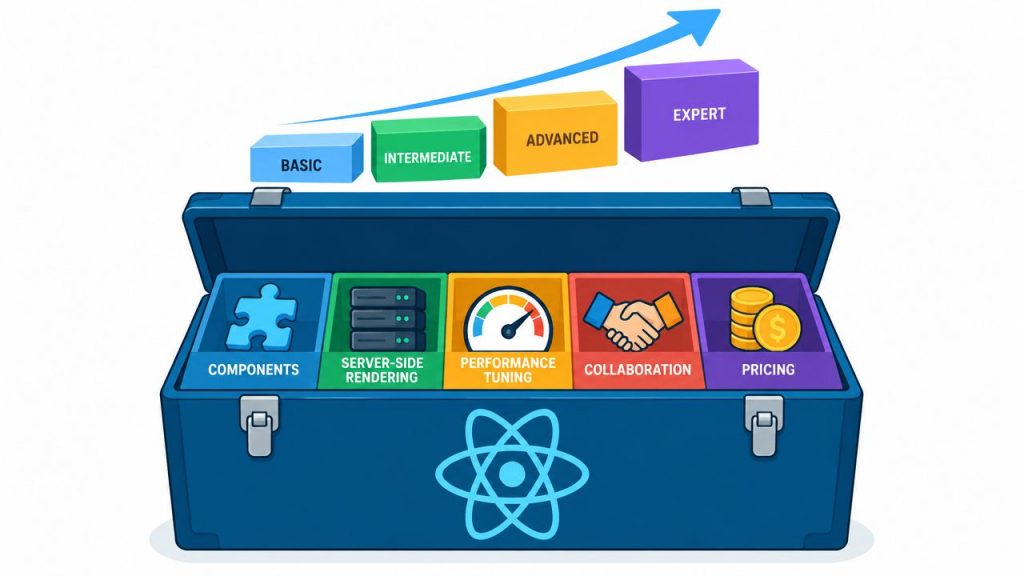



You've been told that React is the obvious choice, received proposals from several vendors, and still can't tell which team will deliver a maintainable product rather than a polished demo. That uncertainty is justified. React development services aren't a framework purchase. They're a decision about architecture, staffing, accountability, and operational risk.
A modern engagement may include component architecture, TypeScript, state management, server-side rendering, accessibility, performance engineering, testing, CI integration, and post-launch support. It may also involve Next.js, AI-streaming interfaces, legacy modernization, or a Node.js backend. Those capabilities aren't automatically included because a provider uses React.
This guide focuses on the hiring-quality problem behind the technology choice. You'll learn how to define the work, compare engagement models, inspect delivery evidence, evaluate pricing without being misled by hourly rates, identify senior production talent, and decide when an external team makes more sense than an in-house hire.
Table of Contents
When a provider says it offers React development services, ask what it will own. A credible scope starts with component architecture, design-system integration, state management, TypeScript conventions, accessibility, testing, performance budgets, and deployment workflows. It should also explain how the team will handle routing, data fetching, error states, observability, and browser compatibility.
A frontend-only engagement usually delivers the interface and its integration with an existing API. Full-stack work goes further, crossing into Node.js services, backend-for-frontend layers, authentication, database-facing endpoints, and edge functions. Don't assume the broader scope is included. Ask for a written responsibility matrix before approving a proposal.
A serious provider can describe its approach to server-side rendering with Next.js or Remix, route-level code splitting, design tokens, accessibility testing, and CI quality gates. It should explain how it will prevent a dashboard, editor, charting library, or modal flow from bloating the initial bundle.
React's official documentation on code splitting explains the underlying mechanism. Dynamic loading ships only the code needed at runtime, reducing the JavaScript the browser must parse, compile, and execute before interaction. That makes bundle analysis an architectural task, not a final cleanup exercise.
React remains a durable choice for production systems. W3Techs reports that React was used by 6.0% of all websites and 7.9% of websites with a known JavaScript library on September 10, 2026. The same data shows React 16 still powering 71.7% of sites using React, while React 18 accounts for 28.3%, a useful reminder that companies often maintain and modernize React systems for years instead of replacing them quickly.
DevOps, automated quality assurance, product design, security review, analytics instrumentation, and long-term maintenance often sit outside the headline service. A vendor may build a frontend while your team owns cloud infrastructure, release management, test automation, and incident response.
Before comparing suppliers, document:
Your choice of model, vetting method, contract, and provider should follow that scope. If the service catalog is vague, the delivery process will be vague too. A useful starting point is to compare the provider's stated capabilities with a practical overview of frontend technology options, then challenge every assumption in the proposal.
React work ranges from a small interface build to a multi-team modernization program. Treating all of it as “a React project” creates bad estimates and worse staffing decisions.
At the entry level, a founder may need a landing page, design-to-code implementation, prototype, or MVP. One senior engineer with product and design support can often handle this efficiently. The main failure pattern is overbuilding. Teams introduce complex state libraries, premature abstractions, and elaborate infrastructure before the product has validated its workflow.
The next tier includes component libraries, headless CMS integration, multi-route applications, dashboards, and search-visible pages. These projects usually need stronger frontend architecture, design-system discipline, QA coverage, and close collaboration with product and design. Server-side rendering can improve the path to visible content, but it doesn't eliminate client work. React SSR analysis notes that hydration still requires React to traverse server-rendered markup, match the component tree, and attach event listeners. A fast first paint can therefore shift pressure to client-side execution if too much code hydrates immediately.

Legacy migrations need a different operating model. Moving from AngularJS, Backbone, Vue 2, or Create React App involves inventorying routes, dependencies, tests, build scripts, analytics, authentication, and release behavior. A legacy system modernization approach that replaces everything at once is usually riskier than incremental replacement, unless the existing system is genuinely unmaintainable.
The emerging frontier is AI-native UI. Clients increasingly request streaming model output, chat surfaces, tool-calling panels, agent activity views, and retrieval-augmented document workspaces. These interfaces fail when developers treat streamed tokens as ordinary strings. A well-engineered implementation treats the stream as a rendering protocol with events, partial states, tool status, cancellation, retries, malformed output, and recoverable errors.
Use this self-check before evaluating vendors:
The higher you move on this spectrum, the less useful a generic portfolio becomes. You need evidence of the exact failure modes your product will face.
The right engagement model depends less on the technology than on who controls the architecture decisions. If nobody has clear authority over technical direction, a dedicated team can drift, staff augmentation can become unproductive, and a fixed bid can hide unresolved decisions inside change requests.
| Model | Cost Structure | Control | Delivery Risk | Best Fit |
|---|---|---|---|---|
| Dedicated cross-functional team | Recurring team cost | Shared, with a named client owner | Shared, managed through planning and demos | Long-running product work with changing scope |
| Fixed-bid project | Agreed price for defined scope | Provider controls execution, client approves milestones | Provider carries estimation risk, client carries scope risk | Stable requirements and bounded deliverables |
| Hourly staff augmentation | Time-based rate | Client controls roadmap and daily priorities | Client carries coordination and architecture risk | Filling a specific team or skill gap |
| Direct in-house hire | Salary, benefits, recruiting, and employment overhead | Highest internal control | Company carries hiring and utilization risk | Continuous product ownership and strategic IP |
A dedicated team is the strongest option when requirements will change as users respond to the product. It gives you continuity, but it can become a black box if the provider owns planning, architecture, and reporting without exposing the work.
Fixed bids look tidy on paper. They work when designs, integrations, acceptance criteria, and dependencies are already clear. They fail when discovery was skipped. A vendor that protects its margin will turn ambiguity into exclusions, change orders, or rushed implementation.
Staff augmentation works when your product manager and technical lead can assign work, review pull requests, and resolve decisions quickly. It doesn't work when you expect an individual contributor to act as an autonomous consulting team without the authority, context, or stakeholder access to do so.
Direct hiring makes sense when the product needs continuous ownership and the company can support a stable engineering function. It's a poor response to a short deadline or a temporary need for SSR performance work.
Decision rule: Choose the model that gives one accountable person authority over architecture, sequencing, and acceptance. If that person doesn't exist, fix the governance problem before signing.
For a closer comparison of team structures, review managed services and staff augmentation. The label matters less than the operating agreement. Define who approves technical decisions, who owns the backlog, who handles incidents, and what happens when the assigned engineer leaves.
A proposal describes intent. Artifacts show whether the team is working. You should see evidence from the first sprint, not after the project is supposedly complete.
A serious React engagement uses a shared Git repository with meaningful commits, pull requests, review history, and a staging environment that reflects the current build. Weekly demos should show working behavior, including empty states, loading states, validation failures, permissions, and error handling. A sequence of polished screenshots isn't a substitute for an executable product.
| Deliverable | Serious Team | Contractor |
|---|---|---|
| Git repository | Shared access, reviewable commits, branches tied to work | Code delivered as a zip file or through an opaque repository |
| Product demo | Recorded walkthrough on real staging data or representative fixtures | Screenshots or scripted demonstrations only |
| Performance | Bundle composition and performance budgets tracked over time | “Fast” stated without measurements |
| Accessibility | Automated scans, keyboard checks, and documented remediation | No accessibility evidence beyond visual appearance |
| Design system | Reusable tokens and components applied consistently | Repeated one-off styles and duplicated UI logic |
| API integration | Typed contracts and explicit error behavior | Loose payload assumptions that break during integration |
| Architecture | Short notes for non-obvious decisions and trade-offs | Implementation choices exist only in a developer's memory |
Ask for a trial sprint before signing a long engagement. Give the team one representative workflow, access to a staging repository, and a realistic acceptance condition. Review the pull request, the demo recording, the test cases, and the written explanation of trade-offs.
Look beyond happy paths. Ask what happens when a request times out, a user loses permission, an API returns an unexpected shape, or a streamed response stops halfway through. Contractor-grade output usually avoids those cases because they're harder to demonstrate. Production teams design for them from the beginning.
There's no responsible way to publish universal React pricing bands by region from the verified information available for this guide. Rates vary with seniority, team composition, timezone overlap, compliance expectations, project management, and whether the provider owns delivery or only supplies engineers. Any vendor that presents a single regional rate as the full cost of a project is leaving out context.
The useful comparison is not a low hourly number against a high hourly number. It's the amount of capable work you receive, the level of oversight included, and the risk you retain.
A senior engineer costs more than a junior implementer, but the difference can be justified when the work involves migration planning, performance diagnosis, state architecture, or production incidents. A mixed team can reduce cost while preserving senior oversight, provided the senior person is genuinely involved in reviews and decisions rather than appearing only during sales calls.
Timezone overlap also changes the economics. Nearshore teams may cost more than distant teams while reducing waiting time for clarification, review, and incident response. Compliance-heavy products can require stricter access controls, documentation, security review, and onboarding procedures. Those activities belong in the proposal even when they don't produce visible interface features.
Compare capacity, not labels: Ask who writes code, who reviews it, who manages delivery, who tests it, and who remains available after launch.
Normalize competing proposals with a common worksheet:
Hidden charges can include onboarding, browser and device testing, third-party licenses, urgent work, scope changes, and exit assistance. A fixed bid is the worst fit for an evolving product with uncertain requirements. Hourly augmentation is the wrong choice when your team lacks the time to direct and review the work. A dedicated team is wasteful for a tiny, stable task.
For a related comparison point outside React, Vue UI component pricing can help you see how another frontend ecosystem presents service costs. Use it as market context, not as a substitute for a project-specific scope review.
React is common. Production judgment is not. The 2025 Stack Overflow Developer Survey reports React usage among 46.9% of professional developers, but broad familiarity doesn't prove that a candidate can design a resilient system or recover from a live incident.
A 2026 hiring guide reports React in 54.1% of full-stack job postings and argues that the gap between mid-level and truly senior engineers is wider than many hiring managers expect. That hiring analysis points to the core evaluation problem: can the person make sound decisions under production constraints?

Don't spend the interview asking candidates to recite hooks. Give them a flawed pull request and ask them to review it. Look for questions about race conditions, stale closures, unnecessary renders, missing cleanup, cache invalidation, authorization boundaries, and failure behavior.
Use prompts such as:
Strong candidates explain trade-offs, identify unknowns, and state what they'd measure. Syntax fluency matters, but it's weaker evidence than a clear debugging process and experience handling consequences.
References from a product at a similar stage can reveal more than a polished portfolio. Ask how the engineer behaved during incidents, whether they documented decisions, how they responded to review, and whether they improved the system beyond the assigned ticket. During the trial sprint, weight reasoning, communication, and safe delivery more heavily than raw typing speed.
External React services make the strongest case in three situations. Your deadline is closer than your recruiting pipeline. Your team lacks a specific capability, such as SSR performance tuning, legacy migration, or AI-streaming interfaces. Or the work is finite and won't justify a permanent role after launch.
The alternative isn't just an external invoice. In-house hiring includes recruiting effort, interviews, employment overhead, onboarding, management, and the risk that the role no longer matches the product after the urgent phase ends. Compare the full cost of building and maintaining that internal capacity with the defined external engagement. Don't claim a breakeven point until both proposals include the same scope and ownership responsibilities.
External delivery becomes less attractive when the codebase contains core intellectual property, requires continuous iteration for years, or needs deep institutional knowledge across product, operations, and customer support. In those cases, an external team can still supplement delivery, but internal engineers should own architecture and absorb knowledge deliberately.
| Factor | External React Services | In-House Hiring |
|---|---|---|
| Speed to capability | Faster when a qualified team is available | Slower while recruiting and onboarding |
| Product context | Must be built through documentation and collaboration | Accumulates inside the company |
| Specialized skills | Useful for temporary or uncommon needs | Valuable when the skill remains strategic |
| Long-term ownership | Requires explicit handover and governance | Naturally stays internal |
| Utilization | Can scale with the project | Continues between major initiatives |
| Sensitive IP | Needs contractual and technical controls | Easier to keep within internal boundaries |
The decision rule is straightforward. Choose external support when the project has a clear endpoint, the required expertise is missing, and the company can define ownership. Choose internal hiring when the product is a long-lived strategic asset and the team must retain architectural knowledge.
A hybrid approach often works best. An external senior engineer can establish patterns, resolve a migration bottleneck, or accelerate an AI interface while an internal lead reviews decisions and takes ownership of the resulting system.
Evaluate React development services as a delivery system, not as a list of framework skills. Confirm the scope before choosing a model. Decide who owns architecture. Separate frontend work from backend, DevOps, QA, design, accessibility, and maintenance responsibilities.
Then vet for production judgment. Request a trial sprint with a real repository, staging demo, performance evidence, accessibility checks, typed API boundaries, tests for failure states, and short architecture notes. Compare total engagement cost, including oversight and handover, instead of choosing the lowest hourly rate. Match the engagement length to the product lifecycle, and keep strategic IP close to the team that will maintain it.
This week, give the same written brief to one external React team and one qualified in-house engineering lead. Ask both to identify assumptions, risks, staffing, milestones, and ownership boundaries. Choose the proposal that makes failure visible and gives you a practical control plan, not merely the one with the cheapest line item.
If you're evaluating an external React team, HireDevelopers.com can provide a shortlist of matched React developers for review. Use the first conversation to test scope, seniority, communication, and delivery ownership before committing to a longer engagement.

Let's get straight to the point. You've heard that hiring in Mexico is the secret weapon for scaling your tech team without torching your runway. You're not wrong, but if you're thinking this is just about "cheap labor," you're making a rookie mistake that almost always ends in bad hires and buggy code. Turns out...

South America is spread across five main time zones, from UTC-5 to UTC-3. For any US company, that translates into an incredible 6 to 8 hours of daily overlap—a goldmine for hiring perfectly aligned remote talent. Say goodbye to 3 AM calls and asynchronous nightmares. This is about seamless, real-time collaboration. Your Secret Weapon for...

What is encryption? A simple guide to how it works, why you need it, and how it protects your data from prying eyes. Secure your digital life today.


