Microservices and APIs: Architecture Guide for Developers

Victor
Posted on 30 September 2026
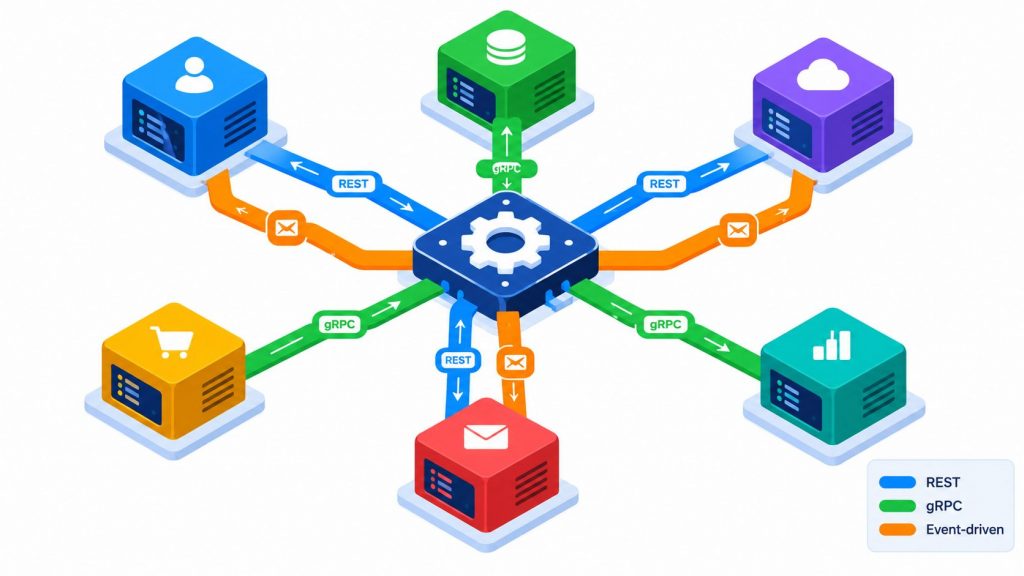



Microservices rely on APIs as their communication layer, and poor API design can turn an apparently flexible system into an unmaintainable distributed monolith. By 2020, 77% of surveyed organizations had adopted microservices, while 90% of developers worked with APIs and spent about 30% of their time building them.
That combination reveals the practical issue architects often underestimate. Creating another service is usually straightforward. Keeping its interface stable while other teams deploy, replace, and scale dependent services is much harder. In a medical practice, the same problem appears when scheduling, patient intake, eligibility verification, billing, messaging, and remote administrative staff all depend on shared software interfaces. One undocumented field change can interrupt a workflow that staff experience as a “system outage,” even when every individual service is technically running.
This guide focuses on the operational side of microservices and APIs. It covers how APIs create service boundaries, when REST, gRPC, or event-driven communication makes sense, how gateways and service meshes manage traffic, and why API evolution creates more incidents than initial service construction. It also considers what changes when software agents become API consumers and why healthcare organizations should treat access control, auditability, and ownership as architectural requirements rather than afterthoughts.
Table of Contents
A monolith usually keeps function calls, data access, and business rules inside one deployable application. A developer can change an internal method and run a broad test suite before releasing the result. Microservices split that application into independently deployable services, so the boundary between one component and another must be explicit. The API becomes the contract that replaces the in-process method call.
Microservices became a mainstream enterprise architecture by 2020. O'Reilly's adoption report found that 77% of respondents had adopted microservices, while Nordic APIs reported that 90% of developers worked with APIs and spent about 30% of their time building them. The Microservice APIs overview connects these developments directly. APIs provide the communication layer that lets independently deployed services exchange requests and responses.

A useful API contract defines more than a URL. It specifies the request shape, response fields, authentication requirements, error behavior, timeout expectations, and ownership. It also explains which fields are stable and which may change. Without those details, a service boundary exists in name only.
Consider a patient scheduling service consumed by a web application, a mobile reminder system, and a remote appointment coordinator. If the scheduling service renames appointmentStatus, changes its meaning, or returns a different date format without coordination, each consumer may fail differently. The scheduling team may consider the release successful because its own tests pass. The downstream teams experience broken reminders, inaccurate queues, or rejected updates.
That is why API-first work starts with the interface before implementation. Teams can review an OpenAPI document, protobuf definition, or event schema before a service is deployed. Practices interested in reducing duplicated integrations can also review how API-first architecture can eliminate plugin sprawl, particularly when multiple systems need the same patient, scheduling, or billing capability.
Practical rule: If another team or application consumes an interface, treat every field, error, and permission as part of a product contract.
“Loose coupling” doesn't mean services can change without consequences. It means the consequences are managed through deliberate contracts instead of hidden dependencies. A service should own its data and expose only the operations that other services need. Sharing a database across services often recreates the monolith because every team can become dependent on tables, columns, and undocumented side effects.
For a medical practice, architectural independence should also reflect operational responsibility. A virtual receptionist may need to create or update appointments, while an insurance verification workflow may only need eligibility data. Those roles should not receive identical access merely because both systems connect to the same API. The service boundary and the permission boundary should reinforce each other.
The industry has not reached this architecture just because smaller services are fashionable. The combination of independently deployable services and pervasive API usage reflects a foundational shift in how enterprise software is designed and integrated. The difficult work begins when those interfaces acquire many consumers, different release schedules, and real operational consequences.
Protocol choice affects latency, compatibility, debugging, and failure behavior. There isn't one universally correct option for every service. The table below is a practical starting point.
| Protocol | Latency Profile | Complexity | Ideal Use Case |
|---|---|---|---|
| REST with JSON | Familiar and adequate for many request-response workflows, but serialization and network overhead can matter in high-frequency calls | Low to moderate | Public interfaces, browser applications, CRUD workflows, and broad integration |
| gRPC with Protobuf | Efficient for internal calls and streaming, with stronger typing and compact binary messages | Moderate | High-frequency service-to-service communication where teams control both sides |
| Event-driven communication | Avoids waiting for an immediate response, but introduces delivery, ordering, replay, and eventual-consistency concerns | Moderate to high | Notifications, workflow reactions, asynchronous processing, and systems that should isolate downstream failures |
A 2026 experimental study measured a REST/JSON path at 148 ms and a gRPC/Protobuf path at 89 ms, a 39.8% reduction, attributing the difference to reduced serialization overhead and more efficient transport in high-frequency, low-latency environments. The study on protocol performance in microservice architectures is useful evidence, but it shouldn't be read as a promise that gRPC will improve every application. Payload size, network distance, service logic, retries, and queueing can dominate the result.
REST remains a sensible default for interfaces used by browsers, external partners, and systems written in different languages. JSON is easy to inspect during an incident, and standard HTTP behavior works with familiar gateways, testing tools, and monitoring systems. For a practice integrating scheduling software with a patient portal, that accessibility may be more valuable than shaving serialization time from an internal call.
REST becomes fragile when teams use it as an excuse to avoid contract discipline. A collection of undocumented endpoints isn't a coherent API. Define schemas, make error responses predictable, use idempotency for repeatable operations, and test behavior rather than only checking that a request returns a successful status. Teams responsible for verification or billing integrations can use a structured RESTful API testing approach to check positive, negative, authorization, and regression scenarios.
gRPC is attractive when services communicate frequently, latency matters, and the organization controls client and server releases. Protobuf definitions provide a typed contract and generated client code, which can reduce hand-written integration errors. Streaming can also suit workloads that exchange a sequence of updates rather than isolated requests.
The trade-off is operational familiarity. Binary payloads are harder to inspect than JSON, browser access typically needs an additional approach, and a change to a shared protobuf definition still requires compatibility discipline. Don't select gRPC merely because a benchmark shows a faster path. Select it when the team can support generated code, schema review, observability, and a clear fallback when a dependent service is unavailable.
An event-driven design lets a service publish a fact, such as “appointment booked,” without waiting for every consumer to finish. Notification, analytics, and follow-up workflows can react independently. This can prevent a slow downstream system from blocking the user-facing booking operation.
Events introduce different obligations. Teams must decide whether delivery is at least once, how consumers handle duplicates, what happens when an event arrives out of order, and how a practice reconstructs a failed workflow. Use synchronous APIs when the caller needs an immediate authoritative answer. Use events when the business process can continue asynchronously and the organization is prepared to operate durable schemas, retries, dead-letter handling, and clear ownership.
An API gateway handles the edge of the system. It can authenticate requests, route traffic, apply rate limits, translate protocols, and provide a consistent external entry point. A service mesh operates deeper inside the platform, managing communication between services through capabilities such as mutual authentication, traffic policy, retries, and telemetry.
Those components solve different problems. A gateway can protect a patient portal from abusive or accidental request volume, while a mesh can show whether the scheduling service is waiting on identity, availability, or notification services. Putting every concern into the gateway creates a heavily coupled choke point. Adding a mesh without operational expertise creates a large control plane that nobody can troubleshoot during an outage.

Gateway selection can directly affect service-level objectives under sustained load. In one GigaOm API management test, Kong achieved 54,250 transactions per second with 100% success and under 30 ms maximum latency. A separate comparison in the same API and microservices management benchmark described a 20,000 requests-per-second workload where 90th percentile latency diverged to 5,681 ms for one gateway versus 3 ms for another.
These figures don't identify a universal winner. They demonstrate why teams must test their own authentication plugins, payload sizes, routing rules, TLS settings, and failure policies. A gateway that performs well in a simple benchmark may behave differently once it validates tokens, writes audit records, transforms requests, and retries an unhealthy upstream.
Run gateway instances across failure domains, keep configuration versioned, and monitor the gateway separately from the services behind it. Rate limiting should reflect business impact. A public appointment-search endpoint may tolerate a different policy from an appointment-creation endpoint, where duplicate requests can create operational confusion.
Retries deserve special caution. Retrying a read may be harmless, but retrying an appointment creation or payment operation can duplicate work unless the API supports idempotency. Timeouts must be shorter than the caller's acceptable response window, and every timeout should produce enough telemetry to identify the failed hop.
A service mesh can make these policies consistent, but it can't decide whether a workflow is safe to retry. Engineers still need request identifiers, trace propagation, structured logs, and dashboards that connect an external request to each internal call. For teams building APIs that support automated assistants, guidance on building AI support APIs is relevant because machine consumers can create traffic patterns that differ from human interaction.
Teams deploying these components on Kubernetes should treat cluster configuration, ingress behavior, secrets, and rollback procedures as part of the API platform. A practical Kubernetes deployment reference can help organize that work, but documentation won't replace load testing and incident rehearsal.
The hardest production incidents often start with a change that looks safe. A team adds a field, tightens validation, removes an old status, or turns a response into an exception. The producer sees a cleaner interface. An older consumer reads the change differently, and the failure shows up far from the deployment that caused it.
A review of API evolution in microservice architectures identifies recurring problems, including change-impact analysis, outdated consumer versions, and poor communication of changes. One analysis of six recurring pitfalls in handling API evolution within microservice architectures also shows how coordination and compatibility break down as service count grows, even when teams believe they are moving faster. The analysis of API evolution in microservices makes that failure mode explicit.
A version number does not preserve compatibility. Before choosing URL versioning, headers, or content negotiation, define what counts as a breaking change. Removing a response field is usually different from adding an optional field. Tightening accepted input can break an existing client even when the endpoint name stays the same.
A workable policy answers five questions:
For a patient-intake workflow, do not retire an old insurance field because the new portal no longer uses it. Check whether a billing process, reporting job, or remote administrative team still depends on it. A consumer inventory is more useful than a version label that nobody maintains.
Consumer-driven contract testing checks that a provider still meets the expectations of its consumers. Provider tests can confirm business logic, while contract tests expose whether a response shape, status code, or required field has changed in a way that affects a real client.
Contract tests are not enough on their own. They can preserve a bad contract, miss asynchronous behavior, or fail to represent a consumer that was never registered. Pair them with schema linting, compatibility checks in continuous integration, documentation generated from the same specification used for development, and telemetry that identifies active versions.
Operational rule: Never remove an API version because the replacement is ready. Remove it only after you know who still calls the old contract and have given those consumers a documented migration path.
Remote development makes communication discipline more important. Teams working across time zones may deploy independently and discover a breaking change only after a patient-facing workflow fails. Start with the practices in our API design best practices guide before you formalize a versioning policy.
An AI agent doesn't interact with an API like a human developer inspecting a response in a debugger. It selects tools, supplies parameters, interprets results, and may call several services in sequence. That makes ambiguous descriptions, permissive permissions, unstable schemas, and weak error messages operational risks rather than minor usability problems.
Infosys describes a 2026 movement toward service-mesh-backed security and observability, polyglot cloud-native frameworks, and “agent-ready API enablement,” while noting that API ecosystems are being refactored for direct consumption by AI agents in its report on APIs in a new era. The practical implication is not that every API needs an agent. It is that machine consumers require explicit contracts and tighter governance.

An agent-ready API should expose narrow, meaningful operations rather than broad database-like access. “Find available appointment slots” is easier to authorize and observe than an endpoint that accepts arbitrary scheduling mutations. Responses should explain whether an operation completed, failed validation, or requires human review.
Healthcare organizations need an additional boundary. An automated consumer or remote assistant shouldn't receive unrestricted patient information merely because it can authenticate. Remote staff who access protected health information remain inside the HIPAA compliance perimeter, and guidance on remote access to PHI emphasizes role-based access, unique logins, multi-factor authentication, and a Business Associate Agreement where applicable.
That is separate from the API design question, but the two cannot be disconnected. A service should enforce authorization at the operation and data level, log sensitive actions, and make privileged workflows reviewable. Practices should confirm their obligations with qualified compliance counsel because the applicable safeguards depend on the organization, role, systems, and jurisdiction.
Older API adoption research highlighted complexity, security, inconsistent standards, documentation, and manual testing as persistent obstacles. More interfaces can therefore increase coordination work if ownership and standards don't grow with them. AI agents intensify that problem because they can generate calls quickly and operate across several services without a person checking every step.
Use an allowlist of tools, explicit scopes, request budgets, traceable identities, and human approval for high-impact actions. A medical virtual assistant may schedule within defined rules, while clinical decisions, diagnosis, and treatment remain with appropriately licensed professionals. The goal isn't to prevent automation. It's to ensure every automated action has a clear purpose, permission, owner, and recovery path.
Microservices and APIs are inseparable, but service decomposition alone doesn't create a maintainable architecture. APIs must define stable contracts, appropriate permissions, predictable errors, and ownership. REST is often practical at broad integration boundaries, gRPC can suit controlled high-frequency internal calls, and events can reduce waiting when the workflow tolerates asynchronous processing.
The highest-value work is operational. Inventory consumers, test contracts, document deprecation windows, monitor every service hop, and rehearse gateway and dependency failures before production traffic exposes them. For healthcare organizations, add role-based access, auditability, minimum-necessary data handling, and clear separation between administrative automation and licensed clinical judgment.
If you're planning a new platform or trying to repair an existing distributed system, begin with an API inventory rather than another service. Identify each consumer, owner, data classification, version, failure policy, and removal condition. That exercise will usually reveal whether microservices are solving an actual boundary problem or just distributing an application that still lacks architectural discipline.
Before introducing microservices into a healthcare workflow, ask an experienced API architect to review your service boundaries, versioning policy, access controls, and failure handling. A focused review can turn undocumented dependencies into an actionable migration plan before they interrupt scheduling, intake, billing, or patient communication.

Here’s the simple, no-BS truth on managed services vs. staff augmentation: Managed services sell you a finished outcome. Staff augmentation sells you skilled people you manage yourself. Your choice boils down to a single question: do you want to hand over the keys, or do you want your hands glued to the steering wheel? The...

Let's be honest: hiring remote developers is broken. You post a job, get buried in a mountain of irrelevant resumes, and waste weeks on candidates who, it turns out, can't actually code. The only alternative seems to be paying eye-watering US salaries that make your investors sweat. Turns out there’s more than one way to...

You’re probably here because US hiring has turned into a bad joke with a real invoice attached. Salaries keep climbing, recruiters keep spamming, and every time you finally find someone solid, another company tries to poach them before their laptop sticker pack arrives. That’s why smart teams are looking at tech in mexico. Not as...


